Why Most Cold Email Campaigns Fail and How to Fix Yours Today
Chetan Agarwal
Contents
Why Most Cold Email Campaigns Fail and How to Fix Yours Today
Your cold outreach campaign went out to 10,000 targets. You got 47 opens and 3 replies.
Two of those replies were auto-responders. One asked to be removed from your list.
Congratulations,you just wasted budget and confirmed that outbound email doesn’t work. Effective cold outreach requires systematic execution across all dimensions.
Except cold outreach does work. Brutally well, for the companies doing it correctly.
The average outbound campaign gets 1-3% reply rates. The top performers hit 8-15%.
Some exceed 20% consistently. The difference isn’t luck,it’s fundamentals.
Most campaigns fail before they start. they’re built on bad data, generic messaging, broken deliverability infrastructure, and wishful thinking instead of strategy.
This guide dissects exactly why cold outreach campaigns fail and provides the systematic fixes that transform average efforts into sales pipeline-generating machines.
Why is my cold email campaign failing?
Your outbound messages are failing because something fundamental is broken. The symptoms vary,low opens, no replies, spam placement,but the root causes are predictable.
Diagnosing Your Specific Failure Mode
Low open rates with good deliverability indicate subject line problems. Your messages reach the inboxes, but recipients scroll past them.
The fix is pattern interrupt subject lines that reference specific details.
Good open rates with zero replies indicate messaging problems. Recipients see your outreach, read it, and decide not to respond.
The fix is personalization that demonstrates genuine research and value. Your response rate depends on the quality of your messaging.
Messages landing in spam indicate deliverability problems. Your content might be excellent, but it never reaches the inbox.
The fix is sender reputation restoration and spam filter avoidance strategies. Your messages end up in spam folders instead of inboxes.
The Common Thread
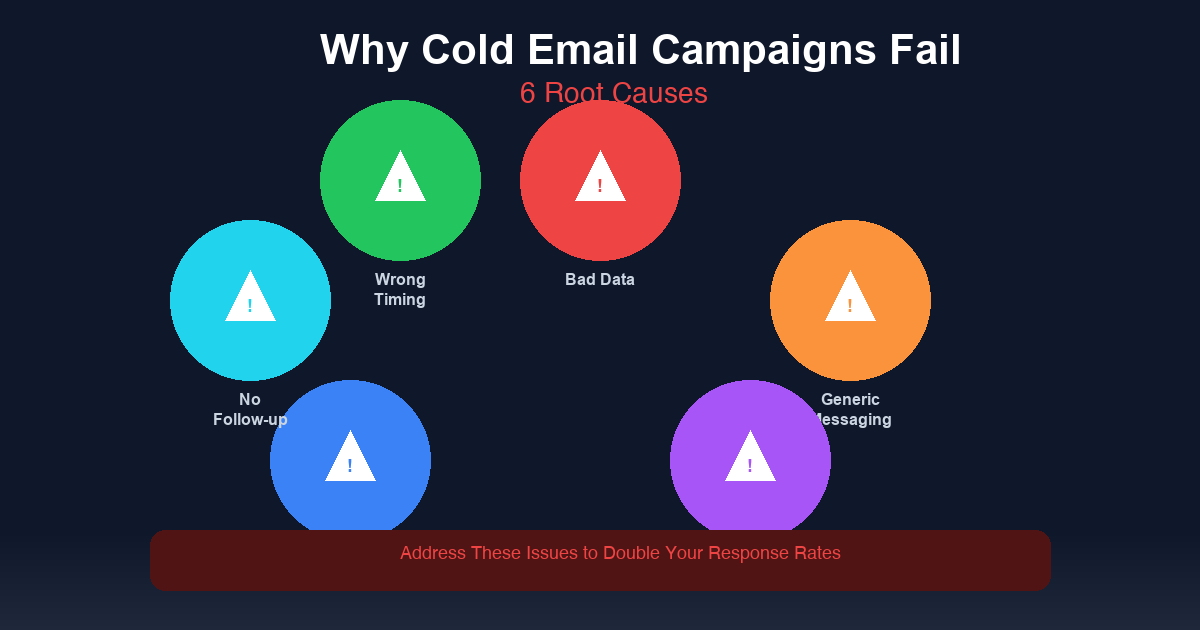
Every outbound failure traces back to one of five root causes: bad data, generic messaging, broken infrastructure, poor targeting, or inadequate follow-up. Fix these five pillars, and your cold outreach results transform.
What are the most common mistakes in cold email campaigns and email outreach?
The most common outbound mistakes are predictable. Most campaigns fail because operators repeat the same errors that have failed before.
Mistake One: Buying Data , Purchased lists have 30-50% invalid addresses; bounce rate destroys sender reputation before anyone reads
Mistake Two: Generic Templates , “Hi [First Name], I help companies like yours” gets deleted instantly; specificity creates credibility
Mistake Three: Single-Touch Outreach , 80% of responses occur after the third touchpoint; abandoning at one message loses 97-99% of potential
Mistake Four: Broken Infrastructure , Perfect copy lands in spam filters without proper sender reputation and authentication
Mistake Six: Ignoring Follow-Up , Most follow-up messages are never sent; most responses never come because operators give up too early
Mistake One: Buying Data
Purchased lists are the single biggest mistake. Typical purchased data has 30-50% invalid addresses, outdated titles, wrong company information, and no target research context.
When you send to unverified addresses, your bounce rate destroys your sender reputation. Your messages land in spam before anyone reads them.
Mistake Two: Generic Templates
“Hi [First Name], I wanted to reach out because I help companies like yours…” This is what decision-makers see 50 times before breakfast. Generic templates are spam dressed in business casual.
Contacts delete them instantly.
Personalization that earns responses looks fundamentally different. It references specific details: “I noticed Cardinal Manufacturing just raised their Series C,that’s typically when infrastructure scaling becomes critical.” This level of specificity creates credibility.
Mistake Three: Single-Touch Outreach
You sent one message. Nobody replied.
The campaign failed. Except that’s not failure,that’s normal.
Reply rates on first cold outreach average 1-3%. If you’re not follow-uping, you’re abandoning 97-99% of your potential customers before they’ve had a chance to respond.
A proper followup sequence dramatically improves outcomes.
Mistake Four: Broken Infrastructure
Your copy is brilliant. Your targeting is perfect.
Your personalization is genuinely useful. And it all lands in spam filters.
Email infrastructure is the foundation most cold outreach campaigns ignore. Without proper sender reputation, authentication, and deliverability optimization, even perfect content fails.
How can I improve my cold email deliverability and avoid spam filters?
Outbound deliverability is the foundation that makes everything else possible. Fix your deliverability, and every other optimization effort pays dividends.
Fix: Sending Domain Reputation , Bounce rates, complaint rates, engagement metrics, and sending volume patterns all factor in; protect this score
Fix: Authentication Requirements , Configure SPF, DKIM, and DMARC correctly; without these, messages struggle with inbox placement
Fix: Domain Warm-Up Protocol , New domains sending high volumes trigger filters; start with 20-50 daily recipients over 4-8 weeks
Fix: Content Factors , Avoid excessive links, “free” or “urgent” language, ALL CAPS, heavy punctuation, and low engagement patterns
Fix: Maintain Text-to-Link Ratios , Include plain text versions alongside HTML; sending patterns should look human
Fix: List Hygiene , Verify all new addresses, remove hard bounces immediately, monitor soft bounce rates
The Deliverability Fundamentals
Sending domain reputation is a score that determines whether your messages reach the inbox or spam filter. Factors include bounce rates, complaint rates, engagement metrics, sending volume patterns, and domain history.
When your reputation is damaged,through high bounces, spam complaints, or suspicious sending patterns,inbox providers route your mail to spam automatically. Protecting this reputation is your highest priority.
Authentication Requirements
Proper outbound deliverability requires authentication protocols. SPF (Sender Policy Framework) authorizes which servers can send mail for your domain.
DKIM (DomainKeys Identified Mail) adds cryptographic signatures proving your messages weren’t tampered with. DMARC (Domain-based Message Authentication, Reporting, and Conformance) tells receiving servers what to do with messages that fail authentication.
Without these protocols configured correctly, your outreach will struggle with inbox placement regardless of content quality. This is why marketing campaigns often fail to reach their audience.
Domain Warm-Up Protocol
New domains sending high volumes trigger spam filters immediately. Proper warm-up gradually increases volume over 4-8 weeks, building sender reputation organically.
Rushing this process,or skipping it entirely,destroys deliverability. Your first campaigns on a new domain should target 20-50 recipients daily for the first week, scaling gradually over the warm-up period.
Content Factors
Certain content patterns trigger spam filters automatically: excessive links, “free” or “urgent” language, ALL CAPS, heavy punctuation, and low engagement patterns. Avoid these in your outbound copy.
Maintain appropriate text-to-link ratios. Include plain text versions alongside HTML.
Ensure your sending patterns look human,not automated batch sends from a machine.
How important is personalization in cold email campaigns, and how can I effectively personalize them?
Personalization isn’t a nice-to-have. it’s the primary determinant of cold outreach success.
The difference between generic templates and genuine personalization is an order of magnitude in reply rates.
The Personalization Spectrum
Most cold outreach personalization is cosmetic: adding the contact‘s first name, company name, or industry to a template. This produces marginal improvements at best.
it isn’t personalization. it’s find-and-replace.
Effective personalization operates at multiple levels: surface-level (name, company), behavioral (recent activities, content engagement), contextual (specific challenges, industry trends), and relational (mutual connections, shared experiences).
The campaigns hitting 20%+ reply rates use all four levels. They reference specific LinkedIn posts the contact wrote.
They mention recent company announcements. They connect their solution to a specific challenge the buyer publicly identified.
Scaling Personalization Effectively
The objection to deep personalization is always scale. How can you research 10,000 potential customers individually?
The answer is hyper-personalization through AI-driven research automation. For every contact in your pipeline, the system researches their company, role, recent activities, and industry context.
It generates unique outreach content referencing specific details.
This isn’t “Hi [First Name].” This is “I noticed your recent post on [specific topic] and your point about [specific challenge] resonated because…” The specificity creates credibility. The credibility drives responses.
What makes a good cold email subject line?
Subject lines matter less than most people think, but they matter enough to optimize. The goal is to get the message opened, not to be clever.
Pattern Interrupt Over Curiosity Gap
Pattern interrupt subject lines that reference something specific to the recipient outperform generic curiosity gap subject lines. “Question about your [company] expansion” beats “Quick question.” “Saw your post on [topic]” beats “Thoughts on [topic].”
Personalization in the subject line increases open rates by 10-25%. Including the recipient’s name, their company name, or a reference to their specific situation signals that this message is for them specifically, not another piece of bulk noise.
Avoidance Checklist
Avoid subject lines that trigger spam filters: words like “free,” “urgent,” “act now,” excessive punctuation, ALL CAPS, or emoji. Avoid subject lines that look like newsletter subject lines.
These signal bulk send rather than individual cold outreach.
The best subject lines
strong> are short, specific, and low-pressure. They create curiosity without manipulation.
They signal that this message is worth reading.
When is the best time to send cold emails for optimal engagement?
When you send matters as much as what you send. Cold outreach timing best practices have shifted as buyer behavior has evolved.
The Data on Send Timing
The data consistently shows that messages sent Tuesday through Thursday between 8am and 10am local time for the recipient generate highest open rates. However, open rates aren’t the goal.
Reply rates are.
The data on reply timing shows slightly different patterns: mid-morning (10am-12pm) and late afternoon (3pm-5pm) tend to generate higher reply rates than early morning sends. People are more likely to respond during work hours when they’ve time to think about their reply.
Time Zone Adjustment
Time zone adjustment is non-negotiable. If you’re sending from New York to contacts in California, don’t send at 8am Eastern.
Send at 8am Pacific. If you’re targeting European decision-makers, send during their business hours, not yours.
Day-of-week patterns vary by industry. SaaS buyers respond differently than manufacturing buyers.
Enterprise buyers have different patterns than SMB buyers. Test your specific audience to find optimal timing.
How many follow-up emails should I send in a cold email sequence?
Most follow-up messages are never sent. Most responses never come.
These facts are connected.
The Math on Follow-Up
Research consistently shows that reply rates increase 300-500% with proper follow-up sequences. A single message to 1,000 targets might generate 20 responses.
The same targets with a 5-touch sequence might generate 80-100 responses.
The optimal follow-up sequence includes 5-7 touches over 3-4 weeks. Each touch should add value, not just repeat the same message.
Sequence Architecture
A high-performing multi-touch sequence might look like this: Day 1: Initial outreach with personalized opener. Day 3: LinkedIn connection request with brief note referencing the initial message.
Day 5: Follow-up outreach with new angle or additional value. Day 8: LinkedIn message with additional insight.
Day 12: Second follow-up with different subject line approach. Day 18: Final outreach with different format.
If your follow-up just says “Did you see my last message?” you’re adding noise, not value. If your follow-up shares a relevant insight, a relevant article, or a new angle on the problem, you’re providing value that justifies another touch.
How can I ensure my cold email list is high-quality and avoid invalid addresses?
Your outbound efforts are only as good as the addresses they reach. Contact list quality determines every other metric.
The Data Decay Problem
The average B2B database decays at 30-40% annually. People change jobs.
Companies change email systems. Email addresses become obsolete.
If you’re using purchased lists or outdated databases, you’re probably sending 40-50% of your outreach to addresses that don’t exist anymore.
Email verification catches some of this,but not all. Soft bounces (temporary delivery failures) and hard bounces (permanent failures) both damage your sender reputation.
Building a Quality Contact List
Quality cold outreach campaigns use triple-verified data: email addresses validated through multiple verification services, title and company data confirmed through multiple sources, and data refreshed within 30 days of sending.
Never buy lists. Build your own through targeted prospecting, or use services that generate fresh, verified data specifically for your ideal customer profile.
The investment in quality data pays dividends in deliverability, reply rates, and sender reputation protection.
List Hygiene Protocol
Implement ongoing contact list hygiene: verify all new addresses before adding to campaigns, remove hard bounces immediately, monitor soft bounce rates and remove persistent failures, and refresh your entire contact database quarterly.
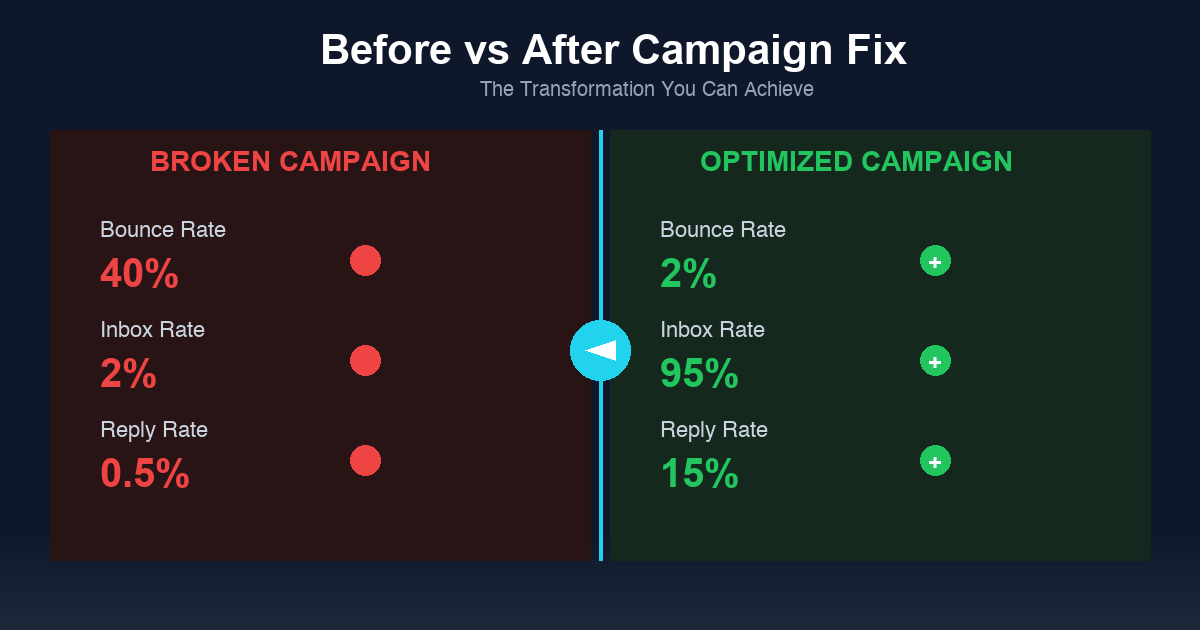
This hygiene protocol keeps your bounce rate below 2% and protects your sender reputation for long-term cold outreach success.
What metrics should I track to measure the success of my cold email campaigns?
you can’t improve what you don’t measure. Effective cold outreach campaign management requires tracking specific metrics at every stage.
Primary Metrics
Delivery rate measures the percentage of messages that reach the inbox versus bouncing or being blocked. Target: 95%+ delivery rate.
Open rate measures subject line effectiveness. Target varies by industry and list quality.
Track trends over time.
Reply rate is the ultimate measure of cold outreach success. This is your conversion rate for responses.
Target: above 5% for average campaigns, above 15% for optimized campaigns.
Secondary Metrics
Click rate measures engagement with links in your outreach. Low click rates with high opens may indicate call to action problems.
Meeting conversion rate tracks what percentage of replies convert to booked meetings. This is where your sales pipeline begins.
Cost per qualified meeting combines outreach costs with meeting conversion to determine true pipeline costs and ROI.
Segmentation Analysis
Track metrics by segment: by industry, company size, title level, and campaign type. What works for a CFO may not work for a VP of Engineering.
Deep segmentation enables optimization that aggregate metrics hide.
Is cold email still an effective strategy, and if so, what’s changed?
Yes. Cold outreach is still effective.
But what “effective” means has changed significantly.
The Evolution of Cold Outreach
Cold outreach in 2026 is fundamentally different from 2016. The bar for quality has risen dramatically.
B2B companies have become sophisticated. they’ve developed finely tuned spam detectors.
They expect relevance, specificity, and genuine value.
The spray-and-pray approach that worked a decade ago now fails completely. Cold outreach campaigns that treat contacts as addresses to be mass-messaged generate 1-3% reply rates.
Cold outreach campaigns that treat buyers as individuals to be engaged generate 20-40%.
What Has Changed
Targeting must be precise. Generic lists targeting “companies with more than 50 employees” fail.
Only specific targeting to decision-makers facing the specific problem your solution solves generates results.
Personalization must be genuine. “Hi [First Name]” personalization is spam.
Only hyper-personalization that references specific details about the specific buyer earns responses.
Multi-channel integration is mandatory. Cold outreach alone underperforms multi-touch sequences across email, LinkedIn, and phone.
Coordinated outreach across channels generates 3-5x more responses than single-channel campaigns.
The Bottom Line
Cold outreach works,for companies willing to execute at the level required. The companies dominating your market are running these campaigns right now, targeting your potential customers, while you debate whether cold outreach still works.
The gap widens every month. Every campaign you run with broken fundamentals trains inbox providers to filter your messages.
Every month of delay is another month your competitors build their sales pipeline while yours stagnates.
Fix your fundamentals. Build your systems.
Execute with discipline. The math works,when you do the work.
Do the math. If our AI infrastructure reaches out to 1,000 highly qualified, triple-verified decision-makers a day, that’s 30,000 people a month. With our hyper-personalization, even an impossibly conservative 1% reply rate yields 300 qualified conversations. In high-ticket B2B, what happens to your revenue when you’ve 300 conversations with your exact ICP?
what’s the fastest way to use Why Most Cold Email Campaigns Fail and How to Fix Yours Today without burning the market?
Start with a tight ICP, verified data, and a small test batch. Scale only after replies, bounces, and meeting quality prove the message is working.
How many prospects should I contact for Why Most Cold Email Campaigns Fail and How to Fix Yours Today?
The number matters less than the fit. A smaller list of verified decision-makers will beat a large scraped list because inbox placement, relevance, and timing decide reply quality.
Why do most campaigns around Why Most Cold Email Campaigns Fail and How to Fix Yours Today fail?
Most campaigns fail because the data is weak, the offer is vague, and the follow-up system is inconsistent. Fix those three points before adding more volume.
Should I use email only for Why Most Cold Email Campaigns Fail and How to Fix Yours Today?
No. Email works better when it’s supported by LinkedIn touches, retargeting, and clean CRM follow-up. One channel creates reminders. Multiple channels create recognition.
When should I hire help for Why Most Cold Email Campaigns Fail and How to Fix Yours Today?
Hire help when you already know the customer profile, the offer is validated, and the bottleneck is execution speed. Outsourcing a broken offer only makes the failure happen faster.
The weak version of Why Most Cold Email Campaigns Fail and How to Fix Yours Today is easy to spot. It talks to everyone, says nothing specific, and asks for a meeting before earning attention. If the list is weak, the message is vague, and the follow-up is random, even a smart idea turns into noise.
Your buyer does not reward clever wording. They reward relevance. Show them that you understand the pressure on their desk before you ask for time. That means the message has to earn attention fast: clear pain, clean proof, and a next step that does not feel like a trap.
Three Filters Before You Add Volume
Fit: Can we explain why this exact person should care in one sentence? If not, the list is too broad.
Timing: Is there a trigger, market shift, hiring signal, funding event, expansion move, compliance deadline, or operational pain that makes the message relevant now?
Proof: Does the email give the buyer a reason to trust the claim before asking for time? A sharp observation beats a generic case-study line.
Most campaigns do not need a cleverer subject line first. They need cleaner segmentation, sharper proof, and a follow-up sequence that sounds like a person is paying attention.
The cleaner version is simple: start with 150 accounts, not a giant scraped list. Segment them by pain, write one message for one segment, and watch replies before scaling. If that first batch does not produce signal, more volume will not save the campaign. It will only make the failure louder.
Here is the practical takeaway: make Why Most Cold Email Campaigns Fail and How to Fix Yours Today narrower, cleaner, and easier to say yes to. Then scale what the market proves, not what the team hopes will work. Build the data layer first, then the message, then the follow-up system. In that order.
How to Judge Why Cold Email Campaigns Fail Before You Scale
The practical test for why cold email campaigns fail is not whether the idea sounds smart. The test is whether it creates qualified pipeline without damaging deliverability, sender reputation, or buyer trust. A strong system connects email marketing , reasons your cold , follow-up email , cold email outreach with clear targeting, clean data, and a message that feels written for the exact account.
If the campaign uses reasons your cold email , cold emails fail , reasons why your cold , sending emails , product or service , email responses, the team needs a simple operating rule: do not add volume until replies prove the angle. That means watching inbox placement, open rates, reply quality, bounce behavior, and the number of sales meetings that come from real decision-makers.
The Execution Checklist
Infrastructure: Check reasons why your cold emails, email isn’t, recipient’s pain points, reasons cold before scaling. If this layer is weak, more sending only creates louder failure.
Targeting: Check personalized emails, common reasons, common reasons cold email campaigns before scaling. If this layer is weak, more sending only creates louder failure.
Message quality: Check reasons cold email campaigns fail, emails land, average cold email, sending cold before scaling. If this layer is weak, more sending only creates louder failure.
Follow-up: Check decision-maker, initial email, send a follow-up email before scaling. If this layer is weak, more sending only creates louder failure.
Measurement: Check warm up your email, email contacts before scaling. If this layer is weak, more sending only creates louder failure.
The bottom line is simple: why cold email campaigns fail should be treated like a revenue system, not a one-off campaign. When the list, email infrastructure, personalization, domain setup, and multichannel follow-up work together, the outreach has a real chance to turn cold attention into booked meetings.
The Human Review Layer
The strongest campaigns feel researched because the language names a specific condition in the buyer’s world. The buyer is filtering for relevance, timing, credibility, and the cost of paying attention. For Why Most Cold Email Campaigns Fail and How to Fix Yours Today, that means the outreach has to connect the business problem, the buying moment, and the proof in a way that feels specific.
A campaign built around deliverability, yours buyers, and today pipeline has more context than a generic pitch. A handover issue needs different copy than a domain issue. A stakeholder bottleneck should not be handled with the same CTA as a positioning bottleneck. This is why shallow templates fail. They flatten different buyer situations into one bland message.
Fail Accounts: Review fail accounts against the buyer’s real context before increasing send volume.
Dashboard: Review dashboard against the buyer’s real context before increasing send volume.
Authentication: Review authentication against the buyer’s real context before increasing send volume.
Threshold: Review threshold against the buyer’s real context before increasing send volume.
Today Accounts: Review today accounts against the buyer’s real context before increasing send volume.
Message: Review message against the buyer’s real context before increasing send volume.
This is the part a generic article usually misses: judgment. A real operator can tell when fail pipeline is the problem, when margin is the problem, and when the whole angle is too soft. That judgment comes from reading replies, checking account quality, and comparing message intent against actual buyer behavior.
The cleaner move is to run a small batch, inspect the signal, then rewrite the weak layer. Do not scale because the copy looks polished. Scale because the replies prove the market understands the value.