B2B Omnichannel Outreach: Complete Omnichannel Marketing Strategy
Your cold outreach campaign achieves a respectable 12% reply rate. Your competitor runs a coordinated multichannel approach and achieves a 35% reply rate.
Same target list. Same personalization depth.
The difference is their omnichannel marketing strategy.
The math is irrefutable: multichannel prospecting generates three to five times more qualified conversations than a cold email campaign alone. This isn’t theory.
This is documented performance across thousands of campaigns. Your B2B buyers live across multiple digital channels simultaneously, and reaching them requires meeting them where they’re.
This guide covers coordinated B2B outreach comprehensively: what it’s, why it works, how to implement it, which metrics matter, and how to build a system that generates consistent pipeline across every channel your decision-makers inhabit.
what’s B2B Omnichannel Marketing/Outreach?
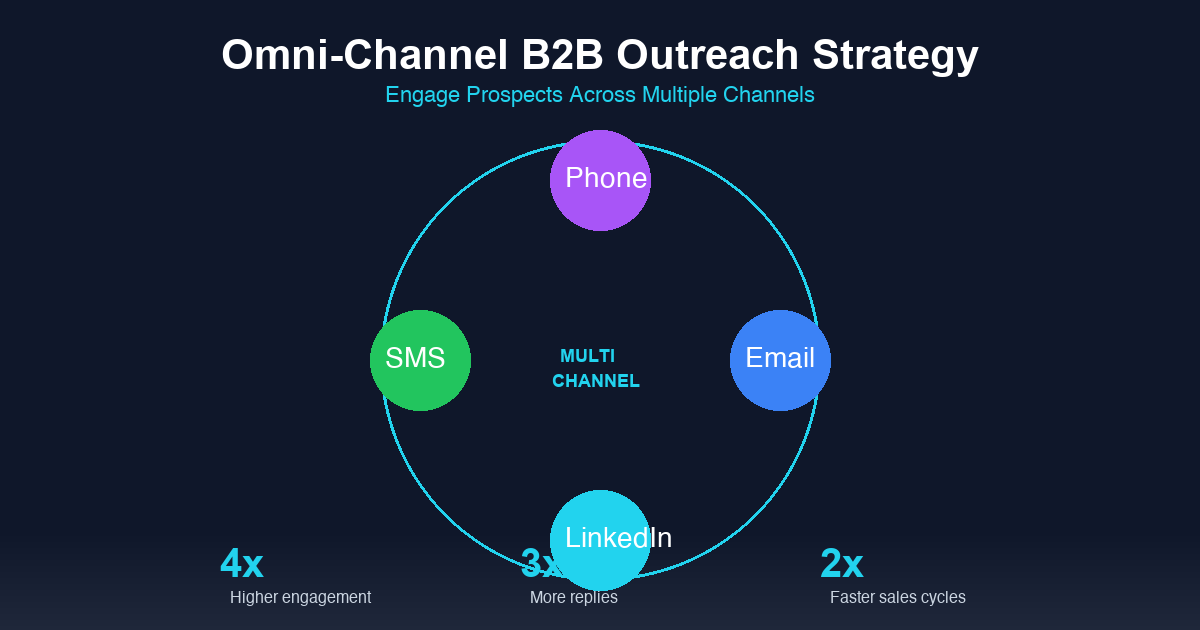
Omnichannel is an integrated approach to enterprise outreach that coordinates messaging across multiple communication channels to create a unified prospect experience. Unlike siloed multichannel campaigns where email, LinkedIn, phone, and SMS operate independently, omnichannel orchestrates touchpoints so each channel reinforces the others.
This integrated approach ensures every interaction builds on the previous one rather than starting fresh each time.
The defining characteristic is intelligence. When a prospect engages with your LinkedIn content, your email sequence adjusts.
When they reply to your cold call, your follow-up emails pause. When they visit your pricing page, your messaging increases urgency.
This real-time adaptation creates a seamless impression of a thoughtful, coordinated effort rather than disconnected blasts.
For B2B marketing, omnichannel recognizes that modern B2B buyers research across multiple platforms before engaging with vendors. They see your LinkedIn posts while scrolling professionally.
They receive your cold email messages during morning inbox review. They notice your ads during web browsing.
Omnichannel B2B outreach coordinates these appearances into a coherent presence that builds familiarity and trust before first contact. Understanding how business-to-business buyers make decisions helps you design strategies that resonate at each stage of their journey.
The Evolution from Multichannel to Omnichannel
Early multichannel campaigns simply ran parallel campaigns: batch email to a list, simultaneous LinkedIn connection requests, generic cold calls to everyone. These campaigns felt disjointed and often created embarrassing over-contact when B2B buyers received messages across channels simultaneously.
Modern omnichannel campaigns use technology to coordinate timing, messaging, and sequence progression based on prospect behavior. The shift from multichannel to omnichannel is the shift from parallel execution to integrated orchestration.
The results are dramatically different.
what’s B2B Outreach?
B2B outreach is proactive communication with potential customers to generate interest, qualify fit, and create sales opportunities. It encompasses every outbound activity: cold outreach, LinkedIn prospecting, cold calling, SMS, direct mail, and event networking.
Your sales and marketing teams must align on buyer journey stages so communication becomes far more effective at moving prospects through the pipeline.
The goal of B2B outreach isn’t immediate sales. it’s initiating relationships with prospect accounts who may become customers.
Effective outreach creates awareness, establishes credibility, and positions your solution for when buying intent emerges.
In modern B2B sales, outreach is increasingly automated and scaled. Human salespeople handle relationship building and complex negotiation.
AI and automation handle initial contact, research, and qualification. This combination achieves scale impossible with purely manual approaches while maintaining the personalization that drives response rates.
The Role of Outreach in the Modern Sales Funnel
B2B outreach operates at the top of the sales funnel, generating initial interest and qualifying fit. It feeds qualified opportunities into your sales process while nurturing prospects not yet ready for direct sales engagement.
Strong lead generation campaigns create the volume needed to sustain pipeline growth across the entire B2B market.
The efficiency of your outreach determines your conversion rate at every subsequent funnel stage. High-quality prospecting generates qualified leads who convert at high rates.
Poor prospecting generates sales leads that waste sales team time without progressing through your pipeline.
What Are the Key Elements or the Four C’s of Omnichannel?
The omnichannel framework rests on four foundational elements that guide strategy and execution.
- Consistency , Your message, positioning, and brand presence remain coherent across every channel from LinkedIn to email to phone
- Context , Adapting your message to each channel’s unique environment while maintaining consistency in positioning
- Continuity , Connecting touchpoints into coherent journeys rather than isolated interactions; referencing LinkedIn in follow-up emails
- Channels , The vehicles through which you reach prospects, prioritized based on where decision-makers in your market actually engage
- Coordination Complexity , Email sequences, LinkedIn automation, phone campaigns, and SMS must be orchestrated to avoid over-contacting
Consistency ensures your message, positioning, and brand presence remain coherent across every channel. Prospects should recognize your company and offering regardless of whether they encounter you on LinkedIn, email, or phone.
Inconsistent messaging fragments brand perception and undermines credibility.
Context requires adapting your message to each channel’s unique environment and audience expectations. LinkedIn audiences expect professional, thoughtful content.
Cold email allows more detailed communication. Phone conversations require conversational brevity.
The same core message adapts to each context while maintaining consistency in positioning.
Continuity connects touchpoints into coherent journeys rather than isolated interactions. When a prospect receives your third email after seeing your LinkedIn post, that email should reference the LinkedIn interaction.
This continuity creates a seamless experience across every touchpoint. You should personalize each touchpoint based on previous engagement to maintain this continuity across all channels.
Channels are the vehicles through which you reach prospects. Effective omnichannel strategies prioritize channels based on where decision-makers in your target market actually engage.
Some audiences are LinkedIn-dominant. Others are email-responsive.
Others answer phones. Channel selection should match audience behavior.
Applying the Four C’s to Campaign Design
Every campaign element should pass the four C’s test. Is your messaging consistent across channels?
Does your content fit each channel’s context? Does your sequence create continuity or fragmentation?
Are you using the right channels for your specific audience? Campaigns that fail any of these tests underperform those that excel across all four.
How Can an Omnichannel Strategy Be Implemented for B2B?
Implementation requires systematic planning across several dimensions. Your outreach strategies must account for the complexity of reaching modern B2B buyers who interact with content across all channels.
Channel selection begins with audience analysis. Map where your decision-makers spend their professional attention.
Are they active LinkedIn users who engage with content daily? Heavy email users who manage overflowing inboxes?
Phone-responsive executives who value direct conversation? Your channel mix should reflect actual behavior, not assumed preferences.
Each buyer journey is unique, so your marketing strategy must adapt to the specific needs and behaviors of your target buyer.
Sequence design creates the touchpoint architecture. Determine how many touchpoints across how many channels over what timeframe.
Map triggers that adjust timing and messaging based on prospect behavior. Define pause conditions that stop sequences when prospects convert through other channels or explicitly decline.
Technology infrastructure enables orchestration at scale. CRM systems track prospect interactions across channels.
Workflow automation manages sequence progression. Multichannel sending platforms coordinate email, LinkedIn, and SMS delivery.
Integration between systems ensures every touchpoint reflects the most recent prospect behavior.
Building Your First Omnichannel Campaign
Start with a focused pilot that proves the approach before scaling. Select your highest-priority segment: 500-1,000 prospect accounts where decision-makers are clearly identifiable.
Design a three-channel sequence: email as the primary volume driver, LinkedIn for relationship building, phone for high-value account follow-up. Run the pilot for eight weeks while tracking reply rates, meeting conversions, and pipeline generation.
Compare results against your email-only baseline. If omnichannel delivers the expected improvement, scale to broader segments.
If results disappoint, diagnose which elements underperformed before expanding.
Why Should B2B Businesses Adopt an Omnichannel Approach?
The competitive imperative is clear: decision-makers who receive coordinated multi-channel outreach convert at dramatically higher rates than those receiving single-channel contact. Your sales development efforts should include personalization tactics that adapt messaging to each prospect’s demonstrated interests and engagement patterns.
Research consistently demonstrates that B2B buying decisions involve six to eight stakeholders, each with different information preferences. Some research through LinkedIn.
Others rely on email. Others trust phone conversations.
Omnichannel reaches all stakeholder types through their preferred channels simultaneously.
The familiarity effect is powerful: prospects who encounter your company three times across three channels feel they know you better than those who receive five emails from a company they’ve never seen elsewhere. This familiarity reduces resistance to sales conversations and accelerates trust-building.
The Revenue Impact of Channel Diversification
Consider the conversion rate implications. Outbound email-only campaigns might generate 5% reply rates from interested prospects.
Adding LinkedIn touchpoints increases reach to prospects who ignore email but are active on LinkedIn. Adding phone follow-up catches prospects who never respond to either digital channel but will engage on a call.
Each channel captures prospects the others miss.
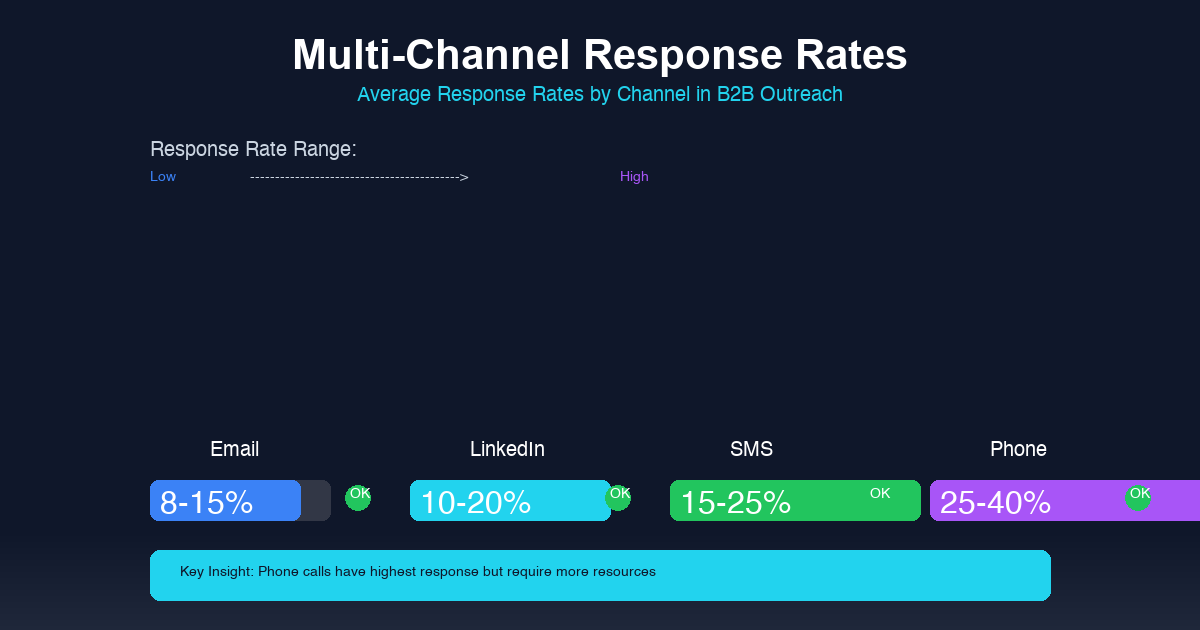
Companies implementing
omnichannel strategie
s report reply rates of 25-40% compared to 8-12% for email-only campaigns. This 3-5x improvement compounds through every subsequent conversion stage, creating dramatic differences in pipeline and revenue.
What Are the Benefits of B2B Omnichannel Outreach?
Benefits extend across every dimension of your B2B sales operation. The customer engagement gains alone justify the investment in coordinated outreach.
- Increased Reach , Captures prospects across all their information channels rather than only those reachable through email alone
- Higher Response Rates , Multiple familiarity-building touchpoints dramatically improve overall response probability
- Accelerated Trust Building , Coordinated professional presence across channels signals credibility that single-channel approaches can’t match
- Better Data Accumulation , Multi-channel engagement generates more interaction signals for future targeting refinement
- Reply Rate Improvement , Companies implementing omnichannel report 25-40% reply rates versus 8-12% for email-only campaigns
- Operational Efficiencies , Workflow automation orchestrates touchpoints without manual coordination once sequences are configured
Increased reach captures prospects across all their information channels rather than only the subset reachable through email. For some audiences, LinkedIn is the only channel that works.
For others, phone is essential. Omnichannel leaves no qualified prospect unreached.
Higher response rates result from multiple familiarity-building touchpoints. Each channel exposure increases the probability of response.
Prospects who ignore email might open your LinkedIn message. Those who ignore both might answer when you call.
Combined exposure dramatically improves overall response probability.
Accelerated trust building happens because coordinated presence signals credibility. Companies that show up professionally across multiple channels appear more established and serious than those visible in only one place.
This perceived credibility reduces prospect hesitation about engaging with your sales team.
Better data accumulation occurs because multi-channel engagement generates more interaction signals. You learn which channels resonate with different prospect segments.
This data informs future targeting and messaging refinement.
Operational Efficiencies from Automation
Omnichannel outreach becomes scalable through workflow automation that orchestrates touchpoints without manual coordination. Once sequences are configured, technology manages timing, personalization, and progression while humans focus on strategy and exception handling.
What Are the Challenges of Implementing B2B Omnichannel Outreach?
Complex execution introduces challenges that require deliberate management. Your team will need to optimize processes continuously to maintain coordination quality across multiple touchpoints.
Coordination complexity multiplies with each additional channel. Email sequences, LinkedIn automation, phone campaigns, and SMS touchpoints must be orchestrated to avoid over-contacting prospects or sending conflicting messages.
Without proper technology infrastructure, coordination becomes unmanageable.
Consistency maintenance across channels requires intentional effort. Different channels have different character limits, tone expectations, and content formats.
Ensuring your core message survives adaptation across formats without becoming inconsistent is challenging but essential.
Data integration across platforms creates technical overhead. Your CRM must capture interactions from every channel.
Your sending platforms must coordinate without creating duplicate contacts or conflicting follow-ups. This integration work is unglamorous but critical.
Resource allocation across channels requires expertise in multiple domains. Email expertise differs from LinkedIn expertise, which differs from phone expertise.
Building or acquiring multi-channel capability demands broader skill development than email-only operations.
Mitigation Strategies
Start with two channels before adding a third. Master email plus LinkedIn orchestration before introducing phone.
Add SMS only when other channels are performing well. This phased approach builds capability without overwhelming execution.
Invest in technology that handles orchestration automatically. The cost of automation platforms is always less than the cost of manual coordination across multiple channels.
How Does Omnichannel Outreach Differ from Multichannel or Cross-Channel Outreach?
These terms are often used interchangeably but represent distinct strategic approaches.
Multichannel outreach uses multiple channels without coordination. Email campaigns run independently from LinkedIn campaigns.
Phone outreach happens separately from other activities. Each channel optimizes for its own metrics without awareness of touchpoints across other channels.
In contrast, true omnichannel strategies ensure the buyer experience feels seamless regardless of which channel initiates engagement.
Cross-channel outreach creates basic handoffs between channels. Email directs recipients to LinkedIn.
LinkedIn prompts email follow-up. These handoffs create some continuity but lack sophisticated behavior-based adaptation.
Omnichannel represents true integration where channels influence each other dynamically. Prospect behavior on one channel triggers adjustments across all other channels.
Sequence progression depends on cross-channel engagement patterns. The prospect experience across all touchpoints is unified and coherent.
Choosing Your Approach
Start with multichannel to build basic channel presence. Progress to cross-channel when you can coordinate basic handoffs.
Invest in omnichannel when you’ve the technology infrastructure and operational expertise to manage true integration. The investment required for each level increases, but so does the return.
What Metrics Should Be Tracked to Measure the Success of B2B Omnichannel Outreach?
Comprehensive measurement is essential for optimization and investment justification. You must track these metrics to optimize your outreach strategies effectively.
Channel-specific metrics evaluate each channel independently. For email: deliverability rates, open rates, click rates, reply rates.
For LinkedIn: connection request acceptance rates, InMail delivery rates, engagement rates on content interactions. For phone: connect rates, conversation conversion rates, appointment show rates.
Cross-channel metrics evaluate integration effectiveness. These include reply rates by channel combination (did prospects who received LinkedIn plus email respond differently than email-only?), meeting conversion rates by sequence type, and pipeline velocity for omnichannel versus single-channel leads.
Revenue metrics connect outreach to business outcomes. Qualified pipeline generated, meeting-to-opportunity conversion rates, opportunity-to-close rates, and revenue influenced by outreach campaigns.
Each b2b lead generated through multi-channel outreach typically has higher lifetime value than single-channel leads.
Attribution metrics determine which channels and touchpoints deserve credit for conversions. Single-touch attribution assigns credit to first or last interaction.
Multi-touch attribution distributes credit across the full customer journey. Understanding attribution informs channel investment decisions and helps your sales and marketing teams allocate resources effectively.
Building Your Measurement Framework
Start with the metrics that connect directly to revenue: qualified pipeline generated and revenue influenced. Layer in conversion metrics that explain why pipeline is growing or shrinking.
Finally, track channel metrics that indicate optimization opportunities. This hierarchy ensures you focus on outcomes rather than vanity metrics.
What Technologies and Tools Are Required for Unified B2B Omnichannel Outreach?
Effective omnichannel outreach requires integrated technology across several categories.
CRM systems serve as the system of record for all prospect interactions. Every touchpoint across every channel must be logged, tracked, and accessible to everyone involved in the B2B sales process.
HubSpot, Salesforce, and Pipedrive offer increasingly sophisticated multi-channel tracking capabilities.
Email sending platforms handle cold email infrastructure, authentication, domain rotation, and volume management. Smartlead, Instant.ly, and similar platforms provide cold outreach sending with deliverability optimization built in.
LinkedIn automation tools manage connection requests, InMail sending, and content engagement at scale. Tools like Phantombuster, LinkedIn Helper, and Sales Navigator integrations extend your LinkedIn presence programmatically.
Phone and SMS platforms enable multi-channel reach through calling and texting. Aircall, Dialpad, and similar services provide business phone infrastructure.
SMS integration through Twilio or platform-native features extends reach to mobile channels.
Workflow automation connects these systems into unified orchestration. n8n, Zapier, or native platform integrations enable cross-channel communication and trigger-based sequence adjustment.
Integration Architecture Considerations
The complexity of your technology stack should match your operational maturity. Start with integrated platforms that bundle multiple channel capabilities.
As needs become more sophisticated, add specialized tools that excel at specific functions while maintaining integration through automation.
The goal is unified prospect intelligence: every team member sees the complete engagement history regardless of which channel generated the interaction. This unified view enables consistent, informed communication that prospects experience as thoughtful rather than fragmented.
With years of experience across multiple industries, we’ve seen how proper integration creates remarkable efficiency gains in sales development operations.
Do the math. If our AI infrastructure reaches out to 1,000 highly qualified, triple-verified decision-makers a day, that’s 30,000 people a month. With our hyper-personalization, even an impossibly conservative 1% reply rate yields 300 qualified conversations. In high-ticket B2B, what happens to your revenue when you’ve 300 conversations with your exact ICP?
Frequently Asked Questions
what’s the fastest way to use Omni-Channel B2B Outreach: Why Email Alone isn’t Enough without burning the market?
Start with a tight ICP, verified data, and a small test batch. Scale only after replies, bounces, and meeting quality prove the message is working.
How many prospects should I contact for Omni-Channel B2B Outreach: Why Email Alone isn’t Enough?
The number matters less than the fit. A smaller list of verified decision-makers will beat a large scraped list because inbox placement, relevance, and timing decide reply quality.
Why do most campaigns around Omni-Channel B2B Outreach: Why Email Alone isn’t Enough fail?
Most campaigns fail because the data is weak, the offer is vague, and the follow-up system is inconsistent. Fix those three points before adding more volume.
Should I use email only for Omni-Channel B2B Outreach: Why Email Alone isn’t Enough?
No. Email works better when it’s supported by LinkedIn touches, retargeting, and clean CRM follow-up. One channel creates reminders. Multiple channels create recognition.
When should I hire help for Omni-Channel B2B Outreach: Why Email Alone isn’t Enough?
Hire help when you already know the customer profile, the offer is validated, and the bottleneck is execution speed. Outsourcing a broken offer only makes the failure happen faster.
The No-Fluff Repair Plan
If Omni-Channel B2B Outreach feels inconsistent, the problem usually is not effort. It is that the campaign has no operating logic behind it. That is why I care less about volume at the start and more about whether the first replies prove the angle is real.
The inbox is not a neutral place. It is a triage system. Buyers delete anything that feels like it was written for a spreadsheet, not a person. The first job of outreach is to prove relevance before persuasion. Name the business problem, make the next step useful, and remove every sentence that sounds like a brochure.
The Quality Gate
- Account quality: Would this company still be attractive if it never replied this month? If not, it probably should not be in the campaign.
- Message angle: Can the opener point to a real business condition, not a lazy compliment? Specificity is what makes the email feel earned.
- Next step: Is the CTA small enough to say yes to? A useful reply is often a better first win than forcing a meeting immediately.
This is not complicated, but it is unforgiving. A sloppy list makes copy look bad. Weak positioning makes good data useless. And a CTA that asks for a meeting too early forces the buyer to do all the mental work.
The cleaner version is simple: start with 200 accounts, not a giant scraped list. Segment them by pain, write one message for one segment, and watch replies before scaling. If that first batch does not produce signal, more volume will not save the campaign. It will only make the failure louder.
Here is the practical takeaway: make Omni-Channel B2B Outreach narrower, cleaner, and easier to say yes to. Then scale what the market proves, not what the team hopes will work. Build the data layer first, then the message, then the follow-up system. In that order.
Book a strategy call
How to Judge Omni Channel B2B Outreach Before You Scale
The practical test for omni channel b2b outreach is not whether the idea sounds smart. The test is whether it creates qualified pipeline without damaging deliverability, sender reputation, or buyer trust. A strong system connects marketing and sales , guide to b2b omnichannel marketing , b2b customers , marketing efforts with clear targeting, clean data, and a message that feels written for the exact account.
If the campaign uses b2b omnichannel marketing strategy , marketing team , marketing campaigns , omnichannel outreach strategy , b2b sales and marketing , b2b companies, the team needs a simple operating rule: do not add volume until replies prove the angle. That means watching inbox placement, open rates, reply quality, bounce behavior, and the number of sales meetings that come from real decision-makers.
The Execution Checklist
- Infrastructure: Check companies with strong omnichannel, building an omnichannel, scale outreach, building your omnichannel before scaling. If this layer is weak, more sending only creates louder failure.
- Targeting: Check omnichannel customer engagement, sales channels, b2b omnichannel strategy before scaling. If this layer is weak, more sending only creates louder failure.
- Message quality: Check customer experience across, single channel, one platform, single source of truth before scaling. If this layer is weak, more sending only creates louder failure.
- Follow-up: Check multichannel marketing means, b2b and b2c, strong omnichannel before scaling. If this layer is weak, more sending only creates louder failure.
- Measurement: Check channel for b2b, comprehensive omnichannel before scaling. If this layer is weak, more sending only creates louder failure.
The bottom line is simple: omni channel b2b outreach should be treated like a revenue system, not a one-off campaign. When the list, email infrastructure, personalization, domain setup, and multichannel follow-up work together, the outreach has a real chance to turn cold attention into booked meetings.
Search Intent Coverage Section for Omni Channel B2B Outreach
How Omnichannel Changes the Buying Decision
For omni channel b2b outreach, buyers are usually comparing seamless omnichannel experience, benefits of omnichannel, marketing automation, toward an omnichannel, outreach platform. The decision is not made from one email or one landing page. It is made from proof, clean positioning, inbox trust, and whether the outreach explains why the offer matters now.
The operational layer matters too: unified customer, email marketing, experience across all channels. If these pieces are weak, the campaign may still create activity, but it will not create enough qualified sales conversations to justify scaling.
How B2B Changes the Buying Decision
For omni channel b2b outreach, buyers are usually comparing weak strategies, per channel, new channel, experience in b2b, b2b buyers use. The decision is not made from one email or one landing page. It is made from proof, clean positioning, inbox trust, and whether the outreach explains why the offer matters now.
The operational layer matters too: another channel, email open rates, know about omnichannel. If these pieces are weak, the campaign may still create activity, but it will not create enough qualified sales conversations to justify scaling.
How Outreach Changes the Buying Decision
For omni channel b2b outreach, buyers are usually comparing improve your marketing, helps b2b, omnichannel, b2b, outreach. The decision is not made from one email or one landing page. It is made from proof, clean positioning, inbox trust, and whether the outreach explains why the offer matters now.
The operational layer matters too: omnichannel marketing, b2b omnichannel, omnichannel strategies. If these pieces are weak, the campaign may still create activity, but it will not create enough qualified sales conversations to justify scaling.
How Omnichannel Marketing Changes the Buying Decision
For omni channel b2b outreach, buyers are usually comparing b2b businesses, marketing strategy, b2b omnichannel marketing, omnichannel marketing strategy, b2b omnichannel marketing strategy. The decision is not made from one email or one landing page. It is made from proof, clean positioning, inbox trust, and whether the outreach explains why the offer matters now.
The operational layer matters too: building your omnichannel, campaign, omnichannel outreach. If these pieces are weak, the campaign may still create activity, but it will not create enough qualified sales conversations to justify scaling.
How B2B Omnichannel Changes the Buying Decision
For omni channel b2b outreach, buyers are usually comparing prospect, b2b sales, sales and marketing, seamless, omnichannel approach. The decision is not made from one email or one landing page. It is made from proof, clean positioning, inbox trust, and whether the outreach explains why the offer matters now.
The operational layer matters too: lead generation, omnichannel b2b, b2b lead. If these pieces are weak, the campaign may still create activity, but it will not create enough qualified sales conversations to justify scaling.
Questions Buyers Ask Before Choosing Omni Channel B2B Outreach
What is B2B omnichannel?
The short answer depends on list quality, deliverability, personalization, follow-up, and whether the campaign is aimed at the correct buyer. For omni channel b2b outreach, the safest move is to validate with a controlled test before increasing volume.
What is omni channel outreach?
The short answer depends on list quality, deliverability, personalization, follow-up, and whether the campaign is aimed at the correct buyer. For omni channel b2b outreach, the safest move is to validate with a controlled test before increasing volume.
What is a B2B outreach?
The short answer depends on list quality, deliverability, personalization, follow-up, and whether the campaign is aimed at the correct buyer. For omni channel b2b outreach, the safest move is to validate with a controlled test before increasing volume.
What are the four C’s of omnichannel?
The short answer depends on list quality, deliverability, personalization, follow-up, and whether the campaign is aimed at the correct buyer. For omni channel b2b outreach, the safest move is to validate with a controlled test before increasing volume.
B2B Omnichannel Outreach: Complete Omnichannel Marketing Strategy
This section gives buyers a direct checklist for omnichannel b2b outreach. It connects the exact terms searchers use with practical execution, so the article answers the query instead of only explaining the concept.
- Omnichannel: Use this layer to judge whether omnichannel b2b outreach can produce qualified pipeline before adding volume.
- B2B: Use this layer to judge whether omnichannel b2b outreach can produce qualified pipeline before adding volume.
- Outreach: Use this layer to judge whether omnichannel b2b outreach can produce qualified pipeline before adding volume.
- Omnichannel Marketing: Use this layer to judge whether omnichannel b2b outreach can produce qualified pipeline before adding volume.
- Campaign: Use this layer to judge whether omnichannel b2b outreach can produce qualified pipeline before adding volume.
- B2B Omnichannel: Use this layer to judge whether omnichannel b2b outreach can produce qualified pipeline before adding volume.
- Omnichannel Outreach: Use this layer to judge whether omnichannel b2b outreach can produce qualified pipeline before adding volume.
- Linkedin: Use this layer to judge whether omnichannel b2b outreach can produce qualified pipeline before adding volume.
- Buyer: Use this layer to judge whether omnichannel b2b outreach can produce qualified pipeline before adding volume.
- Omnichannel Strategies: Use this layer to judge whether omnichannel b2b outreach can produce qualified pipeline before adding volume.
- Marketing Strategy: Use this layer to judge whether omnichannel b2b outreach can produce qualified pipeline before adding volume.
- Prospect: Use this layer to judge whether omnichannel b2b outreach can produce qualified pipeline before adding volume.
- B2B Sales: Use this layer to judge whether omnichannel b2b outreach can produce qualified pipeline before adding volume.
- Multiple Channels: Use this layer to judge whether omnichannel b2b outreach can produce qualified pipeline before adding volume.
- Touchpoints: Use this layer to judge whether omnichannel b2b outreach can produce qualified pipeline before adding volume.
- Personalization: Use this layer to judge whether omnichannel b2b outreach can produce qualified pipeline before adding volume.
- Omnichannel Approach: Use this layer to judge whether omnichannel b2b outreach can produce qualified pipeline before adding volume.
- Lead Generation: Use this layer to judge whether omnichannel b2b outreach can produce qualified pipeline before adding volume.
- Communication Channels: Use this layer to judge whether omnichannel b2b outreach can produce qualified pipeline before adding volume.
- Digital Channels: Use this layer to judge whether omnichannel b2b outreach can produce qualified pipeline before adding volume.
The practical takeaway: omnichannel b2b outreach only works when the buyer profile, message, infrastructure, follow-up, and measurement system are aligned. If one layer is weak, the campaign may create activity without creating enough qualified meetings.
What Separates Useful Outreach From Noise
Look at B2B Omnichannel Outreach through the buyer’s day, not through a marketer’s checklist. The buyer is filtering for relevance, timing, credibility, and the cost of paying attention. For B2B Omnichannel Outreach, that means the outreach has to connect the business problem, the buying moment, and the proof in a way that feels specific.
A campaign built around handoff, authority, and champion has more context than a generic pitch. A personalization bottleneck should not be handled with the same CTA as a priority bottleneck. A attribution issue needs different copy than a sequence issue. This is why shallow templates fail. They flatten different buyer situations into one bland message.
- Omnichannel Pipeline: Review omnichannel pipeline against the buyer’s real context before increasing send volume.
- Urgency: Review urgency against the buyer’s real context before increasing send volume.
- Revenue: Review revenue against the buyer’s real context before increasing send volume.
- Administrator: Review administrator against the buyer’s real context before increasing send volume.
- Marketing Buyers: Review marketing buyers against the buyer’s real context before increasing send volume.
- Reporting: Review reporting against the buyer’s real context before increasing send volume.
This is the part a generic article usually misses: judgment. A real operator can tell when threshold is the problem, when trigger is the problem, and when the whole angle is too soft. That judgment comes from reading replies, checking account quality, and comparing message intent against actual buyer behavior.
The cleaner move is to run a small batch, inspect the signal, then rewrite the weak layer. Do not scale because the copy looks polished. Scale because the replies prove the market understands the value.