SDR as a Service: Outsourced SDR Pipeline for B2B Companies
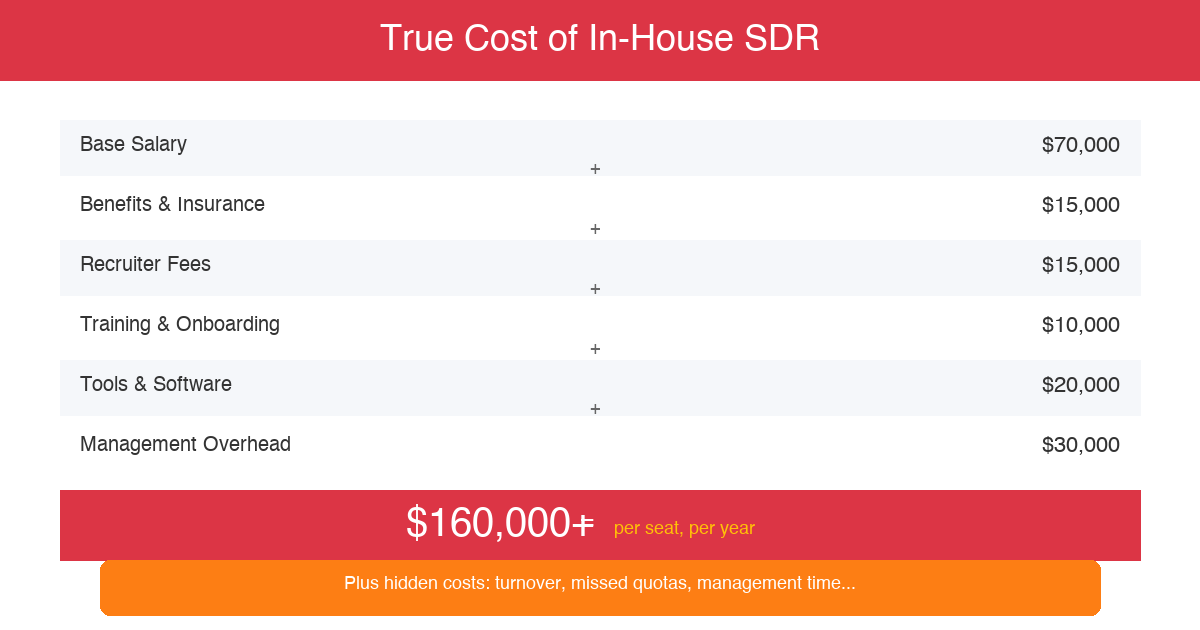
The math on building an in-house sales development function no longer works. Entry-level SDRs cost $60,000 to $80,000 per year in base salary alone.
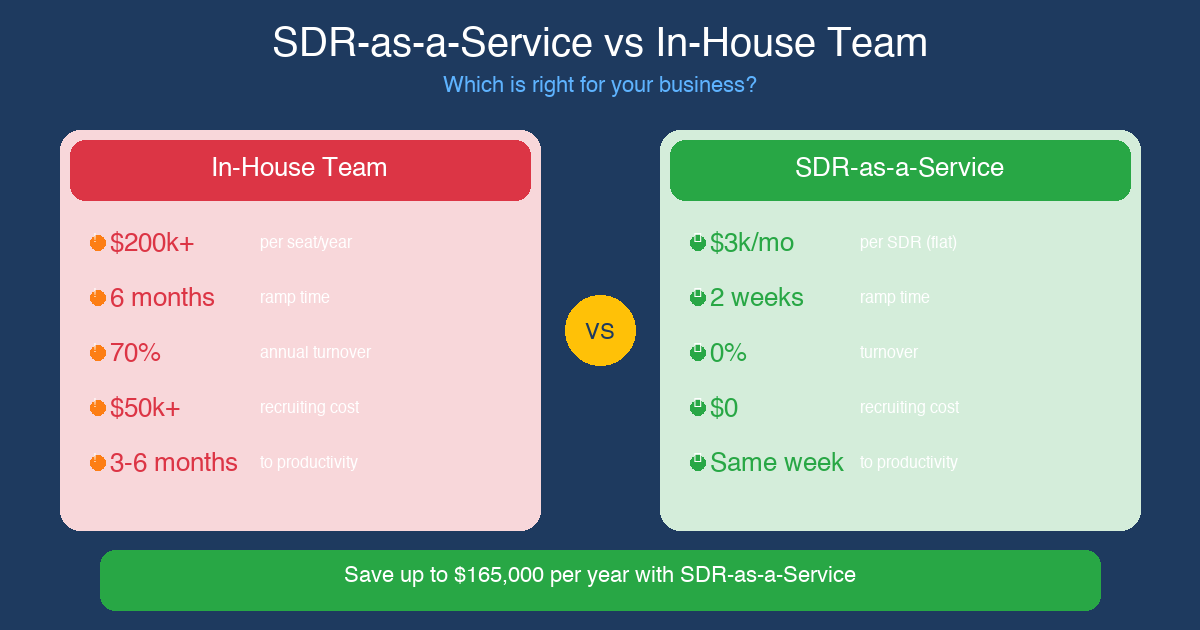
Add benefits, commissions, management overhead, recruiting costs, training time, and the 200% annual turnover rate that plagues the profession, and you’re looking at $150,000 to $250,000 per seat before a single qualified appointment gets booked. For many B2B SaaS companies, these costs make outsourced appointment-setting services the more economical choice.
For most B2B companies, this isn’t a sustainable model. Yet the need for consistent qualified pipeline generation has never been greater.
This external approach answers the problem with a fundamentally different architecture: instead of building and managing your own outreach infrastructure, you partner with specialized providers who have already solved the operational challenges. Many B2B SaaS companies have adopted this model to avoid the overhead of building internal sales development teams, using an established tech stack without the capital investment.
This guide covers everything revenue leaders need to understand about this model: how it works, when it makes sense, what quality looks like, and exactly how to evaluate providers who can transform your revenue pipeline.
what’s SDR as a Service?
SDR-as-a-service is an outsourced model where specialized providers handle cold outreach and sales development activities on behalf of B2B companies. Rather than hiring, training, and managing internal SDRs, companies engage these specialists who bring established infrastructure, proven processes, and accumulated expertise to their prospecting efforts.
When you partner with external providers, you get the benefits of a dedicated sales development function without the overhead of building one internally.
The scope of this service varies by provider. At the comprehensive end, it includes dedicated SDRs trained on your product and ideal customer profile, multi-channel cold outreach combining email, LinkedIn, and phone, lead generation campaigns targeting your specific market segments, prospect qualification using your discovery criteria, and qualified appointments booked directly on your calendar.
The defining characteristic of true outsourced SDR support is outcome focus. you’re not paying for activity metrics like emails sent or calls made.
you’re paying for qualified conversations with decision-makers who match your ideal customer. This alignment of incentives separates quality providers from vendors who generate activity without corresponding business outcomes.
The booking of qualified appointments is the primary metric that matters.
The Evolution From Vendor to Partner
The outsourced SDR market has matured significantly over the past five years. Early providers offered basic list-and-pitch services that generated activity without quality.
Survivors of the market contraction developed sophisticated systems, better technology, and deeper expertise that produce predictable results. The providers worth engaging have moved beyond vendor relationships into strategic partnerships that function as outsourced sales departments.
When you outsource to external teams, you gain dedicated SDRs who can prospect efficiently across multiple channels.
How Does SDR as a Service Work?
The operational mechanics of this model involve several coordinated phases that transform prospecting from an internal burden into an external engine.
Discovery and setup is the first phase, typically spanning two to four weeks. The provider conducts deep-dive sessions to understand your ideal customer profile, value proposition, competitive positioning, and sales process.
They research your market, identify target prospects, and develop messaging frameworks. They set up email infrastructure, integrate with your CRM, and establish reporting cadences.
This phase produces the foundation for everything that follows.
Campaign launch involves deploying initial cold outreach sequences to verified contact lists. The provider implements hyper-personalization research for each prospect, sends coordinated multi-channel sequences, and begins tracking engagement signals across all touchpoints.
Early results establish baseline metrics that guide optimization.
Continuous optimization runs throughout the engagement. The provider analyzes reply patterns, meeting conversion rates, and qualification quality.
They test message variations, adjust sequencing timing, refine targeting criteria, and incorporate feedback from your closers about meeting quality. This iterative improvement compounds over time, lifting performance above initial baselines.
Pipeline review closes the loop between outsourced activity and revenue outcomes. Providers track which meetings advance through your sales process, which converted to opportunities, and which closed as customers.
This data reveals true ROI and guides strategy adjustments that improve conversion rates at every stage of your sales pipeline.
The Handoff Protocol
Effective outsourced SDR requires clear handoff protocols between provider and your internal team. Meetings booked by SDRs must include sufficient context for your closers to prepare productive conversations.
Calendar invites should include discovery notes, qualification details, and any personalization context gathered during outreach. Without this handoff information, even well-qualified meetings underperform their potential.
What Are the Benefits of Using SDR as a Service?
This service delivers benefits that building internal sales development functions can’t match without significant investment in hiring, training, and operational systems.
- Immediate Infrastructure Access , Access enterprise-grade email verification, sequencing software, CRM integrations, and enrichment services immediately
- Accelerated Time-to-Revenue , Launch campaigns within 2-4 weeks versus 3-6 months for internal hires reaching productivity
- Specialized Expertise , Providers have tested thousands of subject lines and optimized hundreds of sequences across dozens of industries
- Scalability Without Headcount , Test new markets or products without permanent headcount commitment; scale from one campaign to ten
- Focus Optimization , Every hour closers spend on cold outreach is an hour not spent closing; specialists perform it more efficiently
- Focus on Closing Deals , Revenue producers can focus on closing rather than prospecting
Immediate infrastructure access is the first major benefit. Quality B2B sales work requires email verification tools, sequencing software, CRM integrations, analytics platforms, and lead data enrichment services.
Building this tech stack internally takes months and significant capital. External providers give you access to enterprise-grade infrastructure immediately, with costs amortized across the provider’s entire client base.
Accelerated time-to-revenue follows from immediate infrastructure combined with experienced SDR teams. Internal hires require three to six months before achieving meaningful productivity.
External providers can launch campaigns within two to four weeks of contract signing because their SDRs are already trained, their processes are established, and their technology is operational.
Specialized expertise accumulates with dedicated providers. they’ve tested thousands of subject lines, optimized hundreds of sequences, and learned what works across dozens of industries.
This expertise compounds over time, creating performance improvements that internal teams can’t replicate due to turnover that resets learning every time an employee departs.
Scalability without headcount enables rapid pipeline expansion without the management burden of hiring. You can test new markets or products without permanent headcount commitment.
You can scale from one campaign to ten with marginal increases in oversight. This flexibility enables strategic experimentation that fixed internal teams discourage.
The Focus Optimization Dividend
Perhaps the most valuable benefit is focus optimization for your existing team. Every hour your closers spend on cold outreach is an hour not spent closing.
At enterprise compensation levels, paying closing prices for prospecting work destroys unit economics. This model transfers B2B sales work to specialists who perform it more efficiently than closers ever could, freeing your revenue producers to focus on closing deals.
What Are the Potential Drawbacks of Using SDR as a Service?
Objectivity about this model requires acknowledging genuine limitations alongside the benefits.
Product knowledge depth limitations affect most outsourced arrangements. External SDRs can’t match the product expertise that internal specialists develop through daily exposure to your solution, customers, and market.
For complex products requiring deep technical understanding, this limitation may constrain prospect qualification quality on nuanced opportunities.
Alignment with company culture varies by provider. Some external providers operate as indistinguishable extensions of your team.
Others maintain distinct operational identity that manifests as messaging inconsistencies or process friction. Evaluating cultural alignment before engagement prevents misalignment that undermines results.
Dependency risk exists with any outsourcing arrangement. If your provider faces challenges, your pipeline generation suffers.
Mitigation requires diversifying across multiple providers for critical functions or maintaining internal backup capabilities for strategic dependencies.
Control trade-offs are inherent in external partnerships. You sacrifice direct oversight of daily execution in exchange for operational efficiency.
For companies that require tight control over sales messaging and process, this trade-off may not be acceptable regardless of the efficiency gains.
When Internal Teams Make More Sense
External providers make less sense when your product requires extensive technical training that external SDRs can’t realistically deliver. If your sales cycle requires six months of product immersion before effective prospecting is possible, these specialists will struggle to generate qualified appointments without that knowledge.
In these cases, the hybrid model works better: external partners handle top-of-funnel prospect generation while your internal team manages complex qualification and discovery.
How Much Does SDR as a Service Cost?
Pricing models for this service vary by provider structure and output focus. Understanding what you’re actually paying for enables meaningful comparison.
Monthly retainer models charge fixed fees for defined scope of service. These typically range from $2,000 to $10,000 per month depending on campaign complexity, target market size, and service level.
Retainer models provide predictability but may not align incentives perfectly if output volume varies.
Per-meeting pricing charges specific amounts for each qualified appointment delivered. Typical ranges span $150 to $500 per meeting depending on qualification criteria rigor and target market complexity.
Per-meeting pricing directly aligns incentives but can become expensive at high volumes.
Hybrid models combine base fees with performance components. These structures typically charge $1,500 to $4,000 monthly base fees plus $100 to $300 per qualified appointment.
Hybrid models balance predictability with performance incentives.
The relevant calculation is cost per qualified appointment, not cost per month. If your outsourced provider charges $4,000 monthly and delivers 15 qualified appointments, your cost per meeting is $267.
If another provider charges $6,000 monthly and delivers 30 qualified appointments, their cost per meeting is $200. The expensive provider is actually cheaper on the metric that matters.
Hidden Costs to Avoid
Some providers advertise low base prices but hide costs in setup fees, minimum commitments, or per-contact charges. Evaluate total cost of ownership across expected campaign duration.
Month-to-month arrangements typica
lly cost more per month than annual commitments but provide flexibility to exit relationships that underperform. The cheapest outsourced option is rarely the best value when measured by actual qualified appointment volume and quality.
How Much Money Does an SDR Make?
Understanding SDR compensation clarifies why this outsourced model delivers cost advantages that internal teams can’t match.
Base salaries for entry-level SDRs in B2B technology companies range from $45,000 to $65,000 annually in most US markets, with higher ranges in major metro areas. Mid-market and enterprise roles command $55,000 to $85,000 base salaries.
Variable compensation including commission and bonuses typically adds 20% to 50% to total cash compensation. Commission structures vary but often include per-meeting bonuses ($25-$75 per qualified appointment) plus pipeline bonuses when meetings convert to opportunities.
Fully-loaded costs including benefits, equipment, software licenses, management overhead, and recruiting expenses typically add 30% to 50% to base salary. Training costs add additional investment before meaningful productivity begins.
Turnover costs including recruiting, onboarding, and ramp time add further expense when calculating true cost per hire.
At fully-loaded costs of $120,000 to $180,000 per seat annually, internal SDR teams require approximately 10 to 15 qualified appointments per month just to cover their compensation costs before generating positive ROI. Most internal teams don’t reach this threshold consistently until their second year of operation.
The Turnover Multiplier
The 200% annual turnover rate in sales development roles multiplies these costs significantly. Each departure requires recruiting expenses ($5,000-$15,000), onboarding investment ($10,000-$25,000), and productivity ramp time (3-6 months).
When your second or third hire in 18 months leaves, the cumulative cost of turnover alone exceeds the annual compensation for a single seat. This structural cost is invisible in most pipeline analyses but is always present.
what’s the Difference Between SDR and BDR Roles?
SDR and BDR roles serve similar functions but with different emphases that affect which model fits your organization. An SDR typically focuses on qualifying inbound interest, while a BDR focuses on cold outreach into new accounts.
Sales Development Representatives typically focus on inbound lead qualification and early-stage outreach. SDRs receive inbound leads from marketing campaigns, conduct initial discovery to assess fit, and pass qualified opportunities to Account Executives for closing.
The emphasis is on qualifying and advancing inbound-generated interest.
Business Development Representatives typically focus on cold outreach into new accounts and markets. BDRs identify target accounts, conduct prospecting to generate new conversations, and book meetings with decision-makers who haven’t previously engaged with your company.
The emphasis is on creating new pipeline rather than qualifying existing interest.
In practice, the SDR/BDR distinction varies significantly by company. Some organizations use the terms interchangeably.
Others reserve SDR for inbound-focused roles and BDR for outbound-focused roles. Some add ADR (Account Development Representative) for roles focused on expanding existing accounts.
Implications for SDR-as-a-Service Selection
When engaging providers, clarify whether you need inbound qualification support, outbound prospecting capability, or both. Some providers specialize in cold outreach and B2B sales generation.
Others focus on inbound lead qualification. The best providers offer both but may emphasize one over the other.
Match your primary need to provider strengths for optimal results.
Is SDR the Hardest Sales Job?
SDR roles are among the most challenging in B2B sales due to a combination of factors that create unique difficulty.
Rejection frequency is the most obvious challenge. Cold outreach generates low response rates by design.
SDRs hear “no” (or silence, which feels worse) hundreds of times for every “yes.” This psychological toll requires resilience that few professionals sustain consistently, contributing to the high turnover rates that plague the profession.
Skill development pressure compounds the rejection challenge. SDRs must master prospecting techniques, product knowledge, discovery questioning, CRM management, and multi-channel communication while simultaneously facing daily rejection.
The learning curve is steep and the environment is unforgiving.
Compensation-to-effort ratios often feel unfair. Entry-level SDR compensation rarely matches the effort required to develop skills and generate results.
This mismatch drives turnover as SDRs seek better opportunities once they’ve developed the skills that make them valuable.
Limited advancement visibility affects retention. Many SDRs face unclear pathways to sales team promotion.
If the path to AE role is unclear or blocked by organizational constraints, top performers seek advancement elsewhere rather than remaining in roles they’ve outgrown.
What This Means for SDR-as-a-Service Buyers
The difficulty of these roles explains why internal teams struggle to perform consistently. The professionals who excel in prospecting quickly advance to higher-compensation roles or leave for opportunities that reward their skills.
This talent flight creates the turnover cycle that makes internal sales development teams perpetually immature.
Quality external partners solve this problem by building SDR teams specifically optimized for outreach persistence. Their business model depends on retaining experienced people who can generate results.
This structural advantage produces more consistent performance than internal teams that face constant rotation through the talent pipeline.
How Do I Choose the Right SDR as a Service Provider?
Evaluating providers requires assessing multiple dimensions that collectively determine partnership success.
Vertical expertise should be your first filter. Cold outreach to healthcare executives requires different messaging, data requirements, and compliance considerations than outreach to technology leaders.
Generic providers apply the same playbook to everyone. Specialized providers adapt their approach to your specific market, which produces significantly better results for B2B companies in niche industries.
Data quality practices reveal provider discipline. Ask specifically how they verify contact information, what their average bounce rates are, and how they maintain data enrichment quality.
Providers who use purchased lists or skip verification will damage your sender reputation and waste your campaign budget. Quality providers maintain systematic verification processes that keep bounce rates below 2%.
Personalization methodology separates template shops from strategic partners. Ask how they prospect, what data sources they use for hyper-personalization, and what their typical outreach looks like in practice.
The answer reveals whether they’ll generate generic campaigns or strategic outreach that demands attention.
Integration capabilities determine how smoothly external cold outreach connects with your sales process. Ask about CRM integration, qualification criteria alignment, and reporting that maps to your pipeline stages.
Providers who operate in silos, delivering spreadsheets without connecting to your systems, create friction that undermines the efficiency advantage of external partnerships.
Contract terms signal provider confidence. Month-to-month arrangements indicate providers who believe in their ability to deliver results quickly.
Long-term contracts required before demonstrating value suggest providers who need lock-in because results are uncertain. You should be able to evaluate most outsourced engagements within 60 to 90 days.
The Trial Engagement Strategy
Before committing to large-scale engagements, structure trial periods that validate provider capabilities. Small initial campaigns (2-3 weeks, limited scope) allow you to assess quality before significant investment.
Pilot programs with clear success criteria prevent sunk-cost situations where you continue partnerships that underperform because you’ve already invested significant resources.
When Does It Make Sense to Use SDR as a Service Versus Building an In-House Team?
The build-versus-partner decision depends on your specific circumstances, priorities, and growth stage.
- Outsourced Support Makes Sense When , You need immediate pipeline generation without infrastructure build time
- Startup in Growth Mode , Established B2B companies launching new products benefit from rapid deployment
- Sales Leadership Focus , When sales leaders should focus on closing deals rather than managing SDRs
- Internal Hiring Has Failed , Repeated turnover or hiring challenges indicate external expertise may be more reliable
- Need to Scale Quickly , Specific campaigns requiring rapid ramp-up without permanent headcount commitment
- Cost per Meeting Math , When outsourced cost per qualified appointment beats your internal fully-loaded cost
- Building In-House Makes Sense , When you’ve predictable volume justifying fixed costs and product requires deep technical knowledge
This approach makes sense when you need immediate pipeline generation without infrastructure build time. This applies to startups in growth mode, established B2B companies launching new products, and organizations where sales leadership should focus on closing deals rather than managing sales development teams.
It makes sense when internal hiring has failed repeatedly, when you need to scale up quickly for specific campaigns, and when the cost per qualified appointment from external partners beats your internal cost.
Building an in-house team makes sense when you’ve predictable volume that justifies fixed costs, when your product requires deep technical knowledge that external SDRs can’t develop, when you’ve the management bandwidth to supervise sales development operations, and when the competitive advantages of proprietary market knowledge outweigh the operational efficiency of external expertise.
The most effective approach for most B2B companies is a hybrid model: internal SDRs for high-value accounts requiring deep product knowledge, outsourced support for volume and breadth across your total addressable market. This is especially effective for B2B SaaS companies that need to scale quickly while maintaining quality.
The hybrid approach uses the depth of internal teams for strategic accounts while using the efficiency of external providers for scale.
The Evaluation Framework
Calculate your actual cost per qualified appointment for both internal and external options. Include fully-loaded costs for internal SDR teams (compensation, management, tools, recruiting, turnover).
Compare against external provider quotes with equivalent qualification criteria. If outsourced cost per meeting is lower, the partnership decision is financially clear.
If internal cost per meeting is lower, understand why before assuming internal is always better.
Do the math. If our AI infrastructure reaches out to 1,000 highly qualified, triple-verified decision-makers a day, that’s 30,000 people a month. With our hyper-personalization, even an impossibly conservative 1% reply rate yields 300 qualified conversations. In high-ticket B2B sales, what happens to your revenue when you’ve 300 conversations with your exact ICP?
Frequently Asked Questions
what’s the fastest way to use SDR-as-a-Service: The Modern Alternative to Building a Sales Team without burning the market?
Start with a tight ICP, verified data, and a small test batch. Scale only after replies, bounces, and meeting quality prove the message is working.
How many prospects should I contact for SDR-as-a-Service: The Modern Alternative to Building a Sales Team?
The number matters less than the fit. A smaller list of verified decision-makers will beat a large scraped list because inbox placement, relevance, and timing decide reply quality.
Why do most campaigns around SDR-as-a-Service: The Modern Alternative to Building a Sales Team fail?
Most campaigns fail because the data is weak, the offer is vague, and the follow-up system is inconsistent. Fix those three points before adding more volume.
Should I use email only for SDR-as-a-Service: The Modern Alternative to Building a Sales Team?
No. Email works better when it’s supported by LinkedIn touches, retargeting, and clean CRM follow-up. One channel creates reminders. Multiple channels create recognition.
When should I hire help for SDR-as-a-Service: The Modern Alternative to Building a Sales Team?
Hire help when you already know the customer profile, the offer is validated, and the bottleneck is execution speed. Outsourcing a broken offer only makes the failure happen faster.
What This Looks Like in a Real Pipeline
The weak version of SDR-as-a-Service is easy to spot. It talks to everyone, says nothing specific, and asks for a meeting before earning attention. That is why I care less about volume at the start and more about whether the first replies prove the angle is real.
The person reading your message is busy, skeptical, and already filtering out vendors who sound interchangeable. In this market, vague copy dies fast. The first job of outreach is to prove relevance before persuasion. Name the business problem, make the next step useful, and remove every sentence that sounds like a brochure.
The Checks I Would Run Before Scaling
- ICP match: The buyer should match your best customer profile, not just a broad industry label.
- Trigger strength: A hiring move, new location, funding event, tech change, compliance push, or public initiative makes outreach feel timely.
- Follow-up logic: Every follow-up should add a new reason to respond. Repeating the first message is not follow-up. It is noise.
Most campaigns do not need a cleverer subject line first. They need cleaner segmentation, sharper proof, and a follow-up sequence that sounds like a person is paying attention.
The cleaner version is simple: start with 300 accounts, not a giant scraped list. Segment them by pain, write one message for one segment, and watch replies before scaling. If that first batch does not produce signal, more volume will not save the campaign. It will only make the failure louder.
Here is the practical takeaway: make SDR-as-a-Service narrower, cleaner, and easier to say yes to. Then scale what the market proves, not what the team hopes will work. Build the data layer first, then the message, then the follow-up system. In that order.
Book a strategy call
How to Judge Sdr As A Service Before You Scale
The practical test for sdr as a service is not whether the idea sounds smart. The test is whether it creates qualified pipeline without damaging deliverability, sender reputation, or buyer trust. A strong system connects sdr team , sales development representative , sales and marketing , cold calling with clear targeting, clean data, and a message that feels written for the exact account.
If the campaign uses sdr outsourcing , sdr outsourcing company , in-house sdr , outsourced sdr agency , sales support , fully outsourced, the team needs a simple operating rule: do not add volume until replies prove the angle. That means watching inbox placement, open rates, reply quality, bounce behavior, and the number of sales meetings that come from real decision-makers.
The Execution Checklist
- Infrastructure: Check fractional sdr, sdr services, outsourcing your sales development, sales team’s time before scaling. If this layer is weak, more sending only creates louder failure.
- Targeting: Check best practices, in-house sdr team, appointment setting before scaling. If this layer is weak, more sending only creates louder failure.
- Message quality: Check qualified sales, sales efforts, new sales, outsourced sales team before scaling. If this layer is weak, more sending only creates louder failure.
- Follow-up: Check single sdr, sales development team, decision-maker before scaling. If this layer is weak, more sending only creates louder failure.
- Measurement: Check b2b marketing, b2b tech before scaling. If this layer is weak, more sending only creates louder failure.
The bottom line is simple: sdr as a service should be treated like a revenue system, not a one-off campaign. When the list, email infrastructure, personalization, domain setup, and multichannel follow-up work together, the outreach has a real chance to turn cold attention into booked meetings.
Search Intent Coverage Section for SDR as a Service
How SDR Changes the Buying Decision
For sdr as a service, buyers are usually comparing best sdr outsourcing companies, outbound sales, outsourced sdr teams, dedicated sdr team, lead generation efforts. The decision is not made from one email or one landing page. It is made from proof, clean positioning, inbox trust, and whether the outreach explains why the offer matters now.
The operational layer matters too: brand awareness, sdr outreach, managed service. If these pieces are weak, the campaign may still create activity, but it will not create enough qualified sales conversations to justify scaling.
How SDR as a Service Changes the Buying Decision
For sdr as a service, buyers are usually comparing intent data, sales engagement platforms, financial services, track record, pipeline for companies. The decision is not made from one email or one landing page. It is made from proof, clean positioning, inbox trust, and whether the outreach explains why the offer matters now.
The operational layer matters too: transactional sales, sales experience, fill your pipeline. If these pieces are weak, the campaign may still create activity, but it will not create enough qualified sales conversations to justify scaling.
How Outsource Changes the Buying Decision
For sdr as a service, buyers are usually comparing revenue growth, 500 companies, cost of hiring in-house, marketing and sales, sdr. The decision is not made from one email or one landing page. It is made from proof, clean positioning, inbox trust, and whether the outreach explains why the offer matters now.
The operational layer matters too: sdr as a service, outsource, outsourced sdr. If these pieces are weak, the campaign may still create activity, but it will not create enough qualified sales conversations to justify scaling.
How Outsourced SDR Changes the Buying Decision
For sdr as a service, buyers are usually comparing b2b, sdr outsourcing, b2b companies, in-house, sdr outsourcing company. The decision is not made from one email or one landing page. It is made from proof, clean positioning, inbox trust, and whether the outreach explains why the offer matters now.
The operational layer matters too: in-house sdr, pipeline, lead generation. If these pieces are weak, the campaign may still create activity, but it will not create enough qualified sales conversations to justify scaling.
How B2B Changes the Buying Decision
For sdr as a service, buyers are usually comparing booking, b2b lead generation, sdr services, best practices, best sdr outsourcing companies. The decision is not made from one email or one landing page. It is made from proof, clean positioning, inbox trust, and whether the outreach explains why the offer matters now.
The operational layer matters too: sales development, sdrs, sales team. If these pieces are weak, the campaign may still create activity, but it will not create enough qualified sales conversations to justify scaling.
Questions Buyers Ask Before Choosing SDR as a Service
What is SDR as a service?
The short answer depends on list quality, deliverability, personalization, follow-up, and whether the campaign is aimed at the correct buyer. For sdr as a service, the safest move is to validate with a controlled test before increasing volume.
How much money does an SDR make?
The short answer depends on list quality, deliverability, personalization, follow-up, and whether the campaign is aimed at the correct buyer. For sdr as a service, the safest move is to validate with a controlled test before increasing volume.
What’s better, SDR or BDR?
The short answer depends on list quality, deliverability, personalization, follow-up, and whether the campaign is aimed at the correct buyer. For sdr as a service, the safest move is to validate with a controlled test before increasing volume.
Is SDR the hardest sales job?
The short answer depends on list quality, deliverability, personalization, follow-up, and whether the campaign is aimed at the correct buyer. For sdr as a service, the safest move is to validate with a controlled test before increasing volume.
SDR as a Service: Outsourced SDR Pipeline for B2B Companies
This section gives buyers a direct checklist for sdr as a service. It connects the exact terms searchers use with practical execution, so the article answers the query instead of only explaining the concept.
- Sdr As A Service: Use this layer to judge whether sdr as a service can produce qualified pipeline before adding volume.
- Sdr: Use this layer to judge whether sdr as a service can produce qualified pipeline before adding volume.
- Outsource: Use this layer to judge whether sdr as a service can produce qualified pipeline before adding volume.
- Sales Development: Use this layer to judge whether sdr as a service can produce qualified pipeline before adding volume.
- Outsourced Sdr: Use this layer to judge whether sdr as a service can produce qualified pipeline before adding volume.
- B2B: Use this layer to judge whether sdr as a service can produce qualified pipeline before adding volume.
- Sdrs: Use this layer to judge whether sdr as a service can produce qualified pipeline before adding volume.
- Pipeline: Use this layer to judge whether sdr as a service can produce qualified pipeline before adding volume.
- Sales Team: Use this layer to judge whether sdr as a service can produce qualified pipeline before adding volume.
- Sdr Team: Use this layer to judge whether sdr as a service can produce qualified pipeline before adding volume.
- Lead Generation: Use this layer to judge whether sdr as a service can produce qualified pipeline before adding volume.
- Prospect: Use this layer to judge whether sdr as a service can produce qualified pipeline before adding volume.
- Sales Development Representative: Use this layer to judge whether sdr as a service can produce qualified pipeline before adding volume.
- Saas: Use this layer to judge whether sdr as a service can produce qualified pipeline before adding volume.
- Outreach: Use this layer to judge whether sdr as a service can produce qualified pipeline before adding volume.
- Outbound: Use this layer to judge whether sdr as a service can produce qualified pipeline before adding volume.
- B2B Sales: Use this layer to judge whether sdr as a service can produce qualified pipeline before adding volume.
- In-House: Use this layer to judge whether sdr as a service can produce qualified pipeline before adding volume.
- Booking: Use this layer to judge whether sdr as a service can produce qualified pipeline before adding volume.
- Linkedin: Use this layer to judge whether sdr as a service can produce qualified pipeline before adding volume.
- Sales Pipeline: Use this layer to judge whether sdr as a service can produce qualified pipeline before adding volume.
- Tech Stack: Use this layer to judge whether sdr as a service can produce qualified pipeline before adding volume.
- Qualification: Use this layer to judge whether sdr as a service can produce qualified pipeline before adding volume.
- Qualified Pipeline: Use this layer to judge whether sdr as a service can produce qualified pipeline before adding volume.
The practical takeaway: sdr as a service only works when the buyer profile, message, infrastructure, follow-up, and measurement system are aligned. If one layer is weak, the campaign may create activity without creating enough qualified meetings.
Where This Campaign Needs Judgment
The strongest campaigns feel researched because the language names a specific condition in the buyer’s world. Look at SDR as a Service through the buyer’s day, not through a marketer’s checklist. For SDR as a Service, that means the outreach has to connect the business problem, the buying moment, and the proof in a way that feels specific.
A service buyers bottleneck should not be handled with the same CTA as a threshold bottleneck. A campaign built around director, domain, and founder has more context than a generic pitch. A automation issue needs different copy than a margin issue. This is why shallow templates fail. They flatten different buyer situations into one bland message.
- Stakeholder: Review stakeholder against the buyer’s real context before increasing send volume.
- Handover: Review handover against the buyer’s real context before increasing send volume.
- Proof: Review proof against the buyer’s real context before increasing send volume.
- Feedback: Review feedback against the buyer’s real context before increasing send volume.
- Champion: Review champion against the buyer’s real context before increasing send volume.
- Consensus: Review consensus against the buyer’s real context before increasing send volume.
This is the part a generic article usually misses: judgment. A real operator can tell when placement is the problem, when context is the problem, and when the whole angle is too soft. That judgment comes from reading replies, checking account quality, and comparing message intent against actual buyer behavior.
The cleaner move is to run a small batch, inspect the signal, then rewrite the weak layer. Do not scale because the copy looks polished. Scale because the replies prove the market understands the value.