Pay Per Meeting Cold Outreach: B2B Appointment Setting Guide
you’ve been burned before. Retainer agreements where agencies took your money and delivered excuses.
cold email campaigns that sent 50,000 messages and generated three replies. Monthly invoices arriving regardless of results.
you’re not alone. The agency model was designed for their convenience, not your revenue pipeline.
that’s why performance-based models are disrupting the outbound industry,and why B2B companies are abandoning traditional retainers in record numbers.
This guide explains exactly how performance-based email outreach pricing works, when it makes sense for your business, and the hidden complexities most providers won’t tell you.
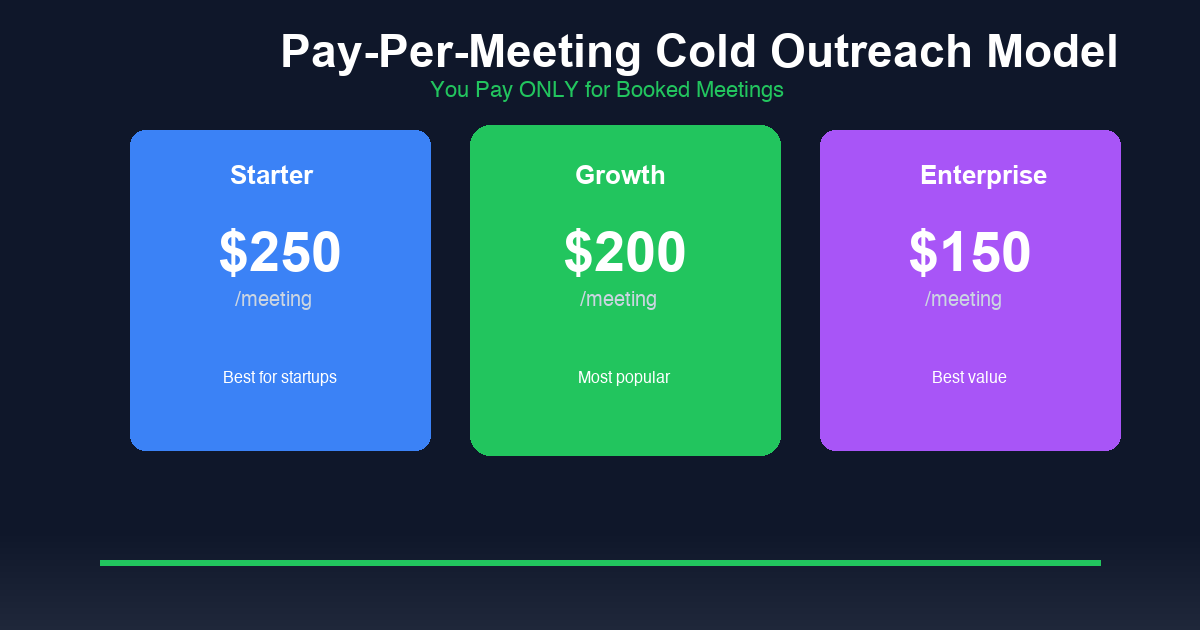
How much does pay per meeting cost?
Per meeting pricing varies based on targeting complexity, market segment, and volume commitments. Understanding the cost structure is essential before evaluating providers.
Understanding Pay Per Meeting Pricing
Arrangements typically specify a fixed fee per qualified meeting, clear definitions of “qualified,” volume commitments from either party, timeline expectations for delivery, and exclusivity provisions. The booking process should be transparent and predictable.
A qualified meeting usually means a 30-minute call with an economic buyer at a company matching your ideal customer profile. It excludes no-shows, unqualified contacts, and wrong-person connections.
The definition matters enormously,what counts as “qualified” determines whether you’re paying for real opportunities or just calendar slots.
What Affects Pay Per Meeting Rates
Several factors influence pricing: target seniority (C-suite prospects cost more than manager-level), industry specificity (niche technology sector targets command premiums), geographic targeting (enterprise regions cost more), deal size (higher ticket equals higher appointment value), and volume commitments (more appointments usually means lower per-unit cost).
Reputable providers establish clear qualification criteria upfront. They verify titles, confirm company size, and ensure targets have genuine buying authority or influence.
Vague qualification definitions are a warning sign. cold email quality depends on these criteria.
what’s pay per lead cold calling/outreach?
Pay per lead and per meeting are related but distinct performance-based models. Understanding the difference is key for choosing the right approach for your sales team.
Pay Per Lead Explained
Pay per lead means you pay for each contact who expresses interest, regardless of whether a meeting occurs. A lead might be a completed form, a replied message expressing interest, or a phone call where the contact agreed to learn more.
Pay per lead shifts more risk to the provider but also provides less conversion certainty. You pay for engagement, not outcomes.
Pay Per Meeting vs Pay Per Lead
Per meeting is more performance-based because you only pay when a confirmed appointment occurs. The provider must deliver a conversation, not just a response.
This alignment of incentives is why per meeting has become the preferred model for enterprise sales organizations seeking reliable lead generation.
The trade-off is that per meeting typically costs more per unit than pay per lead. But when that meeting is qualified and your closing rate is strong, the ROI math often favors the meeting-based model.
Is cold calling dead in 2026?
No. Phone prospecting isn’t dead in 2026.
But it has evolved significantly from the spray-and-pray approach that gave it a bad reputation.
The Evolution of Phone Prospecting
Traditional outbound calls involved dialing numbers from purchased lists, delivering scripted pitches, and accepting high rejection rates as the cost of doing business. This approach is dying.
B2B companies’ buyers have become sophisticated. They screen calls, research vendors before engaging, and expect relevant conversations.
Modern phone outreach is contact-centric. It involves research before the call, personalization based on specific context, value-focused messaging instead of pitch-first approaches, and multi-channel integration with cold email and LinkedIn for effective b2b lead generation.
When Phone Prospecting Still Works
Outbound calls work when combined with proper research and integrated into multi-channel campaigns. A phone call followed by an email reference, or a message followed by a LinkedIn touch and a call, generates response rates that single-channel cold campaigns can’t match.
The key is timing and relevance. A phone call with no context is an interruption.
A call that references specific challenges the prospect has publicly discussed is a conversation starter.
what’s the 30/30/50 rule for cold emails?
The 30/30/50 rule is a framework for structuring your outbound message to maximize response probability in your cold email campaigns. It divides your communication into three proportional segments that must be executed precisely.
Breaking Down the Framework
The first 30% of your message should focus on the prospect, not you. Reference their specific situation, challenge, or context.
This isn’t about you proving your value. it’s about demonstrating you understand their world.
The second 30% should provide social proof and credibility. What gives you the right to reach out?
What similar challenges have you solved? Keep this section brief.
Credibility without arrogance.
The final 50% is your value proposition and call to action. What specific outcome can you help them achieve?
what’s the low-friction next step?
Why This Structure Works
The 30/30/50 rule works because it inverts the typical cold email structure. Most cold campaigns lead with “I’m from XYZ company and we help companies like yours…” This is immediately forgettable.
The rule forces you to lead with the prospect‘s interests, not your pitch.
When providers structure communications around the 30/30/50 framework, reply rates typically improve 2-4x compared to self-focused messaging. This directly impacts their cost per appointment and your pipeline efficiency.
Your ability to book meetings depends on this execution quality.
What are the benefits of pay-per-meeting cold outreach?
Per meeting cold email lead generation offers specific advantages over traditional retainer models for your sales team. Understanding these benefits helps you evaluate whether the model fits your situation.
- Risk Elimination , You pay for results, not effort; providers only earn when you receive qualified meetings
- Predictable Pipeline Costs , You know exactly what each appointment costs, enabling precise pipeline management and ROI calculation
- Quality Focus , Providers are incentivized to focus on qualified meetings, not volume; a VP conversation differs categorically from a junior prospect
- Aligned Incentives , Your cold email provider succeeds only when you succeed; no perverse motivation to run volume over quality
- Forecasting Confidence , When you know your cost per appointment and closing rate, you can predict revenue with reasonable accuracy
- Best For B2B Companies , With $25,000+ average deal sizes and 20%+ close rates, each qualified meeting represents significant expected revenue
Risk Elimination
The primary benefit is risk elimination. You pay for results, not effort.
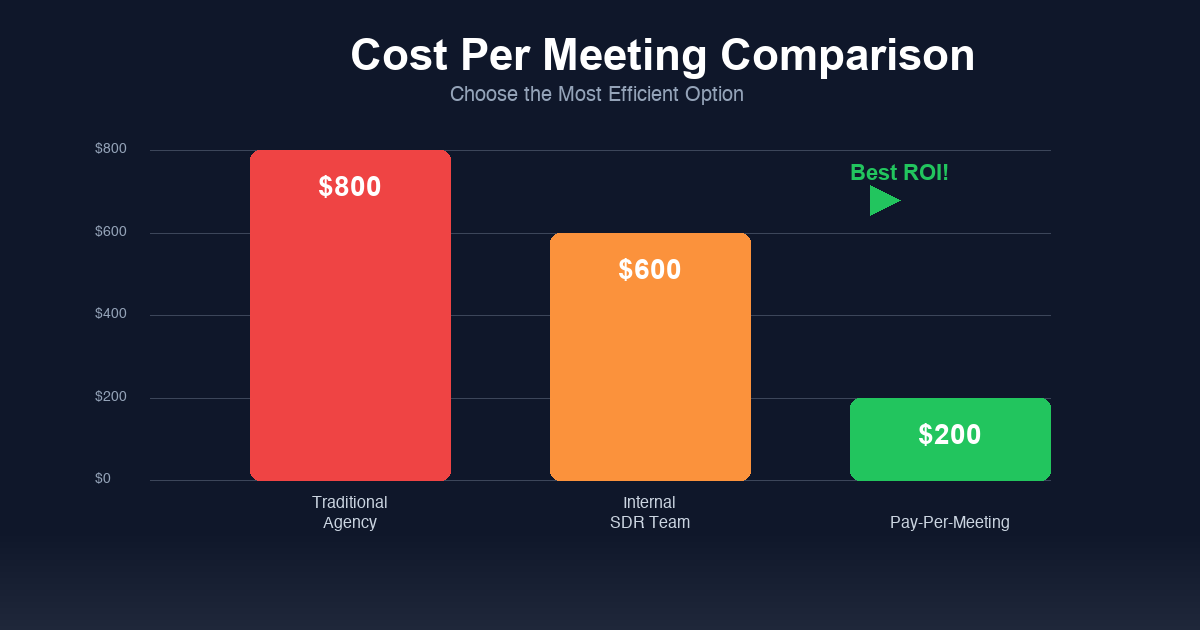
Traditional agencies charge monthly retainers regardless of outcomes. Providers only earn when you receive qualified meetings.
Some companies prefer to outsource entirely to avoid internal overhead.
This model aligns incentives perfectly. Your cold email provider succeeds only when you succeed.
there’s no perverse motivation to run volume over quality or to keep charging while delivering minimal value.
Predictable Pipeline Costs
Performance-based pricing creates predictable pipeline costs. You know exactly what each qualified meeting costs.
This enables precise pipeline management and ROI calculation.
For enterprise sales teams, this predictability is valuable for forecasting. When you know your cost per appointment and closing rate, you can predict revenue generation from campaigns with reasonable accuracy.
Quality Focus
Providers are incentivized to focus on
qualified meetings, not volume. A call with a VP at a Fortune 500 company is categorically different from a conversation with a “Director of O
perations” at a 10-person startup.
Quality providers understand this distinction and optimize for prospect quality, not just quantity.
How does pay-per-meeting cold outreach work?
Understanding the mechanics of per meeting lead generation helps you evaluate providers and set appropriate expectations for your sales team.
The Process Flow
Effective b2b lead generation follows a systematic process: target account identification using your ICP, prospect research and data verification, outbound message sequence development with hyper-personalization, multi-channel orchestration across cold email and LinkedIn, follow-up sequences to capture responses, appointment confirmation and calendar coordination, and handover to your closing team. An experienced team can execute this efficiently.
Quality providers manage the entire demand generation process from research to qualified meeting confirmation. Your team receives b2b leads ready for conversation.
This comprehensive pipeline generation approach eliminates gaps in your pipeline.
What Quality Providers Deliver
The best b2b lead generation providers start with rigorous demand generation using triple-verified data. Every prospect‘s email is validated through multiple verification services.
Title and company data get confirmed through multiple sources.
They build hyper-personalized cold email sequences using AI-driven research. Every communication references specific details about the prospect‘s company, role, recent activities, or publicly stated challenges.
Generic templates get deleted; specific, relevant messages get responses.
They manage email infrastructure obsessively. Domain warm-up, proper authentication (SPF, DKIM, DMARC), sender reputation monitoring, and inbox placement optimization happen continuously.
What should I look for in a pay-per-meeting cold outreach provider?
Not all per meeting providers are created equal. Due diligence is essential before committing your lead generation budget.
Essential Evaluation Criteria
Data quality practices are non-negotiable. Ask how they verify addresses, confirm titles, and validate company data.
Poor data quality destroys sender reputation and wastes your budget.
Personalization capabilities determine reply rates. Ask how they research prospects and what level of personalization they include in standard cold email campaigns.
“Hi [First Name]” isn’t personalization.
Qualification criteria must be clear and meaningful. Ask exactly what counts as a “qualified meeting.” Reputable providers define this precisely: title, company size, confirmation of attendance, and exclusion of wrong-person connections.
Red Flags to Avoid
Volume minimums are almost always required. No one runs campaigns at a loss.
Providers need volume commitments to make the economics work. However, be wary of providers who push volume over qualification.
Aggressive tactics indicate poor long-term thinking. Some providers pressure prospects to confirm appointments they don’t intend to attend.
This damages your brand and generates no real pipeline.
No testing period suggests overconfidence or inflexibility. Quality providers typically offer pilot programs or testing periods to validate approach before full commitment.
When does pay-per-meeting cold outreach make sense, and when doesn’t it?
Per meeting isn’t optimal for every situation. Understanding when it creates value,and when it doesn’t,is critical for effective lead generation.
- Clearly Defined ICP , When you’ve a precise ideal customer profile that the provider can target effectively
- Proven Closing Ability , When you’ve a proven ability to close deals once you get qualified meetings from your commercial process
- Variable Volume Capacity , When your commercial process can handle variable appointment volumes without capacity issues
- Sufficient Deal Value , When deal values are high enough that cost per appointment represents acceptable CAC
- Works Less Well When , Early product-market fit validation, unoptimized closing processes, or extremely niche target markets
- Quality Presumption , If your sales team can’t close 20%+ of qualified meetings, paying per meeting just shifts where losses occur
When Pay Per Meeting Works Best
This model works best when you’ve a clearly defined ideal customer profile, a proven ability to close deals once you get them, a commercial process that can handle variable appointment volumes, a genuine budget for customer acquisition, and enough deal value that the cost per appointment represents acceptable CAC.
For B2B companies with $25,000+ average deal sizes and 20%+ close rates, the ROI math is compelling. Each qualified meeting represents significant expected revenue from effective b2b lead generation.
When Pay Per Meeting doesn’t Work
Per meeting makes less sense when you’re in early product-market fit validation, your closing process isn’t optimized for converting appointments, you need creative services beyond cold email, your target market is extremely niche or small, or you’re running experimental campaigns without clear ROI models.
If your sales team can’t close 20%+ of qualified meetings, paying per meeting just shifts where losses occur. The model presumes your product, positioning, and commercial process are strong enough to convert.
What are the common mistakes to avoid with pay-per-meeting cold outreach?
Most failures trace to predictable mistakes in lead generation. Avoiding these protects your investment and improves results for your sales team.
Mistake One: Focusing on Quantity Over Quality
Some providers optimize for volume over quality. When you’re paying per meeting, aggressive providers may book every warm prospect they can find, regardless of true qualification.
This leads to calendar filled with conversations that waste your closing team’s time.
Ensure your contracts include meaningful qualification criteria. A qualified meeting with a CTO at a $50M company is categorically different from a call with an “IT Manager” at a 10-person startup.
Mistake Two: Ignoring Campaign Optimization Time
Providers need 4-8 weeks to optimize campaigns properly. Initial appointment quality often differs from long-term averages.
don’t judge the model by first-month results.
Campaign optimization takes time because of testing requirements, data refresh cycles, and sequence refinement. Quality providers optimize continuously.
Rushing this process guarantees suboptimal results.
Mistake Three: Inadequate Follow-Up
Reply rates to follow-ups drop 90% after 5 minutes of delay. If your sales team can’t respond to appointment confirmations within hours, you’re leaving conversion on the table.
Coordinate with your team before launching cold email campaigns. Ensure they understand qualification criteria, prospect context, and immediate follow-up protocols.
Which companies offer pay-per-meeting services?
The per meeting market includes providers ranging from solo operators to enterprise performance marketing agencies specializing in b2b lead generation. Understanding the landscape helps you evaluate options.
Provider Categories
Specialized cold email agencies focus exclusively on B2B appointment setting. they’ve deep expertise in email deliverability, personalization at scale, and multi-channel orchestration.
These providers typically offer the best pipeline generation results for B2B companies. The booking volume they generate can transform your lead generation pipeline.
Full-service marketing agencies offer per meeting as one service among many. They may lack the specialized expertise that dedicated providers offer but provide broader marketing capabilities.
AI-powered platforms combine software with managed services. They offer technology platforms that enable automation alongside performance-based pricing.
This hybrid model provides both technology use and execution expertise for b2b lead generation.
Evaluating Providers
When evaluating providers, request case studies from similar B2B companies. Ask about their targeting approach, personalization methodology, and email infrastructure practices.
Request references and follow up with those references specifically about qualified meeting quality and ROI achievement.
Do the math. If our AI infrastructure reaches out to 1,000 highly qualified, triple-verified executives a day, that’s 30,000 people a month. With our hyper-personalization, even an impossibly conservative 1% reply rate yields 300 qualified conversations. In high-ticket enterprise sales, what happens to your revenue when you’ve 300 conversations with your exact ICP?
Frequently Asked Questions
what’s the fastest way to use Pay-Per-Meeting Cold Outreach: How Performance-Based Models Work without burning the market?
Start with a tight ICP, verified data, and a small test batch. Scale only after replies, bounces, and meeting quality prove the message is working.
How many prospects should I contact for Pay-Per-Meeting Cold Outreach: How Performance-Based Models Work?
The number matters less than the fit. A smaller list of verified decision-makers will beat a large scraped list because inbox placement, relevance, and timing decide reply quality.
Why do most campaigns around Pay-Per-Meeting Cold Outreach: How Performance-Based Models Work fail?
Most campaigns fail because the data is weak, the offer is vague, and the follow-up system is inconsistent. Fix those three points before adding more volume.
Should I use email only for Pay-Per-Meeting Cold Outreach: How Performance-Based Models Work?
No. Email works better when it’s supported by LinkedIn touches, retargeting, and clean CRM follow-up. One channel creates reminders. Multiple channels create recognition.
When should I hire help for Pay-Per-Meeting Cold Outreach: How Performance-Based Models Work?
Hire help when you already know the customer profile, the offer is validated, and the bottleneck is execution speed. Outsourcing a broken offer only makes the failure happen faster.
The Pipeline Reality Check
Pay-Per-Meeting Cold Outreach looks simple from the outside. In practice, the money is made in the boring parts: list quality, timing, proof, follow-up, and clean measurement. If the list is weak, the message is vague, and the follow-up is random, even a smart idea turns into noise.
Your buyer does not reward clever wording. They reward relevance. Show them that you understand the pressure on their desk before you ask for time. The first job of outreach is to prove relevance before persuasion. Name the business problem, make the next step useful, and remove every sentence that sounds like a brochure.
Three Filters Before You Add Volume
- Data: Are the names, roles, domains, and company signals verified? Bad data turns good strategy into inbox waste.
- Relevance: Does the message connect to a problem the buyer already cares about? Education is expensive. Recognition is faster.
- Measurement: Can we tell whether silence came from targeting, copy, timing, or deliverability? If not, we cannot improve the campaign intelligently.
Most campaigns do not need a cleverer subject line first. They need cleaner segmentation, sharper proof, and a follow-up sequence that sounds like a person is paying attention.
The cleaner version is simple: start with 250 accounts, not a giant scraped list. Segment them by pain, write one message for one segment, and watch replies before scaling. If that first batch does not produce signal, more volume will not save the campaign. It will only make the failure louder.
Here is the practical takeaway: make Pay-Per-Meeting Cold Outreach narrower, cleaner, and easier to say yes to. Then scale what the market proves, not what the team hopes will work. Build the data layer first, then the message, then the follow-up system. In that order.
Book a strategy call
How to Judge Pay Per Meeting Cold Outreach Before You Scale
The practical test for pay per meeting cold outreach is not whether the idea sounds smart. The test is whether it creates qualified pipeline without damaging deliverability, sender reputation, or buyer trust. A strong system connects sdr , pay-per-appointment lead generation , lead generation companies , cold email outreach with clear targeting, clean data, and a message that feels written for the exact account.
If the campaign uses qualified leads , b2b sales , lead generation agency , sales cycle , email campaign , cold email outreach agency, the team needs a simple operating rule: do not add volume until replies prove the angle. That means watching inbox placement, open rates, reply quality, bounce behavior, and the number of sales meetings that come from real decision-makers.
The Execution Checklist
- Infrastructure: Check cold email agency, lead generation partner, b2b meetings, pay per appointment before scaling. If this layer is weak, more sending only creates louder failure.
- Targeting: Check b2b cold email, lead gen, charge per before scaling. If this layer is weak, more sending only creates louder failure.
- Message quality: Check pay for meetings, appointment setting services, sales meetings, ppa lead generation before scaling. If this layer is weak, more sending only creates louder failure.
- Follow-up: Check lead generation services, inside sales, lead generation efforts before scaling. If this layer is weak, more sending only creates louder failure.
- Measurement: Check per booked, pay for leads before scaling. If this layer is weak, more sending only creates louder failure.
The bottom line is simple: pay per meeting cold outreach should be treated like a revenue system, not a one-off campaign. When the list, email infrastructure, personalization, domain setup, and multichannel follow-up work together, the outreach has a real chance to turn cold attention into booked meetings.
Search Intent Coverage Section for Pay Per Meeting Cold Outreach
How Lead Generation Changes the Buying Decision
For pay per meeting cold outreach, buyers are usually comparing qualified appointments, b2b appointment-setting, b2b tech, sales development, b2b sales agency. The decision is not made from one email or one landing page. It is made from proof, clean positioning, inbox trust, and whether the outreach explains why the offer matters now.
The operational layer matters too: outreach system, b2b lead generation agency, lead lists. If these pieces are weak, the campaign may still create activity, but it will not create enough qualified sales conversations to justify scaling.
How B2B Changes the Buying Decision
For pay per meeting cold outreach, buyers are usually comparing per result, complex b2b, meetings per month, marketing and sales, outreach approach. The decision is not made from one email or one landing page. It is made from proof, clean positioning, inbox trust, and whether the outreach explains why the offer matters now.
The operational layer matters too: cost per lead, lead quality, held meeting. If these pieces are weak, the campaign may still create activity, but it will not create enough qualified sales conversations to justify scaling.
How Pay-per-appointment Lead Generation Changes the Buying Decision
For pay per meeting cold outreach, buyers are usually comparing outbound sales, many b2b, sales conversations, sales process, traditional lead generation. The decision is not made from one email or one landing page. It is made from proof, clean positioning, inbox trust, and whether the outreach explains why the offer matters now.
The operational layer matters too: custom lead generation, book qualified, sales and marketing. If these pieces are weak, the campaign may still create activity, but it will not create enough qualified sales conversations to justify scaling.
How Outreach Changes the Buying Decision
For pay per meeting cold outreach, buyers are usually comparing sales motion, sales reps, sales enablement, generation solutions, complex sales cycles. The decision is not made from one email or one landing page. It is made from proof, clean positioning, inbox trust, and whether the outreach explains why the offer matters now.
The operational layer matters too: sales calls, scheduled appointment, ai-driven outreach. If these pieces are weak, the campaign may still create activity, but it will not create enough qualified sales conversations to justify scaling.
How Booking Changes the Buying Decision
For pay per meeting cold outreach, buyers are usually comparing sales pipeline, us-based sales, lead generation, b2b, pay-per-appointment lead generation. The decision is not made from one email or one landing page. It is made from proof, clean positioning, inbox trust, and whether the outreach explains why the offer matters now.
The operational layer matters too: outreach, booking, pay-per-meeting. If these pieces are weak, the campaign may still create activity, but it will not create enough qualified sales conversations to justify scaling.
Questions Buyers Ask Before Choosing Pay Per Meeting Cold Outreach
How much does pay per meeting cost?
The short answer depends on list quality, deliverability, personalization, follow-up, and whether the campaign is aimed at the correct buyer. For pay per meeting cold outreach, the safest move is to validate with a controlled test before increasing volume.
What is the 30/30/50 rule for cold emails?
The short answer depends on list quality, deliverability, personalization, follow-up, and whether the campaign is aimed at the correct buyer. For pay per meeting cold outreach, the safest move is to validate with a controlled test before increasing volume.
What is pay per lead cold calling?
The short answer depends on list quality, deliverability, personalization, follow-up, and whether the campaign is aimed at the correct buyer. For pay per meeting cold outreach, the safest move is to validate with a controlled test before increasing volume.
Is cold calling dead in 2026?
The short answer depends on list quality, deliverability, personalization, follow-up, and whether the campaign is aimed at the correct buyer. For pay per meeting cold outreach, the safest move is to validate with a controlled test before increasing volume.
Pay-Per-Meeting Lead Generation: B2B Cold Email Outreach Guide
This section gives buyers a direct checklist for pay per meeting cold outreach. It connects the exact terms searchers use with practical execution, so the article answers the query instead of only explaining the concept.
- Lead Generation: Use this layer to judge whether pay per meeting cold outreach can produce qualified pipeline before adding volume.
- B2B: Use this layer to judge whether pay per meeting cold outreach can produce qualified pipeline before adding volume.
- Outreach: Use this layer to judge whether pay per meeting cold outreach can produce qualified pipeline before adding volume.
- Qualified Meeting: Use this layer to judge whether pay per meeting cold outreach can produce qualified pipeline before adding volume.
- Cold Email: Use this layer to judge whether pay per meeting cold outreach can produce qualified pipeline before adding volume.
- Pay Per: Use this layer to judge whether pay per meeting cold outreach can produce qualified pipeline before adding volume.
- B2B Lead Generation: Use this layer to judge whether pay per meeting cold outreach can produce qualified pipeline before adding volume.
- Outbound: Use this layer to judge whether pay per meeting cold outreach can produce qualified pipeline before adding volume.
- Prospect: Use this layer to judge whether pay per meeting cold outreach can produce qualified pipeline before adding volume.
- Per Meeting: Use this layer to judge whether pay per meeting cold outreach can produce qualified pipeline before adding volume.
- Booking: Use this layer to judge whether pay per meeting cold outreach can produce qualified pipeline before adding volume.
- Appointment Setting: Use this layer to judge whether pay per meeting cold outreach can produce qualified pipeline before adding volume.
- Email Outreach: Use this layer to judge whether pay per meeting cold outreach can produce qualified pipeline before adding volume.
- Icp: Use this layer to judge whether pay per meeting cold outreach can produce qualified pipeline before adding volume.
- Pay-Per-Meeting: Use this layer to judge whether pay per meeting cold outreach can produce qualified pipeline before adding volume.
- Qualification: Use this layer to judge whether pay per meeting cold outreach can produce qualified pipeline before adding volume.
- Book Meetings: Use this layer to judge whether pay per meeting cold outreach can produce qualified pipeline before adding volume.
- Pipeline: Use this layer to judge whether pay per meeting cold outreach can produce qualified pipeline before adding volume.
- Outsource: Use this layer to judge whether pay per meeting cold outreach can produce qualified pipeline before adding volume.
- Sales Team: Use this layer to judge whether pay per meeting cold outreach can produce qualified pipeline before adding volume.
- Linkedin: Use this layer to judge whether pay per meeting cold outreach can produce qualified pipeline before adding volume.
- Sdr: Use this layer to judge whether pay per meeting cold outreach can produce qualified pipeline before adding volume.
- Roi: Use this layer to judge whether pay per meeting cold outreach can produce qualified pipeline before adding volume.
The practical takeaway: pay per meeting cold outreach only works when the buyer profile, message, infrastructure, follow-up, and measurement system are aligned. If one layer is weak, the campaign may create activity without creating enough qualified meetings.
The Practical Operator Pass
If the message cannot show why this matters now, the campaign becomes background noise. The buyer is filtering for relevance, timing, credibility, and the cost of paying attention. For Pay Per Meeting Cold Outreach, that means the outreach has to connect the business problem, the buying moment, and the proof in a way that feels specific.
A committee issue needs different copy than a meeting pipeline issue. A threshold buyer cares about different proof than a urgency buyer. A campaign built around handoff, dashboard, and constraint has more context than a generic pitch. This is why shallow templates fail. They flatten different buyer situations into one bland message.
- Coverage: Review coverage against the buyer’s real context before increasing send volume.
- Warmup: Review warmup against the buyer’s real context before increasing send volume.
- Friction: Review friction against the buyer’s real context before increasing send volume.
- Procurement: Review procurement against the buyer’s real context before increasing send volume.
- Authority: Review authority against the buyer’s real context before increasing send volume.
- Benchmark: Review benchmark against the buyer’s real context before increasing send volume.
This is the part a generic article usually misses: judgment. A real operator can tell when latency is the problem, when throttling is the problem, and when the whole angle is too soft. That judgment comes from reading replies, checking account quality, and comparing message intent against actual buyer behavior.
The cleaner move is to run a small batch, inspect the signal, then rewrite the weak layer. Do not scale because the copy looks polished. Scale because the replies prove the market understands the value.