How to Qualify and Set More Sales Meetings with B2B Cold Outreach in 2025. Booking a meeting is brilliant. Booking the right meeting? That’s what turns cold outreach into revenue.
One thing I’ve learned working with B2B founders, service providers, and SaaS teams over the past few years is that cold outreach isn’t just about sending more messages; it’s about better filtering conversations.
You must get qualified buyers on the call who:
Have the problem you solve
Are either actively looking for a solution or at least open to it
Can afford and approve your solution
In this article, I’ll show you how we do the cold B2B outreach at Coldoutreach to better qualify and set more high-intent sales meetings. You’ll learn the frameworks, messaging styles, and systems that keep our clients consistently booked with prospects that convert.
Why Most Cold Outreach Meetings don’t Convert

Here’s the harsh truth: not all booked meetings are wins.
If you ever felt joyful about a prospect and then heard, “We’re not really the decision-maker,” or “We don’t have a budget right now,” then you know quantity doesn’t equal quality.
Here are some of the reasons most cold outreach efforts never actually work:
The targeting is too broad
The offer is too generic.
The messaging is too much from within oneself.
there’s no qualification baked into the conversation.
If the qualification isn’t done early, then the sales team (or you) will waste time with the wrong conversations.
Three layers of qualification.
Before you ever hit send on a cold email or LinkedIn message, there are 3 questions you should ask yourself:
1. Relevance: Does your prospect fit your Ideal Customer Profile?
Don’t just target “marketing managers” in general.
Target:
SaaS marketing managers,
With a team of 3 to 10,
Working in companies that use HubSpot,
And they’ve recently launched a new product.
The tighter your list is, the tighter you can make your message.
2. Urgency: Does he or she show signs of needing a solution right away?
Look for:
– Job openings in their teams;
– Funding announcements;
– Tech stack changes;
– Competitor activity;
Signals = intent. No signals? you’re just shooting in the dark.
3. Authority-Buy or influence buy decisions?
A-TMs won’t be required to forward your email to their managers. Always start at the top and refer downward if needed.
How We Qualify Before We Hit Send
At Coldoutreach agency, qualification is never done after someone replies; it begins right here:
– Lead sourcing
– Copywriting
– CTA design
Let’s break each down.
1. Lead Sourcing: Your Outreach Is Only As Good As Your List
Any successful B2B cold outreach campaign begins with a segmented list rich with signals.
Tools like Apollo, Clay, and LinkedIn Sales Navigator help us build lists with many filters:
– Role (e.g., Head of Ops, not just “Manager”)
– Company size (e.g., 50–200 employees)
– Tech stack (e.g., companies using Intercom + Stripe)
– Triggers (e.g., hiring for SDRs, recently funded)
We may also verify each domain manually when needed, especially when working on high-value campaigns.
When the list is straightforward, you don’t need tricks. Your audience feels more engaged.
2. Email Copy That’s Filtered for the Right Prospects
We get that most cold emails are written in a way that’s meant to get replies. We write them to get the right replies.
Here’s an example of an email we send that qualifies buyers right in the copy:
Subject: Scale onboarding, not headcount?
Email:
Hi [First Name],
I noticed you just [feature/team/hiring update]–congrats.
I work with mid-sized SaaS teams to reduce their onboarding workloads by automating the first 3 touchpoints. Typically, this is a good fit for teams that have:
50-200 employees
CS team of 3-10
Heavy implementation of tools like Intercom, HubSpot, etc.
Happy to share a quick overview if you’re looking at ways to keep CS with a lean overhead and an engaged user?
– [Your Name]
This type of message does 3 things:
Self-qualifies readers (they’ll check out if it’s not for them)
Frames who it’s for without being pushy
Starts a conversation instead of pitching
3. CTA That Filters, Not Forces
Instead of forcing a 30-minute call, we only like soft CTAs like:
“Want a 2-minute breakdown?”
“Open to seeing what this looks like?”
“Should I send over a short Loom?”
These low-friction CTAs
1. invite curiosity,
2. don’t feel “salesy,” and
3. Give you room to qualify further after they opt in.
Sure, or send it over, start a conversation, and give you a deeper qualifying question to ask.
What Happens After They Reply to the First CTA (This is Where Qualification Happens)
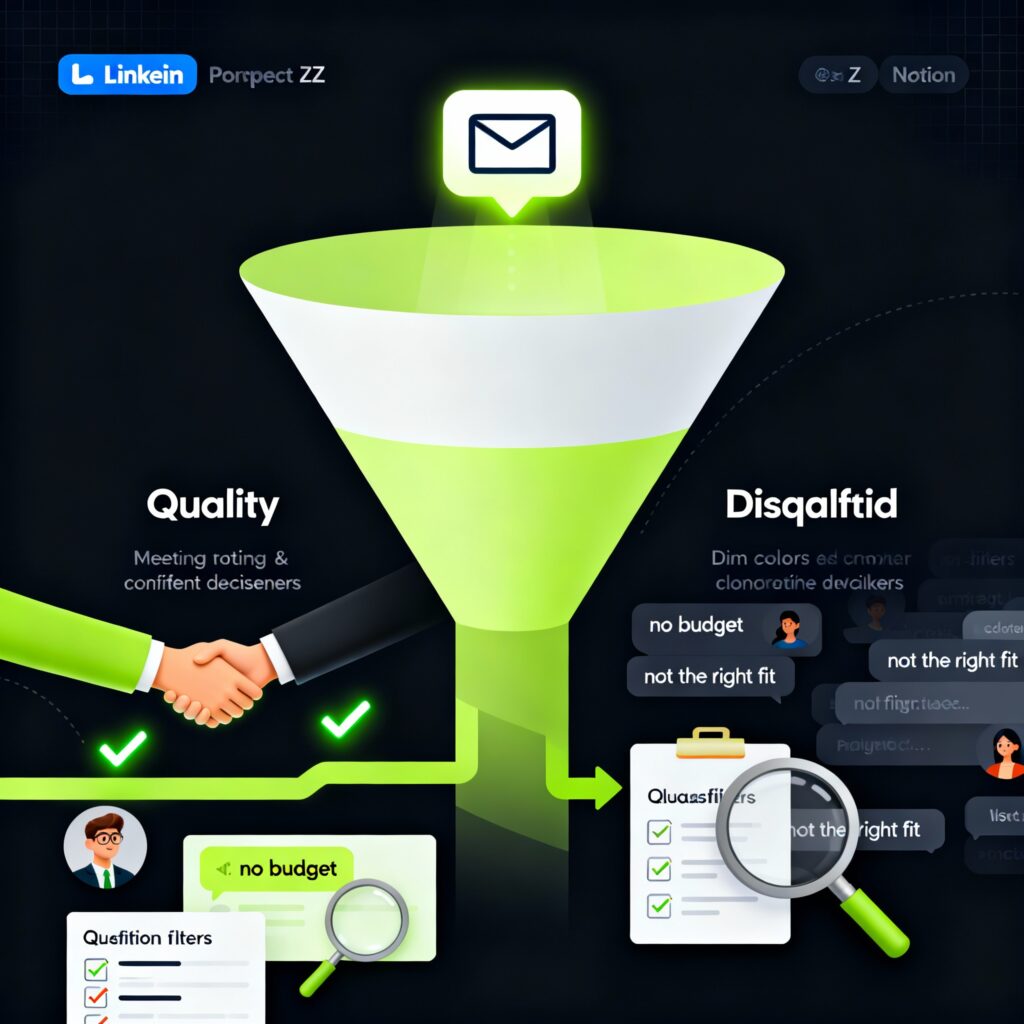
You’ve got their attention. Now what?
Most people jump right to “Here’s my calendar.” A massive opportunity skipped over -using the reply thread to qualify.
Here’s how we do it in 3 replies:
Reply 1 – Confirm Interest & Ask a Filter Question
“Thanks for the interest! Before I send over the breakdown, quick question – are you currently doing onboarding with a manual team or have you put some automation in place?”
This tells you:
Where they’re at, currently
How imploring their issue could be
Reply 2 – Provide Value + CTA to Call
Once they answer, provide a reply with lots of value:
“Thanks! Given that, I suggest starting with [X strategy]. We had some success with [similar company] in a similar situation.
Want to talk through it in a quick 15-minute call next week? Here’s my link – or I’d be happy to schedule through yours.”
Now the meeting invite feels more like earned rather than forced.
Reply 3 – Confirm Buyer’s Role
If you’re not sure they’re the decision-maker, ask something casual like:
“Just curious – are you spearheading this initiative, or would it make sense to include someone else on your end, too?”
there’s absolutely no pressure. But now you know who must be in the room.
Bonus: Use LinkedIn to Layer Qualification
If you’re doing multi-channel outreach, LinkedIn is an absolute gold mine for qualifying leads.
You can:
See mutual connections
See their recent activity (are they talking about the problem?)
Confirm their role and authority.
Sometimes we even use LinkedIn touchpoints first – a profile view or comment – before the email, to warm it up, as it allows the cold email to land warmer.
AI-based enrichment: Use Clay to pull tech stack, hiring data, or funding signals.
Personalized prompts: Use AI to draft intros which you manually edit.
Tiered campaigns: Spend more time on Tier 1 prospects (because they’ll be larger deal size) and automate Tier 2.
Every campaign that comes out of our cold outreach agency is based on the idea that quality scales better than quantity.
Final Thoughts: Qualify Early, Sell Less, Close More
When doing B2B outreach, your #1 asset isn’t your cold email; it’s your qualification strategy.
Instead of:
Sending 1,000 emails to anyone, praying that 5 people will book calls…
You could:
Send 300 messages to qualified ICPs
Get 20 high-intent replies
Book 8–10 meetings that convert
That’s the difference between being busy and being booked with the right people.
If you want to have assistance with crafting messaging that qualifies as it connects or building a lead engine that’s pre-qualified and converts, we’d love to show you how we do it.
FAQ: Qualifying Sales Leads from cold outreach
1. what’s the best way to pre-qualify customers before outreach?
Use tools like Apollo or Clay and filter by size of company, role, tech stack, and buying signals (like funding, hiring, or tech signals). At Coldoutreach agency, we’ve built filters with multiple criteria that ensure you’re only messaging prospects with a high probability of being good leads.
2. How do I tell if a lead is a decision maker?
Look for titles that include “Head of,” “VP,” “Director,” or “Founder.” If you’re still uncertain, you can casually ask in your email thread: “Are you the one leading this, or would someone else need to be looped in?”
3. How many qualification questions should I ask before a call?
Just asking 1 or 2 questions in the email thread is all that’s necessary. You can ask more once they’ve confirmed the call. The goal is simply to confirm fit and not ask so many questions that they feel overwhelmed.
4. What if I book a meeting and then realize they’re not a fit?
Not a big deal. Use the first few minutes of the call to clarify. If there’s no fit, kindly end the call early. This saves you time and keeps your pipeline clean.
5. Should I use a qualification framework like BANT or CHAMP?
BANT and CHAMP can be useful when on the call, but for cold outreach, less is more. I recommend simply asking yourself if the lead can be determined based on:
Relevance (Do they match your ICP?)
Need (Are they signalling the issue your product solves?)
Authority (Can they say yes or loop someone in?)
Frequently Asked Questions
what’s the fastest way to use How to Qualify and Set More Sales Meetings with B2B Cold Outreach in 2025 without burning the market?
How many prospects should I contact for How to Qualify and Set More Sales Meetings with B2B Cold Outreach in 2025?
Why do most campaigns around How to Qualify and Set More Sales Meetings with B2B Cold Outreach in 2025 fail?
Should I use email only for How to Qualify and Set More Sales Meetings with B2B Cold Outreach in 2025?
When should I hire help for How to Qualify and Set More Sales Meetings with B2B Cold Outreach in 2025?
Research worth checking
Pew Research internet behavior data
What This Looks Like in a Real Pipeline
The weak version of How to Qualify and Set More Sales Meetings with B2B Cold Outreach in is easy to spot. It talks to everyone, says nothing specific, and asks for a meeting before earning attention. That is why I care less about volume at the start and more about whether the first replies prove the angle is real.
The person reading your message is busy, skeptical, and already filtering out vendors who sound interchangeable. In this market, vague copy dies fast. The first job of outreach is to prove relevance before persuasion. Name the business problem, make the next step useful, and remove every sentence that sounds like a brochure.
The Checks I Would Run Before Scaling
- ICP match: The buyer should match your best customer profile, not just a broad industry label.
- Trigger strength: A hiring move, new location, funding event, tech change, compliance push, or public initiative makes outreach feel timely.
- Follow-up logic: Every follow-up should add a new reason to respond. Repeating the first message is not follow-up. It is noise.
This is not complicated, but it is unforgiving. A sloppy list makes copy look bad. Weak positioning makes good data useless. And a CTA that asks for a meeting too early forces the buyer to do all the mental work.
The cleaner version is simple: start with 300 accounts, not a giant scraped list. Segment them by pain, write one message for one segment, and watch replies before scaling. If that first batch does not produce signal, more volume will not save the campaign. It will only make the failure louder.
Here is the practical takeaway: make How to Qualify and Set More Sales Meetings with B2B Cold Outreach in narrower, cleaner, and easier to say yes to. Then scale what the market proves, not what the team hopes will work. Build the data layer first, then the message, then the follow-up system. In that order.
How to Make This Feel Built, Not Generated
The strongest campaigns feel researched because the language names a specific condition in the buyer’s world. The buyer is filtering for relevance, timing, credibility, and the cost of paying attention. For How to Qualify and Set More Sales Meetings with B2B Cold Outreach in 2025, that means the outreach has to connect the business problem, the buying moment, and the proof in a way that feels specific.
A trigger issue needs different copy than a champion issue. A blocker bottleneck should not be handled with the same CTA as a budget bottleneck. A founder buyer cares about different proof than a signal buyer. This is why shallow templates fail. They flatten different buyer situations into one bland message.
- Latency: Review latency against the buyer’s real context before increasing send volume.
- Qualify: Review qualify against the buyer’s real context before increasing send volume.
- Pipeline: Review pipeline against the buyer’s real context before increasing send volume.
- Administrator: Review administrator against the buyer’s real context before increasing send volume.
- Routing: Review routing against the buyer’s real context before increasing send volume.
- Throttling: Review throttling against the buyer’s real context before increasing send volume.
This is the part a generic article usually misses: judgment. A real operator can tell when threshold is the problem, when meetings is the problem, and when the whole angle is too soft. That judgment comes from reading replies, checking account quality, and comparing message intent against actual buyer behavior.
The cleaner move is to run a small batch, inspect the signal, then rewrite the weak layer. Do not scale because the copy looks polished. Scale because the replies prove the market understands the value.