Cold Email Agency Cost: Complete 2026 Guide for B2B Growth
Chetan Agarwal
Contents
How Much Does a Cold Email Agency Cost? Pricing Guide 2026
If you’re asking “how much does an email outreach agency cost,” you’re probably weighing whether outsourcing your outbound efforts makes financial sense. Good question.
But here’s what most business owners discover too late: the price of a quality cold outreach service is always less than the cost of doing outbound prospecting badly. Bad data destroys your sender reputation.
Poor infrastructure sends your emails to spam. Generic templates generate zero replies.
When you factor in the damage done by cheap alternatives, premium agencies are actually the cheaper option.
here’s how investment levels actually work in the outbound agency industry, and how to evaluate whether any given price represents real value for your business.
How much does an email outreach agency cost?
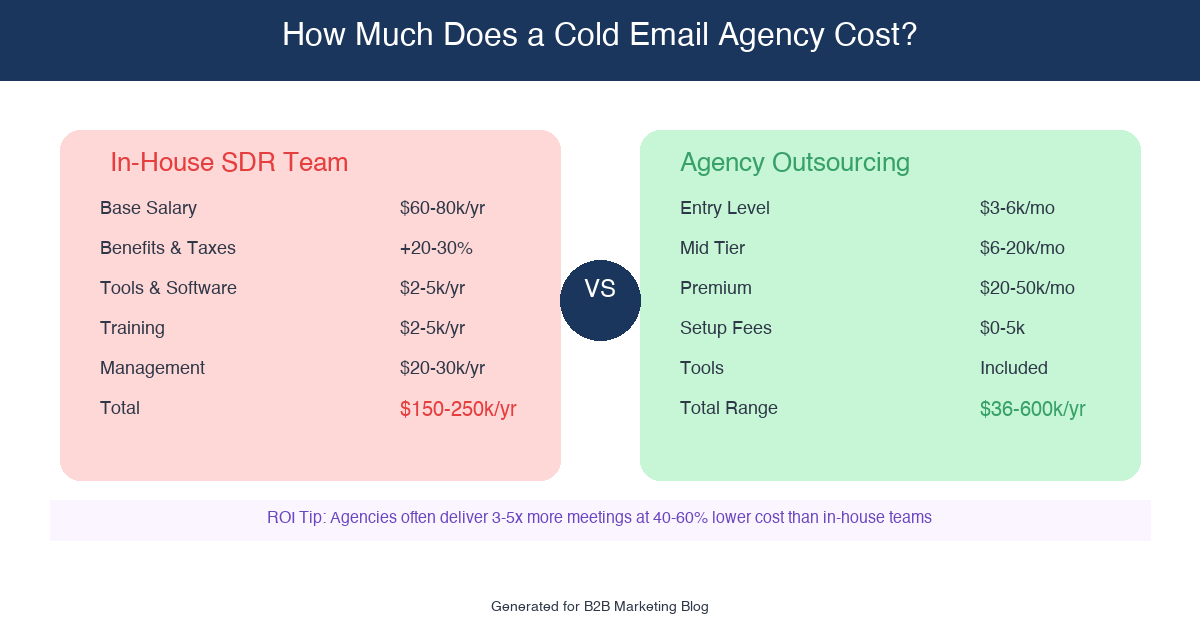
Cold Email Agency Cost vs In-House SDR
Outbound agency fees range from $500 monthly for basic services up to $15,000+ monthly for premium full-service operations. The wide range exists because quality varies enormously.
here’s what you get at each tier.
Entry-level services at $500-1,500 monthly typically deliver basic automation, lower-quality purchased lead lists, and generic templates. These agencies churn volume,sending thousands of outbound messages with low personalization and minimal optimization.
You might get 1,000-2,000 emails per week with basic targeting. The results reflect the investment: high bounce rates, poor deliverability, and low reply rates.
You often get what you pay for.
Mid-tier agencies charging $2,000-5,000 monthly typically provide better data quality, some personalized email content, and multi-channel capabilities. This is where most B2B businesses find decent ROI if they vet carefully.
Expect triple-verified prospect data, A/B testing on subject lines, and basic optimization cycles.
Premium services at $5,000-15,000 monthly deliver enterprise-grade outbound infrastructure, AI-powered personalization, dedicated account management, and sophisticated outbound strategies. The typical messages per month at this tier exceeds 20,000 with sophisticated targeting.
These agencies treat your sender reputation like their own and optimize continuously for qualified leads and sales meetings.
What pricing models do outbound agencies use?
Cold outreach providers structure their fee structures in several ways.
Understanding these models helps you evaluate proposals and align incentives.
Monthly Retainer , Fixed monthly fee for ongoing outreach services, ideal for companies wanting consistent lead generation
Per-Campaign Pricing , Charges per campaign, suitable for one-off product launches but often results in higher long-term costs
Performance-Based Models , Pay-per-meeting or results-based fees where you pay per qualified opportunity delivered
Hourly Consulting , Setup and strategy charged hourly, then ongoing fees for execution, providing transparency but potential scope creep
Monthly Retainer
The most common model. You pay a fixed monthly retainer for ongoing outreach services.
This works well for companies that want consistent lead generation over time. Predictable investment makes budgeting easier, and the agency has incentive to optimize long-term rather than chase short-term metrics.
Most quality agencies prefer this model because it allows proper warm-up periods and sustained optimization.
Per-Campaign Pricing
Some agencies charge per campaign, which can work for one-off product launches or market testing. However, this model often results in higher long-term fees because agencies have no incentive to optimize after the initial send.
You pay for setup repeatedly instead of benefiting from accumulated learning.
Performance-Based Models
A growing number of agencies offer pay-per-meeting or performance-basedrates, where you pay based on results delivered. In this model, the agency delivers qualified opportunities and you pay per meeting booked.
This sounds attractive but can create misaligned incentives. Agencies may focus on easy-to-book unqualified meetings rather than qualified leads that actually convert.
Quality agencies structure performance tiers that align with your definition of success.
Hourly Consulting
Some agencies charge hourly for setup and strategy, then ongoing fees for execution. This model provides transparency but can lead to scope creep and unclear deliverables.
Understand exactly what you get for the hourly rate before committing.
What factors influence outbound agency rates?
Several factors determine what you’ll pay for cold outreach services. Understanding these helps you evaluate whether a quoted investment makes sense.
Scope of Services , From basic email sending to full-service outreach including research, copywriting, and lead qualification
Data Quality Investment , Triple-verified lead data costs more but protects your sender reputation and email deliverability
Infrastructure Requirements , Custom outbound domains, warm-up protocols, and authentication add to costs but protect your primary domain
AI and Automation Level , AI-powered personalization at scale has higher upfront costs but delivers dramatically better results
Campaign Complexity , Single-sequence campaigns cost less than sophisticated multi-channel orchestration across email, LinkedIn, SMS, and phone
Scope of Services
Are you paying for just email sending, or full-service outreach including research, copywriting, multi-channel follow-ups, and lead qualification? Full-service agencies handling the entire lead generation process cost more but deliver more value.
Basic sending services cost less but require internal resources to complete the workflow.
Data Quality Investment
Agencies that invest in triple-verified lead data charge more than those using purchased lists with 40% bounce rates. This isn’t optional if you care about email deliverability.
Data quality directly impacts reply rates, sender reputation, and ultimately ROI. The cost of bad data,including domain damage and wasted sales time,far exceeds the premium for quality verification.
Infrastructure Requirements
Premium agencies build custom outbound domains, warm-up inboxes gradually, and configure authentication records. This infrastructure investment adds to costs but protects your primary domain.
If an agency quotes low investment levels but plans to use your main company email for mass outreach, the hidden costs will devastate your business.
AI and Automation Level
Agencies using proprietary AI infrastructure for personalization at scale have higher upfront costs but deliver better results. AI-powered research finds personalization triggers for thousands of prospects that humans could never identify manually.
The efficiency of outbound prospecting with AI assistance dramatically outperforms manual approaches.
Campaign Complexity
Simple single-sequence campaigns cost less than sophisticated multi-channel orchestration across email, LinkedIn, SMS, and cold calling. Quality email campaigns can include 5-7 touchpoints across multiple channels.
More touchpoints, more channels, more personalization,all increase investment levels but also improve response rates and meeting volume.
What’s included in outbound agency packages or fees?
When evaluating outbound agencyfees, make sure you understand exactly what’s included. here’s what quality packages typically cover.
Prospect Research and List Building
Premium agencies research your ideal customer profile, build targeted lead lists, and verify every email address before outreach begins. This includes company research, decision-maker identification, and multi-step verification to target under 2% bounce rates.
This foundation determines everything else about campaign performance.
Email Infrastructure Setup
The best agencies handle outbound domain setup, warm-up protocols over 4-8 weeks, and SPF/DKIM/DMARC authentication configuration. They rotate sending domains to protect sender reputation and manage volume to maintain healthy inbox placement.
Without this infrastructure, your outbound messages land in spam regardless of content quality.
Copywriting and Personalization
Quality agencies write personalized outbound emails for every campaign,not generic templates that look automated. This includes AI-powered research to surface company news and trigger events, human copywriter refinement to ensure natural language, and A/B testing on subject lines and email copy.
Every message should feel individually crafted to the prospect.
Multi-Channel Follow-Up Sequences
Top agencies combine outbound email with LinkedIn outreach, cold calling, and SMS follow-ups for maximum reach. Different decision-makers prefer different channels,some live in their inbox, others are active on LinkedIn, and some still prefer phone calls.
You should receive detailed dashboards showing delivery rates, open rates, reply rates, meeting bookings, and revenue attributed to outreach. Real-time visibility into campaign performance allows continuous optimization.
If an agency can’t show you these metrics, they probably have poor results to show.
Are there hidden fees when hiring an outbound agency?
When evaluating outbound agency fees, watch for these potential hidden fees that eat into your budget and ROI.
Setup Fees
Some agencies charge $500-3,000 setup fees that aren’t disclosed upfront. Quality agencies include setup in their monthly fees or charge nominal fees clearly explained in the proposal.
Vague disclosures about “one-time setup” costs are red flags.
Infrastructure Add-Ons
Charges for additional email domains, outbound domains, or sending volumes beyond the base package can inflate fees significantly. Understand exactly what infrastructure is included versus what requires additional payment.
Volume Caps and Overage Charges
Some agencies cap monthly email volumes and charge premium rates for additional sends. If you want to scale outreach, these caps become expensive overage charges.
Understand volume limits before signing.
Upsells for “Premium” Features
Be wary of agencies that advertise basic rates but upsell “premium” personalization, additional channels, or advanced analytics. These should be included in quality full-service packages.
Ask specifically how many emails per week are included and what volume caps exist.
Exit Fees and Contract Lock-I
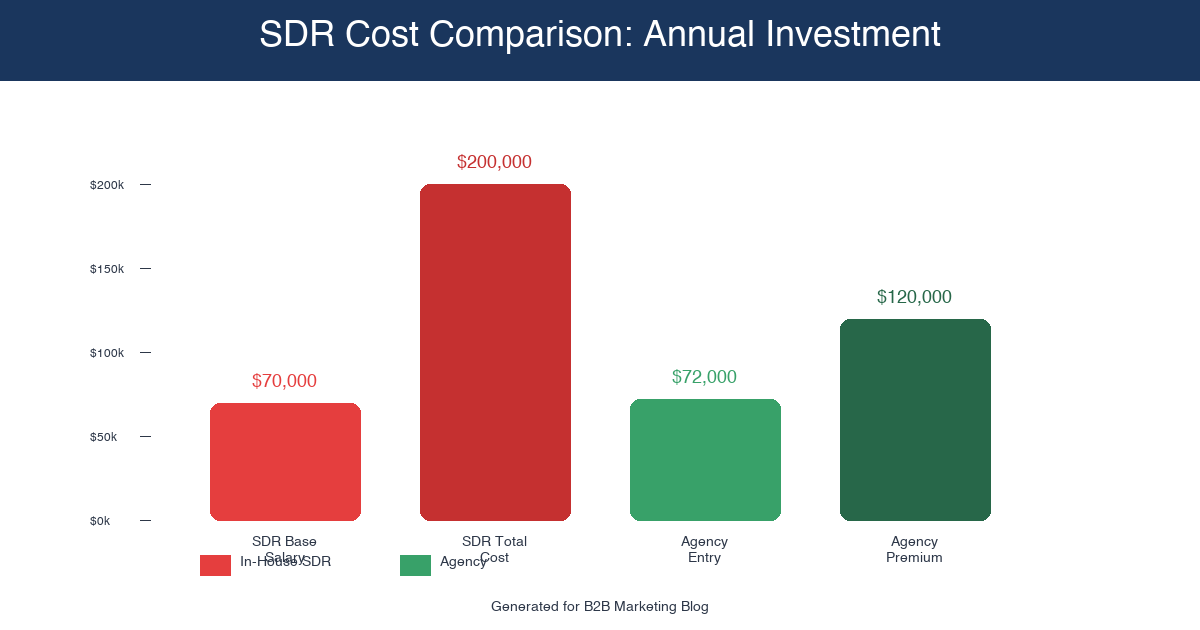
SDR vs Agency Cost Comparison
ns
Some contracts lock you in for 6-12 months with significant exit fees if you want to cancel early. While some commitment is reasonable for quality agencies, punitive exit clauses trap you with poor performers.
How do you evaluate outbound agency rates and proposals?
don’t just compare fee tags. Evaluate total value and true cost per result.
Calculate Cost Per Qualified Meeting
If an agency charges $3,000 monthly and books you 6 qualified meetings, that’s $500 per meeting. Compare that to your customer acquisition cost from other channels.
If your average deal is $20,000 and you close 20% of qualified meetings, each meeting is worth $4,000 in expected revenue. A $500 cost per meeting delivers 8x ROI.
Evaluate the Full Funnel
Focus on meetings booked and revenue generated, not just messages sent. An agency sending 50,000 outbound emails with 1% reply rate generates fewer results than one sending 5,000 highly targeted messages with 15% reply rate.
Volume without quality is vanity.
Consider Infrastructure Quality
Agencies that invest in proper email infrastructure protect your sender reputation long-term. Cheap agencies using purchased lists and your primary domain can destroy your ability to email prospects ever again.
The cost of reputation damage far exceeds any investment premium.
Assess Optimization Commitment
Premium agencies continuously optimize campaigns based on results,A/B testing subject lines, refining email copy, adjusting targeting, and improving reply rates over time. This ongoing optimization improves ROI month over month.
Agencies that set up campaigns and let them run without optimization deliver diminishing returns.
What services do outbound agencies provide?
Beyond basic email sending, quality outbound providers provide comprehensive lead generation services.
Full-Funnel Lead Generation
Top agencies handle the entire process from prospect identification to sales meeting booking. This includes lead list building, email personalization, multi-channel outreach, lead qualification, and calendar scheduling.
They function as an outsourced sales development department.
Strategic Consulting
Premium agencies act as strategic partners, helping define ideal customer profiles, developing outbound strategy, and advising on outbound positioning. They bring experience from hundreds of campaigns across industries.
Technology Integration
Quality agencies integrate with your sales team‘s tools,CRM systems, calendar scheduling, and lead qualification workflows. This ensures seamless handoffs and accurate tracking of pipeline generated by outreach.
What are the pros and cons of using an outbound agency vs. doing it in-house or DIY?
let’s compare the real costs and benefits of agency versus in-houseoutbound prospecting.
Agency Advantages
No recruiting costs or hiring delays. Immediate access to experienced teams, proven processes, and enterprise-grade infrastructure.
No training time or productivity loss. Scalable lead generation without scaling headcount.
Cost is predictable and often 1/3 to 1/2 of equivalent in-housesales development teams.
Agency Disadvantages
Less direct control over day-to-day messaging and process. Requires trust in the agency’s expertise.
Potential misalignment if the agency doesn’t understand your product or market deeply. Some learning curve as they absorb your ideal customer profile and positioning.
In-House Advantages
Complete control over messaging, process, and sales team integration. Deep product knowledge from day one.
Alignment with company culture and immediate feedback loops. Better for very specialized products or complex sales cycles requiring nuanced messaging.
In-House Disadvantages
High fixed costs: $60,000-80,000 annually per SDR plus benefits, recruiting fees ($5,000-15,000), training time (3-6 months), software tools ($2,000-5,000 annually), and management overhead. Total true cost: $80,000-120,000 per SDR annually.
High turnover in sales development roles means constant rehiring and retraining cycles.
How long does it take for an outbound agency to deliver results?
Typical timeline for outbound agency results:
Initial Phase (Weeks 1-4)
Campaign setup, email infrastructure building, warm-up protocols beginning, first lead lists verified and loaded. you’ll see early delivery data but limited engagement.
This is normal,the foundation is being built.
Learning Phase (Weeks 5-8)
First meaningful data on reply rates and engagement. Agency optimizes based on initial results,refining subject lines, testing email copy, adjusting send times.
You should start seeing some qualified leads emerge.
Optimization Phase (Weeks 9-12)
Continuous improvement based on data. Reply rates typically improve as messaging refines.
Lead qualification processes sharpen. You should be booking regular sales meetings by now.
Campaign is generating predictable pipeline.
Scale Phase (Month 4+)
Once a campaign proves profitable, scale volume while maintaining quality. Add more sending domains, expand targeting, and potentially add additional channels like LinkedIn.
ROI compounds as the system optimizes.
How does outbound agency investment compare to email marketing agency pricing?
Outbound agencies and email marketing agencies serve different purposes despite both involving email.
Different Audiences
Email marketing goes to people who opted in,existing subscribers, customers, leads who gave permission. Cold outreach goes to prospects who never heard of you.
This fundamental difference changes investment models, compliance requirements, and expected reply rates.
Different Pricing Structures
Email marketing agencies typically charge based on list size or monthly sends. Outbound agencies charge based on campaign scope, prospect volume, and service depth.
The investment reflects the research, personalization, and infrastructure required to reach cold audiences.
Different Value Propositions
Email marketing nurtures existing relationships. Cold outreach creates new ones.
For enterprise focused on growth, cold outreach generates net-new qualified leads while email marketing nurtures existing pipeline. Both have roles in a comprehensive strategy, but outbound agencyinvestment reflects the harder work of reaching cold prospects.
The real cost of any outbound agency is measured by qualified leads generated and sales meetings booked,not by monthly fees. Evaluate investment levels against expected ROI, and remember that the cheapest option is rarely the most cost-effective when you factor in data quality, sender reputation, and actual results.
Do the math. If our AI infrastructure reaches out to 1,000 highly qualified, triple-verified decision-makers a day, that’s 30,000 people a month. With our hyper-personalization, even an impossibly conservative 1% reply rate yields 300 qualified conversations. In high-ticket business-to-business, what happens to your revenue when you’ve 300 conversations with your exact ICP?
what’s the fastest way to use How Much Does a Cold Email Agency Cost? Pricing Guide 2026 without burning the market?
Start with a tight ICP, verified data, and a small test batch. Scale only after replies, bounces, and meeting quality prove the message is working.
How many prospects should I contact for How Much Does a Cold Email Agency Cost? Pricing Guide 2026?
The number matters less than the fit. A smaller list of verified decision-makers will beat a large scraped list because inbox placement, relevance, and timing decide reply quality.
Why do most campaigns around How Much Does a Cold Email Agency Cost? Pricing Guide 2026 fail?
Most campaigns fail because the data is weak, the offer is vague, and the follow-up system is inconsistent. Fix those three points before adding more volume.
Should I use email only for How Much Does a Cold Email Agency Cost? Pricing Guide 2026?
No. Email works better when it’s supported by LinkedIn touches, retargeting, and clean CRM follow-up. One channel creates reminders. Multiple channels create recognition.
When should I hire help for How Much Does a Cold Email Agency Cost? Pricing Guide 2026?
Hire help when you already know the customer profile, the offer is validated, and the bottleneck is execution speed. Outsourcing a broken offer only makes the failure happen faster.
Here is the part most teams miss with How Much Does a Cold Email Agency Cost? Pricing: the tactic is not the asset. The system around the tactic is the asset. If the list is weak, the message is vague, and the follow-up is random, even a smart idea turns into noise.
The person reading your message is busy, skeptical, and already filtering out vendors who sound interchangeable. In this market, vague copy dies fast. That means the message has to earn attention fast: clear pain, clean proof, and a next step that does not feel like a trap.
The Small-Batch Validation Rule
Data: Are the names, roles, domains, and company signals verified? Bad data turns good strategy into inbox waste.
Relevance: Does the message connect to a problem the buyer already cares about? Education is expensive. Recognition is faster.
Measurement: Can we tell whether silence came from targeting, copy, timing, or deliverability? If not, we cannot improve the campaign intelligently.
Do not hide behind volume. Volume is a multiplier. It multiplies good strategy, and it multiplies bad strategy even faster.
The cleaner version is simple: start with 250 accounts, not a giant scraped list. Segment them by pain, write one message for one segment, and watch replies before scaling. If that first batch does not produce signal, more volume will not save the campaign. It will only make the failure louder.
The hard truth: How Much Does a Cold Email Agency Cost? Pricing is not magic. It is a disciplined system for reaching the right buyer with the right proof at the right time. Build the data layer first, then the message, then the follow-up system. In that order.
How to Judge Cold Email Agency Cost Before You Scale
The practical test for cold email agency cost is not whether the idea sounds smart. The test is whether it creates qualified pipeline without damaging deliverability, sender reputation, or buyer trust. A strong system connects emails per month , pricing structure , cold email agency pricing , per email with clear targeting, clean data, and a message that feels written for the exact account.
If the campaign uses cost to outsource cold email , agency pricing – the ultimate , agency services , agency prices , total cost , email addresses, the team needs a simple operating rule: do not add volume until replies prove the angle. That means watching inbox placement, open rates, reply quality, bounce behavior, and the number of sales meetings that come from real decision-makers.
The Execution Checklist
Infrastructure: Check email marketing services, per account, agency in 2025, email marketing agency cost before scaling. If this layer is weak, more sending only creates louder failure.
Targeting: Check cold email agencies charge, agency pricing models, email marketing budget before scaling. If this layer is weak, more sending only creates louder failure.
Message quality: Check cold email campaigns, email accounts, hire a cold email agency, per inbox before scaling. If this layer is weak, more sending only creates louder failure.
Follow-up: Check evaluate cold email agency pricing, email marketing costs, cold email agency in 2025 before scaling. If this layer is weak, more sending only creates louder failure.
Measurement: Check per user, cold email services before scaling. If this layer is weak, more sending only creates louder failure.
The bottom line is simple: cold email agency cost should be treated like a revenue system, not a one-off campaign. When the list, email infrastructure, personalization, domain setup, and multichannel follow-up work together, the outreach has a real chance to turn cold attention into booked meetings.
Search Intent Coverage Section for Cold Email Agency Cost
How Agency Cost Changes the Buying Decision
For cold email agency cost, buyers are usually comparing included in cold email agency, hire an email marketing agency, much does it cost, cost to hire an email, average cost. The decision is not made from one email or one landing page. It is made from proof, clean positioning, inbox trust, and whether the outreach explains why the offer matters now.
The operational layer matters too: cold email agency services, email marketing agency services, pricing – the ultimate guide. If these pieces are weak, the campaign may still create activity, but it will not create enough qualified sales conversations to justify scaling.
How Pricing Models Changes the Buying Decision
For cold email agency cost, buyers are usually comparing performance-based pricing, email verification, cost and roi, email list, hire an agency. The decision is not made from one email or one landing page. It is made from proof, clean positioning, inbox trust, and whether the outreach explains why the offer matters now.
The operational layer matters too: transparent pricing, agency pricing ranges, email marketing strategy. If these pieces are weak, the campaign may still create activity, but it will not create enough qualified sales conversations to justify scaling.
How Cold Email Changes the Buying Decision
For cold email agency cost, buyers are usually comparing right email marketing agency, per booked meeting, per contact, campaign cost, agency expertise. The decision is not made from one email or one landing page. It is made from proof, clean positioning, inbox trust, and whether the outreach explains why the offer matters now.
The operational layer matters too: average deal size, right agency, choosing the right email marketing. If these pieces are weak, the campaign may still create activity, but it will not create enough qualified sales conversations to justify scaling.
How Cold Email Agency Changes the Buying Decision
For cold email agency cost, buyers are usually comparing performance-based cold email, three pricing, performance-based pricing ties agency, qualified meetings per, customized email. The decision is not made from one email or one landing page. It is made from proof, clean positioning, inbox trust, and whether the outreach explains why the offer matters now.
The operational layer matters too: monthly email marketing, volume per account, email hosting. If these pieces are weak, the campaign may still create activity, but it will not create enough qualified sales conversations to justify scaling.
How Cold Email Agency Pricing Changes the Buying Decision
For cold email agency cost, buyers are usually comparing emails per day, half the cost, many companies, digital marketing, average roi. The decision is not made from one email or one landing page. It is made from proof, clean positioning, inbox trust, and whether the outreach explains why the offer matters now.
The operational layer matters too: per seat, month pilot, agencies average. If these pieces are weak, the campaign may still create activity, but it will not create enough qualified sales conversations to justify scaling.
The Practical Operator Pass
If the message cannot show why this matters now, the campaign becomes background noise. The buyer is filtering for relevance, timing, credibility, and the cost of paying attention. For Cold Email Agency Cost, that means the outreach has to connect the business problem, the buying moment, and the proof in a way that feels specific.
A campaign built around analyst, suppression, and handover has more context than a generic pitch. A reporting bottleneck should not be handled with the same CTA as a inbox bottleneck. A payback issue needs different copy than a routing issue. This is why shallow templates fail. They flatten different buyer situations into one bland message.
Priority: Review priority against the buyer’s real context before increasing send volume.
Partner: Review partner against the buyer’s real context before increasing send volume.
Manager: Review manager against the buyer’s real context before increasing send volume.
Automation: Review automation against the buyer’s real context before increasing send volume.
Coverage: Review coverage against the buyer’s real context before increasing send volume.
Stakeholder: Review stakeholder against the buyer’s real context before increasing send volume.
This is the part a generic article usually misses: judgment. A real operator can tell when constraint is the problem, when margin is the problem, and when the whole angle is too soft. That judgment comes from reading replies, checking account quality, and comparing message intent against actual buyer behavior.
The cleaner move is to run a small batch, inspect the signal, then rewrite the weak layer. Do not scale because the copy looks polished. Scale because the replies prove the market understands the value.