Cold Outreach Agency vs In-house Sdrs: 2026 B2B Growth Guide
Chetan Agarwal
Contents
Cold Outreach Agency vs Hiring In-House SDRs: The Real Math
Every B2B company eventually faces this decision: build an internal SDR team or hire an outsourced SDR agency? Both options can generate sales meetings and build pipeline.
In 2025, the decision between building internally versus outsourcing has become more critical than ever. But when you run the actual numbers on costs, scalability, and long-term ROI, one model wins for most B2B companies.
When you book your first qualified meeting, you’ll understand why. Let me show you the real math so you can make the decision that grows your business, not just your headcount.
The choice between internal SDRs and cold prospecting agencies comes down to how you value time, money, and focus. Building internally gives you control.
Outsourcing gives you use. Understanding which matters more for your specific situation determines the right answer for your B2B sales team.
what’s the difference between in-house and agency SDRs?
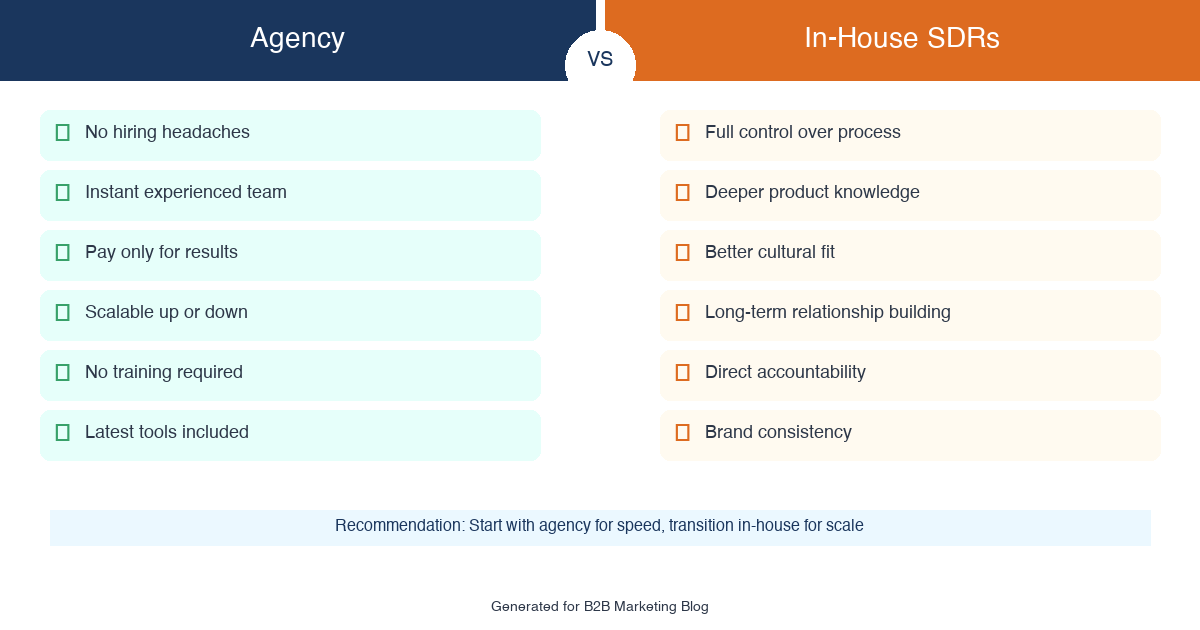
Cold Outreach Agency vs In-House SDRs
Internal SDRs are employees on your payroll who handle sales development activities: cold calling, cold emailing, prospecting, and appointment setting. They work exclusively on your product, your market, and your process.
They attend your meetings, use your CRM, and report to your sales leadership.
Agency SDRs are external partners who handle cold prospecting on your behalf. They bring their own processes, technology, lead data, and expertise.
You pay for results,qualified meetings, qualified leads generated, pipeline created,rather than hours worked. An outsourced SDR team like this validates your market assumptions faster than building internally.
Operational Differences
Internal outbound teams require management, training, software licenses, and ongoing development. You own the process and bear all the overhead.
Cold prospecting agencies own their processes and infrastructure. You consume results without the complexity of building an internal SDR team.
Expertise Differences
Internal SDRs develop deep knowledge about your specific product and market over time. Agency SDRs bring broad experience from working across multiple clients and campaigns, often surfacing best practices that internal teams never discover.
Each outreach message benefits from this cross-client learning. This cross-pollination helps validate what works across different B2B markets.
What are the advantages and disadvantages of using internal SDRs?
Internal outbound teams offer specific advantages but come with significant costs that many B2B companies underestimate.
Advantages of In-House SDRs
Deep Product Knowledge , Outbound reps understand nuances, edge cases, and competitive positioning that external partners can’t match
Complete Cultural Alignment , Internal teams absorb company values and represent your brand authentically
Direct Process Control , You own every aspect of sales development and implement changes immediately
Institutional Knowledge Retention , Compound market knowledge stays with your company as prospecting staff gain experience
Deep product knowledge: Your outbound reps live in your product every day. They understand nuances, edge cases, and competitive positioning in ways external partners can’t match.
This knowledge translates to better prospect conversations and more accurate qualification. When you hire internally, you invest in deep domain expertise that compounds over time.
Complete cultural alignment: Internal SDRs absorb your company culture, values, and communication style. They represent your brand authentically because they’re your brand.
This alignment matters for complex B2B sales where relationship building starts early.
Direct process control: You own every aspect of the sales development process. When you want to change messaging, adjust qualification criteria, or test new approaches, you implement immediately without coordinating with external partners.
Institutional knowledge retention: As prospecting staff gain experience, they accumulate market knowledge, prospect intelligence, and relationship capital that stays with your company. This compound knowledge becomes a competitive advantage over time.
Disadvantages of In-House SDRs
High Fixed Costs , $80,000-120,000 annually per outbound rep including salary, benefits, recruiting, training, tools, and management
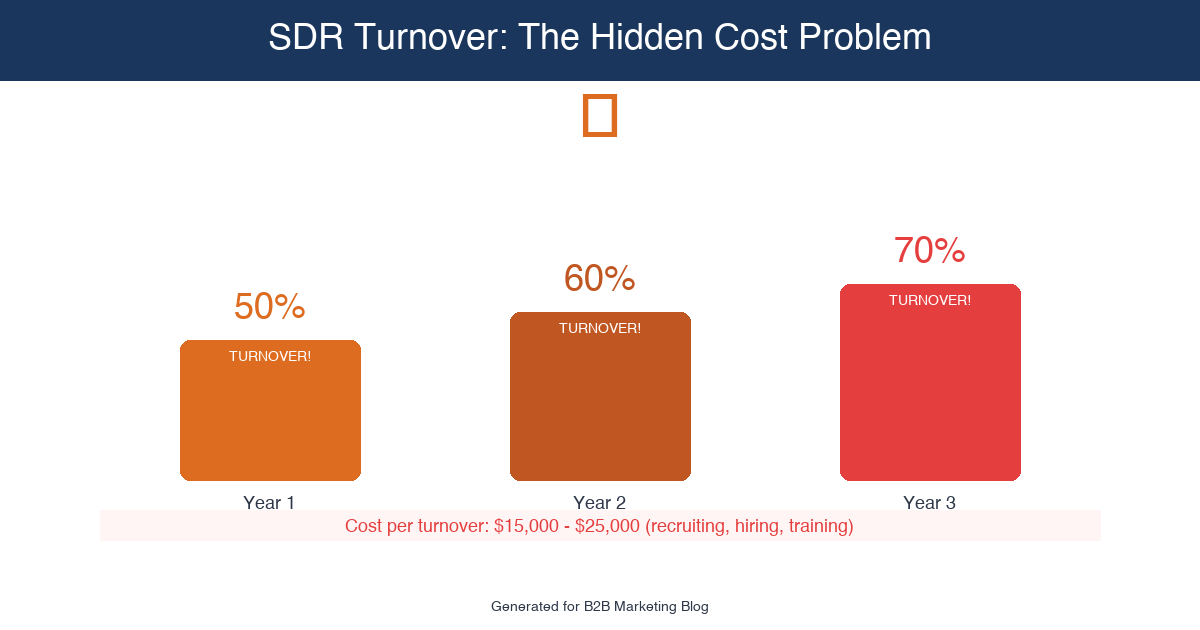
Turnover Risk , Sales development has 30-50% annual turnover, destroying pipeline consistency
Limited Scalability , Adding prospecting staff means more hiring costs, management time, office space, and complexity
Training Investment , 3-6 months of reduced productivity during ramp-up, lost every time someone leaves
High fixed costs: One outbound rep costs $60,000-80,000 annually in base salary alone. Add benefits (15-20%), recruiting fees ($5,000-15,000 per hire), training time (3-6 months of reduced productivity), software tools ($2,000-5,000 annually), and management overhead.
True annual cost: $80,000-120,000 per SDR.
Turnover risk: Sales development has among the highest turnover rates in B2B. Outbound reps frequently leave for advancement opportunities or other companies.
Every departure means losing momentum, restarting recruiting, and retraining replacements. The cycle destroys pipeline consistency and forces repeated hiring cycles.
Limited scalability: Adding more prospecting staff means more hiring costs, more management time, more office space, more tools, and more complexity. Scaling an internal team is expensive and slow compared to outsourcing.
When you outsource, you avoid these scaling challenges entirely. Many B2B companies discover that building in-house creates more problems than it solves.
Training investment: Before outbound reps become productive, they need extensive training on your product, market, sales process, and tools. This investment takes months and gets lost every time someone leaves.
When you hire internally, you repeat this expensive training cycle repeatedly.
What are the advantages and disadvantages of using a cold prospecting agency?
Cold prospecting agencies offer different trade-offs than internal outbound teams. Understanding both helps you evaluate which model fits your B2B situation.
When you outsource, you gain access to proven processes that have been refined across hundreds of campaigns.
Advantages of Cold Prospecting Agencies
Immediate expertise: You get access to experienced teams with proven processes on day one. No recruiting, no training, no ramp-up time.
Agency SDRs have already made the mistakes that internal teams make while learning.
Predictable costs: Pricing is typically monthly or per-campaign. You know exactly what you pay each month.
No unexpected recruiting fees, no benefits negotiations, no tool subscriptions. The agency fee structure is transparent, and cost comparison to outsourced SDR arrangements reveals significant savings.
Infrastructure already built: Quality agencies have enterprise-grade email infrastructure, verified lead databases, AI-powered personalization tools, and multi-channel orchestration systems. You get the benefit of this infrastructure without paying to build it.
they’ve a proven playbook that accelerates your time to first qualified meeting.
Scalability without complexity: Want to scale outreach volume? An agency allocates more resources to your campaigns.
No hire, no equipment, no management overhead. When you outsource, you scale lead generation by adjusting your budget, not your headcount.
An outsourced SDR team can scale up or down without the HR complexity of hiring and firing.
Continuous optimization: Agencies constantly test, learn, and improve based on data across multiple B2B campaigns. When one approach works, they apply it to your campaigns.
This accumulated learning compounds over time. The playbook gets refined with every qualified meeting booked.
p>Disadvantages of Cold Prospecting Agencies
Less direct control: you don’t manage day-to-day activities. You set strategy and review results, but tactical execution happens externally.
Some companies struggle with this lack of direct oversight.
Learning curve on your product: Even with experienced teams, agencies need time to deeply understand your specific product, positioning, and market nuances. This onboarding period exists in both models, but it’s more visible with agencies.
Potential misalignment: If the agency doesn’t truly understand your ideal customer profile or sales process, results suffer. Vetting becomes critical to ensure alignment before committing.
A good agency will validate your assumptions before scaling campaigns.
Why should someone choose a cold prospecting agency instead of internal SDRs?
The decision hinges on three factors: your current stage, your internal capabilities, and your strategic priorities. When you hireoutsourced SDRs versus building internally, the math changes dramatically for B2B companies.
The best agencies deliver results faster than an internal team can ramp up. You can outsource the entire prospecting function or just parts of it.
Many founders start with outsourced SDRs to test the market before committing to full-time hires.
Choose Agency When Speed Matters
If you need meetings booked this month, not six months from now, an agency wins. Internal SDR teams require recruiting (4-8 weeks), hiring, onboarding, training, and ramp-up (3-6 months) before generating meaningful results.
When you hire internally, you wait months for results. A quality cold prospecting agency can have campaigns running within weeks and deliver your first qualified meeting in days.
Choose Agency When Costs Matter
The cost comparison is stark. One internal SDR costs $80,000-120,000 annually.
A quality cold prospecting agency delivering comparable or better results typically costs $36,000-60,000 annually. that’s 50-70% savings on lead generation costs.
The math becomes even clearer when you count how many qualified meetings each approach delivers per dollar spent.
Choose Agency When Focus Matters
Your sales team should close deals, not build prospecting infrastructure. When your closers are spending time on cold calling and list building, they’re not selling.
When you outsource, your team focuses on what matters. Outsourcing cold prospecting lets your B2B team focus on their core competency and close more deals.
Choose Agency When Scale Matters
Want to test new markets? Launch new products?
Expand geographically? Agency SDRs scale immediately without hiring and training cycles.
You experiment and expand with variable costs rather than fixed headcount commitments. An outsourced SDR team gives you flexibility to pivot without the overhead of building in-house.
Does an SDR typically do cold calling or cold emailing?
Modern outbound reps do both, plus more. Sales development in 2026 is multi-channel by necessity.
Cold Calling
Cold calling remains effective for high-value B2B targets. Phone conversations allow immediate feedback, objection handling, and relationship building that email can’t match.
Experienced outbound specialists use phone for decision-makers who prefer real-time conversation and for complex qualification conversations.
Cold Emailing
Cold emailing scales prospecting volume dramatically. One outbound rep can reach hundreds of prospects daily via email versus dozens via phone.
Modern cold email uses AI-powered personalization to achieve response rates that generic blast emailing never could.
LinkedIn Outreach
LinkedIn has become essential for B2Bprospecting. Prospecting teams connect with decision-makers where they spend professional time, send personalized InMails, and engage with content to build relationships before direct outreach.
The LinkedIn message complements the email message for maximum impact.
Multi-Channel Orchestration
Quality sales development coordinates across channels. A typical sequence: personalized cold email, LinkedIn connection request, cold call if no response, follow-up email
SDR Turnover Rate by Year
, another LinkedIn touch.
This multi-channel approach dramatically improves response rates versus single-channel efforts for B2B sales teams.
What factors should influence the decision between an internal team and a cold prospecting agency?
Multiple factors determine which model works better for your specific B2B situation.
Volume Requirements
If you need 2-5 sales meetings weekly, an agency or one outbound rep can handle it. If you need 20+ weekly, you may need a dedicated prospecting team.
Understand your volume requirements before deciding. Many companies hire an agency first to validate demand, then build internally as volume justifies the cost.
Deal Complexity
Complex sales with long cycles, multiple stakeholders, and technical products benefit from internal SDRs who develop deep product expertise. Simpler sales with faster cycles work well with agencies that optimize for volume.
Management Capacity
Do you’ve sales managers who can effectively lead outbound teams? Managing sales development is a specialized skill.
If your managers lack this expertise, agency models may deliver better results without requiring management overhead. When you outsource, the agency handles all the management complexity.
Budget Flexibility
Internal SDRs require significant fixed investment regardless of results. Agency models offer more variable cost structures that scale with performance.
If you prefer predictable costs, agencies deliver better budget visibility. The agency fee is transparent from day one, making financial planning simpler.
Control Preferences
Some B2B companies need direct control over messaging, process, and sales team management. Others prioritize results over control.
Honest self-assessment of your control needs prevents misalignment.
How do the costs of an internal SDR team compare to those of a cold prospecting agency?
Let me break down the actual costs so you can run the numbers yourself for your B2B company.
In-House SDR Cost Breakdown
Base salary for one outbound rep: $50,000-70,000 annually. Benefits and payroll taxes: $15,000-20,000 annually.
Recruiting fees: $5,000-15,000 per hire (plan for turnover). Training time: 3-6 months of reduced productivity ($15,000-35,000 in opportunity cost).
Software and tools: $2,000-5,000 annually. Management overhead: Your sales manager’s time, conservatively $20,000-30,000 allocated.
Total annual cost: $80,000-120,000 per SDR.
Cold Prospecting Agency Cost Breakdown
Quality cold prospecting agencies typically charge $2,000-5,000 monthly depending on scope. At $3,000 monthly: $36,000 annually.
No recruiting costs. No training costs.
No tool subscriptions. No management overhead.
Predictable, fixed pricing that includes infrastructure, data, and optimization. An outsourced SDR arrangement is often significantly more cost-effective than building internally.
The Comparison
Internal SDR: $80,000-120,000 annually, one person who may generate 2-4 meetings weekly at peak performance. Cold prospecting agency: $36,000-60,000 annually, a team that often delivers 4-10+ qualified meetings weekly depending on quality and targeting.
The math is compelling,agencies deliver better ROI for most B2B companies.
How quickly can results be expected from an internal SDR team versus a cold prospecting agency?
Timeline to results differs significantly between models for B2B outreach.
Agency Timeline
Week 1-2: Campaign setup, infrastructure building, data verification. Week 3-4: First outreach waves, initial response data.
Month 3-5: Ramp-up with supervision, building prospecting skills. Month 6+: Approaching full productivity.
Internal outbound teams take 4-6 months to reach productive capacity,and that’s assuming successful hiring without turnover delays.
The Gap
If you need results in 90 days, an agency wins decisively. If you’ve 6+ months to wait and prefer internal ownership, internal SDRs may make sense.
But consider: in those 6 months of waiting for internal to ramp, what’s the opportunity cost of empty pipeline?
What level of expertise can be expected from an internal team versus a cold prospecting agency?
Expertise comparison depends on what you mean by expertise.
Product Knowledge
Internal SDRs develop deeper product expertise over time. They live in your product daily, learn nuances, and become true experts on what you sell.
Agency SDRs know your product at the level needed to generate interest and qualify prospects, but may lack the deep product mastery that complex B2B sales require.
Outreach Expertise
Cold prospecting agencies bring broad experience from dozens or hundreds of campaigns across industries. They know what subject lines work, what personalization triggers response, and how to structure sequences for maximum effect.
Internal SDRs learn by doing,making mistakes that agencies have already learned from.
Technology and Infrastructure
Quality agencies have invested heavily in email infrastructure, AI-powered tools, and automation systems. This technology expertise is expensive to build internally.
Outbound reps typically use standard tools without the sophisticated infrastructure that premium agencies deploy.
Optimization Capability
Agencies optimize continuously based on data across campaigns. When one campaign learns something, it applies to others.
This accumulated optimization compounds over time. Internal outbound teams optimize based only on their own data,much smaller sample size, slower learning curve.
What are the risks associated with each model (in-house vs. agency outbound sales)?
Every model carries risks. Understanding them helps you mitigate and plan.
In-House SDR Risks
Turnover risk is the biggest threat. Sales development has 30-50% annual turnover in many markets.
When your best outbound rep leaves, you lose momentum, restart recruiting, and begin training again. The cycle destroys pipeline consistency and wastes hiring investment repeatedly.
Management burden is often underestimated. Effective SDR management requires dedicated sales managers who coach, train, and develop their teams.
Without proper management, prospecting staff underperform and turnover accelerates. If you hire an agency, you avoid this management burden entirely.
Fixed cost risk exists when sales development needs fluctuate. Paying full salaries and benefits during slow periods strains budgets.
Scaling down means layoffs; scaling up means recruiting cycles. When you outsource, you convert these fixed costs into variable costs that scale with demand.
Agency SDR Risks
Alignment risk emerges if agencies don’t deeply understand your market, product, or ideal customer profile. Poor alignment produces poor results regardless of effort.
Vetting agencies properly and starting with a small test helps validate the fit before scaling.
Control risk exists for companies that need direct oversight. If you can’t function without managing every touchpoint, agency models may create frustration.
The tradeoff is real: you gain speed and expertise but give up some control.
Quality variance between agencies is significant. Some deliver exceptional results; others deliver disappointment.
Vetting becomes critical to avoid underperformers. Look for agencies with proven playbook documentation and case studies in your industry.
Risk Mitigation
The best approach: start with an agency to prove outbound works for your B2B market, then decide whether to consider building an internal team based on actual results and ROI. This limits your risk while gathering data for informed decisions.
Each outreach message should be optimized based on performance data. The agency model lets you validate demand before making the larger commitment of building an internal SDR team.
An outsourced SDR arrangement allows you to test the waters without the full commitment of hiring internally.
Do the math. If our AI infrastructure reaches out to 1,000 highly qualified, triple-verified decision-makers a day, that’s 30,000 people a month. With our hyper-personalization, even an impossibly conservative 1% reply rate yields 300 qualified conversations. In high-ticket B2B, what happens to your revenue when you’ve 300 conversations with your exact ICP?
what’s the fastest way to use Cold Outreach Agency vs Hiring In-House SDRs: The Real Math without burning the market?
Start with a tight ICP, verified data, and a small test batch. Scale only after replies, bounces, and meeting quality prove the message is working.
How many prospects should I contact for Cold Outreach Agency vs Hiring In-House SDRs: The Real Math?
The number matters less than the fit. A smaller list of verified decision-makers will beat a large scraped list because inbox placement, relevance, and timing decide reply quality.
Why do most campaigns around Cold Outreach Agency vs Hiring In-House SDRs: The Real Math fail?
Most campaigns fail because the data is weak, the offer is vague, and the follow-up system is inconsistent. Fix those three points before adding more volume.
Should I use email only for Cold Outreach Agency vs Hiring In-House SDRs: The Real Math?
No. Email works better when it’s supported by LinkedIn touches, retargeting, and clean CRM follow-up. One channel creates reminders. Multiple channels create recognition.
When should I hire help for Cold Outreach Agency vs Hiring In-House SDRs: The Real Math?
Hire help when you already know the customer profile, the offer is validated, and the bottleneck is execution speed. Outsourcing a broken offer only makes the failure happen faster.
If Cold Outreach Agency vs Hiring In-House SDRs feels inconsistent, the problem usually is not effort. It is that the campaign has no operating logic behind it. If the list is weak, the message is vague, and the follow-up is random, even a smart idea turns into noise.
Your buyer does not reward clever wording. They reward relevance. Show them that you understand the pressure on their desk before you ask for time. That means the message has to earn attention fast: clear pain, clean proof, and a next step that does not feel like a trap.
The Small-Batch Validation Rule
Fit: Can we explain why this exact person should care in one sentence? If not, the list is too broad.
Timing: Is there a trigger, market shift, hiring signal, funding event, expansion move, compliance deadline, or operational pain that makes the message relevant now?
Proof: Does the email give the buyer a reason to trust the claim before asking for time? A sharp observation beats a generic case-study line.
Do not hide behind volume. Volume is a multiplier. It multiplies good strategy, and it multiplies bad strategy even faster.
The cleaner version is simple: start with 150 accounts, not a giant scraped list. Segment them by pain, write one message for one segment, and watch replies before scaling. If that first batch does not produce signal, more volume will not save the campaign. It will only make the failure louder.
The hard truth: Cold Outreach Agency vs Hiring In-House SDRs is not magic. It is a disciplined system for reaching the right buyer with the right proof at the right time. Build the data layer first, then the message, then the follow-up system. In that order.
How to Judge Cold Outreach Agency Vs In-House Sdrs Before You Scale
The practical test for cold outreach agency vs in-house sdrs is not whether the idea sounds smart. The test is whether it creates qualified pipeline without damaging deliverability, sender reputation, or buyer trust. A strong system connects in-house team , in-house sdr team , building an in-house , building an in-house sdr team with clear targeting, clean data, and a message that feels written for the exact account.
If the campaign uses outsourced team , cold email agencies , cold email agency vs in-house , email agency vs in-house sdr , cost per , fully loaded in-house, the team needs a simple operating rule: do not add volume until replies prove the angle. That means watching inbox placement, open rates, reply quality, bounce behavior, and the number of sales meetings that come from real decision-makers.
The Execution Checklist
Infrastructure: Check hiring an sdr, in-house hire, sdr function, single in-house sdr before scaling. If this layer is weak, more sending only creates louder failure.
Targeting: Check in-house sales, b2b lead generation agency, quality agency before scaling. If this layer is weak, more sending only creates louder failure.
Message quality: Check sales and marketing, single sdr, true cost, experienced sdrs before scaling. If this layer is weak, more sending only creates louder failure.
Follow-up: Check sales development representative, run a hybrid, dedicated sdr before scaling. If this layer is weak, more sending only creates louder failure.
Measurement: Check mid-level sdr in the us, paying full salary before scaling. If this layer is weak, more sending only creates louder failure.
The bottom line is simple: cold outreach agency vs in-house sdrs should be treated like a revenue system, not a one-off campaign. When the list, email infrastructure, personalization, domain setup, and multichannel follow-up work together, the outreach has a real chance to turn cold attention into booked meetings.
How to Judge Cold Outreach Agency Vs In-House Sdrs Before You Scale
The practical test for cold outreach agency vs in-house sdrs is not whether the idea sounds smart. The test is whether it creates qualified pipeline without damaging deliverability, sender reputation, or buyer trust. A strong system connects in-house sdr , outsource , sdrs , cold email with clear targeting, clean data, and a message that feels written for the exact account.
If the campaign uses outreach , agency vs , in-house team , hire , in-house sdr team , pipeline, the team needs a simple operating rule: do not add volume until replies prove the angle. That means watching inbox placement, open rates, reply quality, bounce behavior, and the number of sales meetings that come from real decision-makers.
The Execution Checklist
Infrastructure: Check outsourced sdr, b2b, lead generation, outsourced sdrs before scaling. If this layer is weak, more sending only creates louder failure.
Targeting: Check cold call, message, in-house sdrs before scaling. If this layer is weak, more sending only creates louder failure.
Message quality: Check sales development, salary, best agencies, internal team before scaling. If this layer is weak, more sending only creates louder failure.
Follow-up: Check icp, building an in-house, 2025 before scaling. If this layer is weak, more sending only creates louder failure.
Measurement: Check qualified meeting, onboarding before scaling. If this layer is weak, more sending only creates louder failure.
The bottom line is simple: cold outreach agency vs in-house sdrs should be treated like a revenue system, not a one-off campaign. When the list, email infrastructure, personalization, domain setup, and multichannel follow-up work together, the outreach has a real chance to turn cold attention into booked meetings.
Search Intent Coverage Section for Cold Outreach Agency vs In-house Sdrs
How In-house SDR Changes the Buying Decision
For cold outreach agency vs in-house sdrs, buyers are usually comparing in-house makes more sense, building an in-house team, outreach sequences, agency beats, outreach campaigns. The decision is not made from one email or one landing page. It is made from proof, clean positioning, inbox trust, and whether the outreach explains why the offer matters now.
The operational layer matters too: company email, sdr salary, linkedin sales navigator. If these pieces are weak, the campaign may still create activity, but it will not create enough qualified sales conversations to justify scaling.
How Outsource Changes the Buying Decision
For cold outreach agency vs in-house sdrs, buyers are usually comparing agency engagement, agency scope, validate your icp, reach full productivity, in-house costs. The decision is not made from one email or one landing page. It is made from proof, clean positioning, inbox trust, and whether the outreach explains why the offer matters now.
The operational layer matters too: one in-house, average sdr tenure, in-house while outsourcing. If these pieces are weak, the campaign may still create activity, but it will not create enough qualified sales conversations to justify scaling.
How Frequently Asked Questions Changes the Buying Decision
For cold outreach agency vs in-house sdrs, buyers are usually comparing cost per qualified meeting, whether the agency, sdr leaves, new sdr, extension of your team. The decision is not made from one email or one landing page. It is made from proof, clean positioning, inbox trust, and whether the outreach explains why the offer matters now.
The operational layer matters too: trained sdrs, sample outreach, use an outsourced. If these pieces are weak, the campaign may still create activity, but it will not create enough qualified sales conversations to justify scaling.
How Agency vs Changes the Buying Decision
For cold outreach agency vs in-house sdrs, buyers are usually comparing lower cost per, calculate cost per, marketing and sales, sdr takes, in-house sdr. The decision is not made from one email or one landing page. It is made from proof, clean positioning, inbox trust, and whether the outreach explains why the offer matters now.
The operational layer matters too: outsource, frequently asked questions, agency vs. If these pieces are weak, the campaign may still create activity, but it will not create enough qualified sales conversations to justify scaling.
How In-house SDR Team Changes the Buying Decision
For cold outreach agency vs in-house sdrs, buyers are usually comparing in-house sdr team, b2b, sdr teams, building an in-house, in-house makes more sense. The decision is not made from one email or one landing page. It is made from proof, clean positioning, inbox trust, and whether the outreach explains why the offer matters now.
The operational layer matters too: sdrs, cold email, pipeline. If these pieces are weak, the campaign may still create activity, but it will not create enough qualified sales conversations to justify scaling.
Questions Buyers Ask Before Choosing Cold Outreach Agency vs In-house Sdrs
What is a disadvantage of using an in-house advertising agency?
The short answer depends on list quality, deliverability, personalization, follow-up, and whether the campaign is aimed at the correct buyer. For cold outreach agency vs in-house sdrs, the safest move is to validate with a controlled test before increasing volume.
Does Sdr do cold calling?
The short answer depends on list quality, deliverability, personalization, follow-up, and whether the campaign is aimed at the correct buyer. For cold outreach agency vs in-house sdrs, the safest move is to validate with a controlled test before increasing volume.
Why should someone choose an agency role instead of an in-house role?
The short answer depends on list quality, deliverability, personalization, follow-up, and whether the campaign is aimed at the correct buyer. For cold outreach agency vs in-house sdrs, the safest move is to validate with a controlled test before increasing volume.
What is the difference between inhouse and agency marketing?
The short answer depends on list quality, deliverability, personalization, follow-up, and whether the campaign is aimed at the correct buyer. For cold outreach agency vs in-house sdrs, the safest move is to validate with a controlled test before increasing volume.
The Human Review Layer
Look at Cold Outreach Agency vs In-house Sdrs through the buyer’s day, not through a marketer’s checklist. The strongest campaigns feel researched because the language names a specific condition in the buyer’s world. For Cold Outreach Agency vs In-house Sdrs, that means the outreach has to connect the business problem, the buying moment, and the proof in a way that feels specific.
A procurement buyer cares about different proof than a pipeline buyer. A campaign built around category, constraint, and analyst has more context than a generic pitch. A partner bottleneck should not be handled with the same CTA as a operator bottleneck. This is why shallow templates fail. They flatten different buyer situations into one bland message.
Administrator: Review administrator against the buyer’s real context before increasing send volume.
Proof: Review proof against the buyer’s real context before increasing send volume.
Cadence: Review cadence against the buyer’s real context before increasing send volume.
Placement: Review placement against the buyer’s real context before increasing send volume.
Growth: Review growth against the buyer’s real context before increasing send volume.
Enrichment: Review enrichment against the buyer’s real context before increasing send volume.
This is the part a generic article usually misses: judgment. A real operator can tell when sdrs is the problem, when growth pipeline is the problem, and when the whole angle is too soft. That judgment comes from reading replies, checking account quality, and comparing message intent against actual buyer behavior.
The cleaner move is to run a small batch, inspect the signal, then rewrite the weak layer. Do not scale because the copy looks polished. Scale because the replies prove the market understands the value.