If you’re reading this, you’re likely at that pivotal moment in your B2B journey where demand gen is becoming a bottleneck, or you’re just tired of inconsistent pipelines. You now have to weigh your two best options: bringing in an in-house SDR team or outsourcing your cold outreach to an agency.
I’ve been on both sides of the equation, so I know it’s not a decision you take lightly. Scalability is the focus here. Not just how many meetings you can book, but how fast you can scale without burning your resources, your time, and your energy.
So let’s discuss the real differences and help you discern what really scales better, a cold outreach agency or an in-house SDR team. First, let’s define the partners involved:
what’s an in-house SDR team?
An in-house SDR (Sales Development Representative) team is exactly what it sounds like,employees on your payroll whose sole function is to prospect and qualify leads and book calls. An in-house SDR team operates internally, and they’re immersed in your product, culture, and goals. what’s a cold outreach agency?
A cold outreach agency (for example, our Cold Outreach Agency under BrandGaytor Marketing Solutions Pvt. Ltd.) is an external service provider that specializes in cold prospecting and lead generation via cold email, LinkedIn, Twitter, and even SMS. We take care of everything from data scraping and company email setup to AI-generated personalized messaging and booking appointments directly into your calendar.
Now that we’ve defined this industry, let’s compare the industry of cold outreach agencies and cold outreach talent in 7 different categories that truly matter for your scalability
1. Speed of implementation, Cold outreach agency wins every. Single. Time.
When you hire an agency, especially one like us that has been doing this for a long time, we already have the systems, tools, processes, people, etc. there’s (almost) nothing you’ve to build. Most traditional agencies have everything built out and ready to go.
Within 7–14 days, you’ve your campaigns up and running, leads being contacted, and some of your first appointments booked. Now, compare that to hiring an SDR team; recruitment takes weeks or months.
Then, onboarding, training, infrastructure, CRMs, domain setups, writing the scripts, testing… You can see where this is going. It wouldn’t be out of the question for it to take 2–3 months to generate consistent results from your new, hired SDR. If speed is what you want (and it should be if you’re in a fast-moving B2B market), then an agency wins here.
2. Cost Structure Short Term: The Agency is expensive.
Long term? Not really.
Let’s look at both costs. In-House SDR Salary: ₹40,000 to ₹80,000/month or $2,500-5,000/month in the US, Tools: CRMs, email tools, LinkedIn Sales Navigator, etc.
Management time: Yes, YOUR time. Infrastructure: laptops, workspace, training, HR support, etc. Cold Outreach Agency Fixed monthly retainer (most often ₹50,000-₹200,000 depending on scope) No overheads, no tool costs. you don’t have to manage operations daily.
On paper, agency looks expensive. But then again, when you consider all the hidden opportunity costs that come with an in-house hire and the risk that they’ll not perform, most early- to mid-stage startups will find that an agency is a better price.
3. Volume Scalability Agency
Again, if you play your cards right If you want to 10x your outreach in about 3 months, which option is more feasible: hiring 5 new SDRs or increasing SF and modifying your agency engagement? Agency scope is more straightforward.
You can simply up your engagement. Want 5 inboxes instead of 2? Add 3 domains and we’ll strengthen. Want to test the social media waters too and get into Twitter DMs or test out LinkedIn?
We can roll that out next week. With in-house teams, there’s no reasonable way to scale upward without significant time investment and issues ancillary to building additional employees, including recruiting, onboarding, training, and quality control.
you can’t just adjust in-house headcount with a toggle. More SDRs mean more costs, potentially more management, and, of course, risks. So, when I consider volume and the speed with which to scale, agencies are more favorable.
4. Control and Customization This one is in favor of fertilization.
I do recognize that if you’ve a hyper-niche product or seller-specific buyer persona, in-house SDRs are sitting in the trenches producing your ideal customer. Ashes are used to produce specific brand messages and tester engagement. Walking into a room to say to your in-house team, “Aquitaine mode.”
You can’t accomplish this with an agency. With your agency working together, you’ve control over changing, too. If you spent some time doing accountability checks, you could review any problems (or any successes) and request to change to another aspect of your pitch, and you could see changes within PhoenVOZ’s different branding, and the results of your changes would be visible on the next IP.
We even offered a case study explaining a program that successfully gained government funding based on 50 initial clients, not scrolling to where you’re today, just to promote a specific desire of your initial product. So, for the granular control freaks out there or the ones who need more technical selling, in-house is probably better.
That said, a good agency (like ours) can act as an extension of your team and not a vendor. we’ve clients that strategize with us every week, we collaborate on messaging, and they send us pitch decks to use to stay aligned.
5. Quality of Talent: It Depends,
But Agencies Have the Advantage. When you hire in-house, you’re typically limited to the talent pool you can attract and afford. And let’s be honest, the top-performing SDRs are expensive and hard to retain. Agencies, however, are built to hire top-performing SDRs, copywriters, campaign strategists, and deliverability experts all under the same roof.
You’re not hiring one person; you’re using a cross-functional group. Especially with cold outreach, success isn’t just about who sends the email.
It’s about Quality of data, Deliverability & inboxing, Copywriting Personalization Execution across multiple channels, Being able to A/B test and iterate quickly. There’s no way hiring one person will get you all that. Agencies bring an entire ecosystem.
6. Experimentation & Innovation Agencies Provide the Ability to Innovate
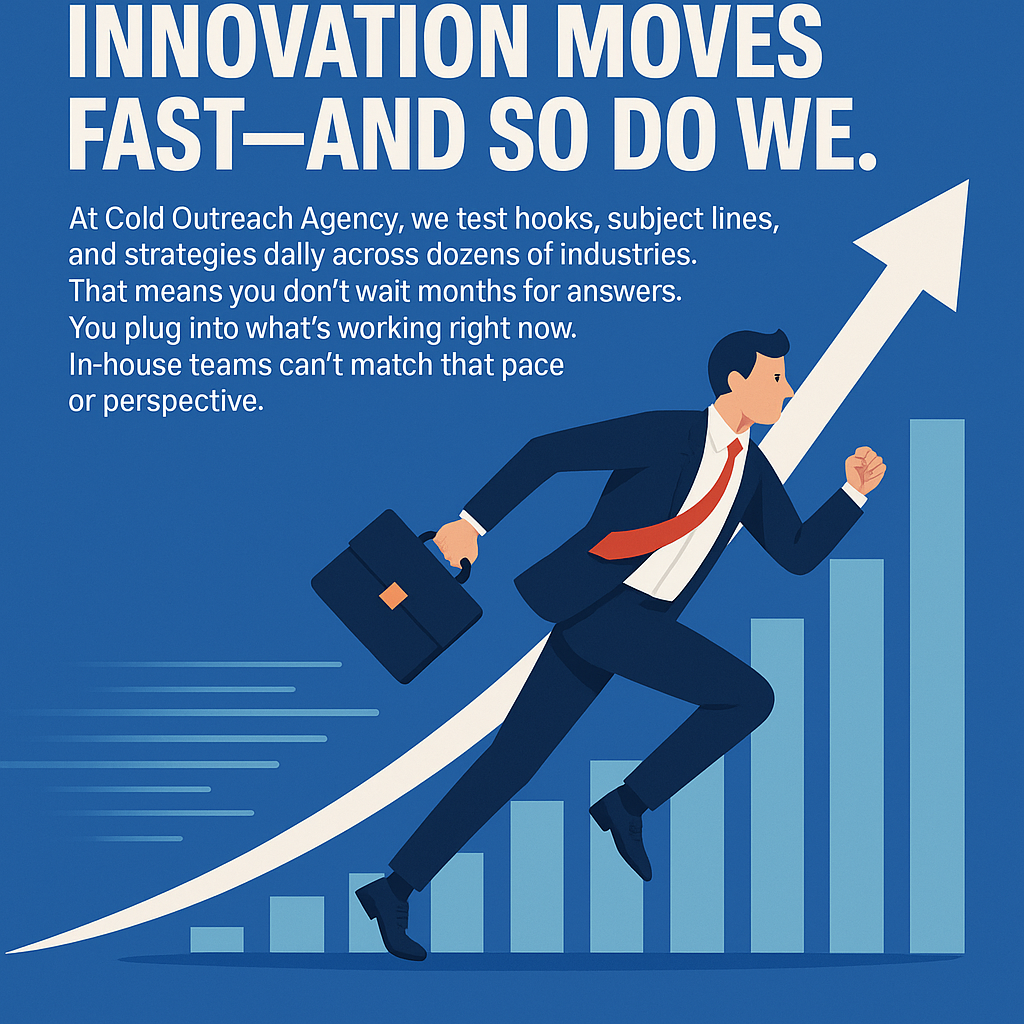
Faster, when you leaf through the cold outreach campaigns of 25 different B2B brands across seven different industries, you start to see patterns of behavior at scale.
We understand what’s working this week, not last quarter. We’re testing different hooks, subject lines, lead sources, and tactics every single day. you’re able to use those learnings.
We’ve had clients see 2x-3x higher conversion rates simply because we duplicated the winning framework we discovered in other industries. That level of experimentation is incredibly difficult to obtain with an in-house team that’s operating in a silo.
7. Risk Mitigation In-House Means Greater Risk. Here’s the thing:
If your in-house SDRs are ineffective, you still have their salaries to pay. You still have tool costs to pay. you’ll still have to manage them.
And if you want to change out these resources, you’ll have a 2-month headache. With an agency or partner, especially one that’s performance-oriented, the risk is dramatically lower.
we’re only incentivized to be successful. We either deliver or we don’t retain your business.
Period. If you’re in early growth or testing new markets, outsourcing allows you to reduce risk with the added benefit of quicker feedback loops.
8. Culture & Long-Term Alignment In-House Wins on Culture.
It’s easy to argue that in-house SDRs are more long-term aligned to your brand.
They can participate in team meetings, learn about your culture, post internal Slack jokes, and even be groomed to become an AE. That much alignment is impossible to achieve with agencies.
While we do our best to align with our clients as partners (not vendors), we’re still external parties. So, if culture, retention, and career pathing strategies are important factors to your GTM strategy, in-house may be better suited.
9. Reporting, Transparency & Optimization
It Comes Down to the Agency. A quality agency will give you dashboards, weekly summaries, and very clear ROI metrics.
you’ll know how many leads went out, how many bounced, how many replied, and ultimately, how many booked. You know you’ll get optimization suggestions proactively, not reactively. Unfortunately, not all agencies are designed this way.
But in the event you find an agency that’s, like we’re going to be at Cold Outreach Agency, you’ll experience a higher level of transparency than most internal teams. A single in-house SDR can be “busy” for a week, did zero calls book, and you’ve no quickly obvious reasons why. An agency will hand you dashboards and intelligence so you can resolve the issue quickly.
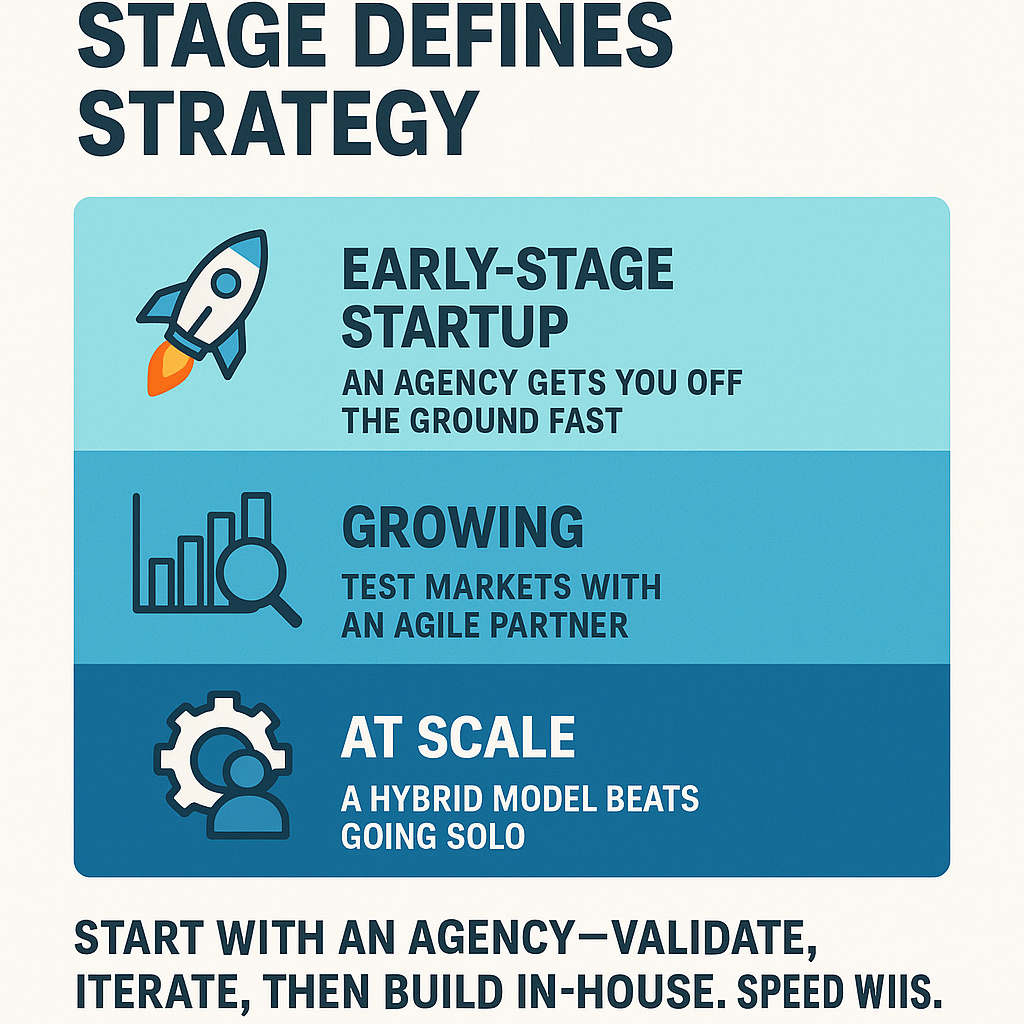
10. What Stage Are You In?
Here’s how I tend to define it, depending on the stage the company is at:
Company Stage Best Fit Early-stage startup (0-1 SDRs) Agency Growth Stage (1-10 SDRs, trialing different markets)
Agency first, hybrid later. Scaling to enterprise (10+ SDRs)
In-house + agency hybrid Final Verdict: So, what’s more scalable?
A cold outreach agency is simply more scalable, no question about it. Here’s why: You start faster. You scale faster. You iterate faster. You gain access to expert talent at a fraction of the cost. You reduce your risk while increasing your booked calls. I’m not here to tear down in-house teams.
they’ve their place, especially if you’ve solidified the product and market fit and are ready to build a solid sales engine internally with long-term players. However, if the goal is to move quickly, validate markets, and get a predictable pipeline, an agency wins. we’ve worked with B2B founders who tried to do it in-house first, struggled for 6 months, then came to us, and turned it around 30–45 days later.
So my honest recommendation? Start with a cold outreach agency. Validate your ICP, message, and channels,and build the in-house team later, once a playbook is validated. If you’re serious about scaling B2B.
Frequently Asked Questions
1. Is retaining a cold outreach agency more costly than building an in-house SDR team?
Not always. A retainer does seem like an obvious higher cost at the start of any client engagement. However, the other costs that would be hidden on the client’s end include recruiting, training, tools, management time, and infrastructure. The upside is that results come faster with less risk involved, so in the greater scope, agencies are less expensive.
2. How fast can one start reaping results with a cold outreach agency?
Most quality cold outreach agencies (including ours) build out campaigns and start booking meetings within as little as 14 days. An in-house SDR team, on the other hand, would need about 8–12 weeks just to ramp up and be productive.
3. Can an agency properly grasp my brand and target ICP? Do they know it as well as an internal team?
Great agencies get to collaborate with you during the whole process. We don’t simply act as external vendors; instead, we embed ourselves as an extension of your team. From ICP calibration down to the messaging tone, we go to great lengths with your input to stay aligned.
4. What if I want to scale the outreach volume or move fast into testing new markets?
Agencies have their tremendous usefulness there: scaling outreach campaigns with us boils down to a change in engagement-adding more inboxes, trying new platforms like LinkedIn or Twitter, launching new campaigns all within a week-without going through a whole hiring and onboarding process.
5. What kind of reporting or transparency can I expect from a cold outreach agency?
A good agency will give you clear dashboards and weekly updates along with ROI tracking (how many leads sent, how many replies, bounce rates, meetings booked). you’ll always know what’s working, and we go ahead and optimize based on data, not guesses.
Frequently Asked Questions
what’s the fastest way to use Cold Outreach Agency vs. In-House SDR Team: what’s More Scalable in 2025? without burning the market?
How many prospects should I contact for Cold Outreach Agency vs. In-House SDR Team: what’s More Scalable in 2025??
Why do most campaigns around Cold Outreach Agency vs. In-House SDR Team: what’s More Scalable in 2025? fail?
Should I use email only for Cold Outreach Agency vs. In-House SDR Team: what’s More Scalable in 2025??
When should I hire help for Cold Outreach Agency vs. In-House SDR Team: what’s More Scalable in 2025??
Research worth checking
What I Would Fix First
If Cold Outreach Agency vs. In-House SDR Team feels inconsistent, the problem usually is not effort. It is that the campaign has no operating logic behind it. That is why I care less about volume at the start and more about whether the first replies prove the angle is real.
Your buyer does not reward clever wording. They reward relevance. Show them that you understand the pressure on their desk before you ask for time. That means the message has to earn attention fast: clear pain, clean proof, and a next step that does not feel like a trap.
Three Filters Before You Add Volume
- ICP match: The buyer should match your best customer profile, not just a broad industry label.
- Trigger strength: A hiring move, new location, funding event, tech change, compliance push, or public initiative makes outreach feel timely.
- Follow-up logic: Every follow-up should add a new reason to respond. Repeating the first message is not follow-up. It is noise.
This is not complicated, but it is unforgiving. A sloppy list makes copy look bad. Weak positioning makes good data useless. And a CTA that asks for a meeting too early forces the buyer to do all the mental work.
The cleaner version is simple: start with 300 accounts, not a giant scraped list. Segment them by pain, write one message for one segment, and watch replies before scaling. If that first batch does not produce signal, more volume will not save the campaign. It will only make the failure louder.
Here is the practical takeaway: make Cold Outreach Agency vs. In-House SDR Team narrower, cleaner, and easier to say yes to. Then scale what the market proves, not what the team hopes will work. Build the data layer first, then the message, then the follow-up system. In that order.
How to Make This Feel Built, Not Generated
The strongest campaigns feel researched because the language names a specific condition in the buyer’s world. The buyer is filtering for relevance, timing, credibility, and the cost of paying attention. For Cold Outreach Agency vs. In-House SDR Team, that means the outreach has to connect the business problem, the buying moment, and the proof in a way that feels specific.
A campaign built around routing, team, and more has more context than a generic pitch. A message buyer cares about different proof than a handover buyer. A segmentation bottleneck should not be handled with the same CTA as a margin bottleneck. This is why shallow templates fail. They flatten different buyer situations into one bland message.
- Founder: Review founder against the buyer’s real context before increasing send volume.
- Context: Review context against the buyer’s real context before increasing send volume.
- Domain: Review domain against the buyer’s real context before increasing send volume.
- Owner: Review owner against the buyer’s real context before increasing send volume.
- Signal: Review signal against the buyer’s real context before increasing send volume.
- Team Buyers: Review team buyers against the buyer’s real context before increasing send volume.
This is the part a generic article usually misses: judgment. A real operator can tell when inbox is the problem, when revenue is the problem, and when the whole angle is too soft. That judgment comes from reading replies, checking account quality, and comparing message intent against actual buyer behavior.
The cleaner move is to run a small batch, inspect the signal, then rewrite the weak layer. Do not scale because the copy looks polished. Scale because the replies prove the market understands the value.