Cold Email vs LinkedIn Outreach: Which Channel Converts Better in 2026
The question I hear most from sales leaders: should we prioritize cold email or LinkedIn outreach? The answer is neither, and both.
The channel-versus-channel framing is the wrong mental model. When comparing cold emailing and linkedin together in coordinated campaigns, results consistently outperform either channel used in isolation.
But understanding the distinct strengths and optimal use cases for each channel is essential for building sequences that actually convert.
In 2026, B2B buyers have developed sophisticated filters for unwanted outreach. Email spam filters block the majority of cold messages.
LinkedIn connection requests pile up ignored. The spray-and-pray approach is dead.
What works now is strategic multi-channel orchestration that reaches decision-makers through multiple touchpoints, each reinforcing the others until a conversation becomes inevitable.
This guide breaks down the actual performance data, the strategic framework for channel selection, and the sequencing tactics that generate the reply rates and meeting volume that fill your pipeline predictably.
Should I Use Cold Email or LinkedIn Outreach?
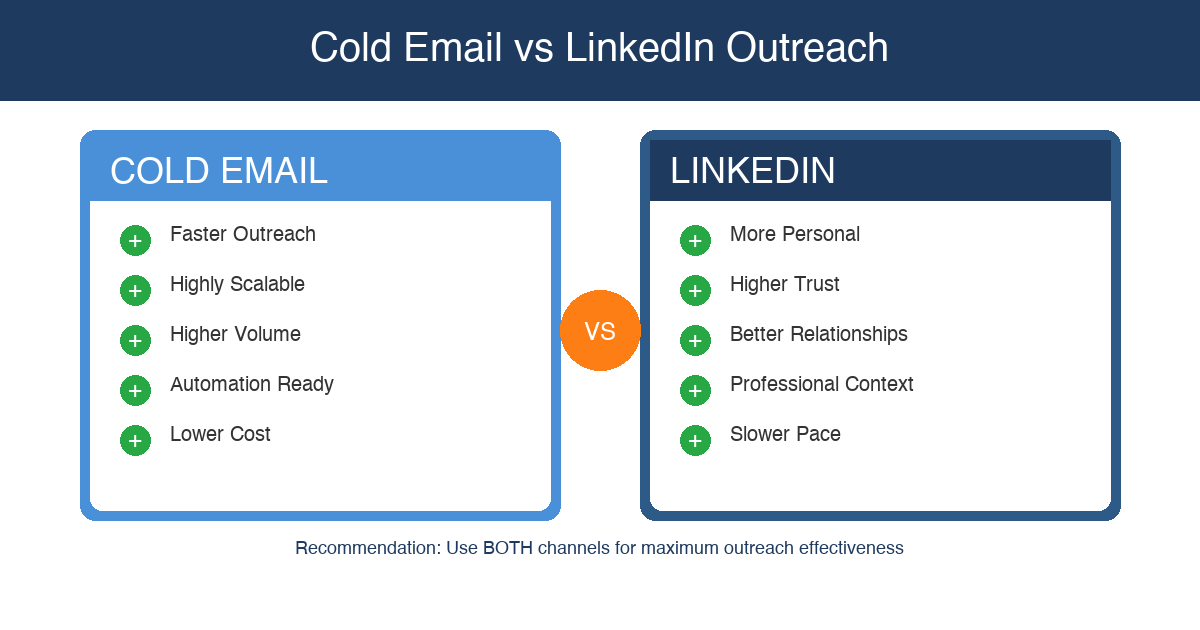
The honest answer: use both, in coordination. Cold email and LinkedIn outreach aren’t competing channels.
they’re complementary channels that serve different functions in your outbound strategy. Cold email provides reach and volume.
LinkedIn outreach provides relationship-building context and executive access. Used separately, each channel underperforms.
Used together, they compound each other’s effectiveness.
The selection logic depends on your specific audience and objectives. For volume-heavy campaigns targeting large prospect pools, cold email is the only scalable option.
A single campaign manager can orchestrate outreach to tens of thousands of prospects via email. LinkedIn’s manual nature makes equivalent volume impractical without prohibitive staffing investment.
For executive-level targeting where relationship context matters more than raw volume, LinkedIn outreach often delivers superior results. C-suite decision-makers actively manage their LinkedIn presence as part of their professional identity.
A thoughtful connection request that demonstrates genuine value cuts through the email noise that fills their inbox.
The highest-performing B2B organizations use both channels in coordinated sequences. They send initial emails to establish contact, use LinkedIn to add visibility and social proof, engage with prospect content to build familiarity, and follow up through whichever channel shows engagement signals.
This multi-channel approach generates three to five times more qualified meetings than single-channel campaigns.
The Channel Selection Matrix
Decision-makers at enterprise companies with 500+ employees: prioritize LinkedIn outreach. These executives are inbox-overloaded but actively engage on LinkedIn.
They respond better to social connection requests than email pitches.
Mid-market B2B companies with 50-500 employees: balance both channels. These professionals check email obsessively and use LinkedIn regularly.
A coordinated multi-channel approach maximizes touchpoints with this audience.
Technical decision-makers in engineering, product, and operations roles: prioritize cold email. These professionals often have LinkedIn accounts they rarely check but monitor email constantly for async communication.
Does Cold Outreach Work on LinkedIn?
Yes, cold outreach on LinkedIn works when executed strategically. The platform’s professional context makes it uniquely suited for business communication.
Unlike cold calling, which interrupts without warning, LinkedIn connection requests arrive in a notification format that decision-makers expect and manage on their own timeline.
The key distinction is between aggressive connection requests followed immediately by sales pitches versus relationship-building outreach that provides value before asking for anything. The first approach generates low acceptance rates and destroys any chance of conversation.
The second approach builds familiarity that makes future engagement natural.
Social selling on LinkedIn works because it uses the platform’s unique characteristics. You can research prospects extensively before reaching out.
You can engage with their content publicly, demonstrating value before direct contact. You can reference specific posts, articles, or company updates that show genuine familiarity with their situation.
This context is impossible to replicate in email, where you know nothing about the recipient beyond their job title.
The effectiveness of LinkedIn outreach depends heavily on personalization depth. Connection requests that say “Hi, I’d like to connect” are ignored.
Connection requests that reference a specific article the prospect wrote, a recent hire at their company, or a mutual connection’s recommendation generate significantly higher acceptance rates. The research investment required for genuine personalization is what makes LinkedIn outreach labor-intensive compared to email.
LinkedIn’s Unique Advantages for Cold Outreach
LinkedIn provides data that email can’t match. You can see a prospect’s complete career history, their published content, their company size and funding stage, and their network connections before reaching out.
This intelligence enables hyper-personalization that makes your outreach feel genuinely crafted rather than mass-produced. When using linkedin strategically like this, your message references something specific about the recipient and they know you’ve done your homework.
what’s the 3/2/1 Rule on LinkedIn?
The 3/2/1 rule structures your LinkedIn outreach to build relationships before asking for anything. Three pieces of value provided through content engagement or direct sharing before two connection attempts.
One direct message requesting a meeting or call after sufficient relationship building.
The logic is straightforward: LinkedIn rewards patience and penalizes impatience. Accepting a connection request and immediately sending a sales pitch signals that you only value the connection instrumentally.
The recipient will either ignore your message or, worse, feel manipulated. Either outcome destroys any chance of future engagement.
Implementing the 3/2/1 rule means engaging with a prospect’s content for several weeks before sending a connection request. Like their posts.
Comment thoughtfully on their articles. Share content relevant to their industry with brief commentary that demonstrates expertise.
This peripheral exposure builds familiarity. When your connection request arrives, your name already triggers recognition.
After acceptance, continue providing value before any sales ask. Share an article they might find useful.
Congratulate them on a professional milestone. Offer a relevant insight without pitching your solution.
Only after establishing genuine rapport does the meeting request become natural rather than transactional.
The Patience Dividend
The 3/2/1 rule requires patience that most outbound operations don’t exercise. But patience compounds.
Prospects who have seen your name repeatedly in positive contexts, who recognize you as someone who provides value, who haven’t been subjected to immediate sales pressure, are dramatically more likely to engage when you finally ask for a conversation. The reply rates on LinkedIn messages to warm contacts consistently exceed cold email outreach benchmarks by significant margins.
what’s the 30/30/50 Rule for Cold Emails?
The 30/30/50 rule structures cold email campaigns for optimal engagement. Thirty percent of your effort goes to research and personalization.
Thirty percent goes to subject line optimization. Fifty percent goes to follow-up persistence.
Most B2B outbound teams invert this allocation. They spend 80% of effort writing the initial email and 20% on follow-up, which often means no follow-up at all.
This approach wastes the most important prospecting opportunity: the follow-up sequence that catches prospects who were interested but busy when your initial message arrived.
The research and personalization allocation ensures your emails are relevant to specific recipients rather than generic templates. Reference recent company events.
Reference their specific role and how it connects to your solution. Reference mutual connections or shared context that establishes credibility.
This research investment pays dividends across every email in your sequence.
Subject line optimization deserves more attention than most teams give it. Your email can’t convert if it’s not opened.
Subject lines should create curiosity without feeling clickbaity. Personalization in subject lines (reference to their company or role) consistently outperforms generic subjects.
Testing multiple subject line variations and optimizing based on open rate data is essential for campaign performance.
The follow-up allocation reflects a fundamental truth: most conversions happen after the first contact. Industry data consistently shows that 80% of B2B conversations occur after the fifth follow-up touchpoint.
If you’re not following up at least five times, you’re leaving the majority of your potential pipeline unconverted.
Implementing the 30/30/50 Rule
For every cold email campaign, allocate your team’s time accordingly. Before writing any email, spend time researching the prospect.
Understand their business, their role, their recent activity, and how your solution connects to their specific situation. Write subject lines that compel opens, not just subject lines that describe your offering.
Build sequences of five to eight follow-up messages that provide additional value with each touch rather than simply repeating the same ask.
What Are the Advantages and Disadvantages of Cold Email Outreach?
Cold email remains the workhorse of B2B outbound prospecting because it delivers unique advantages that no other channel matches. Understanding these advantages helps you use them strategically.
- Scale , Single campaigns can reach thousands of decision-makers per week with email automation platforms managing tens of thousands of relationships
- Trackability , Every open, click, reply, and bounce gets logged automatically for rapid optimization and testing
- Reach to Technical Audiences , Engineering, product, and operations roles often check email obsessively while barely touching social media
- Detailed Communication , Rich formatting, embedded links, and comprehensive messaging enable thorough value articulation
- Deliverability Challenge , Increasing ESP tightening of spam filters requires exceptional subject lines and sender reputation management
Scale is the primary advantage. With proper infrastructure, a single campaign can reach thousands of decision-makers per week.
Email automation platforms can manage tens of thousands of prospect relationships simultaneously, enabling volume that cold calling or manual LinkedIn engagement can’t approach.
Trackability enables rapid optimization. Every open, click, reply, and bounce gets logged automatically.
Subject line tests yield results within hours. Copy variations reveal what messaging resonates with specific segments.
This data velocity allows continuous improvement that less measurable channels can’t match.
Reach to technical audiences favors email. Professionals in engineering, product, and operations roles often check email obsessively while barely touching social media.
For reaching these decision-makers, cold email is often the only viable digital channel.
Email prospecting enables detailed communication. Rich formatting, embedded links, attachments, and comprehensive messaging create opportunities for thorough value articulation that LinkedIn’s message format can’t match.
For complex solutions requiring explanation, email delivers more information more effectively.
The disadvantages are significant and must be managed actively. Email deliverability has become increasingly challenging as ESPs tighten spam filters.
Standing out in crowded inboxes requires exceptional subject lines and sender reputation management. Sender reputation maintenance requires proper authentication (SPF, DKIM, DMARC), volume management, and data hygiene protocols that many teams underestimate.
The Deliverability Tax
Every cold email campaign pays an implicit deliverability tax. Of the emails you send, some percentage lands in spam folders, never to be seen.
Some percentage bounces due to invalid addresses. Some percentage gets filtered by corporate spam systems before reachi
ng the inbox.
Managing these losses requires infrastructure investment that adds operational complexity to email outreach.
What Are the Advantages and Disadvantages of LinkedIn Outreach?
LinkedIn outreach offers advantages that make it indispensable for modern B2B prospecting, particularly for reaching executives and building relationships that cold email can’t match.
Executive access is LinkedIn’s primary advantage. C-suite decision-makers are effectively unreachable via cold email.
Their inboxes overflow with pitches. they don’t answer unknown numbers.
But they do check their LinkedIn notifications. A thoughtful connection request or InMail that provides genuine value reaches these influencers in a context where they’re actually receptive.
Relationship building happens faster on LinkedIn because you can demonstrate value before asking for anything. Engaging with a prospect’s content, joining their professional discussions, and sharing relevant insights creates familiarity that transforms cold outreach into warm outreach.
When you eventually send a personalized email referencing your LinkedIn interaction, the prospect recognizes your name.
Social proof amplifies your credibility. Mutual connections signal trustworthiness.
Shared group memberships establish common ground. Engagement on your content demonstrates thought leadership.
These social signals are impossible to manufacture in email, where you’re a stranger until proven otherwise.
The disadvantages of LinkedIn outreach include significant limitations on volume and automation. The platform actively restricts automated outreach and penalizes users who violate connection limits.
Scaling LinkedIn outreach requires multiple premium accounts and careful activity management that limits total reach compared to email.
The Manual Effort Problem
LinkedIn’s social selling approach requires significant manual effort that limits scalability. Each connection request must feel personal.
Each follow-up message must reference specific context. Generic automation that LinkedIn’s algorithms detect results in account restrictions or bans.
For organizations requiring outreach to thousands of prospects monthly, LinkedIn alone can’t provide the volume required.
When Should I Use Cold Email Versus LinkedIn Outreach?
Channel selection depends on audience characteristics, campaign objectives, and resource constraints. Understanding when each channel excels guides your outreach strategy decisions.
Cold email is optimal when targeting large prospect pools that require volume to generate sufficient meetings. Technical decision-makers who prefer async communication.
Enterprise accounts requiring multi-stakeholder outreach to multiple contacts simultaneously. Products requiring detailed explanation that LinkedIn’s character limits can’t accommodate.
LinkedIn outreach is optimal when targeting executives and C-suite decision-makers who don’t respond to email. Relationship-first sales cycles where trust-building precedes discovery conversations.
Startup and technology audiences who are native LinkedIn users. Account-based outbound prospecting targeting high-value accounts where personalization depth justifies the manual effort.
The multi-channel approach that generates best results typically starts with cold email for initial contact, adds LinkedIn connection requests within 48 hours to reinforce visibility, follows up through whichever channel shows engagement signals, and uses phone calls for high-priority accounts where immediate conversation matters.
Audience-Specific Channel Strategy
For each campaign, segment your prospect list by characteristics that predict channel response. Enterprise executives: lead with LinkedIn.
Mid-market professionals: balance both channels with email primary. Technical roles: lead with email.
SMB owners: email for volume, LinkedIn for relationship accounts. This segmentation maximizes response rates across your total addressable market.
How Do Open and Reply Rates Compare Between Cold Email and LinkedIn Outreach?
Direct rate comparisons require context because the metrics measure different things. Cold email open rates measure whether your message reached the inbox and was opened.
LinkedIn connection request acceptance rates measure whether someone agreed to a professional connection. These are fundamentally different engagement signals.
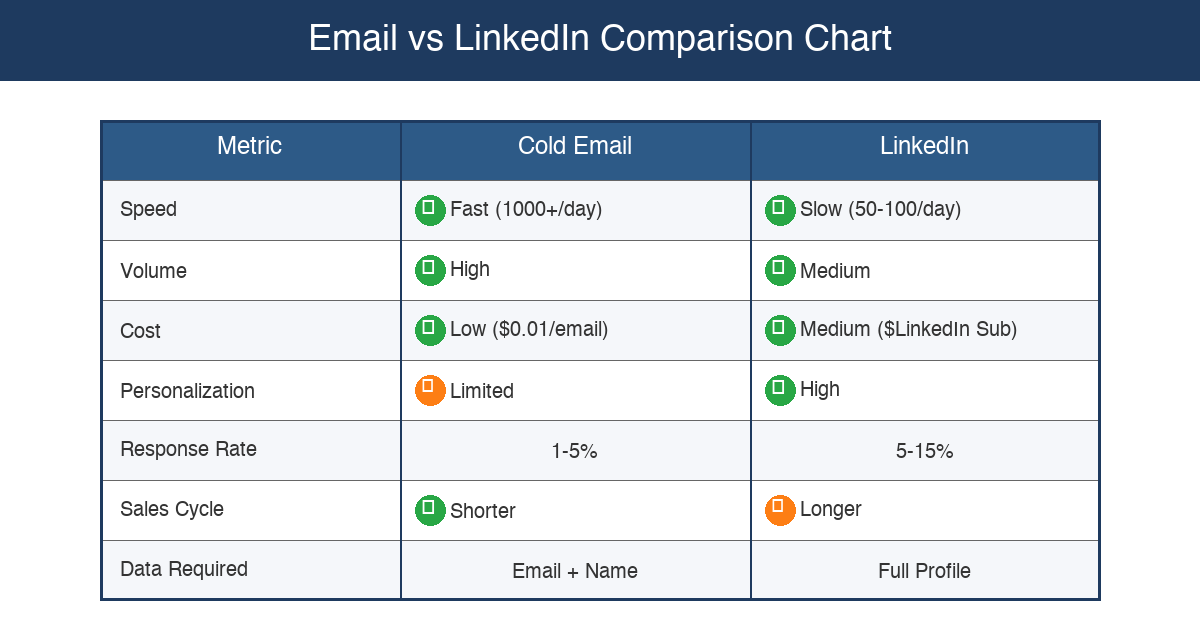
Cold email benchmarks for well-executed campaigns targeting qualified lists: open rates of 20-35%, reply rates of 5-15% for hyper-personalized outreach. Meeting conversion from replies typically runs 30-50%, meaning for every ten replies, three to five convert to booked meetings.
Your overall response rate depends heavily on how well you personalize each message.
LinkedIn benchmarks: connection acceptance rates of 20-40% for InMail-eligible prospects. InMail reply rates of 15-25% for premium users, substantially higher than cold email.
This reflects LinkedIn’s position as a professional communication platform where users expect outreach.
The key insight is that these channels aren’t competitors. Multi-channel campaigns generate responses from both email and LinkedIn, often from the same prospect who engaged through multiple touchpoints.
A prospect who receives your email, sees your connection request, notices your engagement with their content, and receives a follow-up email is far more likely to respond than someone who sees only one channel. The compounding effect of coordinated multi-channel outreach consistently generates three to five times more qualified meetings than single-channel campaigns.
Optimizing Each Channel’s Rates
Email reply rates improve with subject line testing, personalization depth, timing optimization, and follow-up persistence. LinkedIn reply rates improve with relationship-building before direct asks, specific personalization referencing prospect content, and strategic use of InMail for high-priority accounts.
Each channel has distinct optimization levers that effective outbound operations learn to pull.
How Can I Effectively Combine Cold Email and LinkedIn Outreach?
Effective combination requires treating channels as a coordinated system rather than parallel independent efforts. The goal is creating multiple familiarity touchpoints that make conversation inevitable.
Start with cold email on Day One. Email establishes initial contact with detailed value proposition messaging.
It creates a record of your outreach that prospects reference in future interactions. It enables comprehensive communication that LinkedIn outreach can’t match in length and depth.
Add LinkedIn outreach on Day Two or Three. Send a connection request referencing the email.
The prospect now sees your name twice, in two different contexts. This repetition reinforces recognition and legitimacy.
The connection request should reference something specific from your email or add new value, not simply duplicate your pitch.
Engage on social content Days Four through Seven. Like posts, leave thoughtful comments, share relevant articles.
This touchpoint doesn’t require direct contact. It builds familiarity through peripheral exposure.
When the prospect later sees your name in their inbox, it triggers recognition rather than confusion.
Send a second email on Day Seven or Eight that references your LinkedIn engagement. “Hey Sarah, I noticed you just published an article on revenue operations best practices.
Our approach at [Company] takes a similar view on data-driven sales. Happy to share some thoughts if you find it relevant.” This message is personal, valuable, and demonstrates genuine familiarity.
For high-value accounts, add phone calls on Days Ten through Fourteen. Leave voicemail that references both your email and LinkedIn touchpoints.
This voice touch creates urgency and demonstrates multi-channel commitment that sophisticated buyers notice.
The Channel Switching Effect
Channel switching significantly boosts response rates. A reply to an email is more likely from someone who has also seen your LinkedIn request.
A LinkedIn InMail reply is more likely from someone who has received your email. Each channel reinforces the others.
Sophisticated outbound operations track cross-channel engagement and prioritize follow-up on prospects who have shown activity on either channel.
What Are the Best Practices for Cold Email and LinkedIn Outreach?
Best practices for both channels share common principles while requiring channel-specific execution tactics.
- Research Before Reaching Out , Understand business situation, recent activity, professional background, and specific challenges before any message
- Provide Value Before Asking , Every message should give recipients something useful: insight, information, connection, or perspective
- Follow Up Relentlessly , 80% of conversations occur after the fifth follow-up; build sequences providing new value with each touch
- Personalization Depth , First-name-and-company-name find-and-replace isn’t personalization; reference specific articles, events, or trigger events
- Email Deliverability Management , Proper authentication, domain warming, volume management, and data verification are non-negotiable
- Automate Follow-Ups , Manage sequences efficiently by automating follow-up touches wherever possible
Research before reaching out applies to both channels. Understand your prospect‘s business situation, recent activity, professional background, and specific challenges before sending any message.
This research is essential for effective lead generation and b2b sales prospecting. The personalization that transforms generic outreach into relevant conversation starters requires upfront investment.
Provide value before asking is especially critical on LinkedIn but applies to email as well. Every message should give the recipient something useful: insight, information, connection, or perspective they couldn’t get elsewhere.
Messages that only ask for time or attention without giving anything in return generate low response rates regardless of channel.
Follow up relentlessly separates successful prospecting from unsuccessful outreach. Eighty percent of conversations occur after the fifth followup.
Build sequences of five to eight messages that provide new value with each touch rather than simply repeating the same ask. The persistent prospect who provides ongoing value eventually gets the meeting.
To manage these sequences efficiently, you should automate your followup touches wherever possible.
Personalization depth determines response rates. First-name-and-company-name find-and-replace isn’t personalization.
True personalization references specific articles, recent events, mutual connections, or trigger events unique to the prospect’s situation. This research investment pays dividends in dramatically higher reply rates.
Email deliverability management is non-negotiable for cold email. Proper authentication, domain warming, volume management, and data verification keep your messages landing in inboxes rather than spam folders.
Without healthy deliverability, even the best-written emails never get read.
The Consistency Principle
Best practices compound with consistency. A single campaign executed well generates mediocre results.
Consistent application of best practices across hundreds of campaigns generates the pipeline volume that transforms businesses. The teams winning in B2B outbound prospecting are those that have systematized these practices into repeatable processes that improve over time.
Do the math. If our AI infrastructure reaches out to 1,000 highly qualified, triple-verified decision-makers a day, that’s 30,000 people a month. With our hyper-personalization, even an impossibly conservative 1% reply rate yields 300 qualified conversations. In high-ticket B2B, what happens to your revenue when you’ve 300 conversations with your exact ICP?
Frequently Asked Questions
what’s the fastest way to use Cold Email vs LinkedIn Outreach: Which Channel Converts Better in 2026 without burning the market?
Start with a tight ICP, verified data, and a small test batch. Scale only after replies, bounces, and meeting quality prove the message is working.
How many prospects should I contact for Cold Email vs LinkedIn Outreach: Which Channel Converts Better in 2026?
The number matters less than the fit. A smaller list of verified decision-makers will beat a large scraped list because inbox placement, relevance, and timing decide reply quality.
Why do most campaigns around Cold Email vs LinkedIn Outreach: Which Channel Converts Better in 2026 fail?
Most campaigns fail because the data is weak, the offer is vague, and the follow-up system is inconsistent. Fix those three points before adding more volume.
Should I use email only for Cold Email vs LinkedIn Outreach: Which Channel Converts Better in 2026?
No. Email works better when it’s supported by LinkedIn touches, retargeting, and clean CRM follow-up. One channel creates reminders. Multiple channels create recognition.
When should I hire help for Cold Email vs LinkedIn Outreach: Which Channel Converts Better in 2026?
Hire help when you already know the customer profile, the offer is validated, and the bottleneck is execution speed. Outsourcing a broken offer only makes the failure happen faster.
Field Notes From Real Outreach Work
Here is the part most teams miss with Cold Email vs LinkedIn Outreach: the tactic is not the asset. The system around the tactic is the asset. If the list is weak, the message is vague, and the follow-up is random, even a smart idea turns into noise.
The buyer is not sitting around waiting for your pitch. They are dealing with prospects who can see your profile, your credibility, and your weak positioning before they ever reply. The first job of outreach is to prove relevance before persuasion. Name the business problem, make the next step useful, and remove every sentence that sounds like a brochure.
The Checks I Would Run Before Scaling
- Fit: Can we explain why this exact person should care in one sentence? If not, the list is too broad.
- Timing: Is there a trigger, market shift, hiring signal, funding event, expansion move, compliance deadline, or operational pain that makes the message relevant now?
- Proof: Does the email give the buyer a reason to trust the claim before asking for time? A sharp observation beats a generic case-study line.
This is not complicated, but it is unforgiving. A sloppy list makes copy look bad. Weak positioning makes good data useless. And a CTA that asks for a meeting too early forces the buyer to do all the mental work.
The cleaner version is simple: start with 150 accounts, not a giant scraped list. Segment them by pain, write one message for one segment, and watch replies before scaling. If that first batch does not produce signal, more volume will not save the campaign. It will only make the failure louder.
Here is the practical takeaway: make Cold Email vs LinkedIn Outreach narrower, cleaner, and easier to say yes to. Then scale what the market proves, not what the team hopes will work. Build the data layer first, then the message, then the follow-up system. In that order.
Book a strategy call
How to Judge Cold Email Vs Linkedin Outreach Before You Scale
The practical test for cold email vs linkedin outreach is not whether the idea sounds smart. The test is whether it creates qualified pipeline without damaging deliverability, sender reputation, or buyer trust. A strong system connects wall street oasis , cold email still , email list , sales navigator with clear targeting, clean data, and a message that feels written for the exact account.
If the campaign uses inmail and cold email , best approach , comments on linkedin , email format , email that references your linkedin , cold email is still, the team needs a simple operating rule: do not add volume until replies prove the angle. That means watching inbox placement, open rates, reply quality, bounce behavior, and the number of sales meetings that come from real decision-makers.
The Execution Checklist
- Infrastructure: Check b2b leads, inmails, linkedin inmail messages, emails per day before scaling. If this layer is weak, more sending only creates louder failure.
- Targeting: Check linkedin to build, linkedin offers, linkedin premium before scaling. If this layer is weak, more sending only creates louder failure.
- Message quality: Check hit rate, deliverability is a constant, choosing one, conversion rates before scaling. If this layer is weak, more sending only creates louder failure.
- Follow-up: Check platform for b2b, thousands of emails, limits on connection requests before scaling. If this layer is weak, more sending only creates louder failure.
- Measurement: Check marketing agency, return on investment before scaling. If this layer is weak, more sending only creates louder failure.
The bottom line is simple: cold email vs linkedin outreach should be treated like a revenue system, not a one-off campaign. When the list, email infrastructure, personalization, domain setup, and multichannel follow-up work together, the outreach has a real chance to turn cold attention into booked meetings.
How to Judge Cold Email Vs Linkedin Outreach Before You Scale
The practical test for cold email vs linkedin outreach is not whether the idea sounds smart. The test is whether it creates qualified pipeline without damaging deliverability, sender reputation, or buyer trust. A strong system connects linkedin , cold email , outreach , cold email vs linkedin with clear targeting, clean data, and a message that feels written for the exact account.
If the campaign uses linkedin outreach , response rate , personalize , cold emailing and linkedin , b2b , linkedin messages, the team needs a simple operating rule: do not add volume until replies prove the angle. That means watching inbox placement, open rates, reply quality, bounce behavior, and the number of sales meetings that come from real decision-makers.
The Execution Checklist
- Infrastructure: Check lead generation, spam, deliverability, connection requests before scaling. If this layer is weak, more sending only creates louder failure.
- Targeting: Check using linkedin, conversion, b2b sales before scaling. If this layer is weak, more sending only creates louder failure.
- Message quality: Check followup, rapport, automate, cold email vs linkedin outreach before scaling. If this layer is weak, more sending only creates louder failure.
- Follow-up: Check linkedin inmail, cold email and linkedin outreach, cold email or linkedin before scaling. If this layer is weak, more sending only creates louder failure.
- Measurement: Check email outreach, linkedin’s before scaling. If this layer is weak, more sending only creates louder failure.
The bottom line is simple: cold email vs linkedin outreach should be treated like a revenue system, not a one-off campaign. When the list, email infrastructure, personalization, domain setup, and multichannel follow-up work together, the outreach has a real chance to turn cold attention into booked meetings.
The Human Review Layer
The strongest campaigns feel researched because the language names a specific condition in the buyer’s world. The buyer is filtering for relevance, timing, credibility, and the cost of paying attention. For Cold Email vs LinkedIn Outreach, that means the outreach has to connect the business problem, the buying moment, and the proof in a way that feels specific.
A campaign built around better pipeline, which accounts, and authority has more context than a generic pitch. A revenue bottleneck should not be handled with the same CTA as a director bottleneck. A converts pipeline issue needs different copy than a offer issue. This is why shallow templates fail. They flatten different buyer situations into one bland message.
- Reporting: Review reporting against the buyer’s real context before increasing send volume.
- Buyer: Review buyer against the buyer’s real context before increasing send volume.
- Warmup: Review warmup against the buyer’s real context before increasing send volume.
- Which Pipeline: Review which pipeline against the buyer’s real context before increasing send volume.
- Priority: Review priority against the buyer’s real context before increasing send volume.
- Inbox: Review inbox against the buyer’s real context before increasing send volume.
This is the part a generic article usually misses: judgment. A real operator can tell when workflow is the problem, when margin is the problem, and when the whole angle is too soft. That judgment comes from reading replies, checking account quality, and comparing message intent against actual buyer behavior.
The cleaner move is to run a small batch, inspect the signal, then rewrite the weak layer. Do not scale because the copy looks polished. Scale because the replies prove the market understands the value.