In B2B sales and service-driven growth, a well-crafted cold email isn’t merely a message,it’s the beginning of a sales dialogue that can translate into actual revenue. But crafting that one email that gets booked as a demo with a decision-maker? That requires structure, accuracy, and timing.
I’ve witnessed hundreds of cold email campaigns fail just because the sender didn’t realize one reality: you’re not selling in the first email,you’re attempting to initiate a conversation.
At our cold outreach firm, this is a shift in thinking that we take with every campaign that we construct. Today, I’m going to take you through our time-tested 5-step process for converting cold emails into qualified appointments,with templates and real-world advice mixed in.
Why Cold Emails Still Work (If You Do It Right)
Let’s put one thing straight,cold email isn’t dead. It’s just overpopulated with terrible messaging.
The issue isn’t that no one responds to cold emails. The issue is that most cold emails:
Chat too much about the sender
Request time too soon
Come across like copy-pasted spam
Provide no obvious reason to respond
When you turn the script around and think about the buyer,what matters to them, what they’re busy with, and what’s on their mind,you begin to make your emails relatable. Human. Worth answering.
The 5-Step Framework: Cold Email to Demo
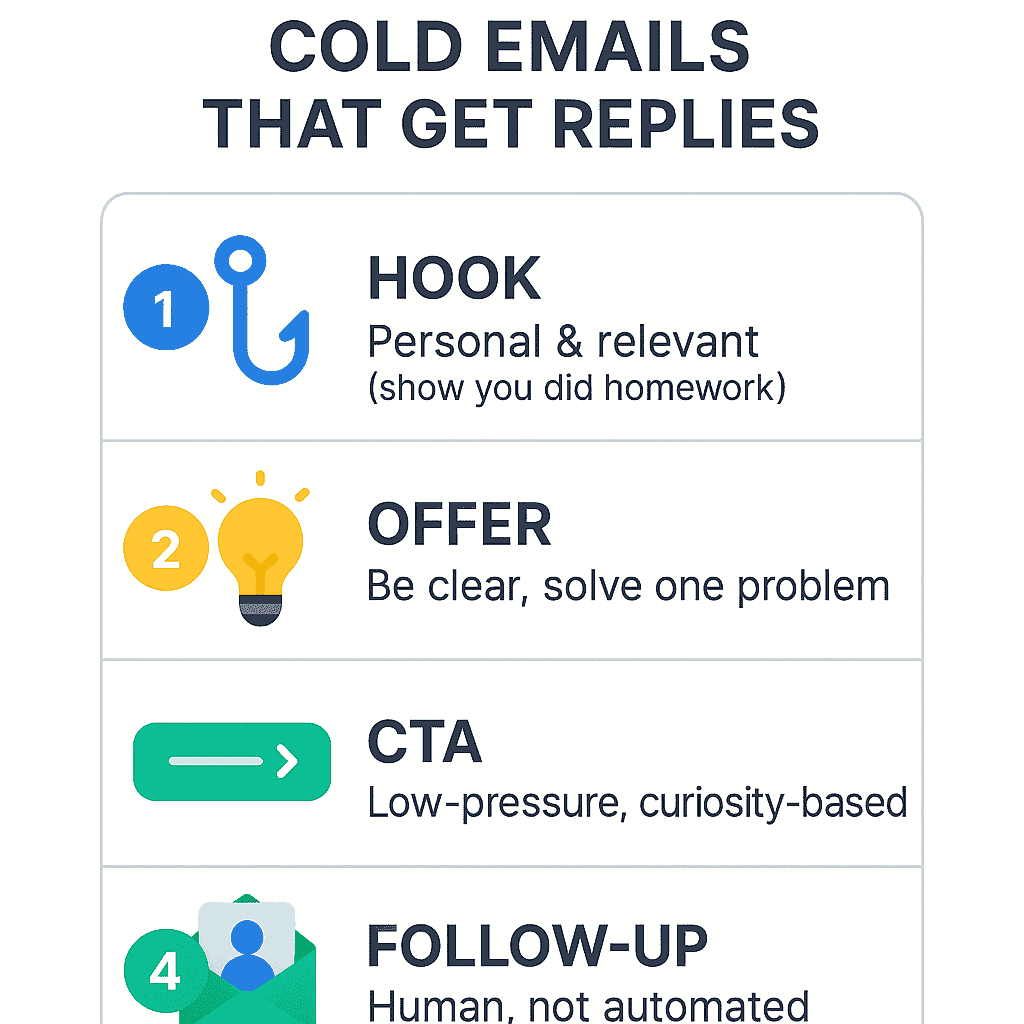
Let’s get into it. This is the same process we follow within our cold outreach agency to reliably book client calls with decision-makers.
Step 1: Begin With a Hyper-Relevant Hook
Your opening sentence is what decides if the rest of your email gets any consideration at all.
This isn’t the time for a boring, generic opening like:
“I hope this email finds you well…”
Instead, tailor your hook to something current and pertinent. Consider:
A LinkedIn update they recently posted
A job listing
A funding announcement
A podcast they were on
A shift in their team or product
Sample Hook:
“Saw that your team rolled out the new payment feature,great rollout. Wondering how you’re approaching customer onboarding with the increased complexity.”
The hook’s job is to demonstrate: “I’m not a bot. I did my homework.”
Step 2: Make Your Offer Crystal Clear
This is where you say what you assist with,in 1–2 sentences maximum. Be ridiculously clear. Don’t use jargon. No buzzwords. No fluff.
The trick: Don’t tell them everything you do. Simply demonstrate how you assist in the resolution of a particular problem they most likely have.
Formula:
I assist [type of firm] in resolving [particular pain] so that they can [benefit/outcome].
Example:
I assist SaaS teams in decreasing lead drop-off during onboarding by streamlining the first 3 touchpoints,something we’ve accomplished for tools such as [X] and [Y].
Now you’ve established the value,without hitting them over the head with it.
Step 3: Employ a Soft, Casual CTA
This is where most cold emails get it wrong: they request a 30-minute call immediately. That’s a tall order from a stranger.
Instead, employ a low-friction CTA,one that sparks curiosity rather than commitment.
Nice CTAs:
“Would it make sense to share a quick idea?”
“Want a 2-line summary of what worked for [company]?”
“Open to hearing a shortcut we’ve seen work in your space?”
The objective is to receive a response, not a calendar invite. When they do, you lead them to a call organically.
Step 4: Send Non-Automated-Looking Follow-Ups
Few demos are scheduled after the initial email. It takes 2–4 considerate, value-focused follow-ups.
Here’s our framework:
Follow-Up #1 (2–3 days later): “Just checking if this struck a chord,happy to further clarify if useful.”
Follow-Up #2: Introduce a new spin or mini-case study. “Saw something similar work for [Competitor X],happy to share the logic if you’re curious.”
Final Nudge: “Totally understand if now’s not the right time. Want me to circle back in a few weeks?”
Each note remains short, human, and polite.
Step 5: Make Scheduling Frictionless (Once They Say Yes)
As soon as one person responds with “Sure, tell me more” or “Send something over,” you’ve got an opportunity. Don’t blow it by shooting them a 10-link proposal.
This is how we respond when a prospect expresses interest:
Example Response:
Great,I’ll keep it brief. Would you be willing to do a quick 15-minute call next week so I can work the examples into what you’re doing?
Here’s my calendar: [Link]
Or send yours, and I’ll make it work.
Make it easy. Flexible. Casual. And always reconfirm the value: you’re not just selling,you’re sharing something useful.
The Cold Email Template (Steal This One)
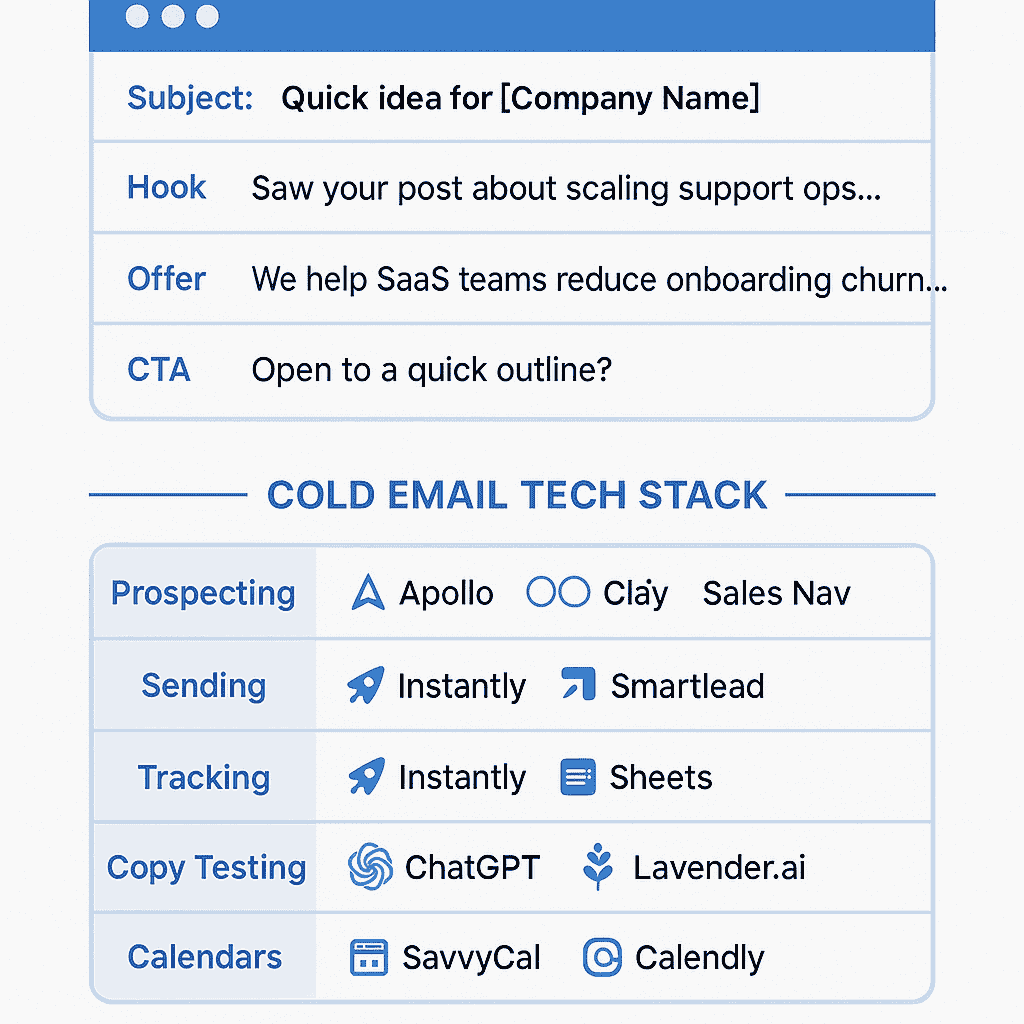
Here’s a full template based on the above structure that consistently gets replies:
Subject Line: Quick idea for [Company Name]
Email:
Hi [First Name],
Saw your post about scaling your support ops last week,looks like things are moving fast.
I consult with growth-stage SaaS teams to minimize onboarding user churn (typically by rewriting the first 3 engagement emails + demo logic). We’ve had fantastic success with [X] and [Y].
Would be happy to send a rough outline of what helped them out,might be useful if you’re struggling with similar gaps. Open to it?
– [Your Name]
Brief. Simple. Friendly. And it gets you into conversation,not friction.
Bonus: Scaling Cold Email Tech Stack (What We Use)
Scaling your cold emailing efforts? You’ll need the tools. Here’s our go-to tech stack at Coldoutreach agency:
Prospecting & Data: Apollo, Clay, LinkedIn Sales Nav
Email Sending: Instantly, Smartlead, Mailreach (warmup)
Tracking & Sequences: Instantly + custom-built Google Sheets dashboard
Copy Testing: ChatGPT (for draft gen), Lavender.ai
Calendars: SavvyCal or Calendly with round-robin for sales teams
But remember,tools won’t fix bad targeting or unclear offers. They just scale what’s already working.
Final Thoughts: Your First Cold Email Isn’t the Pitch. It’s the Preview.
I’ll be honest,getting demo calls from cold email isn’t about fancy copywriting or automation. It’s about being relevant, fast, and easy to talk to.
At our cold outreach agency, each client campaign is designed with one purpose in mind: to open doors with the right individuals through messages that read like they’re from a human, not a machine.
So if your current cold emails aren’t driving booked demos, ask yourself:
Are you too wrapped up in what you do?
Are you creating a reason for people to care?
Are you making it easy for them to say “yes”?
Repair those,and observe your response rate change.
And if you need assistance crafting cold emails that get real responses, we’re here.
FAQs on Converting Cold Emails into Appointments
1. How long should a cold email be when attempting to schedule a demo?
Your first cold email should be no more than 50–100 words. Make it short, personalized, and all about the value you’re providing. In our experience at Coldoutreach agency, we’ve found the best results using 3–4 sentence formats that start with relevance.
2. Is a calendar link something that I should add in the initial cold email?
No. Putting a calendar link in your initial email might come across as pushy. Use a gentle CTA such as “Open to hearing a quick idea?” and share your link only after they express interest.
3. What subject lines have the most effective open rates?
Short, specific, and personalized subject lines work best. Steer clear of clickbait. Good examples: “Quick idea for [Company],” or “Saw this on your LinkedIn.”
4. How many follow-ups do I send?
Send 3–4 follow-ups max, staggered over 7–10 days. Each follow-up should introduce fresh context or insight,not simply the dreaded “bumping this.” If you don’t get a response after four tries, stop or recycle later.
5. What’s a good reply rate on demo-focused cold emails?
A solid reply rate is between 8–12%, with 3 to 5% of those turning into booked demos. If you’re under that, revisit your targeting, offer clarity, or your CTA. Cold outreach agency clients usually see consistent appointment flows once those three are aligned.
Frequently Asked Questions
what’s the fastest way to use Cold Email to Appointment in 5 Steps: Template for Scheduling Demos with Decision-Makers without burning the market?
How many prospects should I contact for Cold Email to Appointment in 5 Steps: Template for Scheduling Demos with Decision-Makers?
Why do most campaigns around Cold Email to Appointment in 5 Steps: Template for Scheduling Demos with Decision-Makers fail?
Should I use email only for Cold Email to Appointment in 5 Steps: Template for Scheduling Demos with Decision-Makers?
When should I hire help for Cold Email to Appointment in 5 Steps: Template for Scheduling Demos with Decision-Makers?
Research worth checking
Pew Research internet behavior data
Field Notes From Real Outreach Work
Here is the part most teams miss with Cold Email to Appointment in Steps. The tactic is not the asset. The system around the tactic is the asset. If the list is weak, the message is vague, and the follow-up is random, even a smart idea turns into noise. That is why we look at Cold Email to Appointment in Steps through one simple question: would a serious buyer believe this was built for their situation, or would they assume it was blasted to 10,000 people?
The buyer is not sitting around waiting for your pitch. They are dealing with inbox providers, skeptical buyers, and prospects who delete anything that feels copied. So the first job of outreach is not persuasion. It is pattern interruption with proof. Show that you understand the buyer’s world, name the business problem clearly, and make the next step feel useful instead of needy.
The 3-Part Check We Use Before Scaling
- Fit: Can we explain why this exact person should care in one sentence? If not, the list is too broad.
- Timing: Is there a trigger, market shift, hiring signal, funding event, expansion move, compliance deadline, or operational pain that makes the message relevant now?
- Proof: Does the email give the buyer a reason to trust the claim before asking for time? A sharp observation beats a generic case-study line.
This is not complicated, but it is unforgiving. A sloppy list makes copy look bad. Weak positioning makes good data useless. And a CTA that asks for a meeting too early forces the buyer to do all the mental work. That is where most campaigns die.
Want the cleaner version? Start with 200 accounts, not 20,000. Segment them by pain, write one message for one segment, and watch replies before scaling. If the first 200 prospects do not produce signal, more volume will not save the campaign. It will only make the failure louder.
A Simple 7-Day Repair Plan
- Day 1: Cut the list down to the buyers who match your best customer profile. Remove anyone who looks attractive but cannot buy.
- Day 2: Rewrite the opener around a trigger. A hiring post, expansion page, tech stack clue, or operational bottleneck gives you a reason to exist in their inbox.
- Day 3: Replace feature language with business language. Buyers do not care that your system is clever. They care whether it reduces risk, creates pipeline, saves time, or improves conversion.
- Day 4: Build two follow-ups before sending the first email. If the campaign depends on one message, it is not a campaign. It is a wish.
- Day 5: Check the infrastructure. SPF, DKIM, DMARC, domain age, inbox rotation, and bounce control matter because brilliant copy in spam is still invisible.
- Day 6: Add one LinkedIn touch. Not a pitch. A profile visit, useful comment, or soft connection request gives the email context.
- Day 7: Review replies by category. Interested, wrong person, timing issue, objection, unsubscribe, and silence all tell you what to fix next.
The mistake is treating campaign failure like a copywriting problem only. Sometimes it is. Often it is a targeting problem, a data problem, a deliverability problem, or a lazy offer problem. You do not fix those with a prettier subject line. You fix them by isolating the bottleneck and improving one variable at a time.
The bottom line: Cold Email to Appointment in Steps works when it is specific, measured, and tied to a real buying moment. It fails when it sounds like every other vendor trying to sound clever. If you want this installed properly, build the data layer first, then the message, then the follow-up system. In that order.