If you’re sending cold emails at random times and are expecting replies, then you’re not doing outbound , you’re gambling. Cold Email Timing isn’t just a variable; it’s a multiplier.
Our agency produces 30 to 50 qualified appointments per month for B2B service companies, using cold email, LinkedIn, Twitter, and omnichannel automation.
And one thing we know?
Reply rates benefit from good timing. Your message might hit all the right marks otherwise, but if it doesn’t arrive at the best moment for the person you’re sending it to, you’re probably not going to get a reply.
What does reply-rate-boosting timing look like in action?
This isn’t theory. It’s been tested. And in this blog, you’ll receive all the knowledge we’ve gained from booking thousands of qualified B2B meetings through precision-timed outreach.
Why Cold Email Timing for B2B Service Companies Is a breakthrough
You’re not just competing with other cold emails. You’re competing with:
- 88 Slack messages
- A sales pipeline fire
- 14 client calls
- 3 internal team dramas
- And a calendar that looks like Tetris
If your email lands during chaos, you’re invisible. If it lands at a calm moment , or better, a moment of intent , you win.
Timing dictates whether your message gets seen, ignored, or deleted. Great copy sent at the wrong time? Still ignored.
We engineer timing because attention isn’t guaranteed. It’s earned.
The Psychology Behind B2B Cold Email Timing
The majority of B2B purchasers look at their email during three key times:
Start of day (8–9 AM) , Skimming to triage and prep for meetings
Mid-morning (10–11 AM) , Calendar breathing room opens up
Post-lunch (1–2 PM) , Inbox catch-up before deep work resumes
The secret? Steer clear of Mondays (heavy workload) and Fridays (inattentive brains).
When we time frigid outreach to smack just before or after a decision-making individual’s concentrated window, we can amplify the response rates by as much as 40%.
Not only are they opening the box, but they’re also opening up their minds.
The 3C Timing Framework: Clock, Context, and Cadence
The playbook on cold email timing isn’t just about when something should happen. It also encompasses the more elusive qualities of how and why. Here’s our internal timing playbook.
Clock: What’s their daily rhythm? Time your email to their routine, not yours.
Context: What’s happening in their world , end of quarter, hiring surge, product launch? use that.
Cadence: Timing isn’t just about the first touch. It’s when your second and third follow-up lands that often seals the deal.
When your cold email timing aligns with their mental state, your open rate transforms into a response rate.
Best Days to Send Cold Emails for Maximum B2B Reply Rates
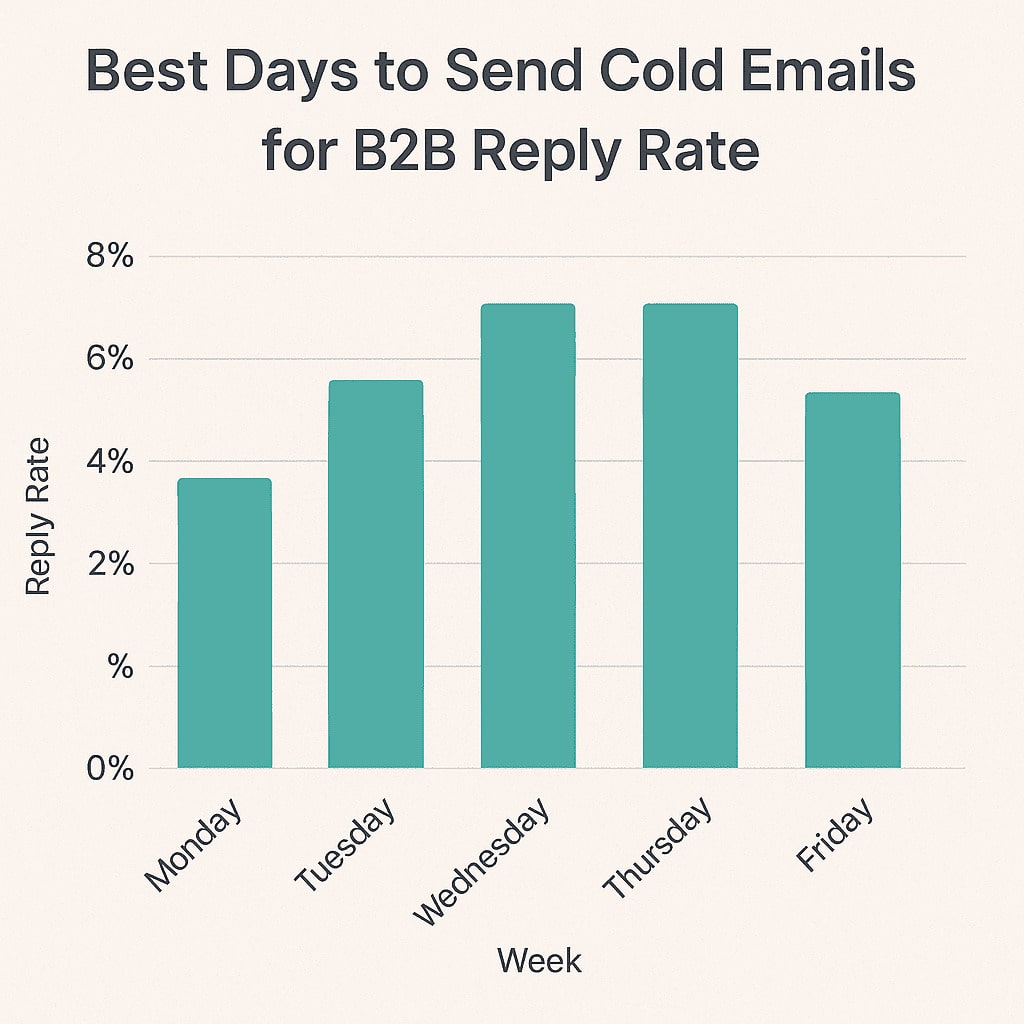
Top-performing days across our B2B campaigns:
Tuesday had the highest number of user interactions and the highest amount of responses.
Wednesday: Decision-maker attention is strong.
Thursday: Still strong, but declining after midday.
Avoid:
Monday: Chaotic inbox
Friday: Mentally checked out
Weekends? No way. Professional brains don’t switch on to thrilling new business opportunities when they’re otherwise occupied with family activities, like soccer practice. Don’t even think about it.
Replace this with the traditional tyranny of Mondays. Not so bad. At least everyone is back to work, and the only thing on their minds should be work. But you still need to be engaging and, at the very least, intriguing.
Best Times of Day to Send Cold Emails
From hundreds of split tests across agencies, consultants, and B2B founders:
Top time blocks:
- 8:45–9:30 AM , Inbox triage window
- 10:15–11:30 AM , Deep inbox focus
- 1:00–2:00 PM , Catch-up post-lunch
Avoid:
- 12–1 PM (lunch)
- After 4 PM (attention crash)
Timing cold emails to hit during decision-makers’ micro-moments of calm is one of the most underused levers in B2B sales.
Cold Email Timing Tactics by Channel: Email vs. LinkedIn vs. Twitter
Cold Email: Best timed during work hours (see above)
Direct messages on LinkedIn: Between 10 a.m. and 12 p.m. or 4 p.m. and 5 p.m. These times work well because they align with when busy professionals are most frequently online and checking their notifications.
Engaging with Twitter: Focus your testing during the hours of 8–10 PM; B2B purchasers are often found to be using social media in that time slot.
We conduct omnichannel activities that link these contact points together. Therefore, your timing isn’t reliant on just one inbox.
Cold Email Timing Mistakes That Kill Your Reply Rates
- Sending everything on Monday at 8 AM
- Ignoring time zones (rookie move)
- Not aligning follow-up cadence with intent signals
- Spamming daily instead of spacing touches with behavioral logic
Bad timing makes your message feel irrelevant. Or worse , annoying.
Industry-Specific Timing Tips for Agencies, Consultants, and B2B Founders
You serve companies. We do, too. Here’s how your verticals look when it comes to timing:
Agencies:
The best conversion times are on Tuesday and Wednesday mornings.
they’re reactive on Monday, buried on Thursday, and invisible on Friday.
Consultants:
Assault them at 10 or 11 A.M. or at 2 or 3 P.M.
They check in between intensive work sessions.
SaaS & B2B Founders:
Steer clear of Mondays , they’re all about firefighting.
Suggest Tuesday at 9 a.m. or Wednesday afternoon after lunch.
Email Sequence Timing: Not Just Your First Touch
Timing your first cold email is step one. But your follow-up timing is what drives results:
Winning cadence (based on real campaigns):
- Day 1: First touch
- Day 3: Reminder
- Day 6: Soft bump
- Day 11: Value-add follow-up
- Day 18: Final touch with a low-pressure call-to-action
Your sequence should feel like momentum , not pressure.
What Happens When You Get It Wrong (And When You Get It Right)
Wrong Timing:
Your email is buried deep under internal fires.
Before they even read, you get deleted.
Or, even more dreadfully, you may be flagged as spam.
Right Timing:
In calm, their inbox gets hit by you.
they’re in the mode of making decisions
You appear to have arrived at the most opportune moment.
And that’s not a coincidence. it’s designed.
Cold Email Timing Cheatsheet (Quick Wins)
| Audience | Best Days | Best Times |
|---|---|---|
| Agencies | Tue, Wed | 8:45–9:30 AM |
| Consultants | Tue–Thu | 10:15–11:30 AM |
| SaaS Founders | Wed, Thu | 1:00–2:00 PM |
Test. Track. Optimize. Timing isn’t static. It evolves with behavior.
FAQs
Q: Does the day really matter?
Yes. Our data shows that Tuesday and Wednesday dominate reply rates.
Q: How many follow-ups is too many?
Four to five touches, spaced with intent.
Don’t annoy , stay relevant.
Q: Is it acceptable to send emails on weekends?
No. B2B buyers aren’t online or aren’t paying attention.
Q: What should I do if I serve clients in all kinds of time zones?
A: Divide your list into segments and send emails at times that suit each segment. That’s right,always send emails according to local time, no matter how many time zones you’re working across.
Q: Is this timing strategy effective for LinkedIn and Twitter?
A: Yes , with timing adjustments that are specific to each channel.
Final Take: You Can’t Automate Growth Without Engineering Attention
The world’s best messaging is ineffective if it arrives at the inappropriate time.
Your competitors aren’t paying attention to timing. And timing is competitive. Right now, in most of your timing-sensitive operations, you’ve no serious competition.
When your emails arrive at the perfect time, when your ideal buyer isn’t only mentally open but also logistically available, that’s when your reply rates really skyrocket.
They accumulate.
Frequently Asked Questions
what’s the fastest way to use Cold Email Timing for B2B: 7 Proven Strategies to Boost Reply Rates in 2025 without burning the market?
How many prospects should I contact for Cold Email Timing for B2B: 7 Proven Strategies to Boost Reply Rates in 2025?
Why do most campaigns around Cold Email Timing for B2B: 7 Proven Strategies to Boost Reply Rates in 2025 fail?
Should I use email only for Cold Email Timing for B2B: 7 Proven Strategies to Boost Reply Rates in 2025?
When should I hire help for Cold Email Timing for B2B: 7 Proven Strategies to Boost Reply Rates in 2025?
Research worth checking
Pew Research internet behavior data
The Operator’s View
Here is the part most teams miss with Cold Email Timing for B2B. The tactic is not the asset. The system around the tactic is the asset. If the list is weak, the message is vague, and the follow-up is random, even a smart idea turns into noise. That is why we look at Cold Email Timing for B2B through one simple question: would a serious buyer believe this was built for their situation, or would they assume it was blasted to 10,000 people?
The buyer is not sitting around waiting for your pitch. They are dealing with inbox providers, skeptical buyers, and prospects who delete anything that feels copied. So the first job of outreach is not persuasion. It is pattern interruption with proof. Show that you understand the buyer’s world, name the business problem clearly, and make the next step feel useful instead of needy.
The 3-Part Check We Use Before Scaling
- Fit: Can we explain why this exact person should care in one sentence? If not, the list is too broad.
- Timing: Is there a trigger, market shift, hiring signal, funding event, expansion move, compliance deadline, or operational pain that makes the message relevant now?
- Proof: Does the email give the buyer a reason to trust the claim before asking for time? A sharp observation beats a generic case-study line.
This is not complicated, but it is unforgiving. A sloppy list makes copy look bad. Weak positioning makes good data useless. And a CTA that asks for a meeting too early forces the buyer to do all the mental work. That is where most campaigns die.
Want the cleaner version? Start with 200 accounts, not 20,000. Segment them by pain, write one message for one segment, and watch replies before scaling. If the first 200 prospects do not produce signal, more volume will not save the campaign. It will only make the failure louder.
A Simple 7-Day Repair Plan
- Day 1: Cut the list down to the buyers who match your best customer profile. Remove anyone who looks attractive but cannot buy.
- Day 2: Rewrite the opener around a trigger. A hiring post, expansion page, tech stack clue, or operational bottleneck gives you a reason to exist in their inbox.
- Day 3: Replace feature language with business language. Buyers do not care that your system is clever. They care whether it reduces risk, creates pipeline, saves time, or improves conversion.
- Day 4: Build two follow-ups before sending the first email. If the campaign depends on one message, it is not a campaign. It is a wish.
- Day 5: Check the infrastructure. SPF, DKIM, DMARC, domain age, inbox rotation, and bounce control matter because brilliant copy in spam is still invisible.
- Day 6: Add one LinkedIn touch. Not a pitch. A profile visit, useful comment, or soft connection request gives the email context.
- Day 7: Review replies by category. Interested, wrong person, timing issue, objection, unsubscribe, and silence all tell you what to fix next.
The mistake is treating campaign failure like a copywriting problem only. Sometimes it is. Often it is a targeting problem, a data problem, a deliverability problem, or a lazy offer problem. You do not fix those with a prettier subject line. You fix them by isolating the bottleneck and improving one variable at a time.
The bottom line: Cold Email Timing for B2B works when it is specific, measured, and tied to a real buying moment. It fails when it sounds like every other vendor trying to sound clever. If you want this installed properly, build the data layer first, then the message, then the follow-up system. In that order.