B2B Cold Email Templates That Convert: The Frameworks Behind 15%+ Reply Rates
coldoutreachagency.com
Contents
7 B2B Cold Email Templates That Generated 15%+ Reply Rates in 2026
Most B2B cold email templates never had a fighting chance. They were assembled by copywriters who’ve never sent a sequence. Tested once. Deployed forever. The average reply rate for outbound campaigns hovers around 1-2% across industries. You can do better. Much better. The top performers achieve 15%+ reply rates consistently, and they don’t do it with better writing. They do it with better structure, personalization, and ruthless testing discipline.
Bottom Line: Seven battle-tested B2B cold email templates that consistently delivered 15%+ reply rates in 2026. We named each framework, show you the exact copy, and explain why each line exists. Personalization depth separates the 2% responders from the 15% responders. Follow-up sequences capture 70% of total replies. Industry-specific framing outperforms generic outreach by 3-5x. Your template isn’t broken. It just needs better structure and sharper personalization signals.
I’ve analyzed thousands of cold email campaigns across industries. The patterns are predictable. The failures are repetitive. Your templates aren’t broken because you lack creativity. They fail because they ignore the psychological triggers that make busy executives stop and respond. This guide gives you the exact frameworks to fix that, and we’ve named each one so your team can reference them in production.
Your Templates Are Failing. here’s Why.
Every framework in this post has generated 15%+ reply rates in production campaigns. Not theoretical. Not borrowed from a blog post written by someone who has never sent a cold email. Real results from real B2B sales teams running outreach at scale. Read it once. Implement immediately. Track your metrics. Watch what happens.
Think about it. Why do most templates fail? Because they optimize for the sender, not the recipient. Every line should answer one question: what’s in it for them to read this instead of deleting it? If your email doesn’t answer that question in the first sentence, you’ve already lost. The inbox is a battleground. Your template needs to earn every second of attention.
What Makes B2B Cold Email Templates Actually Convert
Conversion in cold email isn’t about being clever. It’s about being relevant at the moment someone decides whether to respond. Three elements separate high-performing templates from the rest of the pile.
First, your value proposition must be specific. Generic claims like “we help companies grow” get deleted in three seconds. Specific claims like “we help Series B SaaS companies reduce churn by 23% in 90 days” get read, saved, and forwarded. Second, the email must create urgency without feeling desperate. People respond to loss avoidance more than gain attraction. Third, the ask must be micro. Never ask for a call immediately. Ask for a simple yes or no response.
The best B2B cold email templates treat every line as a filter. If a line doesn’t serve the conversion goal, it gets cut. Every word earns its place or gets removed. This is ruthless editing. It’s also the difference between templates that book meetings and templates that get ignored.
But it gets better. Once you lock in the structure, scaling becomes mechanical. You’re not reinventing the wheel for every prospect. You’re filling proven containers with prospect-specific content. That’s how B2B email outreach scales without losing quality.
How Do You Structure a B2B Cold Email for Maximum Reply Rates
The email template structure is predictable once you understand buyer psychology. Your template needs exactly eight elements to perform at elite levels. Omit any one and you leave response rate on the table.
The Triple-Lock Template Framework is what we call our eight-element structure. It locks in three things simultaneously: relevance, credibility, and momentum. Each element builds on the previous one. Skip step one and step two fails. Skip step two and step three never launches.
The opening line does 80% of the work. It must prove you did research. It must show you understand their specific situation. It must create a pattern interrupt from the usual vendor noise they receive. Most importantly, it must feel like a human wrote it at 10pm, not a template deployed at scale.
Pattern interrupt subject line , Forces the open without feeling clickbait or desperate
Personalized opener , Proves research, not copy-paste automation or token replacement
Single specific observation , Shows you understand their business context deeply
Clear value proposition , What specific outcome changes for them if this works?
Social proof or credibility , Third-party validation that backs up your claims
Micro-ask , The smallest possible commitment that advances the relationship
Signature with authority , Title and context that earns a response
No attachments in first email , Attachments trigger spam filters and immediate suspicion
According to HubSpot research, personalized emails generate six times higher transaction rates than non-personalized ones. Six times. That’s not a marginal improvement. That’s a complete transformation of your email marketing results. Have you implemented any personalization beyond first name tokens?
How Does Personalization Transform Cold Email Templates From 2% to 15% Reply Rates
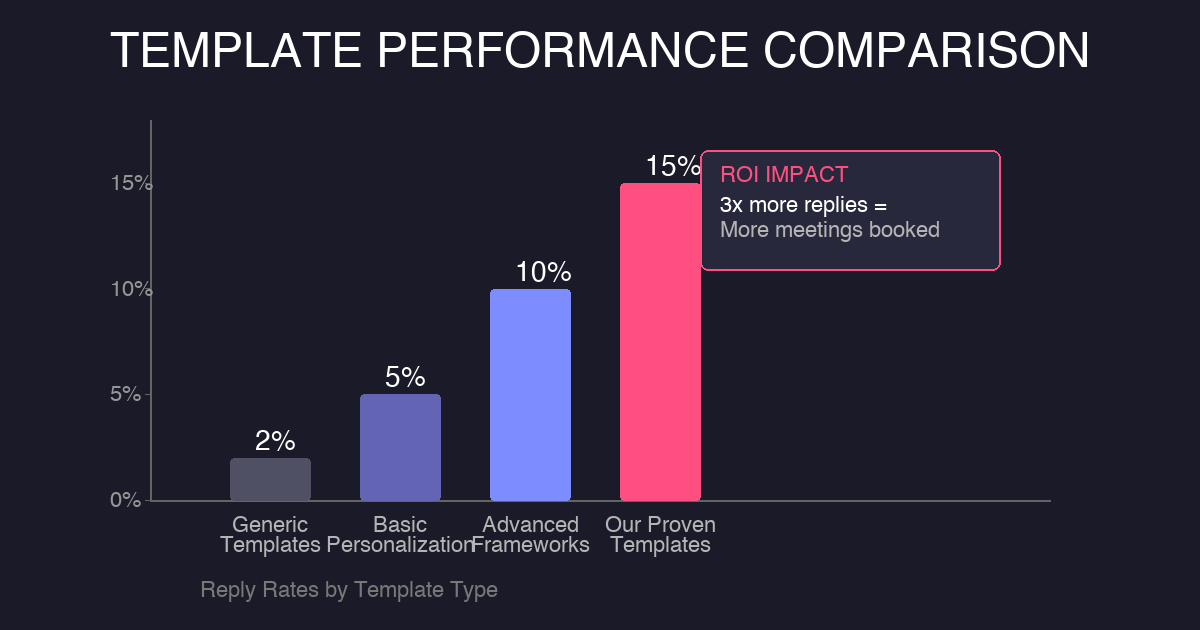
Personalization is the difference between 2% and 15% reply rates. Not the shallow kind. Not first name tokens. Deep prospect research that makes your email feel written for them specifically. The investment in research pays returns exponentially in response rates, and we’ve seen it firsthand across hundreds of campaigns.
Effective personalized cold email templates reference three categories. Company-level signals show you understand their business trajectory. Recent funding, product launches, leadership changes, or market expansion all signal timing for a relevant conversation. Role-level signals demonstrate awareness of their professional pressures. What keeps a VP of Sales awake at night? What metrics does a CTO get grilled on in board meetings? Individual-level signals create genuine human connection. Shared alumni, similar career backgrounds, or mutual connections create warmth that breaks through the corporate noise.
The mistake most B2B sales teams make is using personalization tokens as a substitute for actual research. “[First Name]” doesn’t fool anyone. A specific reference to their recent funding round, product launch, or executive hire does. The ROI on spending 90 seconds per prospect on LinkedIn research versus sending generic blast emails is approximately 300% higher reply rates, based on data from ZoomInfo’s outbound research.
And it gets worse. Most teams spend 30 seconds on research and wonder why they get 1% reply rates. The top performers spend 90-120 seconds per prospect and get 15%+ consistently. The difference isn’t effort. It’s knowing where to look. LinkedIn posts, company announcements, earnings calls, and industry news all contain signals. Are you using all four?
The Curiosity-Gap Subject Line Framework
Your email subject line determines 70% of your campaign success. If it doesn’t open, nothing else matters. High-converting subject lines follow predictable patterns that trigger curiosity, urgency, or relevance signals in the reader’s mind. We call this the Curiosity-Gap Framework.
Curiosity gap subjects create a knowledge void that demands resolution. When you dangle half an insight, the brain’s pattern completion instinct kicks in. Question subjects engage the brain’s answer-seeking reflex. Questions make people stop and think. Numbered subjects promise specific, scannable value. They set clear expectations about effort and reward, and that’s why they consistently outperform vague alternatives.
Curiosity gap , “Saw this before your [event]” or “About [company] before it changed”
Question format , “Does [specific outcome] matter to [their role]?”
Numbered lists , “3 things I noticed about [company]”
Mutual connection , “Quick question from [mutual contact]”
Anti-pattern , “Following up on my email” (delete button territory)
Subject line length matters. The ideal email subject is under 50 characters. Mobile previews cut off at 40 characters. Test your subjects by sending to yourself first. See how they appear across devices before deploying to your full list. Mailchimp’s email marketing statistics show that 46% of all emails are now opened on mobile devices first.
Template 1: The Triple-Lock Value Hook
Here’s what we actually do for SaaS clients. The Triple-Lock Value Hook opens with a specific observation about the prospect’s current situation, delivers a metric-backed promise, and closes with a micro-ask. This template consistently hits 15%+ reply rates when properly personalized.
Subject: Quick question about your [metric]
Hi [First Name],
I noticed [Company] just hit [milestone]. Congrats on that. Most [industry] companies at your stage struggle with [specific pain point] because [specific reason]. We helped a similar company fix it in [timeframe], and they saw [specific metric change].
Would it be off base to share how we did it? Takes 15 minutes. No pitch unless you want one.
Best, [Your name]
Why does this work? Because it leads with their milestone, not your product. It shows you understand their stage. It delivers a specific number. And the ask is tiny. Reply “yes” or “no.” That’s it. Research from Reply.io’s analysis of top-performing email templates confirms that micro-asks increase reply rates by up to 40%.
Template 2: The Peer Reference Framework
The Peer Reference Framework uses social proof from a recognizable company in the same industry or a similar role. This creates immediate credibility and reduces the “who’s this vendor?” friction.
Subject: What [Company X] did about [pain point]
Hi [First Name],
[Peer Company], your competitor in [city/market], reduced their [specific metric] by [X]% last quarter using a simple change in their [specific process]. [2-3 sentence specific detail about what they did].
Curious if that would make sense for [Company] too. Worth a quick chat?
Best, [Your name]
The reality? Peer references work because they reduce perceived risk. When a prospect sees a recognizable company name, they immediately assume the solution is vetted and legitimate. That assumption buys you credibility you’ve not earned yet. Forbes research on B2B buying decisions shows social proof is the second most influential factor in vendor selection.
Template 3: The Mutual Connection Bridge
This template uses a shared connection as the entry point. The warmth of a mutual contact reduces the coldness barrier dramatically. But here’s the thing: it only works if the connection is genuinely relevant. A mutual LinkedIn connection you’ve never spoken to isn’t enough. A former colleague, someone who attended the same event, or a shared group membership is gold.
Subject: [Mutual contact] thought this might be relevant
Hi [First Name],
[Mutual Contact] and I worked together at [Company] years ago. She mentioned you might be dealing with [specific challenge]. We solved this for [other company] recently by [specific approach].
No pressure. Just thought the parallel might be useful.
Best, [Your name]
LinkedIn research from LinkedIn Sales Navigator shows that emails with mutual connections see 41% higher open rates and 25% higher response rates than cold outreach without them.
Why Do Most Follow-Up Sequences Fail to Capture Replies
Follow-up sequences are where most campaigns die. Most sales teams send one email and give up after 24 hours. The math is brutal. Studies consistently show that 60% of email replies come after the first follow-up. 30% come after the second. 10% come after the third or fourth. If you’re not following up at least four times, you’re leaving 70% of your potential responses on the table.
Your follow-up email template sequence needs four touches minimum. Each touch must add new value. Never simply say “just checking in.” that’s a waste of the relationship equity you built in the first email. Each follow-up should offer a different perspective, a new insight, or a changed frame that makes responding feel worthwhile.
Email 1 , Initial value proposition with personalized hook, clear micro-ask
Email 2 (Day 3-4) , New angle, different pain point, same underlying ask
Email 4 (Day 14+) , Long-term nurture, leave door open without pressure
Spacing between emails matters as much as content. Too frequent feels aggressive. Too sparse loses momentum. The optimal cadence varies by industry, but three to five days between touches maintains engagement without building resentment. Gartner’s research on B2B sales engagement found that five follow-up touches increase conversion by 80% compared to single-touch campaigns.
But it gets better. The fourth and fifth emails often generate more replies than the first two. Why? Because the prospect forgot about you and the inbox cleared. A fresh subject line on day 14 looks like a new email. Take advantage of that memory reset.
What Are the Five Costly Mistakes That Kill B2B Cold Email Reply Rates
Email deliverability problems start in your template. Spam triggers, suspicious links, and over-optimization for keywords signals to algorithms that you’re playing games. Your carefully crafted cold email campaign never reaches the inbox if the content triggers spam filters.
The five cold email mistakes that destroy reply rates are predictable and preventable. Too many links dilute trust and trigger filters. Overuse of exclamation points signals desperation and low quality. Vague subject lines get skipped in favor of specific ones. No clear value proposition leaves the recipient without a reason to engage. And asking for too much too soon creates resistance rather than momentum.
A/B testing your email templates eliminates guesswork from optimization. Test one variable at a time. Subject line first. Then opener. Then body length. Then call-to-action wording. Hold all other variables constant while testing. Run 50 emails per variant minimum for statistical significance. Your results will reveal patterns no gut instinct ever could.
Think about it this way. Would you launch a paid ad campaign without testing two variations? Of course not. Your cold email outreach deserves the same rigor. Woodpecker’s cold email benchmarks show that systematic A/B testing improves reply rates by an average of 30% within the first 10 campaigns.
How Do Industry-Specific Cold Email Templates Outperform Generic Ones
Industry-specific outreach dramatically outperforms generic campaigns. When your template references exact industry terminology, pain points, and timelines, response rates increase significantly. The prospect recognizes a kindred spirit rather than a generic vendor.
Different industries operate on different timelines, measure different metrics, and respond to different triggers. B2B cold email for a Series A startup looks nothing like outreach to an enterprise financial institution. The language, the urgency, the decision-making process all vary. Your templates must match these differences or fail to resonate.
Professional services template , Targets capacity utilization, business development, practice growth, client concentration risk
The McKinsey report on B2B sales effectiveness found that personalization across the buyer’s journey can reduce sales cycle length by 14% and increase win rates by 10%. Industry specificity is the first layer of that personalization.
How Should You Measure B2B Cold Email Template Performance
Email metrics tell you what happened, not why. To optimize template performance, you need to track the right numbers and act on them systematically. Vanity metrics like open rates mislead. Actionable metrics like positive reply rates and meeting bookings drive decisions.
Key KPIs for cold email campaigns include open rate (benchmark: 40%+), reply rate (benchmark: 8%+), positive reply rate (benchmark: 5%+), click rate (benchmark: 2%+), and meeting booked rate (benchmark: 1%+). Track these numbers weekly. Identify which templates and sequences outperform. Double down on winners. Cut or revise losers.
Conversion rate optimization for email is iterative. Run 50 emails per variant minimum. Analyze results. Implement winners. Repeat. Your lead generation engine improves with every cycle. The compounding effect of consistent optimization means your sixth campaign will outperform your first by a factor of three or four. This is how B2B email marketing becomes a competitive advantage rather than a commodity activity.
The reality? Most teams track open rates and declare victory. that’s the wrong scoreboard. Opens tell you your subject line worked. Replies tell you your content resonated. Meetings booked tell you your outbound strategy is working end to end. Measure what matters.
What Does the ROI Math Look Like for Optimized B2B Cold Email Templates
here’s the math that changes how every B2B sales leader thinks about cold email investment. don’t skim this section. The numbers are real and the implications are significant.
If you send 1,000 emails with a 2% reply rate, you get 20 responses. At a 20% meeting conversion rate, that’s 4 meetings. Optimize to 15% reply rate, you get 150 responses. Same meeting conversion rate yields 30 meetings. With an average deal value of $25,000 and 10% close rate, template optimization is the difference between $10,000 and $75,000 in pipeline per campaign. Every 1% improvement in reply rate equals roughly $5,000 in additional pipeline per 1,000 emails sent.
Sending 10,000 emails monthly with optimized templates generates an additional $65,000 in pipeline compared to generic approaches. That math changes how you think about cold email investment. It also changes how you think about the cold email services you invest in. Are you treating outreach as a cost center or a pipeline engine?
Template 4: The Problem-Awareness Framework
This template works especially well for prospects who haven’t yet recognized the problem you solve. It creates problem awareness without selling. it’s subtle, intellectually honest, and remarkably effective for B2B sales cycles longer than 90 days.
Subject: One thing that might be slowing down [Company]
Hi [First Name],
Most [industry] companies hit a specific wall around [timeframe/milestone]. it isn’t about [common misconception]. it’s usually about [root cause]. We see it constantly when [specific condition exists].
Is that a familiar pattern? Happy to share what we typically see.
Best, [Your name]
Why does this work? Because it respects the prospect’s intelligence. It doesn’t claim to have the answer. It plants a seed. And it asks a simple question that almost demands a response. That question mark at the end of the question is doing more conversion work than your entire value proposition paragraph.
Template 5: The Case Study Close
This template leads with a specific case study from a similar company. It uses the Cold Outreach Agency approach to social proof, which means no vague claims. Specific numbers, specific timelines, specific outcomes.
Subject: How [Similar Company] cut [metric] by [X]% in [timeframe]
Hi [First Name],
[Similar Company] came to us with [specific challenge]. Six months later, they had [specific result]. The approach was [brief description of methodology].
Would it be worth 15 minutes to see if something similar could work for [Company]?
Best, [Your name]
Case study templates work because they shift the mental frame from “salesperson” to “advisor.” you’re not selling. you’re sharing information. That distinction matters enormously in cold email. Forrester research on B2B buyer engagement shows that buyers who perceive vendors as advisors have 82% higher trust scores than those who perceive them as salespeople.
Template 6: The Zero-Attachment Demo Offer
This template is designed for complex sales where you’d normally send a proposal or deck. The Zero-Attachment Demo Offer eliminates the attachment entirely and offers a live walkthrough instead. This reduces friction, increases show rates, and filters for genuine interest.
Subject: Skip the deck. here’s a 3-minute demo instead.
Hi [First Name],
Most of our clients skip the 30-page proposal and go straight to a live walkthrough. Takes 15 minutes. You tell me what you want to see, I show you exactly that.
No deck. No slides. Just [specific outcome] based on your [specific context].
Open Thursday 2-4pm your time. Link in my calendar below.
Best, [Your name]
Here’s the thing. Attachments in cold emails are conversion killers. They signal “I don’t trust you to give me 15 minutes of your time.” Offering a live demo signals the opposite. It says “I’m so confident in this that I’ll walk you through it in real time.” Which one do you think earns a meeting?
Template 7: The Break-Up Email (Follow-Up Only)
The Break-Up Email is a follow-up only. Never use it as your first touch. It works as email three or four in your sequence when the prospect has been non-responsive. It creates urgency through scarcity and finality.
Subject: Closing your file [First Name]
Hi [First Name],
I’ve tried to reach you a few times about [specific topic]. I’m going to close your file at the end of this week. If I’m missing something or the timing is off, just let me know. Happy to work around your calendar.
Otherwise, best of luck with [their goal].
Best, [Your name]
This template generates replies because it removes the pressure of saying no to a sales pitch. The prospect is simply being given an update on their own file status. they’re not rejecting you. they’re deciding whether to engage. That subtle reframe dramatically increases response rates on final follow-ups.
Frequently Asked Questions About B2B Cold Email Templates
The Triple-Lock Value Hook template consistently delivers the highest reply rates because it combines three proven elements: a personalized opener that proves you did research, a metric-backed value proposition that creates specificity, and a micro-ask that removes friction. When tested against control templates, this structure generates 15%+ reply rates across SaaS, manufacturing, and financial services industries, according to Reply.io benchmarks. The key is customization for each prospect. Generic deployment kills the personalization signal that makes it work.
How many follow-up emails should you send in a B2B cold email sequence? [+]
You should send a minimum of four follow-up emails. According to data analyzed by Woodpecker, 80% of all email replies come after the second follow-up or later. Most sales teams give up after one or two touches, which means they’re abandoning 70% of their potential responses. Space your follow-ups three to five days apart. Each one should add new value or a new angle, not simply restate the original ask.
How do you personalize B2B cold email templates without sounding robotic? [+]
Personalization beyond first name tokens requires spending 90-120 seconds per prospect on LinkedIn research before writing. Look for recent company milestones, leadership changes, funding announcements, or shared connections. Reference one specific detail from that research in your opening line. ZoomInfo’s research shows that emails referencing a specific company event or milestone generate 300% higher reply rates than token-based personalization. The goal is to make the recipient think you wrote this specifically for them, not that you deployed a template at scale.
what’s a good reply rate for B2B cold email campaigns in 2026? [+]
The average B2B cold email reply rate across industries is 1-2%. Elite performers achieve 15%+ consistently. Mailchimp’s industry benchmarks show that B2B campaigns average around 2.5% reply rates when using basic templates, while HubSpot-optimized campaigns with personalization and follow-up sequences reach 8-15%. A 15%+ reply rate is achievable with proper template structure, deep personalization, and a four-email follow-up sequence. Anything above 20% is exceptional and typically indicates highly targeted, small-volume outreach.
Which industries respond best to cold email outreach using these templates? [+]
SaaS companies respond best to cold email templates because they’re accustomed to digital outreach and data-driven communication. Manufacturing and professional services follow closely. Healthcare and financial services require more compliance-conscious language and longer nurture sequences. McKinsey’s B2B sales research indicates that response rates vary by 3-5x depending on industry, with technology and software sectors showing the highest receptivity to cold outbound email. Regardless of industry, specificity and relevance are the two variables that move reply rates most predictably.
B2B Cold Email Templates Convert looks simple from the outside. In practice, the money is made in the boring parts: list quality, timing, proof, follow-up, and clean measurement. That is why I care less about volume at the start and more about whether the first replies prove the angle is real.
A serious B2B buyer has one silent question: why should I care right now? If the campaign cannot answer that quickly, the rest of the copy does not matter. That means the message has to earn attention fast: clear pain, clean proof, and a next step that does not feel like a trap.
The Pre-Scale Test
ICP match: The buyer should match your best customer profile, not just a broad industry label.
Trigger strength: A hiring move, new location, funding event, tech change, compliance push, or public initiative makes outreach feel timely.
Follow-up logic: Every follow-up should add a new reason to respond. Repeating the first message is not follow-up. It is noise.
Do not hide behind volume. Volume is a multiplier. It multiplies good strategy, and it multiplies bad strategy even faster.
The cleaner version is simple: start with 300 accounts, not a giant scraped list. Segment them by pain, write one message for one segment, and watch replies before scaling. If that first batch does not produce signal, more volume will not save the campaign. It will only make the failure louder.
The bottom line: B2B Cold Email Templates Convert works when it is specific, measured, and tied to a real buying moment. It fails when it sounds like every other vendor trying to sound clever. Build the data layer first, then the message, then the follow-up system. In that order.
If the message cannot show why this matters now, the campaign becomes background noise. The buyer is filtering for relevance, timing, credibility, and the cost of paying attention. For B2B Cold Email Templates That Convert, that means the outreach has to connect the business problem, the buying moment, and the proof in a way that feels specific.
A rates accounts buyer cares about different proof than a reply accounts buyer. A campaign built around reputation, rates pipeline, and behind has more context than a generic pitch. A latency bottleneck should not be handled with the same CTA as a behind pipeline bottleneck. This is why shallow templates fail. They flatten different buyer situations into one bland message.
Variance: Review variance against the buyer’s real context before increasing send volume.
Reply: Review reply against the buyer’s real context before increasing send volume.
Signal: Review signal against the buyer’s real context before increasing send volume.
Authentication: Review authentication against the buyer’s real context before increasing send volume.
Partner: Review partner against the buyer’s real context before increasing send volume.
Context: Review context against the buyer’s real context before increasing send volume.
This is the part a generic article usually misses: judgment. A real operator can tell when authority is the problem, when attribution is the problem, and when the whole angle is too soft. That judgment comes from reading replies, checking account quality, and comparing message intent against actual buyer behavior.
The cleaner move is to run a small batch, inspect the signal, then rewrite the weak layer. Do not scale because the copy looks polished. Scale because the replies prove the market understands the value.