BOTTOM LINE: Most cold email sequences fail because they pitch too fast and quit too early. The agencies generating consistent replies use 8-touch sequences that mix value, curiosity, and social proof across email and LinkedIn over 14-21 days. The math is simple: 5 touches generates 3x more replies than a single email, and the break-up email (email 7-8) often generates the highest reply rate of the entire sequence. If you’re not going to 8 touches, you’re leaving money on the table.
what’s a Cold Email Sequence and Why Does It Matter in 2026?
Why Do Most Cold Email Sequences Fail Before They Even Start?
How Many Emails Should Your Cold Email Sequence Actually Have?
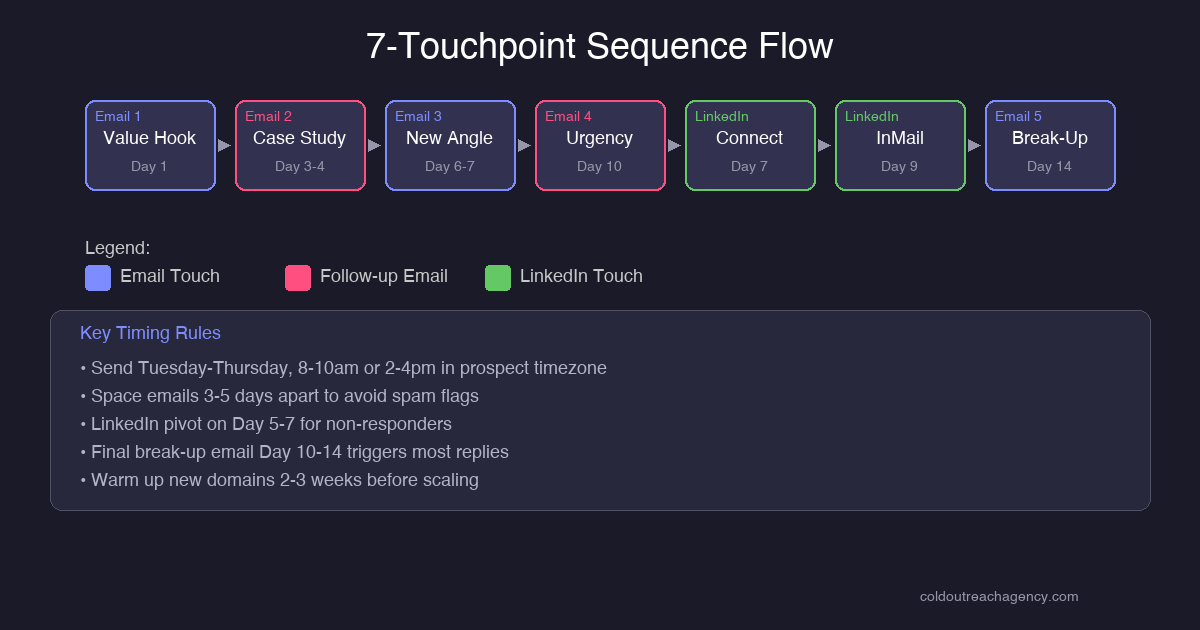
- Email 1 , Hook with a pattern interrupt or social proof angle
- Email 2 , Deliver value or share a case study result
- Email 3 , Pivot the angle or highlight a different pain point
- Email 4 , Add urgency or scarcity signal
- Email 5-6 , LinkedIn engagement or social touch
- Email 7-8 , Final break-up email or re-engagement
What Types of Touchpoints Should You Include in Your Sequence?
- Cold outreach email , Initial value-first message with clear CTA
- Case study highlight , Specific results from a similar company
- Video touch , Loom or camera video increases reply rates by 26% according to Yesware research
- LinkedIn connection request , Pivots to social channel mid-sequence
- LinkedIn InMail , Direct social follow-up after connection
- Break-up email , Last-chance message that often generates replies
- Re-engagement , 30-60 day follow-up for non-responders
When Is the Best Time to Send Cold Emails in Your Sequence?
- Email 1 to 2 , 2 to 3 days apart
- Email 2 to 3 , 3 to 4 days apart
- Email 3 to 4 , 4 to 5 days apart
- LinkedIn pivot , Day 5 to 7
- Break-up email , Day 10 to 14
How Do You Personalize Cold Emails Without Spending Hours per Prospect?
- Company-specific hooks , Reference a recent press release, funding round, or executive hire
- Mutual connection mention , “Saw you and Sarah connected on LinkedIn last week”
- Trigger-based content , “Noticed your team is hiring for SDRs, which means…”
- Industry-specific angle , Tailor pain points to their vertical, not just their name
- Competitor mention , “I noticed you’re using [Competitor]. We helped [Similar Company] cut their costs by 34% when they switched.”
What Subject Line Patterns Generate the Most Opens?
- Question format , “Is [Company] still using [Old Tool]?”
- Curiosity gap , “Quick question about [Trigger]”
- Pattern interrupt , “Re: [Random observation]”
- Social proof , “Following up on [Mutual Connection]”
- Number specificity , “3 ways [Company] is leaving money on the table”
- Loss aversion , “Closing the loop on [Previous Email Topic]”
How and When Should You Pivot to LinkedIn in Your Cold Email Sequence?
- Day 1-3 , Send initial cold outreach emails (emails 1-2)
- Day 4-6 , Follow up with 2-3 email touches
- Day 5-7 , Send LinkedIn connection request with personalized note
- Day 7-9 , Follow LinkedIn connection with InMail
- Day 10-14 , Return to email with final break-up email
What Metrics Should You Track to Measure Sequence Performance?
- Reply rate , Primary optimization target. Industry average is 1-5%. Top performers hit 10-15%.
- Meeting conversion rate , How many replies become booked calls. Target: 20-30% of replies.
- Spam complaint rate , Must stay below 0.1% or your domain gets blacklisted.
- Unsubscribe rate , Below 0.5% is acceptable. Higher means your targeting is off.
- Open rate , Important for deliverability signals, but replies beat opens every time.
What Are the Costly Mistakes That Kill Cold Email Sequence Results?
- No value before ask , Leading with a pitch in email one signals you see them as a transaction, not a person. Value first. Pitch later.
- Same message, same day , Sending identical emails to your entire list tanks engagement. Rotation exists for a reason.
- Ignoring deliverability , Your brilliant sequence means nothing if it lands in spam folders. Warm up domains for 2-3 weeks before scaling.
- No ICP filter , Sending to everyone generates responses from no one. Specificity converts. Vagueness kills.
- Giving up too early , Most sequences die after email 2. Top performers go to 7+ touches. The gold is in emails 5-8.
- Generic personalization , First-name tokens aren’t personalization. they’re a waste of your tooling and an insult to your prospects.
- No mobile optimization , 68% of email opens happen on mobile according to Mailchimp. If your emails look broken on mobile, you lose.
How Do You Build a High-Converting Cold Email Sequence From Scratch?
- Define your ICP , Who exactly should reply? Be specific by title, company size, industry, and pain point. “SaaS founders with 50-200 employees who raised funding in the last 18 months.” Not “small business owners.”
- Map the buyer journey , What do they already know? What do they need to believe before booking a call? Your sequence educates them through those beliefs one at a time.
- Write value-first email 1 , Zero pitch. Pure curiosity or insight. Give them something useful before you ask for anything.
- Build 5-8 email variations , Rotate touchpoint types and angles. Each email should feel distinct, not like the same message with different subject lines.
- Add LinkedIn pivot points , Schedule social touches mid-sequence. The Surround Strategy requires being where your prospects are.
- Set up rotation rules , Subject lines, send times, and spacing. Automation without rotation is just faster failure.
- Launch with warmup , Warm up new domains for 2-3 weeks before scaling. Clean your list monthly. High bounce rates kill deliverability.
How Does AI Change Cold Email Sequence Best Practices in 2026?
- Research speed , AI scrapes LinkedIn, news, and company pages in seconds. What took 3 minutes per prospect now takes 3 seconds.
- Subject line testing , AI predicts which subject lines will perform based on historical data from millions of sends.
- Send time optimization , AI analyzes open patterns and sends at the exact moment each prospect is most likely to engage.
- Content variation , AI generates multiple email variants that maintain your voice while testing different angles.
Frequently Asked Questions About Cold Email Sequences
{
“@context”: “https://schema.org”,
“@type”: “FAQPage”,
“mainEntity”: [
{
“@type”: “Question”,
“name”: “How long should a cold email sequence run?”,
“acceptedAnswer”: {
“@type”: “Answer”,
“text”: “The ideal cold email sequence runs 14-21 days with 5-8 touchpoints. B2B buyers often need 8-12 touches before engaging according to Forrester research. Shorter sequences miss the window when prospect timing aligns with your message. Stopping at email 2 means quitting right before the magic happens.”
}
},
{
“@type”: “Question”,
“name”: “Is cold email legal in 2026?”,
“acceptedAnswer”: {
“@type”: “Answer”,
“text”: “Yes, cold email remains legal if you follow CAN-SPAM requirements: accurate sender info, clear identification as advertising, valid physical address, and an opt-out mechanism. GDPR applies if you target EU contacts. CASL applies for Canada. Legal cold email is very much alive and generating results for agencies worldwide.”
}
},
{
“@type”: “Question”,
“name”: “How do I avoid the spam folder with cold email sequences?”,
“acceptedAnswer”: {
“@type”: “Answer”,
“text”: “Domain warmup for 2-3 weeks before scaling is essential. Keep spam complaint rates below 0.1%. Use dedicated sending domains for outreach. Rotate subject lines and sending times. Avoid spam trigger words. Monitor your sender reputation via Google Postmaster Tools. Your sequence brilliance means nothing if your emails never reach the inbox.”
}
},
{
“@type”: “Question”,
“name”: “Should I use email sequences or LinkedIn outreach first?”,
“acceptedAnswer”: {
“@type”: “Answer”,
“text”: “Start with email for three reasons: it scales better, is easier to automate, and doesn’t burn your professional reputation if the prospect isn’t interested. Use LinkedIn as the pivot mid-sequence (around emails 4-5) when email responses stall. This Surround Strategy approach covers both channels without over-investing in one.”
}
},
{
“@type”: “Question”,
“name”: “How do I track ROI from cold email sequences?”,
“acceptedAnswer”: {
“@type”: “Answer”,
“text”: “Track reply rate first (industry average 1-5%, top performers 10-15%). Then track meeting conversion (target 20-30% of replies). Finally track close rate from meetings. The full funnel: 10,000 emails at 5% reply rate equals 500 replies. At 25% meeting conversion, that’s 125 meetings. At 20% close rate with a $5,000/month retainer, that’s 25 new clients generating $125,000/month.”
}
}
]
}
Field Notes From Real Outreach Work
Here is the part most teams miss with Cold Email Sequence Practices: the tactic is not the asset. The system around the tactic is the asset. That is why I care less about volume at the start and more about whether the first replies prove the angle is real.
The buyer is not sitting around waiting for your pitch. They are dealing with inbox providers, skeptical buyers, and prospects who delete anything that feels copied. The first job of outreach is to prove relevance before persuasion. Name the business problem, make the next step useful, and remove every sentence that sounds like a brochure.
What Must Be True Before You Send More
- ICP match: The buyer should match your best customer profile, not just a broad industry label.
- Trigger strength: A hiring move, new location, funding event, tech change, compliance push, or public initiative makes outreach feel timely.
- Follow-up logic: Every follow-up should add a new reason to respond. Repeating the first message is not follow-up. It is noise.
Do not hide behind volume. Volume is a multiplier. It multiplies good strategy, and it multiplies bad strategy even faster.
The cleaner version is simple: start with 300 accounts, not a giant scraped list. Segment them by pain, write one message for one segment, and watch replies before scaling. If that first batch does not produce signal, more volume will not save the campaign. It will only make the failure louder.
The bottom line: Cold Email Sequence Practices works when it is specific, measured, and tied to a real buying moment. It fails when it sounds like every other vendor trying to sound clever. Build the data layer first, then the message, then the follow-up system. In that order.
How to Make This Feel Built, Not Generated
Look at Cold Email Sequence Best Practices through the buyer’s day, not through a marketer’s checklist. If the message cannot show why this matters now, the campaign becomes background noise. For Cold Email Sequence Best Practices, that means the outreach has to connect the business problem, the buying moment, and the proof in a way that feels specific.
A enrichment bottleneck should not be handled with the same CTA as a sequences buyers bottleneck. A automation buyer cares about different proof than a build accounts buyer. A campaign built around sequences pipeline, handoff, and trigger has more context than a generic pitch. This is why shallow templates fail. They flatten different buyer situations into one bland message.
- Authority: Review authority against the buyer’s real context before increasing send volume.
- Latency: Review latency against the buyer’s real context before increasing send volume.
- Benchmark: Review benchmark against the buyer’s real context before increasing send volume.
- Build: Review build against the buyer’s real context before increasing send volume.
- Hygiene: Review hygiene against the buyer’s real context before increasing send volume.
- Build Pipeline: Review build pipeline against the buyer’s real context before increasing send volume.
This is the part a generic article usually misses: judgment. A real operator can tell when generate is the problem, when bounce is the problem, and when the whole angle is too soft. That judgment comes from reading replies, checking account quality, and comparing message intent against actual buyer behavior.
The cleaner move is to run a small batch, inspect the signal, then rewrite the weak layer. Do not scale because the copy looks polished. Scale because the replies prove the market understands the value.