B2B Lead Generation for IT Services and Consulting Companies
Chetan Agarwal
Contents
B2B Lead Generation for IT Services and Consulting Companies
Your IT services company has world-class technical talent. Your consulting practice delivers genuine transformation.
Yet your sales pipeline runs dry while competitors with inferior offerings seem flooded with opportunities.
here’s the uncomfortable truth: most B2B lead generation fails for technology businesses because it was never designed for them. Generic campaigns built for e-commerce or SaaS don’t account for your reality: 6-to-18-month sales cycles, committees of IT decision-makers, and buyers who will dissect your technical architecture before they ever shake your hand.
Your prospect is evaluating multiple vendors simultaneously, and nurturing that relationship over months isn’t optional,it’s the baseline expectation.
This guide is for IT services firms, managed services providers (MSP), tech consulting companies, and anyone responsible for outbound revenue in a technical business. Working with a lead generation agency that understands your industry can help you avoid the mistakes that cause conventional efforts to collapse.
what’s B2B lead generation for IT services?
B2B lead generation for IT services is the systematic process of identifying, qualifying, and engaging decision-makers at companies that need technology solutions, cybersecurity services, managed services, or technology consulting.
The IT Services Lead Generation Definition
Unlike consumer lead generation, B2B lead generation for IT services targets organizational buyers with complex decision-making processes. you’re not selling to individuals.
you’re selling to companies with specific technology solutions needs, multiple stakeholders, and technical requirements that must be met.
Effective B2B lead generation for IT services must account for the technical depth of your offering, the multiple stakeholders involved in purchasing decisions, the long sales cycles typical in the technology sector, and the high trust requirements for technology vendors. Many B2B companies underestimate how much nurturing is required before prospects are ready to engage.
Your marketing strategies must align with how technical buyers actually make decisions, not how you wish they’d.
The IT Services Landscape
The IT services market encompasses managed services providers, cybersecurity firms, tech consulting companies, cloud migration specialists, infrastructure providers, and technology solutions integrators. Each segment has unique lead generation requirements based on buyer behavior, decision-making processes, and buying criteria.
Your lead generation strategy must reflect your specific segment. What works for MSP lead generation may not work for cybersecurity lead generation.
Understand your market before building your campaigns.
How much does B2B lead generation for IT services cost?
B2B lead generation costs for IT services vary dramatically based on targeting specificity, campaign complexity, and quality requirements. here’s what you need to know.
Cost Variables in IT Services Lead Generation
The cost of B2B lead generation for IT services depends on several factors: target seniority (CTO and CIO targeting costs more than manager-level), industry specificity (cybersecurity for healthcare costs more than general IT), geographic targeting (enterprise regions require more research), and volume requirements.
A cold outreach campaign targeting 500 qualified leads monthly with triple-verified data, personalized sequences, and multi-touch follow-up will cost more than a basic email blast to a purchased list. The difference is ROI.
Understanding True Cost Per Lead
Focus on cost per qualified lead, not cost per contact. A $50 cost per contact that converts at 5% is $1,000 per qualified lead.
A $200 cost per contact that converts at 30% is $667 per qualified lead. The more expensive approach is actually cheaper.
For IT services, a qualified lead typically means a decision-maker at a company matching your ICP with budget authority and a timeline for purchase. Everything else is a contact, not a lead.
Which platforms or tools are best for B2B lead generation in the IT sector?
The lead generation strategy is only as effective as the platforms and tools supporting it. IT services companies need a specific tech stack that can handle technical depth and multi-stakeholder complexity.
Essential B2B Lead Generation Tools
Account-based marketing platforms enable targeted outreach to specific IT decision-makers at ideal customer accounts. These tools combine prospect data, engagement tracking, and orchestration capabilities for coordinated campaigns.
LinkedIn Sales Navigator is essential for IT servicesB2B sales. Decision-makers research vendors on LinkedIn before engaging.
Building relationships through content engagement and direct outreach on LinkedIn generates lead generation results that cold outreach alone can’t achieve.
CRM platforms like Salesforce or HubSpot manage your sales pipeline, track engagement, and enable segmentation. Without a CRM, you can’t track the multi-touch sequences that generate B2B lead generation success.
Data and Research Tools
Triple-verified prospect data is non-negotiable. Services that provide email verification, title confirmation, and company data validation protect your sender reputation and ensure your cold outreach reaches real decision-makers.
This data-driven approach is essential for IT services, but you also need ongoing data enrichment to keep contact records current as people change roles and companies evolve.
AI-driven research tools enable the hyper-personalization required for high response rates. Manual research can’t scale to the volume required for meaningful B2B lead generation.
Automation is mandatory. Your digital marketing strategy,including content SEO, thought leadership, and account-specific outreach,must include these tools to compete effectively.
What B2B lead generation strategies and channels are effective for IT companies?
IT services buyers don’t respond to single-channel outbound email campaigns. They require multi-touch, multi-channel engagement that builds credibility over time.
Your marketing strategies must span multiple touchpoints to reach different stakeholders with messages that resonate at each stage of their evaluation process.
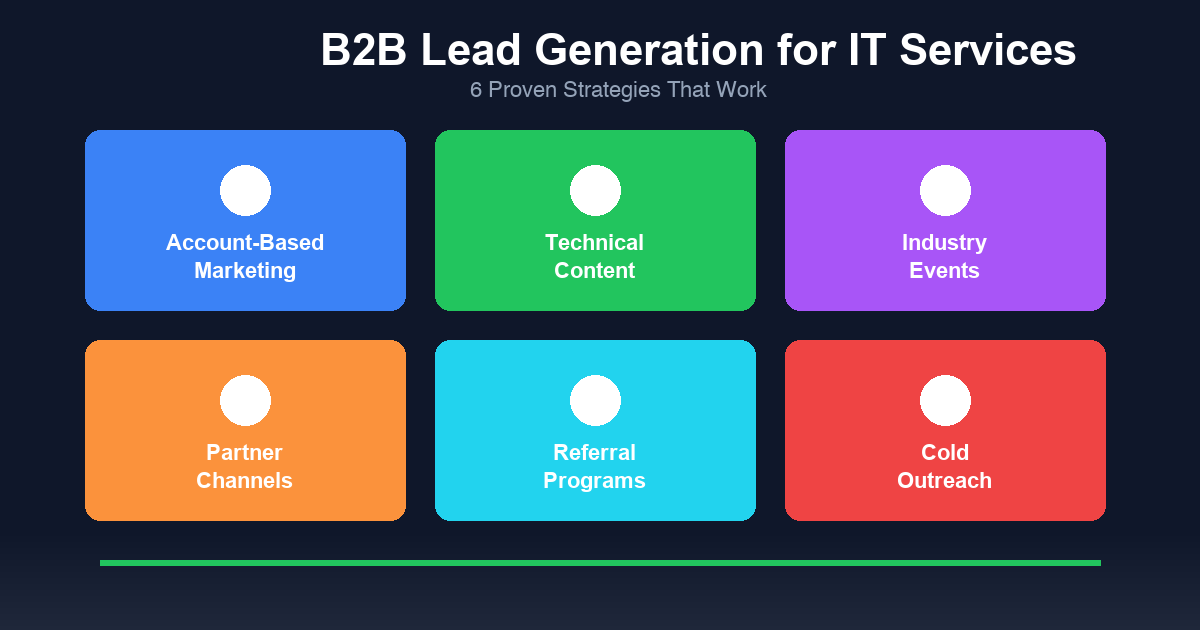
The Multi-Channel Architecture , Combines cold outreach, LinkedIn engagement, content marketing, and retargeting for comprehensive coverage
Cold Email for IT Services , Must demonstrate technical credibility while addressing business outcomes with specific references
Account-Based Marketing (ABM) , Focuses resources on 50-100 ideal customer accounts with account-specific messaging
Content and Thought Leadership , Addresses specific technical concerns and builds credibility before direct outreach
Hyper-Personalization , References specific technical challenges, recent announcements, and industry trends affecting their segment
The Multi-Channel Architecture
Effective B2B lead generation for IT services combines cold outreach, LinkedIn engagement, content marketing, and retargeting. Each channel serves a specific purpose in the buyer journey.
Cold outreach initiates conversations with decision-makers who haven’t raised their hand yet. LinkedIn builds brand awareness and enables warm introductions.
Content demonstrates expertise and addresses specific technical concerns. Retargeting keeps your company visible to buyers who have shown interest.
Cold Email Strategy for IT Services
Outbound email for IT services must demonstrate technical credibility while addressing business outcomes. Your prospects are technically sophisticated.
Generic claims will be dismissed. Specific, technically accurate references to their situation will earn credibility and open the door to sales conversations that actually convert.
Effective cold outreach for IT services references specific technical challenges, recent company announcements (funding, hires, product launches), industry trends affecting their segment, and concrete outcomes achieved for similar companies.
Account-Based Marketing for IT Companies
Account-based marketing (ABM) is particularly effective for IT services because it aligns marketing effort with specific target accounts. Rather than broadcasting to generic lists, ABM focuses resources on the exact companies most likely to become clients.
A mature ABM strategy identifies 50-100 ideal customer accounts, researches each account thoroughly, develops account-specific messaging, and engages multiple stakeholders within each account through coordinated generation campaigns that align with how each contact prefers to be reached.
How do I measure ROI from IT services lead generation investments?
you can’t improve what you don’t measure. For IT servicesB2B lead generation, the metrics that matter go beyond simple lead counts.
Lead Generation ROI Framework
Pipeline velocity measures how quickly leads move from initial contact to qualified lead to closed deal. In IT services with 6-to-18-month sales cycles, this metric reveals bottlenecks in your qualification or nurturing process.
Lead quality scoring evaluates whether you’re attracting decision-makers at the right companies with appropriate budget and timeline. A thousand low-quality leads from companies that will never buy is worthless.
One hundred qualified leads from ideal accounts is a sales pipeline.
Cost per qualified meeting measures the efficiency of your cold outreach investment. For IT services, a $500 cost per qualified meeting with a CTO at a $50M company might be excellent ROI.
For commodity services, it might be prohibitively expensive.
Revenue Attribution
Track which channels and campaigns generate closed revenue. This requires CRM integration with marketing automation and careful UTM tagging on all campaigns.
v style=”margin-bottom:28px;line-height:1.7;font-size:18px;”>When you know which lead generation efforts generate actual revenue, you can optimize investment allocation accordingly.
What are the key challenges in B2B lead generation for IT services?
B2B lead generation for IT services faces specific challenges that generic lead generation strategy doesn’t address.
The Multi-Stakeholder Challenge , IT Director cares about feasibility, CFO cares about ROI, CEO cares about competitive advantage, CTO cares about architecture
The Trust Deficit , IT decision-makers have been burned before; they require social proof, technical credentials, and specific delivery evidence
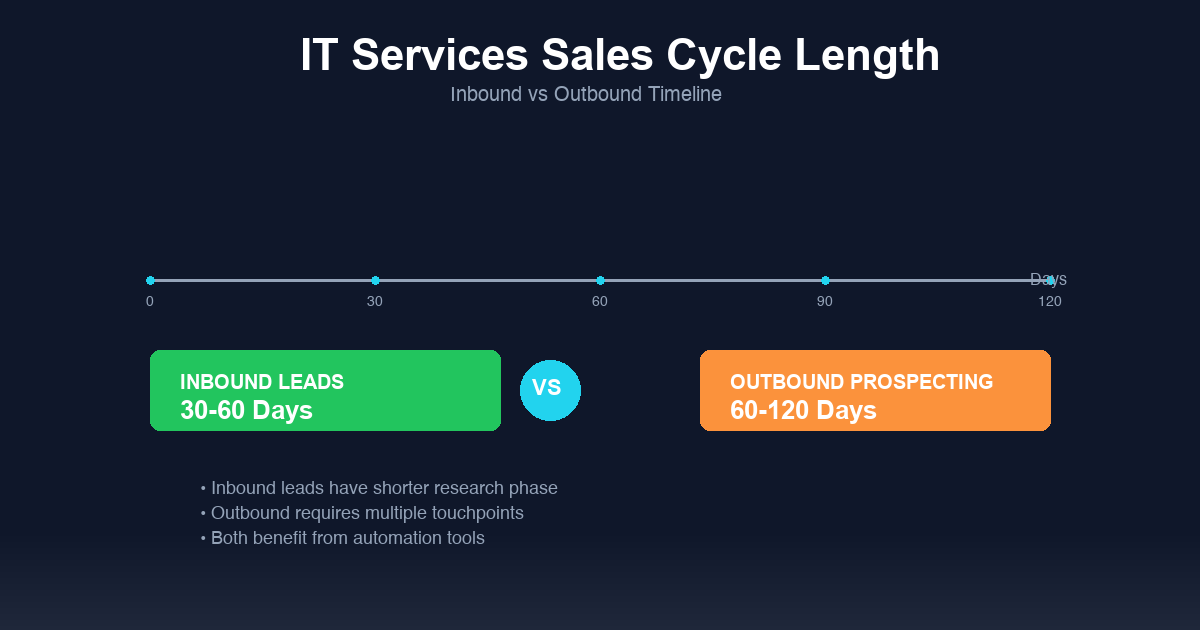
The Long Sales Cycle , IT services sales cycles run 6-18 months; outreach must sustain engagement without becoming annoying
Technical Depth Requirements , Generic claims will be dismissed; specific, technically accurate references earn credibility
The fundamental problem is that IT services purchases involve multiple stakeholders with conflicting priorities. An IT Director cares about implementation feasibility.
A CFO cares about ROI. A CEO cares about competitive advantage.
A CTO cares about technical architecture.
Your lead generation must address all stakeholders in a coordinated sequence. Generic messaging that appeals to no one specifically will be ignored by everyone.
The Trust Deficit
IT decision-makers have been burned before. they’ve read horror stories about infrastructure projects that went 300% over budget.
they’ve experienced consulting engagements that delivered 40-page reports no one read. they’re skeptical, research-heavy, and won’t engage until you’ve demonstrated genuine expertise.
This means your B2B lead generation can’t rely on marketing claims alone. It must include social proof, technical credentials, and specific evidence of delivery capability.
Case studies, testimonials, and industry recognition matter more for IT services than for most other categories.
The Long Sales Cycle
IT services sales cycles run 6-18 months. Your lead generation must sustain engagement over this timeline without becoming annoying.
This requires content marketing, thought leadership, and multi-touch sequences that provide ongoing value without constant asks.
Should I outsource B2B lead generation or build an internal team for IT services?
This is the question every IT services company eventually asks. The answer depends on your specific situation.
Building Internal Lead Generation Capability
In-house prospecting teams offer control, institutional knowledge, and alignment with your specific offerings. However, building this capability requires significant investment in hiring, training, tools, and ongoing optimization.
If you choose this path, your SDRs need deep technical training to engage IT decision-makers credibly.
In-house teams work best when you’ve predictable, high-volume needs, the budget to attract and retain talent, and the patience to build capability over 6-12 months. Your marketing strategies must support whatever team structure you choose.
The tech stack you deploy,including your CRM, prospecting tools, and analytics platforms,will determine how efficiently your team operates.
Outsourcing Lead Generation for IT Services
Outsourcing to B2B lead generation specialists offers faster deployment, specialized expertise, and variable cost structure. You pay for results, not headcount.
Outsourcing works best when you need immediate sales pipeline, lack internal expertise, or want to test lead generation before building permanent capability.
The Hybrid Approach
Most successful IT services companies use a hybrid model: outsourcing demand generation to specialists while building internal capabilities for high-value accounts and relationship management. This provides speed and expertise for volume lead generation while maintaining strategic control for key accounts.
What factors should I consider when choosing a B2B lead generation company for IT services?
Not all B2B lead generation companies are created equal. For IT services, specific criteria matter.
Technical Credibility
Your lead generation partner must understand your technical offering well enough to engage IT decision-makers credibly. A partner who can’t discuss cybersecurity frameworks, MSP SLAs, or cloud architecture concepts will generate cold outreach that IT decision-makers immediately dismiss.
Ask potential partners about their experience with IT services clients. Request examples of campaigns they’ve run for similar companies.
Evaluate their understanding of your specific segment.
Data and Infrastructure Quality
Verify that your potential partner uses triple-verified prospect data with ongoing data enrichment. Poor data quality destroys sender reputation and wastes budget on invalid addresses.
Ask about their data verification processes, refresh frequency, and email deliverability practices.
Understand their email infrastructure. How do they manage sender reputation?
what’s their domain warm-up process? How do they handle authentication (SPF, DKIM, DMARC)?
These technical details determine whether your campaigns actually reach the inbox. Data enrichment should be layered on top of this foundation to ensure every contact record is accurate and actionable.
Reporting and Optimization
Effective B2B lead generation requires continuous optimization. Your partner should provide transparent reporting on key metrics: delivery rates, open rates, reply rates, qualified lead conversion, and pipeline generation.
This data helps you improve lead quality over time.
Ask about their optimization process. How quickly do they iterate on underperforming campaigns?
What testing protocols do they use? Continuous optimization separates effective lead generation from batch-and-blast campaigns.
How long does it take to see results from B2B lead generation services for IT?
B2B lead generation for IT services requires realistic timeline expectations. Instant results are a fantasy.
Realistic Timeline for IT Services Lead Generation
Most companies see initial reply rates within 2-4 weeks of launching campaigns. Qualified leads typically start appearing within 4-8 weeks.
Pipeline generation sufficient to impact revenue generally requires 3-6 months of sustained outbound effort.
The sales cycle for IT services purchases means full revenue impact often takes 9-18 months from campaign launch. This isn’t a sprint.
it’s a systematic discipline.
Factors Affecting Timeline
Several factors affect how quickly you see results: targeting specificity (broader targeting reaches more people faster but with lower quality), sales cycle length (longer cycles delay revenue recognition), market conditions (buyers in-market respond faster), and competitive intensity (heavily targeted markets require more sophisticated approaches).
don’t terminate campaigns prematurely based on short-term metrics. Give your lead generation programs time to optimize and compound.
How can I improve the quality of B2B leads for IT services?
Lead quality matters more than lead quantity. Ten qualified leads from ideal accounts beats 1,000 unqualified contacts every time.
Tighten Your Ideal Customer Profile
Most IT services companies target too broadly. “Any company with more than 50 employees” isn’t a strategy.
Your ICP must include company size, industry, technology stack, growth stage, specific pain points, and decision-making process characteristics. Data enrichment should be part of your ICP refinement process,refining your targeting with verified firmographic and technographic data improves prospecting quality dramatically.
The more precisely you define your ICP, the more relevant your messaging becomes, the higher your response rates, and the better your qualified lead quality.
Qualify Ruthlessly in Your Sequences
Build qualification criteria into your cold outreach sequences. Your emails should filter for decision-makers with budget authority, timeline awareness, and problem recognition.
Stop trying to create interest where none exists. Focus on prospects who are already in-market.
You need to qualify leads ruthlessly to protect your team’s time.
Personalization that demonstrates understanding of their specific challenges naturally qualifies. When you reference their exact technical situation, only prospects facing that situation will respond.
Each message should address their specific pain points directly.
Multi-Touch Qualification
Use multi-touch sequences to qualify over time. Initial outreach casts a wide net.
Follow-up sequences filter for engagement. Each touchpoint provides data on prospect interest and qualification level.
By the time a prospect reaches your sales team, they should have engaged multiple times with your content and outreach. This self-selected engagement is the best qualification filter available.
Focus on high-quality leads rather than volume.
Do the math. If our AI infrastructure reaches out to 1,000 highly qualified, triple-verified decision-makers a day, that’s 30,000 people a month. With our hyper-personalization, even an impossibly conservative 1% reply rate yields 300 qualified conversations. In high-ticket B2B, what happens to your revenue when you’ve 300 conversations with your exact ICP?
what’s the fastest way to use B2B Lead Generation for IT Services and Consulting Companies without burning the market?
Start with a tight ICP, verified data, and a small test batch. Scale only after replies, bounces, and meeting quality prove the message is working.
How many prospects should I contact for B2B Lead Generation for IT Services and Consulting Companies?
The number matters less than the fit. A smaller list of verified decision-makers will beat a large scraped list because inbox placement, relevance, and timing decide reply quality.
Why do most campaigns around B2B Lead Generation for IT Services and Consulting Companies fail?
Most campaigns fail because the data is weak, the offer is vague, and the follow-up system is inconsistent. Fix those three points before adding more volume.
Should I use email only for B2B Lead Generation for IT Services and Consulting Companies?
No. Email works better when it’s supported by LinkedIn touches, retargeting, and clean CRM follow-up. One channel creates reminders. Multiple channels create recognition.
When should I hire help for B2B Lead Generation for IT Services and Consulting Companies?
Hire help when you already know the customer profile, the offer is validated, and the bottleneck is execution speed. Outsourcing a broken offer only makes the failure happen faster.
Here is the part most teams miss with B2B Lead Generation for IT Services and Consulting Companies: the tactic is not the asset. The system around the tactic is the asset. That is why I care less about volume at the start and more about whether the first replies prove the angle is real.
The person reading your message is busy, skeptical, and already filtering out vendors who sound interchangeable. In this market, vague copy dies fast. That means the message has to earn attention fast: clear pain, clean proof, and a next step that does not feel like a trap.
Three Filters Before You Add Volume
Account quality: Would this company still be attractive if it never replied this month? If not, it probably should not be in the campaign.
Message angle: Can the opener point to a real business condition, not a lazy compliment? Specificity is what makes the email feel earned.
Next step: Is the CTA small enough to say yes to? A useful reply is often a better first win than forcing a meeting immediately.
Most campaigns do not need a cleverer subject line first. They need cleaner segmentation, sharper proof, and a follow-up sequence that sounds like a person is paying attention.
The cleaner version is simple: start with 200 accounts, not a giant scraped list. Segment them by pain, write one message for one segment, and watch replies before scaling. If that first batch does not produce signal, more volume will not save the campaign. It will only make the failure louder.
Here is the practical takeaway: make B2B Lead Generation for IT Services and Consulting Companies narrower, cleaner, and easier to say yes to. Then scale what the market proves, not what the team hopes will work. Build the data layer first, then the message, then the follow-up system. In that order.
How to Judge B2B Lead Generation It Services Before You Scale
The practical test for b2b lead generation it services is not whether the idea sounds smart. The test is whether it creates qualified pipeline without damaging deliverability, sender reputation, or buyer trust. A strong system connects b2b marketing , nurture , best lead generation , lead scoring with clear targeting, clean data, and a message that feels written for the exact account.
If the campaign uses lead nurturing , b2b tech , lead gen , tech companies , top 10 b2b lead generation , sales and marketing, the team needs a simple operating rule: do not add volume until replies prove the angle. That means watching inbox placement, open rates, reply quality, bounce behavior, and the number of sales meetings that come from real decision-makers.
The Execution Checklist
Infrastructure: Check tech lead generation, lead generation agency for b2b, lead generation platform, lead generation for it companies before scaling. If this layer is weak, more sending only creates louder failure.
Targeting: Check b2b technology, technology companies, sales and marketing teams before scaling. If this layer is weak, more sending only creates louder failure.
Message quality: Check lead generation for tech companies, contact database, inbound lead, data points before scaling. If this layer is weak, more sending only creates louder failure.
Follow-up: Check actively researching solutions, contact details, outbound lead generation before scaling. If this layer is weak, more sending only creates louder failure.
Measurement: Check lead and account, poor lead quality before scaling. If this layer is weak, more sending only creates louder failure.
The bottom line is simple: b2b lead generation it services should be treated like a revenue system, not a one-off campaign. When the list, email infrastructure, personalization, domain setup, and multichannel follow-up work together, the outreach has a real chance to turn cold attention into booked meetings.
What Separates Useful Outreach From Noise
If the message cannot show why this matters now, the campaign becomes background noise. The buyer is filtering for relevance, timing, credibility, and the cost of paying attention. For B2B Lead Generation for IT Services and Consulting Companies, that means the outreach has to connect the business problem, the buying moment, and the proof in a way that feels specific.
A campaign built around timing, coverage, and procurement has more context than a generic pitch. A reporting issue needs different copy than a throttling issue. A signal buyer cares about different proof than a seller buyer. This is why shallow templates fail. They flatten different buyer situations into one bland message.
Cadence: Review cadence against the buyer’s real context before increasing send volume.
Trigger: Review trigger against the buyer’s real context before increasing send volume.
Founder: Review founder against the buyer’s real context before increasing send volume.
Reputation: Review reputation against the buyer’s real context before increasing send volume.
Objection: Review objection against the buyer’s real context before increasing send volume.
Evaluation: Review evaluation against the buyer’s real context before increasing send volume.
This is the part a generic article usually misses: judgment. A real operator can tell when operator is the problem, when suppression is the problem, and when the whole angle is too soft. That judgment comes from reading replies, checking account quality, and comparing message intent against actual buyer behavior.
The cleaner move is to run a small batch, inspect the signal, then rewrite the weak layer. Do not scale because the copy looks polished. Scale because the replies prove the market understands the value.