How to Get 40%+ Reply Rates on Cold Emails Without Spamming
The average cold email reply rate across all industries hovers between 1% and 3%. Most campaigns never break 5%.
If you’re getting these numbers, you’re getting the same results as everyone else who sends generic messages to purchased lists and wonders why nobody responds.
But some campaigns consistently hit 30%, 40%, even 50% reply rates. These aren’t anomalies.
they’re not luck. they’re the result of systematic execution across dimensions that most cold outreach operators completely ignore.
Achieving reply rates at this level requires abandoning the spray-and-pray mentality and adopting a precision-engineered approach that treats every email as a strategic conversation starter.
This guide breaks down exactly what it takes to join the top performers. Not theoretical advice that sounds good in a blog post, but the specific systems, tactics, and sequences that generate elite reply rates in B2B sales.
what’s a good cold email reply rate?
Before you can improve your cold email reply rate, you need to understand what benchmark you’re actually measuring against.
Reply Rate Benchmarks by Tier
The reply rate is the percentage of recipients who respond to your cold email, regardless of whether they convert. This is distinct from your click rate or open rate, which measure different engagement behaviors.
When calculating your response rate, include all types of responses,replies, forwards, and out-of-office acknowledgments,as each indicates engagement.
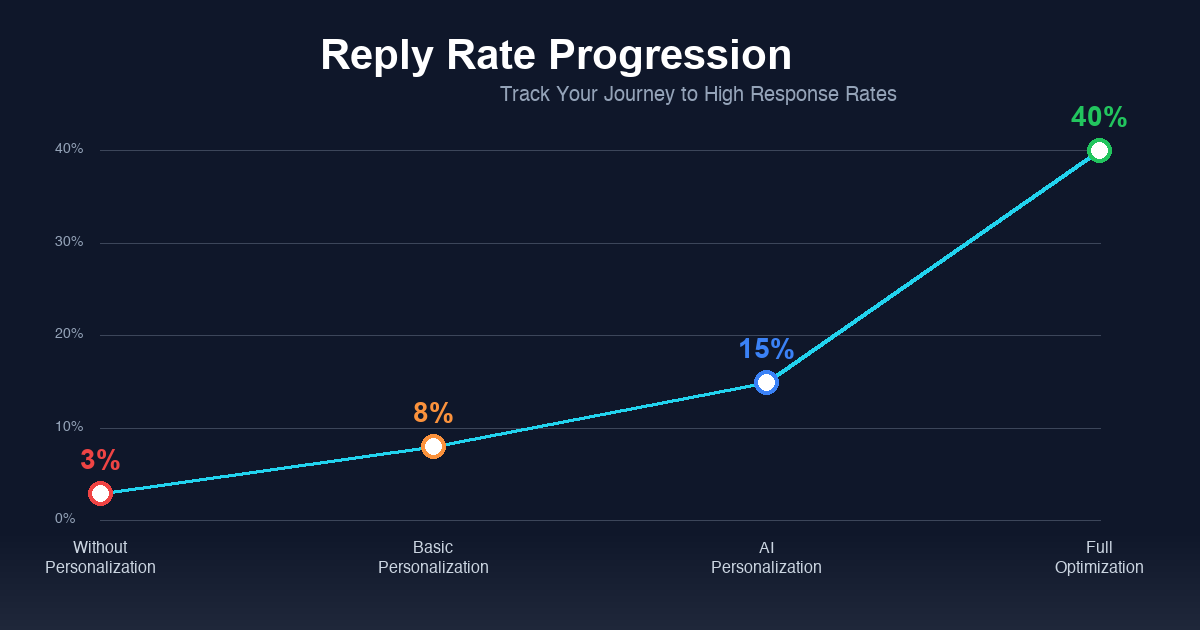
here’s the honest breakdown: 1-3% reply rates represent average performance for batch-and-blast campaigns. 4-8% represents solid execution with basic personalization.
10-15% represents strong campaigns with genuine research-backed messaging. 20-40% represents elite performance that most operators never achieve.
Tracking your average response rate over time reveals whether your campaigns are improving or declining. When evaluating the rate for cold emails in your industry, benchmark against similar company sizes and target audiences rather than aggregate averages.
If you’re at 1-3%, you’re operating at the same level as automated spam. If you want to reach 40%+, you need to operate fundamentally differently.
The gap isn’t about being smarter. it’s about being systematic.
Why Reply Rate Matters More Than Open Rate
Most operators obsess over open rates. This is the wrong metric.
Open rates tell you your subject line worked. Reply rates tell you your message resonated.
A high open rate with a 1% reply rate means people see your email and immediately delete it. that’s not success.
Your response rate tells the real story.
The goal is a response. Any response.
Even “not interested” is a qualifying data point that moves a prospect through your pipeline. When you focus on reply rates instead of vanity metrics, your entire campaign optimization changes.
Generating positive replies requires demonstrating genuine value before asking for anything in return.
What factors influence cold email reply rates?
Five factors determine whether your cold email generates responses. Most campaigns fail because they optimize for the wrong variables.
- The Data Foundation , Email deliverability depends on data quality, sender reputation, and inbox placement; unverified addresses destroy reputation
- The Personalization Variable , “Hi [First Name]” is find-and-replace, not personalization; specificity signals are required for higher response rate
- The Ask Calibration , “Book a demo” is high-friction; “Would a 15-minute call next week make sense?” is low-friction and gets more responses
- The Follow-Up Factor , 80% of responses come after the third touchpoint; single-email campaigns abandon most of their potential
- The Timing Element , Emails sent Tuesday-Thursday between 8am-10am local time generate highest open rates for recipients
The Data Foundation
Your cold email can’t succeed if it never reaches the inbox. Email deliverability depends on your data quality, sender reputation, and inbox placement.
If you’re sending to unverified addresses, your bounce rate destroys your reputation before your message even gets read. Major email providers like Google and Microsoft employ sophisticated filtering algorithms that penalize senders with poor reputation scores, making infrastructure quality non-negotiable for reaching the inbox.
Triple-verified data is mandatory for reply rates above 10%. Every address must pass syntax validation, domain verification, and mailbox confirmation.
This keeps bounce rates below 2% and protects the infrastructure that delivers your messages to the inbox instead of spam.
The Personalization Variable
Personalization isn’t optional. it’s the difference between responses and deletions.
But most personalization is fake. “Hi [First Name]” isn’t personalization.
it’s find-and-replace that produces find-and-replace results. A higher response rate comes from showing you understand their specific challenges.
True personalization requires specificity signals: references so precise that the recipient can’t believe they were generated automatically. A mention of a specific article they wrote.
A reference to a recent company announcement. A comment on a challenge they publicly identified.
This level of hyper-personalization is what separates 5% reply rates from 40%. When prospects see genuine effort, your positive reply rate climbs.
The Ask Calibration
Your call to action determines response probability. “Book a demo” is a high-friction ask that prospects decline reflexively.
“Would a 15-minute call next week make sense?” is a low-friction ask that prospects often accept. Calibrating your ask directly impacts your conversion rate.
The smaller the ask, the higher the reply rate. Your initial goal is a conversation, not a close.
Get them talking first.
How can I improve my cold email reply rates?
Improving your cold email response rate requires fixing multiple variables simultaneously. there’s no single hack.
there’s only systematic execution. The average cold email gets ignored; exceptional emails get responses.
Each optimization compounds to increase response rates exponentially, creating a multiplicative effect when all elements align.
Step One: Fix Your Data
Start with verified prospect data. If you’re using purchased lists or outdated databases, every other optimization is wasted effort.
Your cold email campaign is only as good as the addresses it reaches.
Use multiple verification services to confirm email validity. Verify titles and company data through multiple sources.
Refresh your data within 30 days of sending. The investment in data quality pays dividends in every other metric.
Step Two: Rewrite Every Template
Delete every template that uses “[First Name]” or “companies like yours.” These are spam signals that trigger immediate deletion.
Replace generic messaging with specific references. Research each prospect before writing.
Reference their specific situation. Demonstrate genuine understanding of their challenges.
Show you did the work.
Step Three: Optimize Your Sequence
Single emails fail because they depend on perfect timing and immediate need. Build multi-touch sequences that include 5-7 touches across email and LinkedIn over 3-4 weeks.
Most responses come after the third touchpoint. If you send one email and stop, you’re giving up before the moment when most responses arrive.
what’s the 30/30/50 rule for cold emails?
The 30/30/50 rule is a framework for structuring your cold email to maximize response probability. It divides your email into three proportional segments.
Breaking Down the Framework
The first 30% of your email should focus on the prospect, not you. Reference their specific situation, challenge, or context.
This isn’t about you proving your value. it’s about demonstrating you understand their world.
The second 30% should provide social proof and credibility. What gives you the right to reach out?
What similar challenges have you solved? Keep this section brief.
Credibility without arrogance. This section often determines whether you get a cold email response.
The final 50% is your value proposition and call to action. What specific outcome can you help them achieve?
what’s the low-friction next step?
Why This Structure Works
The 30/30/50 rule works because it inverts the typical email structure. Most cold email copy leads with “I’m from XYZ company and we help companies like yours…” This is immediately forgettable.
The rule forces you to lead with the prospect‘s interests, not your pitch.
When you structure emails around the 30/30/50 framework, reply rates typically improve 2-4x compared to self-focused messaging. Your response rate compounds with each optimization.
What are effective cold email subject lines?
Subject lines matter less than most people think, but they matter enough to optimize. The goal is to get the email opened, not to be clever.
- Pattern Interrupt Over Curiosity Gap , “Question about your [company] expansion” beats “Quick question”; specificity creates relevance
- Personalization in Subject Lines , Including recipient’s name, company, or situation increases open rates by 10-25%
- Avoid Spam Triggers , Words like “free,” “urgent,” “act now,” excessive punctuation, ALL CAPS, or emoji
- Short and Specific , Best subject lines are short, specific, and low-pressure; create curiosity without manipulation
- Newsletter Avoidance , Avoid subject lines that look like newsletter subject lines; these signal bulk send
- Test Multiple Variants , A/B test subject lines and optimize based on open rate data within hours of sending
Pattern Interrupt Over Curiosity Gap
Pattern interrupt subject lines that reference something specific to the recipient outperform generic curiosity gap subject lines. “Question about your [company] expansion” beats “Quick question.” “Saw your post on [topic]” beats “Thoughts on [topic].” This affects both your open rate and eventual response rate.
Personalization in the subject line increases open rates by 10-25%. Including the recipient’s name, their company name, or a reference to their specific situation signals that this email is for them specifically, not another piece of bulk noise.
Avoidance Checklist
Avoid subject lines that trigger spam filters: words like “free,” “urgent,” “act now,” excessive punctuation, ALL CAPS, or emoji. Avoid subject lines that look like newsletter subject lines.
These signal bulk send rather than targeted
email outreac
h
.
The best subject lines are short, specific, and low-pressure. They create curiosity without manipulation.
what’s the best time to send cold emails for higher reply rates?
When you send matters as much as what you send. Cold email timing best practices have shifted as buyer behavior has evolved.
The Data on Send Timing
The data consistently shows that emails sent Tuesday through Thursday between 8am and 10am local time for the recipient generate highest open rates. However, open rates aren’t the goal.
Reply rates are.
The data on reply timing shows slightly different patterns: mid-morning (10am-12pm) and late afternoon (3pm-5pm) tend to generate higher reply rates than early morning sends. People are more likely to respond during work hours when they’ve time to think about their reply.
Time Zone Adjustment
Time zone adjustment is non-negotiable. If you’re sending from New York to prospects in California, don’t send at 8am Eastern.
Send at 8am Pacific. If you’re targeting European decision-makers, send during their business hours, not yours.
Day-of-week patterns vary by industry. SaaS buyers respond differently than manufacturing buyers.
Enterprise buyers have different patterns than SMB buyers. Test your specific audience to find optimal timing.
what’s the 80 20 rule in email marketing?
The 80/20 rule in outreach,often called the Pareto Principle,states that 80% of results come from 20% of efforts. In B2B sales, this translates directly to response rate patterns.
Applying the 80/20 to Cold Outreach
In practice, the 80/20 rule means that 80% of your reply rates will come from 20% of your prospects. These are the decision-makers who are actively in-market, have budget authority, and face the specific problem your solution addresses.
Your response rate depends on finding these high-fit prospects.
The implication is clear: stop trying to convert everyone. Focus 80% of your effort on identifying and reaching the 20% of prospects most likely to respond.
This means tighter prospecting, more specific targeting, and ruthless qualification. Every B2B lead that enters your funnel should pass strict fit criteria before receiving a single outreach email.
The 80/20 in Follow-Up
The 80/20 rule also applies to follow-up sequences. Most responses come after multiple touches, but the majority of your results will come from a small percentage of your prospect pool.
Identifying those high-response segments early and prioritizing them is the key to conversion optimization.
what’s the 60 40 rule in email?
The 60/40 rule in cold email refers to the ratio of value you provide versus the ask you make. Give 60, ask 40.
The Reciprocity Principle
When you provide genuine value in your message, recipients feel compelled to respond. The value doesn’t have to be complicated.
It can be a relevant insight, a connection to someone they should know, or a different perspective on a problem they face.
Most cold email copy gets this backwards. They lead with the ask and sprinkle in vague value claims.
The 60/40 rule inverts this. Lead with value.
Ask second.
Practical Application
Structure your email so that even if the recipient never responds, they’ve gained something: a useful observation, a relevant connection, a different way of thinking about their challenge. This transforms your email from an interruption into a service.
When recipients perceive genuine value, reply rates increase dramatically. they’re not responding to your ask.
they’re responding to the exchange of value.
How many follow-up emails should I send to increase reply rates?
Most follow-up emails are never sent. Most responses never come.
These facts are connected.
The Math on Follow-Up
Research consistently shows that reply rates increase 300-500% with proper follow-up sequences. A single email to 1,000 prospects might generate 20 responses.
The same prospects with a 5-touch sequence might generate 80-100 responses. This dramatically improves your response rate.
The optimal follow-up sequence includes 5-7 touches over 3-4 weeks. Each touch should add value, not just repeat the same message.
Sequence Architecture
A high-performing multi-touch sequence might look like this: Day 1: Initial cold email with personalized opener. Day 3: LinkedIn connection request with brief note referencing the email.
Day 5: Follow-up cold email with new angle or additional value. Day 8: LinkedIn message with additional insight.
Day 12: Second follow-up email with different subject line approach. Day 18: Final email with different format.
If your follow-up just says “Did you see my last email?” you’re adding noise, not value. If your follow-up shares a relevant insight, a relevant article, or a new angle on the problem, you’re providing value that justifies another touch.
what’s the impact of personalization on cold email reply rates?
Personalization isn’t a nice-to-have. it’s the primary determinant of reply rate success.
The difference between generic templates and genuine personalization is an order of magnitude.
The Personalization Spectrum
Most cold email personalization is cosmetic: adding the prospect‘s first name, company name, or industry to a template. This produces marginal improvements at best.
it isn’t personalization. it’s find-and-replace.
Effective personalization operates at multiple levels: surface-level (name, company), behavioral (recent activities, content engagement), contextual (specific challenges, industry trends), and relational (mutual connections, shared experiences).
The campaigns hitting 40%+ reply rates use all four levels. They reference specific LinkedIn posts the prospect wrote.
They mention recent company announcements. They connect their solution to a specific challenge the prospect publicly identified.
Each level boosts your response rate. These personalized emails stand out in crowded inboxes because they prove you did your homework before reaching out.
Hyper-Personalization at Scale
The objection to deep personalization is always scale. How can you research 10,000 prospects individually?
The answer is hyper-personalization through AI-driven research automation. For every prospect in your pipeline, the system researches their company, role, recent activities, and industry context.
It generates unique email content referencing specific details that demonstrate genuine research.
This isn’t “Hi [First Name].” This is “I noticed your recent post on [specific topic] and your point about [specific challenge] resonated because…” The specificity creates credibility. The credibility drives responses.
Do the math. If our AI infrastructure reaches out to 1,000 highly qualified, triple-verified decision-makers a day, that’s 30,000 people a month. With our hyper-personalization, even an impossibly conservative 1% reply rate yields 300 qualified conversations. In high-ticket B2B, what happens to your revenue when you’ve 300 conversations with your exact ICP?
Frequently Asked Questions
what’s the fastest way to use How to Get 40%+ Reply Rates on Cold Emails Without Spamming without burning the market?
Start with a tight ICP, verified data, and a small test batch. Scale only after replies, bounces, and meeting quality prove the message is working.
How many prospects should I contact for How to Get 40%+ Reply Rates on Cold Emails Without Spamming?
The number matters less than the fit. A smaller list of verified decision-makers will beat a large scraped list because inbox placement, relevance, and timing decide reply quality.
Why do most campaigns around How to Get 40%+ Reply Rates on Cold Emails Without Spamming fail?
Most campaigns fail because the data is weak, the offer is vague, and the follow-up system is inconsistent. Fix those three points before adding more volume.
Should I use email only for How to Get 40%+ Reply Rates on Cold Emails Without Spamming?
No. Email works better when it’s supported by LinkedIn touches, retargeting, and clean CRM follow-up. One channel creates reminders. Multiple channels create recognition.
When should I hire help for How to Get 40%+ Reply Rates on Cold Emails Without Spamming?
Hire help when you already know the customer profile, the offer is validated, and the bottleneck is execution speed. Outsourcing a broken offer only makes the failure happen faster.
The Operator’s View
I would not scale How to Get 40%+ Reply Rates on Cold Emails Spamming until the first small batch proves three things: the market is right, the message lands, and the follow-up creates conversations. If the list is weak, the message is vague, and the follow-up is random, even a smart idea turns into noise.
The person reading your message is busy, skeptical, and already filtering out vendors who sound interchangeable. In this market, vague copy dies fast. That means the message has to earn attention fast: clear pain, clean proof, and a next step that does not feel like a trap.
The Checks I Would Run Before Scaling
- Fit: Can we explain why this exact person should care in one sentence? If not, the list is too broad.
- Timing: Is there a trigger, market shift, hiring signal, funding event, expansion move, compliance deadline, or operational pain that makes the message relevant now?
- Proof: Does the email give the buyer a reason to trust the claim before asking for time? A sharp observation beats a generic case-study line.
Most campaigns do not need a cleverer subject line first. They need cleaner segmentation, sharper proof, and a follow-up sequence that sounds like a person is paying attention.
The cleaner version is simple: start with 150 accounts, not a giant scraped list. Segment them by pain, write one message for one segment, and watch replies before scaling. If that first batch does not produce signal, more volume will not save the campaign. It will only make the failure louder.
Here is the practical takeaway: make How to Get 40%+ Reply Rates on Cold Emails Spamming narrower, cleaner, and easier to say yes to. Then scale what the market proves, not what the team hopes will work. Build the data layer first, then the message, then the follow-up system. In that order.
Book a strategy call
How to Judge Cold Email Reply Rates Before You Scale
The practical test for cold email reply rates is not whether the idea sounds smart. The test is whether it creates qualified pipeline without damaging deliverability, sender reputation, or buyer trust. A strong system connects email outreach , average cold email response , average cold email response rates , b2b cold with clear targeting, clean data, and a message that feels written for the exact account.
If the campaign uses cold email conversion rates , b2b cold email , cold email statistics , cold email open rate , cold email success , many cold emails, the team needs a simple operating rule: do not add volume until replies prove the angle. That means watching inbox placement, open rates, reply quality, bounce behavior, and the number of sales meetings that come from real decision-makers.
The Execution Checklist
- Infrastructure: Check cold email performance, cold email response rates 2026, what’s a good cold email, highest reply before scaling. If this layer is weak, more sending only creates louder failure.
- Targeting: Check click-through rates, emails with personalized subject lines, emails per day before scaling. If this layer is weak, more sending only creates louder failure.
- Message quality: Check decent open rate, cold emails that get, make cold emails, ensure your cold emails before scaling. If this layer is weak, more sending only creates louder failure.
- Follow-up: Check high reply rate, average cold email conversion rate, average open rate before scaling. If this layer is weak, more sending only creates louder failure.
- Measurement: Check cold email benchmark report 2026, make or break your cold before scaling. If this layer is weak, more sending only creates louder failure.
The bottom line is simple: cold email reply rates should be treated like a revenue system, not a one-off campaign. When the list, email infrastructure, personalization, domain setup, and multichannel follow-up work together, the outreach has a real chance to turn cold attention into booked meetings.
The Non-Template Execution Layer
If the message cannot show why this matters now, the campaign becomes background noise. The buyer is filtering for relevance, timing, credibility, and the cost of paying attention. For How to Get 40%+ Reply Rates on Cold Emails Without Spamming, that means the outreach has to connect the business problem, the buying moment, and the proof in a way that feels specific.
A evaluation issue needs different copy than a category issue. A latency buyer cares about different proof than a offer buyer. A timing bottleneck should not be handled with the same CTA as a buyer bottleneck. This is why shallow templates fail. They flatten different buyer situations into one bland message.
- Threshold: Review threshold against the buyer’s real context before increasing send volume.
- Verification: Review verification against the buyer’s real context before increasing send volume.
- Spamming Buyers: Review spamming buyers against the buyer’s real context before increasing send volume.
- Emails Pipeline: Review emails pipeline against the buyer’s real context before increasing send volume.
- Founder: Review founder against the buyer’s real context before increasing send volume.
- Percent Accounts: Review percent accounts against the buyer’s real context before increasing send volume.
This is the part a generic article usually misses: judgment. A real operator can tell when rates is the problem, when hygiene is the problem, and when the whole angle is too soft. That judgment comes from reading replies, checking account quality, and comparing message intent against actual buyer behavior.
The cleaner move is to run a small batch, inspect the signal, then rewrite the weak layer. Do not scale because the copy looks polished. Scale because the replies prove the market understands the value.