Verified Lead Data: Triple-Verification for B2B Cold Email
Your cold outreach campaign is only as good as the contact records behind it. Send to wrong addresses and you get bounces.
Send to outdated addresses and your sender reputation craters. Send to spam traps and you get blacklisted.
Every one of these outcomes traces back to a single root cause: bad data.
I’ve analyzed hundreds of B2B outreach campaigns over the past five years. The pattern is consistent.
Campaigns using triple-validated data hit reply rates between 25% and 45%. Campaigns using standard purchased lists or unvalidated scraped data average 1% to 3%.
The difference isn’t the copy, the offer, or the sender. The difference is the data.
This is the guide that explains why contact accuracy matters more than anything else in cold outreach, what triple validation actually means, how to evaluate data providers, and exactly what happens to your cold email campaigns when you cut corners on email validation.
What Does “Verified Lead” Mean?
A validated lead is a contact record that has passed multi-layer validation confirming the accuracy of every data point before being used in any outreach campaign. The validation process confirms the email address exists and accepts mail, the phone number connects to a real person, the job title accurately reflects the contact’s current role, and the company information matches the organization where they work.
Unvalidated leads are exactly what they sound like: raw data that hasn’t been checked for accuracy. Purchased lists, scraped contact databases, and conference attendee rosters all fall into this category.
They may be accurate at the time of collection, but email addresses change constantly as employees change jobs, companies update their email systems, and domains expire or get reassigned.
The validation status of your contact records determines the ceiling of your campaign performance. No amount of excellent copy or sophisticated sequencing compensates for sending to addresses that don’t exist.
Data quality assurance isn’t optional. it’s the foundation.
The Validation Gap
Most companies don’t realize how rapidly their data decays. Industry research consistently shows that 30% to 40% of business email addresses become invalid within 12 months of collection.
A prospect list purchased or collected six months ago may already contain significant error rates that silently destroy campaign performance. Without continuous data cleaning and re-validation, even initially accurate data becomes a liability over time.
what’s Lead Verification and Why Is It Important?
Lead validation is the systematic process of validating contact information through multiple technical checks before using that data for outreach. Each validation layer catches different categories of errors that would otherwise damage campaign performance.
Importance manifests in three areas. First, sender reputation protection.
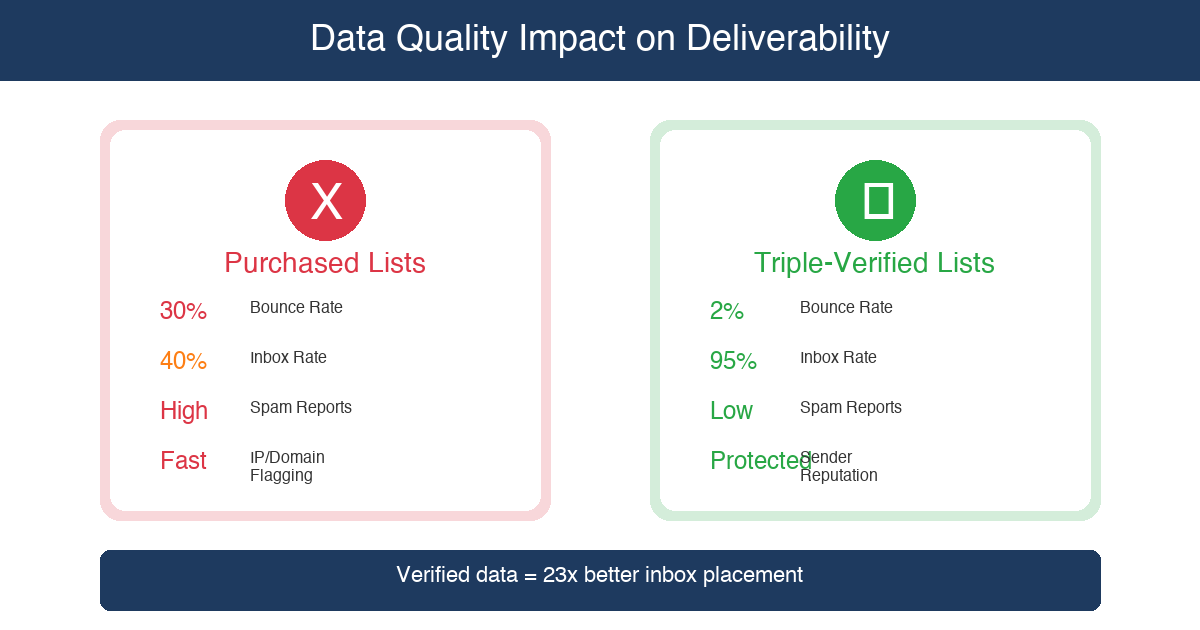
Every bounced email signals to inbox providers that you may be a spammer. Bounce rates above 5% damage your reputation score.
Above 10%, your cold email starts landing in spam folders. Above 20%, you risk blacklisting.
Email validation prevents bounces by confirming addresses exist before you send.
Second, inbox placement optimization. Even legitimate emails from reputable senders land in spam when inbox providers detect poor sending practices.
High bounce rates are the most reliable indicator of poor practices. Keeping bounce rates below 2% demonstrates sending discipline that inbox providers reward with better placement.
This directly improves your cold email deliverability rates.
Third, reply rate improvement. you can’t get replies from addresses that don’t exist or from economic buyers who left their roles years ago.
Verified data ensures your messages reach actual people in actual roles who can actually respond. This accuracy directly translates to higher engagement rates in your cold email campaigns.
The Cost of Skipping Validation
The cost of bad contact records extends far beyond wasted sends. It damages infrastructure that took years to build.
A campaign that destroys your sending domain’s reputation requires months of recovery, reduced sending volume, careful warming, and technical remediation. During this recovery period, all your email including customer communications suffers reduced deliverability.
The upfront “savings” from skipping quality assurance multiply into long-term costs that far exceed the validation investment.
What Are the Different Types of Lead Verification?
Professional lead validation involves multiple distinct layers, each catching different categories of errors. Understanding these layers clarifies what quality data providers actually do.
Every contact in your prospect list should pass these validation checks before you invest outreach resources in contacting them.
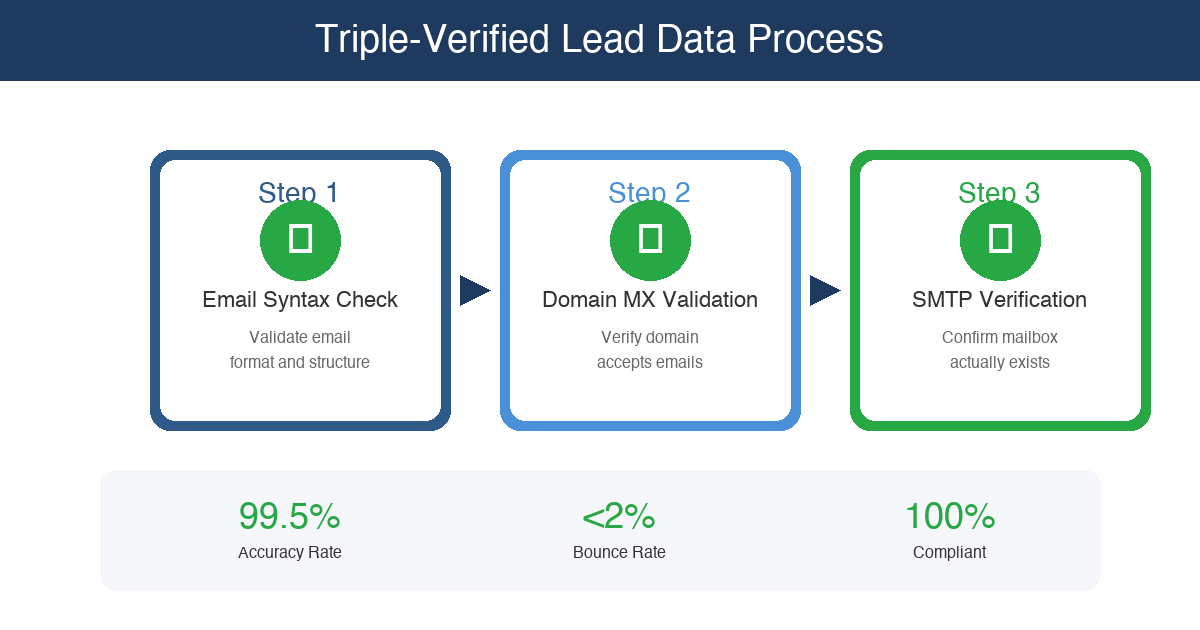
- Syntax Validation , Checks whether email follows proper formatting rules; catches missing @ symbols, invalid characters, and malformed domains
- Domain Validation , Confirms domain operates a mail server by checking DNS records including MX (mail exchange) records
- Mailbox Validation , Confirms specific email address exists on target mail server through simulated delivery without sending
- SMTP Check , Tests full SMTP conversation revealing mailbox existence, sender acceptance, and server restrictions
- MX Validation , Specifically checks mail exchange records; domains without MX explicitly don’t accept mail
- Role-Based Identification , Flags addresses like info@ and sales@ that are monitored by multiple people and generate low engagement
- Catch-All Detection , Identifies domains accepting any address, creating false positives that inflate list size without engagement
Syntax validation is the first layer. This checks whether an email address follows proper formatting rules.
It catches obvious errors like missing @ symbols, invalid characters, extra dots, and malformed domain names. Syntax validation eliminates the low-hanging fruit of manual data entry errors and web form typos that accumulate in any contact database over time.
Domain validation is the second layer. This confirms that the domain portion of the email address actually exists and operates a mail server.
Validators check DNS records to confirm MX (mail exchange) records are configured properly. This catches entire domains that have expired, been reassigned, or misconfigured their email systems.
For any cold email campaign, catching these errors before sending protects your sender reputation.
Mailbox validation is the third and most critical layer. This confirms that the specific email address actually exists on the target mail server.
Validators connect to the mail server and simulate message delivery without actually sending. A positive response means the mailbox accepts mail.
A negative response means the address is invalid, closed, or a trap that identifies spammers.
SMTP check extends mailbox validation by testing the full SMTP conversation. This reveals whether the mailbox exists, whether it accepts mail from specific senders, and whether the server implements any restrictions that might affect deliverability.
This additional layer of cold email verification catches issues that basic mailbox checks miss.
MX validation specifically checks mail exchange records to confirm the domain is configured to receive email. Some domains have no MX records, meaning they explicitly don’t accept mail.
These domains never produce valid contacts regardless of the local part of the address.
Role-based identification flags addresses like info@company.com, sales@company.com, and admin@company.com. These shared addresses are monitored by multiple people, aggressively filtered by spam systems, and generate extremely low engagement rates.
Quality contact records excludes role-based addresses or flags them prominently so senders can make informed decisions.
Catch-All Domain Detection
Catch-all domains accept any email address at that domain, returning positive validation even for addresses that don’t correspond to real people. This creates false positives that inflate list size while generating no actual engagement.
Advanced validation services detect catch-all domains and flag addresses accordingly, allowing senders to make informed decisions about including or excluding them from cold email campaigns. This cold email verification step is often overlooked but critically important for maintaining high list quality.
What Are the Benefits of Using Verified Lead Data?
Verified contact records delivers compounding benefits that extend beyond immediate campaign performance into long-term sales pipeline health. When your cold email outreach reaches the right inboxes consistently, every other metric improves.
Bounce rate reduction is the most immediate benefit. Verified data keeps bounce rates below 2% consistently, protecting sender reputation and maintaining inbox placement over time.
Unvalidated data generates bounce rates of 30% to 60%, with corresponding damage to sending infrastructure. The math is simple: lower bounces equal better deliverability equal more opportunities for your cold email campaigns to succeed.
Reply rate improvement follows naturally. When your messages reach real people in real roles who can actually engage, response rates increase dramatically.
Industry benchmarks show validated data campaigns averaging 32% reply rates compared to 2.1% for unvalidated campaigns. This 15x improvement in engagement directly translates to pipeline generation.
For high-ticket B2B prospecting, the difference between a 2% and 32% reply rate can mean the difference between a thriving business and a failing one.
Sender reputation protection is the long-term benefit that enables sustainable cold outreach operations. Companies that invest in contact accuracy maintain healthy reputations with all major inbox providers.
Their emails land in inboxes consistently. Their campaigns generate predictable results month after month.
Cost efficiency improves with validated data despite higher per-record costs. When you calculate effective cost per contactable address, validated data often costs less than unvalidated data.
Unvalidated lists deliver 40% to 60% invalid addresses, inflating effective cost per valid contact. Verified lists deliver near-100% valid addresses, concentrating your outreach on people who can actually respond.
Your cost per reply drops dramatically when you eliminate the wasted spend on bad addresses.
Pipeline Generation Impact
The ultimate impact of validated data is pipeline generation improvement. More messages reaching real economic buyers who can respond generates more qualified meetings with people who have budget authority and purchase timeline.
This pipeline fills your calendar with opportunities your closers can advance through your sales process toward closed revenue. Every step of your demand generation efforts improves when you start with better data.
what’s the Best Method for Lead Verification?
The best lead validation method combines multiple technical checks with continuous real-time processing rather than one-time batch validation.
Real-time validation processes addresses at the moment of use rather than at the moment of collection. This matters because email validity changes constantly.
Someone employed at a target company last month may have left this month. A company that accepted mail in January may have changed email systems in February.
Real-time validation catches these changes that batch processing misses. For any active cold email campaign, point-of-use validation is essential.
Multi-layer validation ensures comprehensive checking across all potential failure modes. The optimal validation stack includes syntax validation for format checking, domain validation for MX record confirmation, mailbox validation for specific address existence, catch-all detection for false positive elimination, and role-based identification for spam trap avoidance.
Provider selection matters as much as validation methodology. Quality providers maintain high-deliverability data sources, invest in validation infrastructure, and update their contact databases continuously.
Cheap providers cut corners that manifest as poor campaign performance.
The best validation combines automated checks with human review for edge cases. Automated systems handle volume efficiently.
Human review handles ambiguous cases that algorithms can’t resolve confidently. This combination catches errors that either approach alone would miss.
Verification Frequency Considerations
Data cleaning should happen continuously for active outreach lists and quarterly for dormant lists. Even validated data decays over time.
Job changes, company acquisitions, and domain changes all alter contact validity. Lists
that were validated three months ago may contain significant error rates today.
Continuous validation ensures every campaign reaches accurate contacts.
How Often Should I Clean and Verify My Lead Data?
Data cleaning frequency depends on list activity, source quality, and campaign volume. Establishing systematic hygiene protocols prevents data decay from silently undermining campaign performance.
Active outreach lists should be validated in real-time at the moment of use. Every address scheduled for a cold email campaign should pass fresh validation checks before any message goes out.
This catches decay that occurred since the last validation and prevents bounces from outdated addresses.
Passive contact databases that aren’t actively used for outreach should undergo complete re-validation quarterly. Even lists not receiving new contacts decay over time.
Regular cleaning removes invalid addresses and updates changed information, keeping your prospect list ready for future campaigns.
Purchased lists require validation before any use regardless of age. you’ve no way to know how long ago the data was collected, how it was sourced, or how it has been handled.
Every purchased address should pass full multi-layer validation before entering any campaign.
Event attendee lists and trade show contacts should be validated within 48 hours of collection. Even fresh lists from your own capture forms benefit from validation.
Typos happen. People provide work email addresses they rarely check instead of preferred contacts.
Verification catches these errors before they waste outreach effort.
The Cost of Neglected Data Hygiene
The hidden cost of poor data cleaning is campaign failure disguised as strategy failure. When reply rates disappoint, most teams blame their messaging, offer, or targeting.
They revise copy, adjust offers, and narrow ICPs. Rarely do they examine whether their contact records contains significant error rates that prevent any message from reaching real people.
Before revising strategy, verify your data. The problem is often not the message but the delivery address.
Can ChatGPT Generate Leads?
ChatGPT and similar AI tools can’t directly generate validated lead data. AI language models process existing text and generate new text.
they don’t access real-time databases, verify email addresses, or confirm job titles. Asking ChatGPT to “find me CFOs at Fortune 500 companies” yields generic suggestions, not actual contact data.
What AI can do is enhance prospecting processes. AI writing tools generate personalized cold outreach copy at scale.
AI research tools analyze public data to identify trigger events and personalization opportunities. AI qualification tools score and prioritize prospect lists based on engagement signals.
These applications of AI improve prospecting efficiency but don’t replace the need for accurate contact data.
The most effective demand generation combines AI capabilities with validated data. AI handles the volume-intensive work of research and personalization.
Verified contact databases provide the accurate contact information that AI-generated messaging addresses. This combination enables hyper-personalization at scale that neither approach achieves alone.
What AI can’t Replace in Lead Generation
AI can’t replace human judgment in prospect qualification. Determining whether a specific contact represents a qualified prospect requires understanding the nuance of their situation that no database captures.
AI can flag potential fit indicators but can’t fully qualify complex B2B opportunities. Human qualification remains essential for complex sales.
What Are the Three Types of Leads?
The three types of leads in B2B sales are Marketing Qualified Leads (MQLs), Sales Accepted Leads (SALs), and Sales Qualified Leads (SQLs). Understanding the distinction clarifies what each category represents and how to handle each type.
Marketing Qualified Leads are contacts who have shown interest in your offering through marketing interactions: website visits, content downloads, webinar attendance, or email engagement. MQLs have indicated general interest but haven’t been validated against specific sales criteria.
They represent top-of-funnel interest without sales readiness confirmation.
Sales Accepted Leads are MQLs that your sales team has reviewed and accepted as appropriate for follow-up. The SAL stage involves initial qualification to confirm basic fit: company size, industry relevance, and potential need.
Accepted SALs move from marketing responsibility to sales ownership.
Sales Qualified Leads are contacts who have been validated against full qualification criteria: budget authority, purchase timeline, problem recognition, and fit with your solution. SQLs represent genuine sales opportunities that merit discovery conversations and pipeline progression.
Only SQLs should consume your closers’ time.
The Lead Flow Process
Understanding lead types clarifies responsibility handoffs in your sales process. Marketing generates MQLs through awareness activities.
Sales accepts SALs through initial qualification. Sales qualifies SQLs through discovery conversations.
Each handoff should involve clear criteria, documented validation, and appropriate routing. Ambiguity about lead responsibility creates gaps where qualified opportunities fall through.
what’s the Highest Paid Lead Generation?
The highest-value prospecting in B2B sales is qualified meetings with economic buyers at companies that match your ideal customer profile. The economic buyer is the person with budget authority to purchase your solution.
Meetings with these contacts accelerate your sales cycle dramatically compared to meetings with influencers, champions, or blockers who can’t close deals.
Account-based marketing approaches generate the highest concentration of economic buyer meetings. Rather than targeting broadly across your market, ABM focuses on specific target accounts and maps the buying committee within each.
This approach identifies economic buyers directly and sequences outreach to reach them first.
Cold outreach that reaches C-suite executives generates the highest paid leads when successful. These economic buyers control budget allocation across their organizations.
A single meeting with a CEO or CFO who sees value in your solution can accelerate deals that would otherwise take months to progress through lower-level stakeholders.
The value of any lead depends on the deal value it represents, the probability it converts to a customer, and the timeline until it closes. A single meeting with a $500,000 deal decision-maker is worth more than ten meetings with $10,000 deal influencers.
Lead generation quality matters more than quantity.
Maximizing Lead Value Through Qualification
The highest-paid prospecting processes incorporate qualification rigor that ensures every meeting has maximum value potential. Qualification criteria should include company size match (appropriate for your solution), role authority (budget and decision-making influence), timeline indication (active buying process or near-term planning), and problem recognition (awareness of the challenge your solution addresses).
How Do I Choose the Right B2B Lead Generation Database With Triple-Verified Data?
Choosing a contact database requires evaluating multiple dimensions that collectively determine whether your investment generates qualified meetings or wasted budget.
- Verification Methodology , Ask specifically how they validate emails, whether they offer real-time or batch processing, and how they handle catch-all domains
- Data Freshness , Ask when data was last updated and how frequently records are refreshed; data older than 90 days should be re-validated
- Coverage Depth , Evaluate providers for your target market segments; some excel at tech but struggle with healthcare or manufacturing
- Enrichment Capabilities , Quality databases include job titles, funding data, hiring signals, and trigger events for hyper-personalization
- Integration Options , APIs, direct integrations, and bulk export options serve different use cases; evaluate how data enters your workflow
- Verification Benchmark Test , Purchase small sample (100-500 records), run through independent validation service, compare results to claimed accuracy
Validation methodology is your first evaluation criterion. Ask specifically how they validate email addresses, whether they offer real-time validation or only batch processing, what their typical bounce rates are, and how they handle catch-all domains and role-based addresses.
Quality contact databases implement multi-layer validation that maintains bounce rates below 2%.
Data freshness determines how rapidly the database reflects reality. Ask when data was last updated, how frequently they refresh their records, and whether they offer real-time validation at point of use.
Data older than 90 days should be re-validated before use in cold email campaigns.
Coverage depth varies significantly by provider. Some contact databases have excellent coverage for technology companies but poor coverage for healthcare or manufacturing.
Others cover SMB well but struggle with enterprise. Evaluate providers specifically for your target market segments.
Enrichment capabilities determine how much context you receive with each contact. Quality B2B databases include job titles, company information, industry classification, funding data, hiring signals, and trigger events that enable hyper-personalization.
Basic databases provide only names and email addresses.
Integration options determine how smoothly data flows into your CRM and cold outreach tools. APIs, direct integrations, and bulk export options all serve different use cases.
Evaluate how data will actually enter your workflow before committing.
The Validation Benchmark Test
The most reliable test of any B2B contact database is a validation benchmark. Purchase a small sample of records (100-500) from any provider you’re evaluating.
Run every record through an independent validation service you trust. Compare the results.
Providers with validation accuracy above 95% earn continued evaluation. Providers with significant discrepancies between claimed data and validated data should be disqualified regardless of price or coverage claims.
Do the math. If our AI infrastructure reaches out to 1,000 highly qualified, triple-validated economic buyers a day, that’s 30,000 people a month. With our hyper-personalization, even an impossibly conservative 1% reply rate yields 300 qualified conversations. In high-ticket B2B, what happens to your revenue when you’ve 300 conversations with your exact ICP?
Frequently Asked Questions
what’s the fastest way to use Triple-Verified Lead Data: Why Data Quality Determines Your Reply Rate without burning the market?
Start with a tight ICP, verified data, and a small test batch. Scale only after replies, bounces, and meeting quality prove the message is working.
How many prospects should I contact for Triple-Verified Lead Data: Why Data Quality Determines Your Reply Rate?
The number matters less than the fit. A smaller list of verified decision-makers will beat a large scraped list because inbox placement, relevance, and timing decide reply quality.
Why do most campaigns around Triple-Verified Lead Data: Why Data Quality Determines Your Reply Rate fail?
Most campaigns fail because the data is weak, the offer is vague, and the follow-up system is inconsistent. Fix those three points before adding more volume.
Should I use email only for Triple-Verified Lead Data: Why Data Quality Determines Your Reply Rate?
No. Email works better when it’s supported by LinkedIn touches, retargeting, and clean CRM follow-up. One channel creates reminders. Multiple channels create recognition.
When should I hire help for Triple-Verified Lead Data: Why Data Quality Determines Your Reply Rate?
Hire help when you already know the customer profile, the offer is validated, and the bottleneck is execution speed. Outsourcing a broken offer only makes the failure happen faster.
The Practical Fix
If Triple-Verified Lead Data feels inconsistent, the problem usually is not effort. It is that the campaign has no operating logic behind it. If the list is weak, the message is vague, and the follow-up is random, even a smart idea turns into noise.
The buyer is not sitting around waiting for your pitch. They are dealing with inbox providers, skeptical buyers, and prospects who delete anything that feels copied. That means the message has to earn attention fast: clear pain, clean proof, and a next step that does not feel like a trap.
The Checks I Would Run Before Scaling
- Data: Are the names, roles, domains, and company signals verified? Bad data turns good strategy into inbox waste.
- Relevance: Does the message connect to a problem the buyer already cares about? Education is expensive. Recognition is faster.
- Measurement: Can we tell whether silence came from targeting, copy, timing, or deliverability? If not, we cannot improve the campaign intelligently.
This is not complicated, but it is unforgiving. A sloppy list makes copy look bad. Weak positioning makes good data useless. And a CTA that asks for a meeting too early forces the buyer to do all the mental work.
The cleaner version is simple: start with 250 accounts, not a giant scraped list. Segment them by pain, write one message for one segment, and watch replies before scaling. If that first batch does not produce signal, more volume will not save the campaign. It will only make the failure louder.
Here is the practical takeaway: make Triple-Verified Lead Data narrower, cleaner, and easier to say yes to. Then scale what the market proves, not what the team hopes will work. Build the data layer first, then the message, then the follow-up system. In that order.
Book a strategy call
How to Judge Triple Verified Lead Data Before You Scale
The practical test for triple verified lead data is not whether the idea sounds smart. The test is whether it creates qualified pipeline without damaging deliverability, sender reputation, or buyer trust. A strong system connects every lead , listkit , intent data , phone numbers with clear targeting, clean data, and a message that feels written for the exact account.
If the campaign uses smartlead , lead quality , verified emails , triple-verification , filter , lead lists, the team needs a simple operating rule: do not add volume until replies prove the angle. That means watching inbox placement, open rates, reply quality, bounce behavior, and the number of sales meetings that come from real decision-makers.
The Execution Checklist
- Infrastructure: Check triple-verified b2b leads, apollo, outbound, crm integrations before scaling. If this layer is weak, more sending only creates louder failure.
- Targeting: Check stale data, data quality and lead, cold email lead before scaling. If this layer is weak, more sending only creates louder failure.
- Message quality: Check free plan, employee data, data platform, lead gen before scaling. If this layer is weak, more sending only creates louder failure.
- Follow-up: Check stale, onboarding, small teams before scaling. If this layer is weak, more sending only creates louder failure.
- Measurement: Check high-quality data, real-time verification before scaling. If this layer is weak, more sending only creates louder failure.
The bottom line is simple: triple verified lead data should be treated like a revenue system, not a one-off campaign. When the list, email infrastructure, personalization, domain setup, and multichannel follow-up work together, the outreach has a real chance to turn cold attention into booked meetings.
How to Judge Triple Verified Lead Data Before You Scale
The practical test for triple verified lead data is not whether the idea sounds smart. The test is whether it creates qualified pipeline without damaging deliverability, sender reputation, or buyer trust. A strong system connects verify , verified lead , verification , lead generation with clear targeting, clean data, and a message that feels written for the exact account.
If the campaign uses triple-verified , database , cold email , b2b , deliverability , enrichment, the team needs a simple operating rule: do not add volume until replies prove the angle. That means watching inbox placement, open rates, reply quality, bounce behavior, and the number of sales meetings that come from real decision-makers.
The Execution Checklist
- Infrastructure: Check prospect, export, crm, every lead before scaling. If this layer is weak, more sending only creates louder failure.
- Targeting: Check b2b lead, triple-verified lead, data quality before scaling. If this layer is weak, more sending only creates louder failure.
- Message quality: Check intent data, phone numbers, data providers, smartlead before scaling. If this layer is weak, more sending only creates louder failure.
- Follow-up: Check lead quality, verified emails, triple-verification before scaling. If this layer is weak, more sending only creates louder failure.
- Measurement: Check verified data, filter before scaling. If this layer is weak, more sending only creates louder failure.
The bottom line is simple: triple verified lead data should be treated like a revenue system, not a one-off campaign. When the list, email infrastructure, personalization, domain setup, and multichannel follow-up work together, the outreach has a real chance to turn cold attention into booked meetings.
Search Intent Coverage Section for Triple Verified Lead Data
How Verification Changes the Buying Decision
For triple verified lead data, buyers are usually comparing automate, send cold, best practices, leads from a data tool, entire database. The decision is not made from one email or one landing page. It is made from proof, clean positioning, inbox trust, and whether the outreach explains why the offer matters now.
The operational layer matters too: outdated data, listkit’s, bespeak. If these pieces are weak, the campaign may still create activity, but it will not create enough qualified sales conversations to justify scaling.
How Listkit Changes the Buying Decision
For triple verified lead data, buyers are usually comparing free onboarding call, email sending, csv, quality signal, verified emails and mobile numbers. The decision is not made from one email or one landing page. It is made from proof, clean positioning, inbox trust, and whether the outreach explains why the offer matters now.
The operational layer matters too: automation tools, high deliverability, technographics. If these pieces are weak, the campaign may still create activity, but it will not create enough qualified sales conversations to justify scaling.
How Prospect Changes the Buying Decision
For triple verified lead data, buyers are usually comparing ai search, saas, verification, listkit, prospect. The decision is not made from one email or one landing page. It is made from proof, clean positioning, inbox trust, and whether the outreach explains why the offer matters now.
The operational layer matters too: verify, b2b, b2b lead. If these pieces are weak, the campaign may still create activity, but it will not create enough qualified sales conversations to justify scaling.
How Verify Changes the Buying Decision
For triple verified lead data, buyers are usually comparing free plan, small teams, verified lead, triple-verified, database. The decision is not made from one email or one landing page. It is made from proof, clean positioning, inbox trust, and whether the outreach explains why the offer matters now.
The operational layer matters too: cold email, deliverability, enrichment. If these pieces are weak, the campaign may still create activity, but it will not create enough qualified sales conversations to justify scaling.
How B2B Changes the Buying Decision
For triple verified lead data, buyers are usually comparing smartlead, filter, triple-verified b2b leads, email verification, apollo. The decision is not made from one email or one landing page. It is made from proof, clean positioning, inbox trust, and whether the outreach explains why the offer matters now.
The operational layer matters too: outbound, workflow, real-time. If these pieces are weak, the campaign may still create activity, but it will not create enough qualified sales conversations to justify scaling.
Questions Buyers Ask Before Choosing Triple Verified Lead Data
What does “verified lead” mean?
The short answer depends on list quality, deliverability, personalization, follow-up, and whether the campaign is aimed at the correct buyer. For triple verified lead data, the safest move is to validate with a controlled test before increasing volume.
What are the three types of leads?
The short answer depends on list quality, deliverability, personalization, follow-up, and whether the campaign is aimed at the correct buyer. For triple verified lead data, the safest move is to validate with a controlled test before increasing volume.
What is the highest paid lead generation?
The short answer depends on list quality, deliverability, personalization, follow-up, and whether the campaign is aimed at the correct buyer. For triple verified lead data, the safest move is to validate with a controlled test before increasing volume.
Can ChatGPT generate leads?
The short answer depends on list quality, deliverability, personalization, follow-up, and whether the campaign is aimed at the correct buyer. For triple verified lead data, the safest move is to validate with a controlled test before increasing volume.
The Buyer Reality Check
The buyer is filtering for relevance, timing, credibility, and the cost of paying attention. Look at Verified Lead Data through the buyer’s day, not through a marketer’s checklist. For Verified Lead Data, that means the outreach has to connect the business problem, the buying moment, and the proof in a way that feels specific.
A payback buyer cares about different proof than a benchmark buyer. A deliverability bottleneck should not be handled with the same CTA as a champion bottleneck. A campaign built around workflow, reporting, and market has more context than a generic pitch. This is why shallow templates fail. They flatten different buyer situations into one bland message.
- Validated Accounts: Review validated accounts against the buyer’s real context before increasing send volume.
- Personalization: Review personalization against the buyer’s real context before increasing send volume.
- Hygiene: Review hygiene against the buyer’s real context before increasing send volume.
- Variance: Review variance against the buyer’s real context before increasing send volume.
- Procurement: Review procurement against the buyer’s real context before increasing send volume.
- Data Pipeline: Review data pipeline against the buyer’s real context before increasing send volume.
This is the part a generic article usually misses: judgment. A real operator can tell when blocker is the problem, when seller is the problem, and when the whole angle is too soft. That judgment comes from reading replies, checking account quality, and comparing message intent against actual buyer behavior.
The cleaner move is to run a small batch, inspect the signal, then rewrite the weak layer. Do not scale because the copy looks polished. Scale because the replies prove the market understands the value.