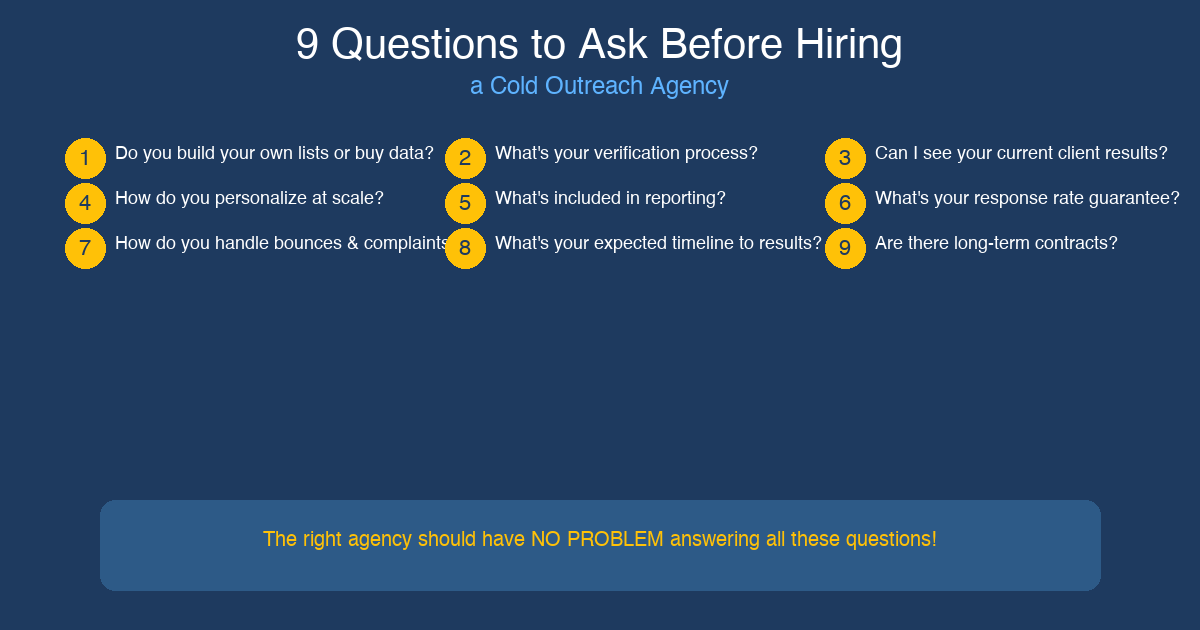
How to Hire a Cold Outreach Agency: 9 Questions to Ask Before Signing
Most companies that hire a cold email provider make the same mistake: they choose based on price or a slick sales deck, not proven results. Six months later, they’ve burned through their budget, damaged their sender reputation, and concluded that cold prospecting doesn’t work.
That conclusion is wrong. Outbound sales works.
The partner you choose determines whether it works for you.
I’ve watched dozens of companies make this mistake. I’ve also watched companies avoid it entirely by asking the right questions before committing.
This guide gives you those questions. Ten of them.
Every serious provider should answer each one clearly, specifically, and without hesitation. If they can’t, that silence reveals a gap in their process that will cost you money.
What Services Do Cold Outreach Providers Typically Offer?
The cold email landscape spans a wide range of service levels, from basic list provision to full-cycle SDR services. Understanding what you’re buying determines whether your investment generates returns for your lead generation efforts.
Basic B2B prospecting services typically include contact list provision, templated outbound email campaigns, basic LinkedIn prospecting, and activity reporting on sent messages. These services deliver volume without quality guarantees.
You receive what you pay for: a list of names and reports showing emails were sent.
Mid-tier cold campaigns add personalization at scale, multi-channel sequences combining email and LinkedIn, basic demand generation qualification, and improved reporting on engagement metrics. These services move beyond templated approach to generate meaningful response rates, though results vary significantly by vendor.
Elite cold email services include dedicated campaign strategy development, deep hyper-personalization research, rigorous qualification frameworks aligned with your sales process, booked meetings on your calendar with qualified prospects, and continuous optimization based on conversion data. These partners function as outsourced sales development organizations rather than simple email prospecting vendors.
Services That Actually Move Pipeline
Services that genuinely impact your sales pipeline focus on outcomes rather than activities. Booking qualified meetings on your calendar matters more than reporting that emails were opened.
Lead qualification against your specific criteria matters more than volume of connection requests sent. Appointment setting that delivers decision-makers with budget authority and timeline urgency creates pipeline.
Everything else is noise.
How Much Do Cold Outreach Services Cost?
Direct cost comparison is meaningless without understanding what you receive. A $500 monthly provider delivering zero meetings costs infinitely more than a $5,000 monthly service filling your pipeline with qualified appointments every week.
Cost structures in the cold prospecting market include monthly retainer models based on scope of service, per-meeting pricing that ties payment to booked appointments, hybrid models combining base fees with performance components, and project-based pricing for specific campaign objectives. When you need to generate leads efficiently, understanding these cost structures becomes critical for making smart investment decisions.
The relevant calculation is cost per qualified meeting, not cost per month. If your provider charges $3,000 monthly and delivers 12 qualified meetings, your cost per meeting is $250.
If another provider charges $5,000 monthly and delivers 25 qualified meetings, their cost per meeting is $200. The expensive provider is actually cheaper on the metric that matters.
Be wary of vendors that advertise specific prices without understanding your requirements. Any provider that quotes pricing before asking about your ICP, target market, and campaign objectives is selling a commodity product, not a strategic partnership.
Real pricing reflects real scope, which requires real conversation.
What Pricing Should Include
Every pricing proposal should clearly specify setup fees and what work they cover, monthly management fees and service level, cost per booked meeting if performance-based, list sourcing costs if not included, additional domain or campaign charges, and any minimum commitments or volume requirements. Vague pricing proposals hide costs that appear later.
How Do I Choose the Right Cold Outreach Provider for My Business?
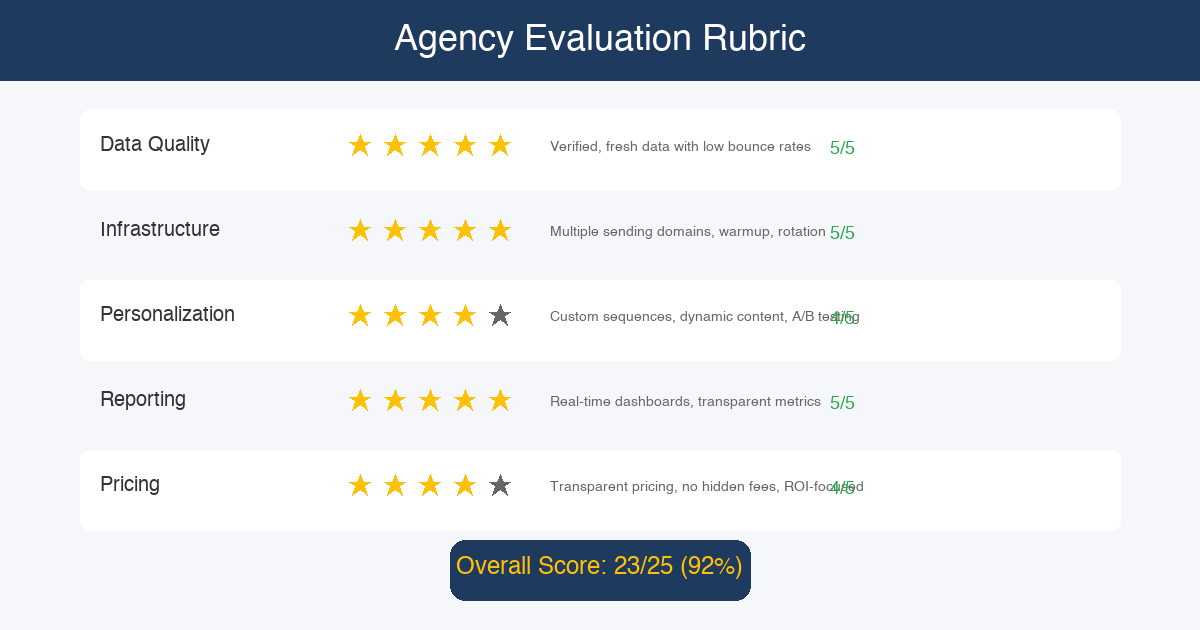
Choosing the right cold email partner requires evaluating multiple dimensions that collectively determine partnership success.
Vertical expertise should be your first filter. Providers that claim success across all industries are experts in none.
The messaging that works for SaaS companies doesn’t work for manufacturing firms. The data requirements for healthcare differ from technology.
A provider with documented experience in your specific vertical has already learned the lessons that would otherwise delay your results by months. Look for vendors that specialize in your space rather than those offering generic outbound services.
Methodology transparency separates professional services from amateur operations. Ask how they research prospects, how they personalize communication, how they handle email deliverability, and how they optimize based on data.
Providers that share their process openly demonstrate confidence in their approach. Providers that hide their methodology have something to protect.
Integration capabilities determine whether outsourced cold prospecting connects smoothly with your sales process. Ask about CRM integration, calendar booking procedures, and reporting that maps to your pipeline stages.
Services that operate in silos, delivering spreadsheets without connecting to your systems, create friction that undermines the efficiency advantage of outsourcing. The best partners help you generate leads while smoothly integrating with your existing workflows.
Client fit matters beyond industry matching. Consider company size alignment, budget range compatibility, sales cycle complexity match, and cultural alignment.
A provider that excels serving startups may not have the sophistication required for enterprise sales cycles. Find the partner that matches where you’re, not where you aspire to be.
Questions That Reveal Methodology Depth
Ask prospective providers how they handle email deliverability management, what their typical bounce rates are, how they warm new sending domains, and what their reply rate benchmarks look like. The answers reveal whether they understand the operational complexity of cold prospecting or are simply sending templated messages into the void.
Does the provider have a dedicated cold caller on staff, or do they rely solely on email channels?
How Long Does It Take to See Results From Cold Outreach?
Realistic timelines vary by campaign type, but honest cold email partners will share consistent patterns.
The first two to four weeks involve infrastructure setup and verification. New sending domains require gradual warming.
Fresh lead data must be verified before use. Copy development requires research and drafting.
This preparatory phase generates no meetings but is essential for long-term success. Buyers who expect results in week two typically cancel before their campaign reaches full velocity.
Weeks four through eight represent the learning phase. Initial campaigns run and generate data.
Reply rates reveal what messaging resonates. Conversion rates identify optimization opportunities.
Sophisticated providers use this data to refine targeting, adjust messaging, and improve qualification criteria. You should see first meetings during this phase, though at lower volumes than later stages.
Months three through six deliver optimized performance. Campaigns have been refined based on real data.
The provider has learned what works for your specific market. Meeting volume should increase steadily as optimization compounds.
By month six, you should have clear evidence whether the partnership generates ROI.
Meeting rates depend heavily on targeting quality, offer strength, and market conditions. Industry benchmarks suggest 4 to 8 qualified meetings per month per active campaign targeting mid-market enterprise audiences with 2,000 to 3,000 verified contacts.
If you’re significantly below these benchmarks after three months, either the provider or the campaign requires adjustment.
The Patience Test
The most common mistake buyers make is abandoning campaigns before optimization completes. Cold email campaigns that receive three months of consistent effort and refinement typically outperform campaigns abandoned after six weeks.
Before signing with any provider, commit to the timeline required for meaningful results. If you can’t commit to three months, you shouldn’t hire a partner.
What Are Some Red Flags to Watch Out for When Hiring a Cold Outreach Provider?
Warning signs that signal inadequate providers deserve serious consideration before committing resources for your email outreach campaigns.
- Volume Guarantees Without Qualification , Providers promising meetings without understanding your ICP will flood your CRM with noise
- Generic Messaging for Any Industry , One-size-fits-all templates generate one-size-fits-all mediocre results; ask about custom template development
- No Mention of Email Authentication , SPF, DKIM, and DMARC are non-negotiable; providers skipping this discussion will damage your deliverability
- Refusal to Share Case Studies , Professional services have verifiable results to point toward; vague responses reveal vague processes
- Pricing Too Good to Be True , The provider is cutting corners on prospecting data quality, personalization depth, or infrastructure management
- Long-Term Contracts Before Demonstrating Value , Month-to-month arrangements indicate confidence in quick value delivery
Volume guarantees without qualification requirements signal a provider focused on vanity metrics rather than business outcomes. If they promise 200 meetings per month without understanding your ICP, they’ll flood your CRM with noise rather than qualified opportunities.
Generic messaging that applies to any industry suggests they’ve not invested in understanding your market. One-size-fits-all templates generate one-size-fits-all mediocre results.
Each industry has unique vocabulary, pain points, and buying triggers that require tailored approaches. Ask specifically whether they’ll create a custom template library for your industry or reuse existing assets.
No mention of email authentication or deliverability management indicates they send cold email without proper infrastructure. SPF, DKIM, and DMARC records are non-negotiable for maintainable email deliverability.
Any provider that doesn’t discuss these technical requirements is sending emails that will land in spam folders.
Refusal to share case studies or client references suggests they don’t have verifiable results to point toward. Professional services have stories to tell.
they’ve worked with clients in your space and can connect you with references who validate their approach.
Pricing that seems too good to be true almost certainly is. The provider is cutting corners somewhere, typically on prospecting data quality, personalization depth, or infrastructure management.
Bad data destroys your sender reputation in days. Recovery takes months.
Additional Disqualifying Signals
Long-term contract requirements before demonstrating value signal providers that need lock-in because results are uncertain. Month-to-month arrangements indicate confidence in quick value delivery.
e:18px;”>Any provider that can’t articulate their methodology in specific terms may not have a methodology at all. Vague answers reveal vague processes that produce vague results.
What Are the Benefits and Drawbacks of Using a Cold Outreach Provider Versus Doing It In-House?
Internal cold prospecting capabilities require significant investment that most companies underestimate. Understanding the tradeoffs clarifies whether external partnership or internal build makes sense for your situation.
Effective lead generation requires careful consideration of these tradeoffs.
Benefits of provider outsourcing include immediate access to established infrastructure, specialized expertise accumulated across multiple clients, scalability without adding permanent headcount, predictable costs with measurable output, and focus optimization allowing internal teams to concentrate on closing deals rather than hunting for contacts. When you outsource your cold calling operations, you gain these benefits immediately.
Drawbacks of provider outsourcing include less direct control over daily execution, potential misalignment with specific product knowledge, dependency on vendor responsiveness and availability, and the risk of partnering with an underperforming service. These drawbacks are manageable with proper vetting and clear contractual expectations.
Benefits of in-house prospecting include direct control over strategy and execution, deeper product and customer knowledge, alignment with company culture and messaging, and proprietary data accumulation that compounds over time.
Drawbacks of in-house prospecting include significant time-to-competency (3-6 months minimum), SDR turnover rates averaging 200% annually, infrastructure build costs that exceed most vendor fees, and management attention diverted from closing revenue to supervising hunters.
The Hybrid Model
Most successful B2B companies eventually develop hybrid approaches. Internal teams handle high-value accounts requiring deep product knowledge and relationship continuity.
External email outreach partners handle volume and breadth across the total addressable market. This combination delivers both the depth that complex sales require and the scaling that pipeline generation demands.
What Metrics Should I Track to Measure the Success of a Cold Outreach Campaign?
Measuring cold prospecting success requires tracking beyond activity metrics into outcomes that actually impact revenue for your lead generation strategy.
Activity metrics reveal whether campaigns are executing: emails sent, delivery rate, open rate, click rate, connection requests sent, engagement rate on LinkedIn. These metrics indicate whether your infrastructure functions and whether prospects engage with your content.
But activity metrics alone don’t reveal business impact.
Engagement metrics reveal whether communication generates interest: reply rate, meeting request acceptance rate, unsubscribe rate, spam complaint rate. These metrics indicate whether your messaging resonates with your audience.
Reply rates above 5% for B2B prospecting indicate well-targeted, well-personalized campaigns. Rates below 2% suggest messaging or targeting problems.
Pipeline metrics reveal whether engagement converts to opportunity: meeting conversion rate, qualified meeting rate, opportunity creation rate, pipeline generated by campaign. These metrics connect prospecting activity to business outcomes that matter to sales leadership.
Revenue metrics reveal ultimate ROI: revenue closed from outreach-sourced opportunities, customer acquisition cost by channel, sales pipeline velocity for outreach-sourced deals, and win rate by outreach channel. These metrics determine whether your outbound sales investment generates positive returns.
The Cost Per Qualified Meeting
The most actionable metric for comparing campaign efficiency is cost per qualified meeting. Calculate total investment (vendor fees plus internal costs) divided by meetings that meet your qualification criteria.
This metric enables direct comparison between campaigns, providers, and internal versus outsourced approaches. If you don’t know your cost per qualified meeting, you can’t evaluate whether your email outreach investment makes sense.
How Can I Improve the Deliverability of Cold Emails and Avoid Spam Filters?
Email deliverability is the foundation of outbound sales success. Even the best-written emails fail if they don’t reach the inbox.
Understanding and managing deliverability separates successful campaigns from expensive failures. Effective email prospecting requires proper infrastructure setup before launching any campaign for your lead generation efforts.
- Sender Reputation , ESPs track sending patterns and maintain scores; high reputation means inbox, low reputation means spam folder or blocking
- Build Reputation Through , Consistent sending patterns, low bounce rates (below 2%), low spam complaint rates (below 0.1%), high engagement rates
- Email Verification , Multi-layer verification including syntax, domain, and mailbox verification keeps bounce rates below threshold
- Authentication Records , SPF, DKIM, DMARC prove legitimacy; every sending domain requires correct configuration before launching
- Domain Warming , Gradually increase volume over 4-8 weeks; anyone promising instant volume is preparing to damage your infrastructure
- Content Factors , Spam-triggering language, excessive links, and sudden pattern changes all trigger algorithmic review
Sender reputation is the primary deliverability factor. Email service providers (Gmail, Outlook, corporate spam filters) track sending patterns and maintain reputation scores for every sending domain and IP address.
High reputation scores result in inbox placement. Low reputation scores result in spam folder placement or blocking.
Reputation builds through consistent sending patterns, low bounce rates (below 2%), low spam complaint rates (below 0.1%), and high engagement rates (opens and clicks). Reputation declines through bounce rate spikes, spam complaints, sending to spam traps, and irregular volume patterns that trigger algorithmic suspicion.
Email verification is the most effective deliverability investment. Every email sent to an invalid address damages reputation.
Multi-layer verification including syntax validation, domain confirmation, and mailbox verification keeps bounce rates below the threshold that triggers ESP penalties. Quality cold email providers implement rigorous verification as standard practice.
Authentication records (SPF, DKIM, DMARC) prove to receiving servers that your emails are legitimate rather than forged. Without proper authentication, your emails look suspicious regardless of content.
Every sending domain requires these records configured correctly before launching any campaign.
Domain warming is essential for new sending infrastructure. Gradually increasing volume over four to eight weeks signals to ESPs that you’re a legitimate sender rather than a spammer.
Anyone who promises instant volume from new domains either doesn’t understand deliverability or is preparing to damage your infrastructure.
Content Factors That Affect Deliverability
Beyond infrastructure, content quality impacts deliverability. Spam-triggering language in subject lines and body copy increases spam filter activation.
Excessive links relative to text signals promotional content. Sudden changes in sending patterns trigger algorithmic review.
Quality providers manage both infrastructure and content factors systematically.
What Are Realistic Reply and Meeting Rates to Expect From Cold Outreach?
Honest expectations prevent disappointment that undermines otherwise viable campaigns. Rate benchmarks depend heavily on targeting quality, message personalization, and offer strength for your lead generation efforts.
Reply rates for typical outbound email campaigns targeting qualified lists average 1-3%. Campaigns with hyper-personalization and well-defined ICPs typically achieve 5-15%.
Anything above 15% requires exceptional targeting and messaging. Anything below 1% suggests problems with list quality, messaging, or email deliverability.
LinkedIn connection acceptance rates average 20-40% for InMail-eligible prospects. InMail reply rates average 15-25% for premium users.
These rates are substantially higher than cold email because LinkedIn’s professional context makes prospecting more expected and acceptable.
Meeting conversion from replies typically runs 30-50%. This means for every ten replies to your email outreach, three to five convert to booked meetings.
Meeting show rates average 30-40%, meaning one in three booked meetings actually occurs. Qualified meeting rates from prospecting depend on qualification rigor: providers that book every interested reply generate volume with low close rates, while providers that qualify strictly generate fewer meetings with higher close rates.
Multi-channel campaigns consistently outperform single-channel benchmarks. Prospects who receive coordinated email and LinkedIn prospecting generate response rates three to five times higher than prospects receiving only one channel.
The compounding effect of multiple familiarity touchpoints dramatically improves conversion at every stage.
Rate Variation by Segment
Rates vary significantly by industry, company size, seniority level, and offer attractiveness. Enterprise targeting typically generates lower reply rates but higher meeting quality.
SMB targeting generates higher reply rates but lower deal values. Technical audiences require different messaging than business audiences.
Understanding segment-specific benchmarks requires experience that quality providers accumulate across multiple campaigns.
How Do I Integrate Outsourced Cold Outreach With My Existing CRM and Sales Processes?
Integration quality determines whether outsourced cold prospecting becomes a seamless extension of your sales process or a disconnected silo that creates extra work without corresponding benefit. Proper integration is essential for effective lead generation.
CRM integration is the foundation. All prospect activity should flow into your CRM automatically: touchpoints, engagement data, reply signals, and qualification notes.
Without CRM integration, your sales team can’t see what outreach has occurred before their first call. With integration, every AE enters conversations with full context about prospect engagement.
Qualification alignment ensures outsourced teams use your criteria, not generic qualification frameworks. Define specific requirements for what makes a meeting “qualified.” Specify discovery questions that should be asked before booking.
Clarify budget thresholds, timeline indicators, and authority requirements. The more specific your qualification criteria, the better your outsourced team can apply them.
Calendar integration simplifys booking. When qualified meetings book directly into your AEs’ calendars with full context notes, conversion rates improve significantly.
Vague meeting descriptions force AEs to do discovery again. Rich context notes enable AEs to prepare for productive conversations from the moment the meeting is booked.
Feedback loops close the optimization cycle. Your AEs should consistently report which meetings were well-qualified versus which wasted their time.
This data should flow back to your provider weekly. Campaigns that never incorporate feedback stagnate.
Campaigns that adapt based on real-world results continuously improve.
Integration Checkpoints
Before launching any partnership, establish integration checkpoints that verify everything works smoothly. Test CRM data flow before campaign launch.
Verify calendar booking procedures work with your scheduling tools. Confirm reporting dashboards show the metrics you need.
Establish communication channels for feedback and adjustment. Integration isn’t a one-time setup but an ongoing optimization process.
Do the math. If our AI infrastructure reaches out to 1,000 highly qualified, triple-verified decision-makers a day, that’s 30,000 people a month. With our hyper-personalization, even an impossibly conservative 1% reply rate yields 300 qualified conversations. In high-ticket business-to-business, what happens to your revenue when you’ve 300 conversations with your exact ICP?
Frequently Asked Questions
what’s the fastest way to use How to Hire a Cold Outreach Agency: 9 Questions to Ask Before Signing without burning the market?
Start with a tight ICP, verified data, and a small test batch. Scale only after replies, bounces, and meeting quality prove the message is working.
How many prospects should I contact for How to Hire a Cold Outreach Agency: 9 Questions to Ask Before Signing?
The number matters less than the fit. A smaller list of verified decision-makers will beat a large scraped list because inbox placement, relevance, and timing decide reply quality.
Why do most campaigns around How to Hire a Cold Outreach Agency: 9 Questions to Ask Before Signing fail?
Most campaigns fail because the data is weak, the offer is vague, and the follow-up system is inconsistent. Fix those three points before adding more volume.
Should I use email only for How to Hire a Cold Outreach Agency: 9 Questions to Ask Before Signing?
No. Email works better when it’s supported by LinkedIn touches, retargeting, and clean CRM follow-up. One channel creates reminders. Multiple channels create recognition.
When should I hire help for How to Hire a Cold Outreach Agency: 9 Questions to Ask Before Signing?
Hire help when you already know the customer profile, the offer is validated, and the bottleneck is execution speed. Outsourcing a broken offer only makes the failure happen faster.
How I Would Tighten This Campaign
How to Hire a Cold Outreach Agency looks simple from the outside. In practice, the money is made in the boring parts: list quality, timing, proof, follow-up, and clean measurement. That is why I care less about volume at the start and more about whether the first replies prove the angle is real.
The buyer is not sitting around waiting for your pitch. They are dealing with service buyers who have heard every vague promise already and need proof before they book a call. That means the message has to earn attention fast: clear pain, clean proof, and a next step that does not feel like a trap.
The Checks I Would Run Before Scaling
- Account quality: Would this company still be attractive if it never replied this month? If not, it probably should not be in the campaign.
- Message angle: Can the opener point to a real business condition, not a lazy compliment? Specificity is what makes the email feel earned.
- Next step: Is the CTA small enough to say yes to? A useful reply is often a better first win than forcing a meeting immediately.
This is not complicated, but it is unforgiving. A sloppy list makes copy look bad. Weak positioning makes good data useless. And a CTA that asks for a meeting too early forces the buyer to do all the mental work.
The cleaner version is simple: start with 200 accounts, not a giant scraped list. Segment them by pain, write one message for one segment, and watch replies before scaling. If that first batch does not produce signal, more volume will not save the campaign. It will only make the failure louder.
Here is the practical takeaway: make How to Hire a Cold Outreach Agency narrower, cleaner, and easier to say yes to. Then scale what the market proves, not what the team hopes will work. Build the data layer first, then the message, then the follow-up system. In that order.
Book a strategy call
How to Judge How To Hire Cold Outreach Agency Before You Scale
The practical test for how to hire cold outreach agency is not whether the idea sounds smart. The test is whether it creates qualified pipeline without damaging deliverability, sender reputation, or buyer trust. A strong system connects cold calling service , outsource cold calling services , outsourced cold calling , cold calling company with clear targeting, clean data, and a message that feels written for the exact account.
If the campaign uses b2b cold calling , cold calling agency , right cold calling , cold calls , hire cold callers , clients through cold, the team needs a simple operating rule: do not add volume until replies prove the angle. That means watching inbox placement, open rates, reply quality, bounce behavior, and the number of sales meetings that come from real decision-makers.
The Execution Checklist
- Infrastructure: Check subject line, cold calling campaigns, qualified leads, potential clients before scaling. If this layer is weak, more sending only creates louder failure.
- Targeting: Check cold calling process, use cold, potential customers before scaling. If this layer is weak, more sending only creates louder failure.
- Message quality: Check cold calling team, choose the best cold calling, right agency, quality leads before scaling. If this layer is weak, more sending only creates louder failure.
- Follow-up: Check freelancers, specific needs, sales funnel before scaling. If this layer is weak, more sending only creates louder failure.
- Measurement: Check recipient’s, brand’s before scaling. If this layer is weak, more sending only creates louder failure.
The bottom line is simple: how to hire cold outreach agency should be treated like a revenue system, not a one-off campaign. When the list, email infrastructure, personalization, domain setup, and multichannel follow-up work together, the outreach has a real chance to turn cold attention into booked meetings.
Search Intent Coverage Section for How to Hire Cold Outreach Agency
How Outreach Changes the Buying Decision
For how to hire cold outreach agency, buyers are usually comparing scheduling a call, sdrs, setup for cold, using chatgpt, call to discuss. The decision is not made from one email or one landing page. It is made from proof, clean positioning, inbox trust, and whether the outreach explains why the offer matters now.
The operational layer matters too: cold calling scripts, sending cold emails, use tools. If these pieces are weak, the campaign may still create activity, but it will not create enough qualified sales conversations to justify scaling.
How Cold Outreach Changes the Buying Decision
For how to hire cold outreach agency, buyers are usually comparing product or service, number of cold, email marketing, sales goals, sales and marketing. The decision is not made from one email or one landing page. It is made from proof, clean positioning, inbox trust, and whether the outreach explains why the offer matters now.
The operational layer matters too: call to action, marked as spam, generate sales. If these pieces are weak, the campaign may still create activity, but it will not create enough qualified sales conversations to justify scaling.
How Cold Calling Service Changes the Buying Decision
For how to hire cold outreach agency, buyers are usually comparing sales representatives, sales development representatives, copywriter, build relationships, free trial. The decision is not made from one email or one landing page. It is made from proof, clean positioning, inbox trust, and whether the outreach explains why the offer matters now.
The operational layer matters too: hiring process, b2b saas, lead quality. If these pieces are weak, the campaign may still create activity, but it will not create enough qualified sales conversations to justify scaling.
How Lead Generation Changes the Buying Decision
For how to hire cold outreach agency, buyers are usually comparing list of potential, capture their interest, saas company, industry-specific, services come. The decision is not made from one email or one landing page. It is made from proof, clean positioning, inbox trust, and whether the outreach explains why the offer matters now.
The operational layer matters too: pricing models, generic emails, find qualified. If these pieces are weak, the campaign may still create activity, but it will not create enough qualified sales conversations to justify scaling.
How Cold Email Changes the Buying Decision
For how to hire cold outreach agency, buyers are usually comparing salesperson, set appointments, spark interest, manual work, outreach. The decision is not made from one email or one landing page. It is made from proof, clean positioning, inbox trust, and whether the outreach explains why the offer matters now.
The operational layer matters too: cold outreach, cold calling service, lead generation. If these pieces are weak, the campaign may still create activity, but it will not create enough qualified sales conversations to justify scaling.
What I Would Inspect Manually
If the message cannot show why this matters now, the campaign becomes background noise. Look at How to Hire Cold Outreach Agency through the buyer’s day, not through a marketer’s checklist. For How to Hire Cold Outreach Agency, that means the outreach has to connect the business problem, the buying moment, and the proof in a way that feels specific.
A campaign built around consensus, committee, and category has more context than a generic pitch. A reputation bottleneck should not be handled with the same CTA as a revenue bottleneck. A verification buyer cares about different proof than a hire buyer. This is why shallow templates fail. They flatten different buyer situations into one bland message.
- Qualification: Review qualification against the buyer’s real context before increasing send volume.
- Priority: Review priority against the buyer’s real context before increasing send volume.
- Dashboard: Review dashboard against the buyer’s real context before increasing send volume.
- Automation: Review automation against the buyer’s real context before increasing send volume.
- Director: Review director against the buyer’s real context before increasing send volume.
- Latency: Review latency against the buyer’s real context before increasing send volume.
This is the part a generic article usually misses: judgment. A real operator can tell when partner is the problem, when offer is the problem, and when the whole angle is too soft. That judgment comes from reading replies, checking account quality, and comparing message intent against actual buyer behavior.
The cleaner move is to run a small batch, inspect the signal, then rewrite the weak layer. Do not scale because the copy looks polished. Scale because the replies prove the market understands the value.