B2B Sales Prospecting Services: What to Expect and How to Choose
Most B2B companies face the same brutal arithmetic: their closers spend 40% of their time hunting instead of selling. Every hour spent searching for contacts, verifying data, and sending outbound communication sequences is an hour not spent closing revenue.
This is the fundamental inefficiency that enterprise sales demand generation services are designed to eliminate.
The market for outsourced outbound sales has exploded over the past five years. Every week brings new agencies promising to fill your sales pipeline with qualified opportunities.
But not all outbound outreach services are created equal. The difference between a partner who transforms your revenue and a vendor who drains your budget comes down to methodology, data quality, and whether they actually understand your market.
This guide covers everything you need to know before engaging any outbound sales provider. From understanding what quality services actually include to identifying the red flags that signal trouble, you’ll know exactly what to look for and what questions to ask.
What Are B2B Sales Prospecting Services?
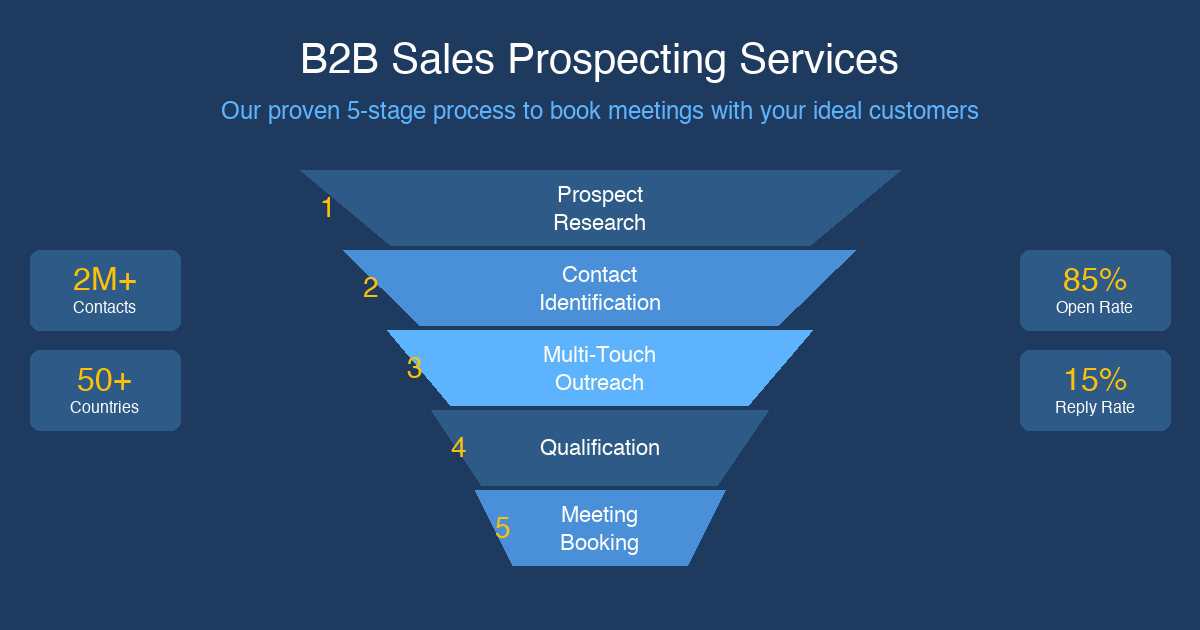
enterprise sales demand generation services are specialized operations that handle the top of your sales funnel: identifying potential buyers, verifying their contact information, qualifying their fit, and booking meetings with your commercial team. The scope varies significantly between providers, ranging from basic list provision to full-cycle appointment setting.
At the comprehensive end, outbound sales services include ICP definition and refinement, prospect identification using multiple data sources, email demand generation and LinkedIn sequences, lead qualification using discovery criteria you define, and confirmed appointment setting on your calendar. At the bare minimum, you should expect a demand generation partner who delivers booked meetings, not just contact lists.
The critical distinction is output type. A list of 500 names is worthless without follow-up.
A calendar full of meetings with qualified prospects who have budget authority and purchase timeline is the foundation of predictable revenue. When evaluating B2B outreach services, clarify exactly what deliverables you’ll receive before signing any contract.
Full-Funnel vs Partial Prospecting Services
Understanding where a provider operates on the service spectrum determines expectations and results. Demand generation agencies focus on top-of-funnel activities: awareness and interest creation.
They deliver names and contact information for your team to follow up. Sales development providers go deeper, handling SDR-level qualification and often delivering qualified conversations ready for AE engagement.
The most sophisticated outbound sales services function as true outsourced outbound demand generation departments. They manage the entire process from target list creation through booked meetings, integrating with your CRM, following your qualification framework, and continuously optimizing based on what converts in your pipeline.
What Are Common Challenges in B2B Sales Prospecting?
outbound sales fails in predictable ways. Understanding these failure modes helps you identify weak providers and avoid common mistakes that undermine even well-resourced demand generation operations.
- Data Quality , Purchased lists contain 30-60% invalid addresses within 12 months, destroying sender reputation and wasting campaigns
- Targeting Precision , Vague ICPs generate vague results; account-based marketing requires discipline in defining specific characteristics
- Personalization at Scale , Generic templates produce generic results; hyper-personalization is required to break through prospect noise
- Cold Calling Challenges , Gatekeepers screen calls effectively; average connection rates have declined as buyers prefer digital channels
- SDR Turnover , 200% annual turnover means hiring and losing three people per year per seat, resetting learning constantly
Data quality is the most common failure point. Purchased lists contain 30-60% invalid addresses within 12 months of collection.
Bad data generates bounces that destroy sender reputation, lands messages in spam folders, and wastes your entire campaign before it starts. Many B2B outreach operations fail not because their messaging is weak but because they’re sending to addresses that no longer exist.
Targeting precision represents the second major challenge. Companies with vague ICPs generate vague results.
If you can’t clearly articulate who should receive your outreach and why they need your solution, your demand generation will spray across your market without generating traction. Account-based marketing requires discipline in defining specific company characteristics, job titles, and trigger events that indicate buying readiness.
Personalization at scale defeats most demand generation operations. Generic templates produce generic results.
Prospects receive dozens of identical messages daily and have learned to ignore anything that doesn’t feel personally relevant. The agencies that win in outbound sales have systems for researching individual prospects and incorporating specific context into every message.
Cold calling presents unique challenges in modern sales environments. Gatekeepers screen calls effectively.
Prospects screen calls through caller ID and voicemail. Average connection rates for cold calls have declined steadily as buyers communicate primarily through digital channels.
Effective demand generation requires multi-channel sequences that reach buyers where they actually engage.
Internal vs Outsourced Prospecting Challenges
Companies attempting internal outbound sales face systematic challenges that external providers have solved operationally. SDR turnover rates average 200% annually, meaning you hire and lose three people per year per seat.
Training takes three to six months before meaningful productivity. Management attention diverts from closing deals to supervising hunters.
These costs rarely appear in demand generation budgets but they destroy ROI systematically.
What Are Effective B2B Sales Prospecting Strategies and Techniques?
Modern outbound sales requires coordinated multi-channel strategies that reach executives through the channels they actually use. No single channel dominates.
The highest-performing demand generation operations combine email, LinkedIn, and phone in sequences designed to create multiple familiarity touchpoints before asking for anything.
- Account-Based Prospecting , Focus on specific target accounts and map the buying committee within each organization
- Multi-Channel Orchestration , Combine email, LinkedIn, and phone in sequences creating multiple familiarity touchpoints
- Hyper-Personalization , Reference specific company events, individual content, and specific pain points relevant to the prospect’s situation
- Decision-Maker Identification , Map multiple roles at each account with coordinated outreach tailored to each stakeholder
- Continuous Optimization , Test variations systematically, measuring what resonates with specific segments and doubling down on winning approaches
Account-based demand generation represents the dominant strategy for complex B2B sales. Rather than targeting individuals broadly, ABM focuses on specific target accounts and maps the buying committee within each organization.
This approach requires economic buyer identification across multiple roles, coordinated outreach to multiple contacts at each account, and messaging tailored to each stakeholder’s specific priorities.
Cold outreach sequences must incorporate hyper-personalization to generate meaningful response rates. This means referencing specific company events (funding rounds, executive hires, product launches), individual content (articles published, presentations given), and specific pain points relevant to the prospect’s situation.
Generic first-name-and-company-name personalization produces generic results that fail to differentiate from the hundreds of other messages prospects receive daily. Your sales professionals need these personalized touchpoints to engage prospects effectively.
Effective demand generation strategy requires continuous optimization based on real data. Reply rates vary significantly by industry, company size, seniority level, and message type.
Sophisticated demand generation operations test variations systematically, measuring what resonates with specific segments and doubling down on winning approaches. Static campaigns that never change reflect demand generation operations that aren’t learning.
Multi-Channel Sequence Architecture
The most effective outbound demand generation sequences combine channels strategically. Day One typically features outbound email as the primary touchpoint, establishing initial contact with detailed messaging.
Day Two or Three adds a LinkedIn connection request that references the email, creating a second touchpoint with a different format. Days Four through Seven involve social engagement: liking posts, leaving comments, sharing relevant content that demonstrates value without asking for anything.
Day Seven through Ten often includes a follow-up email with additional context or value provision. High-priority accounts might receive a phone call during this window, adding voice to the digital sequence.
The goal is creating multiple exposure touchpoints so that when the prospect is ready to evaluate your category, your name triggers recognition rather than confusion.
What Are the Benefits of Outsourcing B2B Sales Prospecting?
Outsourcing outbound sales delivers advantages that build internal teams can’t match without significant investment in hiring, training, and operational systems.
Immediate infrastructure is the first major benefit. Quality demand generation requires email verification tools, sequencing software, CRM integrations, analytics platforms, and lead data enrichment services.
Building this stack internally takes months and significant capital. Outsourcing gives you access to enterprise-grade demand generation infrastructure immediately, with costs amortized across all the provider’s clients.
Specialized expertise accumulates with dedicated demand generation providers. they’ve tested thousands of subject lines, optimized hundreds of sequences, and learned what works across dozens of industries.
This expertise compounds over time. Your internal team resets this learning every time an SDR departs, which happens on average every 18 months.
Scalability favors outsourcing. Adding internal demand generation capacity requires hiring, onboarding, and management bandwidth that grows linearly with output.
Outsourcing allows you to scale from one campaign to ten with marginal increases in management attention. You can test new markets or products without committing to permanent headcount.
Focus optimization allows your closers to concentrate on revenue-generating activities. Every hour your AEs spend on demand generation is an hour not spent closing.
At enterprise compensation levels, paying closing prices for hunting work destroys unit economics. When you outsource demand generation to specialists, your closers can focus on closing while your target market gets properly addressed.
The Hidden Costs of Internal Prospecting
Internal demand generation appears cheaper than outsourcing on a direct cost comparison, but this analysis ignores significant hidden costs. Recruitment for sales development roles consumes significant HR bandwidth.
Training requires three to six months of sub-optimal productivity. Management oversight distracts sales leadership from strategic activities.
Turnover destroys institutional knowledge and restarts the training cycle. When you calculate fully-loaded costs including all these factors, internal demand generation rarely beats outsourced alternatives on cost-per-qualified-meeting.
These costs directly impact your overall sales cycle length and efficiency.
How Do B2B Sales Prospecting Services Impact Revenue and ROI?
The impact of quality outbound sales services on revenue follows a compounding logic. More qualified meetings in front of your closers means more opportunities to advance through your sales process.
More pipeline at the top creates more closed revenue at the bottom.
Revenue impact manifests through several mechanisms. First, increased conversation volume expands your sample size of potential customers.
Even with constant conversion rates, more initial contacts generate more qualified opportunities. Second, consistent demand generation eliminates feast-or-famine sales pipeline patterns that stress organizations and lose deals.
Third, qualified prospects who arrive pre-researched allow closers to spend discovery time advancing deals rather than gathering basic information.
ROI calculation requires understanding your actual cost per qualified meeting. This includes fully-loaded demand generation costs divided by meetings that meet your qualification criteria.
If your cost per qualified meeting with an outsourced provider is lower than your internal cost, the decision is mathematically clear. Most companies find that external demand generation delivers better unit economics than building equivalent internal capacity.
The key is ensuring every qualified lead meets your specific criteria before counting it toward ROI.
The second-order revenue impact involves commercial team efficiency. AEs who receive consistent qualified meetings spend more time selling and less time on demand generation or qualifying inbound leads that don’t fit.
This efficiency gain compounds across your entire sales organization, multiplying the impact of any demand generation improvement.
Measuring True Prospecting ROI
Proper ROI measurement requires tracking beyond activity metrics like emails sent or meetings booked. What matters is lead qualification quality, pipeline generated from demand-gen-sourced meetings, revenue closed from demand-gen-sourced opportunities, and customer acquisition cost by demand generation channel.
=”margin-bottom:28px;line-height:1.7;font-size:18px;”>These metrics reveal whether your demand generation investment generates actual business outcomes rather than vanity numbers that don’t translate to revenue.
What Are the Best B2B Sales Prospecting Tools and Software?
Effective outbound sales requires integrated tooling across several categories. Understanding the landscape helps you evaluate provider infrastructure and identify gaps in your own operations.
Lead data platforms provide the foundation: contact information, company data, job titles, and organizational hierarchies. Leading providers offer real-time verification, data enrichment capabilities, and APIs that integrate with your CRM and email demand generation tools.
The quality of your data determines the ceiling of your demand generation performance.
Email sequencing software automates outreach while maintaining personalization at scale. Modern platforms incorporate AI-powered hyper-personalization, behavior-triggered follow-ups, and analytics that reveal what messaging resonates with specific segments.
The best tools enable experimentation with subject lines, send times, and message content while tracking performance automatically.
LinkedIn engagement tools extend demand generation beyond email into social channels. These tools automate connection requests, follow-up messages, and content engagement while maintaining the personalization required to generate responses.
Integration with your email sequences creates the multi-channel approach that modern demand generation requires.
CRM platforms serve as the system of record for all demand generation activity. Modern CRMs capture touchpoints across channels, track engagement signals, and enable scoring models that identify which prospects deserve priority follow-up.
Without CRM integration, demand generation activity becomes disconnected from your sales process.
What Features Should I Look for in B2B Sales Prospecting Tools?
Not all demand generation tools deliver equal value. Features that differentiate performance-critical tools from commoditized alternatives determine whether your technology investment generates returns.
Real-time data verification is non-negotiable. Email addresses change constantly as people change jobs and companies update systems.
Batch verification processes data once and marks it verified indefinitely. Real-time verification checks addresses at the moment of use, catching changes that batch processing misses.
This feature alone can double your effective deliverability by eliminating bounces from recently-invalidated addresses.
Multi-channel orchestration capabilities distinguish sophisticated tools from email-only platforms. Your demand generation sequences should coordinate across email, LinkedIn, and phone while tracking engagement signals across all channels.
If a prospect engages with your LinkedIn content, your email follow-up should reflect that engagement. If they reply to your email, your LinkedIn sequence should adapt accordingly.
Tools that silo channels prevent this optimization.
Analytics and attribution features reveal what actually works. Surface-level metrics like emails sent and open rates tell you whether your infrastructure functions.
Deep metrics like reply rate by segment, meeting conversion by message type, and revenue attribution by channel reveal what generates business outcomes. The tools you choose determine what optimization is even possible.
CRM integration depth matters more than most buyers realize. Surface-level integration creates contacts but doesn’t sync engagement data, conversation history, or qualification signals.
Deep integration ensures your demand generation activity creates a complete prospect record that empowers your closers to continue conversations productively.
what’s the Difference Between Lead Generation and Sales Prospecting?
These terms are often used interchangeably, but understanding the distinction clarifies what you’re actually buying when you engage demand generation services.
Demand generation focuses on awareness and interest creation at the top of the funnel. The output is names and contact information for people who might be interested in your solution.
Demand generation is primarily a marketing function concerned with volume and reach. The quality bar is typically low: a lead is anyone who raises their hand, not necessarily anyone ready to buy.
Demand generation focuses on qualified conversation initiation. The output is scheduled meetings with buyers who have been qualified against specific criteria: budget authority, purchase timeline, problem recognition, and fit with your solution.
Sales development is the operational function that executes outbound demand generation to generate these qualified conversations.
The relationship is sequential. Demand generation creates potential.
Demand generation qualifies potential and advances it toward conversation. Appointment setting converts qualified potential into booked meetings.
A sales funnel requires all three stages functioning effectively. Investing heavily in demand generation while neglecting outreach leaves you with a database full of names that never convert to revenue.
Quality B2B outreach services help you generate leads that actually move through this funnel.
Why the Distinction Matters for Your Strategy
Understanding this distinction clarifies vendor selection and internal resource allocation. If you need names for your team to follow up, a demand generation provider suffices.
If you need qualified meetings on your calendar, you need a outbound sales service that handles qualification and appointment setting. Most companies discover they’ve plenty of names and a shortage of qualified meetings.
The gap is demand generation execution, not lead volume.
How Does GDPR Affect B2B Sales Prospecting?
GDPR and similar privacy regulations have fundamentally altered outbound sales requirements, especially for companies targeting European contacts or European-headquartered companies.
The core principle of legitimate interest allows outbound communication to business contacts under specific conditions. You must have a legitimate business reason for contacting someone.
The contact must be reasonably expected based on their professional role. You must minimize data collection to what’s necessary.
You must provide easy opt-out mechanisms. You must respect opt-out requests immediately and permanently.
Practical compliance requirements include documenting your legitimate interest assessment, maintaining records of consent or legitimate interest basis for each contact, implementing suppression lists that honor all opt-out requests across all campaigns, and limiting data retention to what’s necessary for your demand generation purposes.
Data sourcing becomes critically important under GDPR. Purchased lists created without proper legal basis represent significant compliance risk.
The ICO and national data protection authorities have fined companies millions for using improperly-sourced contact data. Your demand generation provider’s data sourcing practices directly impact your legal exposure.
Compliance as Competitive Advantage
Companies that implement rigorous data hygiene and compliance practices protect themselves from regulatory risk while often outperforming competitors who cut corners. Prospects increasingly notice the difference between thoughtful, relevant outreach and spammy spray-and-pray campaigns.
GDPR-compliant demand generation tends to be better-targeted, better-personalized, and more effective because it requires the discipline that produces results regardless of regulatory environment.
What Are the Key Considerations When Choosing a B2B Sales Prospecting Service?
Selecting a demand generation partner requires evaluating multiple dimensions that collectively determine whether your investment generates returns.
Vertical expertise matters more than most buyers realize. Cold outreach to healthcare executives requires different messaging, different data fields, and different compliance considerations than outreach to tech leaders.
Generic providers apply the same playbook to everyone. Specialized providers adapt their approach to your specific market, which produces significantly better results for industries with unique characteristics.
Data quality practices reveal provider discipline. Ask specifically how they verify contact information, what their average bounce rates are, and how they handle data decay.
Providers who use purchased lists or skip verification will damage your sender reputation and waste your campaign budget. Quality providers have systematic verification processes that keep bounce rates below 2%.
Personalization methodology separates template shops from strategic partners. Ask how they research prospects, what data sources they use for personalization, and what their typical personalization looks like in practice.
The answer reveals whether they’ll generate generic campaigns that blend into prospect noise or strategic outreach that demands attention.
Integration approach determines how smoothly outsourced demand generation connects with your sales process. Ask about CRM integration, qualification criteria alignment, and reporting that connects demand generation activity to pipeline outcomes.
Providers who operate in silos, delivering spreadsheets without connecting to your systems, create extra work that eliminates the efficiency advantage of outsourcing.
Contract terms signal provider confidence. Month-to-month arrangements indicate providers who believe in their ability to deliver results quickly.
Long-term contracts required before demonstrating value suggest providers who need lock-in because results are uncertain. You should be able to evaluate most demand generation campaigns within 60 to 90 days.
Do the math. If our AI infrastructure reaches out to 1,000 highly qualified, triple-verified executives a day, that’s 30,000 people a month. With our hyper-personalization, even an impossibly conservative 1% reply rate yields 300 qualified conversations. In high-ticket B2B, what happens to your revenue when you’ve 300 conversations with your exact ICP?
Frequently Asked Questions
what’s the fastest way to use B2B Sales Prospecting Services: What to Expect and How to Choose without burning the market?
Start with a tight ICP, verified data, and a small test batch. Scale only after replies, bounces, and meeting quality prove the message is working.
How many prospects should I contact for B2B Sales Prospecting Services: What to Expect and How to Choose?
The number matters less than the fit. A smaller list of verified decision-makers will beat a large scraped list because inbox placement, relevance, and timing decide reply quality.
Why do most campaigns around B2B Sales Prospecting Services: What to Expect and How to Choose fail?
Most campaigns fail because the data is weak, the offer is vague, and the follow-up system is inconsistent. Fix those three points before adding more volume.
Should I use email only for B2B Sales Prospecting Services: What to Expect and How to Choose?
No. Email works better when it’s supported by LinkedIn touches, retargeting, and clean CRM follow-up. One channel creates reminders. Multiple channels create recognition.
When should I hire help for B2B Sales Prospecting Services: What to Expect and How to Choose?
Hire help when you already know the customer profile, the offer is validated, and the bottleneck is execution speed. Outsourcing a broken offer only makes the failure happen faster.
How to Make This Less Fragile
I would not scale B2B Sales Prospecting Services until the first small batch proves three things: the market is right, the message lands, and the follow-up creates conversations. That is why I care less about volume at the start and more about whether the first replies prove the angle is real.
The inbox is not a neutral place. It is a triage system. Buyers delete anything that feels like it was written for a spreadsheet, not a person. That means the message has to earn attention fast: clear pain, clean proof, and a next step that does not feel like a trap.
The Quality Gate
- ICP match: The buyer should match your best customer profile, not just a broad industry label.
- Trigger strength: A hiring move, new location, funding event, tech change, compliance push, or public initiative makes outreach feel timely.
- Follow-up logic: Every follow-up should add a new reason to respond. Repeating the first message is not follow-up. It is noise.
This is not complicated, but it is unforgiving. A sloppy list makes copy look bad. Weak positioning makes good data useless. And a CTA that asks for a meeting too early forces the buyer to do all the mental work.
The cleaner version is simple: start with 300 accounts, not a giant scraped list. Segment them by pain, write one message for one segment, and watch replies before scaling. If that first batch does not produce signal, more volume will not save the campaign. It will only make the failure louder.
Here is the practical takeaway: make B2B Sales Prospecting Services narrower, cleaner, and easier to say yes to. Then scale what the market proves, not what the team hopes will work. Build the data layer first, then the message, then the follow-up system. In that order.
Book a strategy call
How to Judge B2B Sales Prospecting Services Before You Scale
The practical test for b2b sales prospecting services is not whether the idea sounds smart. The test is whether it creates qualified pipeline without damaging deliverability, sender reputation, or buyer trust. A strong system connects b2b prospecting , sales team , b2b prospecting services , outbound prospecting with clear targeting, clean data, and a message that feels written for the exact account.
If the campaign uses prospecting campaigns , prospecting tool , prospecting process , sales prospecting process , superhuman prospecting , sales prospecting efforts, the team needs a simple operating rule: do not add volume until replies prove the angle. That means watching inbox placement, open rates, reply quality, bounce behavior, and the number of sales meetings that come from real decision-makers.
The Execution Checklist
- Infrastructure: Check outbound sales prospecting, sales navigator, sales appointments, product or service before scaling. If this layer is weak, more sending only creates louder failure.
- Targeting: Check sales rep, in-house sales, marketing and sales before scaling. If this layer is weak, more sending only creates louder failure.
- Message quality: Check prospecting services help, in-house sales team, b2b marketing, sales conversations before scaling. If this layer is weak, more sending only creates louder failure.
- Follow-up: Check best sales prospecting, like linkedin sales navigator, services for b2b before scaling. If this layer is weak, more sending only creates louder failure.
- Measurement: Check help b2b, cold email outreach before scaling. If this layer is weak, more sending only creates louder failure.
The bottom line is simple: b2b sales prospecting services should be treated like a revenue system, not a one-off campaign. When the list, email infrastructure, personalization, domain setup, and multichannel follow-up work together, the outreach has a real chance to turn cold attention into booked meetings.
How to Judge B2B Sales Prospecting Services Before You Scale
The practical test for b2b sales prospecting services is not whether the idea sounds smart. The test is whether it creates qualified pipeline without damaging deliverability, sender reputation, or buyer trust. A strong system connects prospect , b2b , sales prospecting , prospecting service with clear targeting, clean data, and a message that feels written for the exact account.
If the campaign uses b2b prospecting , sales team , b2b sales , lead generation , outreach , campaign, the team needs a simple operating rule: do not add volume until replies prove the angle. That means watching inbox placement, open rates, reply quality, bounce behavior, and the number of sales meetings that come from real decision-makers.
The Execution Checklist
- Infrastructure: Check sales cycle, sales pipeline, pipeline, message before scaling. If this layer is weak, more sending only creates louder failure.
- Targeting: Check linkedin, outbound prospecting, cold calling before scaling. If this layer is weak, more sending only creates louder failure.
- Message quality: Check prospecting campaigns, outsource, crm, generate leads before scaling. If this layer is weak, more sending only creates louder failure.
- Follow-up: Check cold email, target market, sales professionals before scaling. If this layer is weak, more sending only creates louder failure.
- Measurement: Check roi, pain points before scaling. If this layer is weak, more sending only creates louder failure.
The bottom line is simple: b2b sales prospecting services should be treated like a revenue system, not a one-off campaign. When the list, email infrastructure, personalization, domain setup, and multichannel follow-up work together, the outreach has a real chance to turn cold attention into booked meetings.
How to Make This Feel Built, Not Generated
The strongest campaigns feel researched because the language names a specific condition in the buyer’s world. Look at B2B Sales Prospecting Services through the buyer’s day, not through a marketer’s checklist. For B2B Sales Prospecting Services, that means the outreach has to connect the business problem, the buying moment, and the proof in a way that feels specific.
A campaign built around operator, hygiene, and sequence has more context than a generic pitch. A offer issue needs different copy than a signal issue. A routing buyer cares about different proof than a throttling buyer. This is why shallow templates fail. They flatten different buyer situations into one bland message.
- Conversion: Review conversion against the buyer’s real context before increasing send volume.
- Pipeline: Review pipeline against the buyer’s real context before increasing send volume.
- Administrator: Review administrator against the buyer’s real context before increasing send volume.
- Blocker: Review blocker against the buyer’s real context before increasing send volume.
- Market: Review market against the buyer’s real context before increasing send volume.
- Domain: Review domain against the buyer’s real context before increasing send volume.
This is the part a generic article usually misses: judgment. A real operator can tell when automation is the problem, when choose pipeline is the problem, and when the whole angle is too soft. That judgment comes from reading replies, checking account quality, and comparing message intent against actual buyer behavior.
The cleaner move is to run a small batch, inspect the signal, then rewrite the weak layer. Do not scale because the copy looks polished. Scale because the replies prove the market understands the value.