How to Build a Cold Email Infrastructure That Scales to 10000 Emails Per Day
Scaling a cold email campaign to 10,000 daily sends sounds straightforward. Find a tool, upload a list, click send.
But the reality is brutal in 2025: sending 10,000 emails without proper cold email infrastructure guarantees junk folder placement, domain blacklisting, and complete outreach effort failure within days. When cold emails land in the bulk folder, your carefully crafted message never reaches the intended recipient, wasting every dollar spent on list acquisition and content creation.
The difference between campaigns that deliver and campaigns that die depends entirely on infrastructure fundamentals. Domain reputation management.
IP address isolation. Authentication protocols.
Volume ramp strategies. Sender reputation protection.
Every domain you send from requires proper DNS configuration to achieve high deliverability rates that justify your investment.
This guide provides the complete infrastructure blueprint for scaling to 10,000 daily sends while maintaining inbox rate above 95%. Follow these principles and your cold email campaigns will consistently reach decision-makers rather than disappearing into void.
Managing cold emails across multiple domains is essential for maintaining reputation and avoiding the pitfalls that plague single domain senders.
what’s Cold Email Infrastructure?
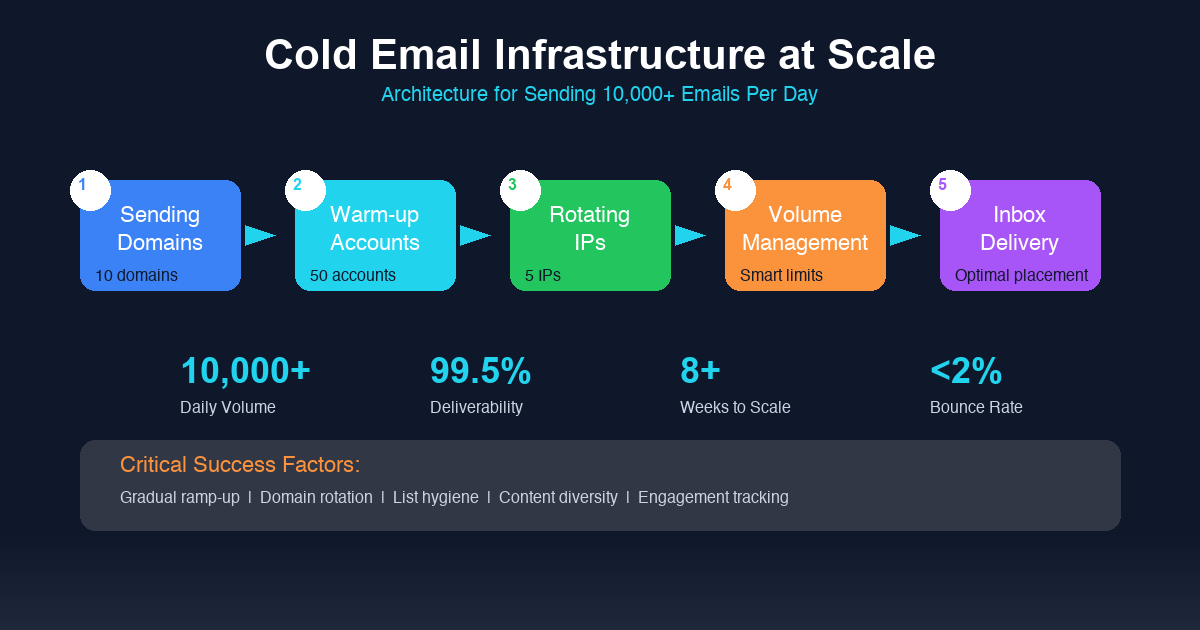
Cold email infrastructure is the technical foundation that enables your messages to reach intended recipients. It encompasses every element that inbox providers evaluate when deciding where your emails land: domains, IP addresses, authentication records, sending patterns, and reputation history.
Without proper technical setup, even the best-written cold emails will land in the junk folder rather than the primary inbox. Many senders make the mistake of running everything from a single domain, which concentrates risk and often results in complete outreach effort failure when that one domain gets flagged.
Most organizations treat email infrastructure as an afterthought, focusing instead on content quality and personalization. This is backwards thinking.
Your carefully crafted cold email is irrelevant if spam filters intercept it before inbox delivery. Infrastructure determines whether your content ever reaches human eyes.
When scaling cold emails across multiple email campaigns and audiences, the infrastructure foundation becomes even more critical to success.
The components of cold email infrastructure work together as an integrated system. Your sending domain carries reputation that inbox providers track.
Your IP address carries separate reputation that influences delivery decisions. Your SPF, DKIM, and DMARC records prove your identity to receiving servers.
Your sending patterns signal legitimacy or bulk behavior to filtering algorithms.
Why Infrastructure Matters More Than Content
Consider two scenarios. Campaign A has mediocre content but excellent infrastructure: authenticated domains, warmed dedicated IP addresses, consistent sending patterns.
Campaign B has excellent content but poor infrastructure: unauthenticated sending, new domains at volume, erratic sending patterns. Campaign A achieves 95% inbox placement.
Campaign B achieves 20%.
The math is straightforward: content inside the junk folder generates zero results regardless of quality. Infrastructure that delivers to the inbox generates results even with average content.
Prioritize infrastructure before content.
Why Is Cold Email Infrastructure Important for Deliverability?
Email deliverability is the outcome of infrastructure quality. Every factor that determines whether your messages reach the inbox traces back to infrastructure decisions.
Inbox providers evaluate sender reputation before considering content. Your domain’s historical behavior, your IP address’s sending patterns, your DKIM/SPF status, and your engagement metrics all get synthesized into a reputation score.
This score determines delivery outcomes before content evaluation begins.
For cold emails, you’re starting from zero reputation. Unlike existing customer communications where reputation is established, cold outreach requires building reputation from scratch.
Proper infrastructure accelerates this building process. Sloppy infrastructure can permanently damage your ability to send.
At scale, infrastructure becomes a competitive advantage. Organizations with excellent infrastructure reach your shared decision-makers while your messages disappear.
The infrastructure investment pays dividends through consistent pipeline generation that competitors can’t match.
The Cost of Infrastructure Failures
Domain blacklisting from poor infrastructure is difficult to recover from. Once major inbox providers flag your domain, subsequent emails face raised filtering permanently.
Recovery requires new domains, fresh reputation building, and weeks of careful warm-up. The productivity loss during recovery often exceeds the investment required for proper initial setup.
How Do I Set Up Cold Email Infrastructure?
Setup follows a systematic process that builds foundation before scaling volume.
Step one involves domain acquisition and configuration. Register domains that will serve as your sending domain separate from your primary business domain.
These outreach domains should appear legitimate but distinct from your main brand to isolate reputation risk. If your company is acmecorp.com, consider acmecorp-io.com, acme-outreach.com, or similar variations.
Some organizations use Google Workspace for their sending domains to add legitimacy, though any properly configured domain can achieve good deliverability.
Step two requires email authentication configuration. Add SPF records listing your authorized sending servers.
Generate DKIM keys and publish public keys in DNS. Configure DMARC records starting with monitoring policies.
Verify sending authentication using MXToolbox or similar tools before sending anything. Learning how to set up SPF records correctly is essential for every domain you plan to use for outreach.
Step three establishes sending infrastructure. Choose between cold email platforms that handle infrastructure internally or self-hosted SMTP configurations.
Platform solutions offer convenience with less control. Self-hosted solutions offer control with more complexity.
Most organizations benefit from established platforms designed specifically for outbound email at scale.
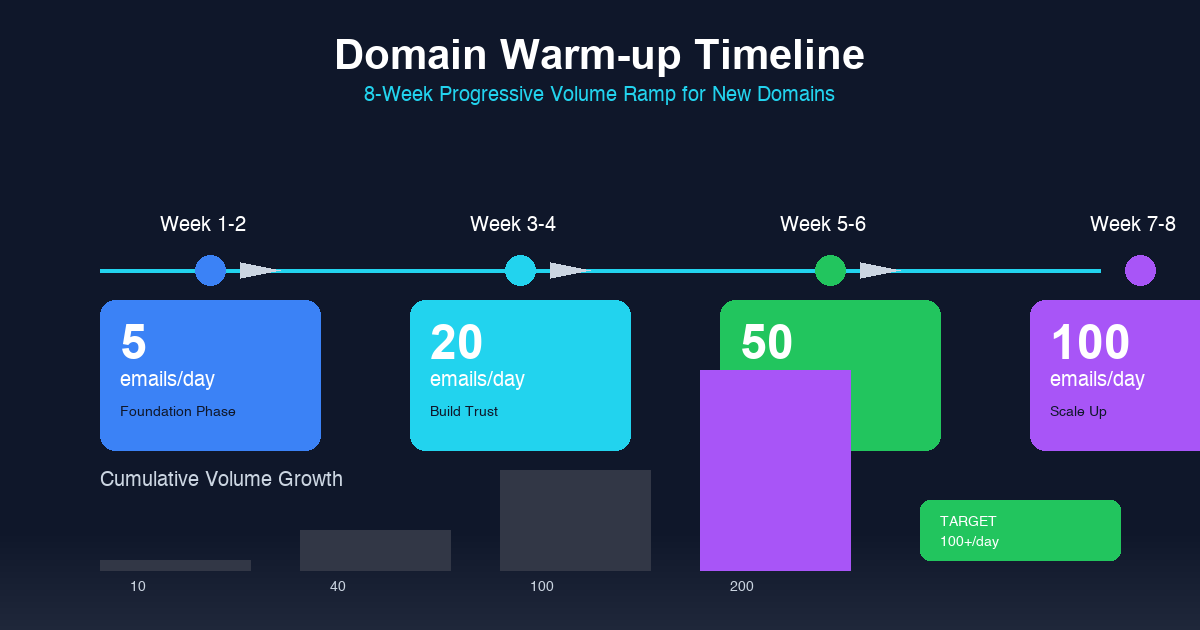
Step four implements warm-up protocols. Before sending meaningful volume, establish sending reputation through gradual volume increases and engagement-focused sends.
This warm-up period typically requires four to eight weeks depending on target volume. During this warmup phase, each mailbox earns trust with inbox providers, setting the foundation for sustainable sending volumes.
Infrastructure Verification Before Launch
Before sending any cold outreach campaign emails, verify your complete setup. Test email authentication using mail-tester.com or similar tools.
Send seed tests to verify inbox placement. Check reputation scores using Google Postmaster Tools and Microsoft SNDS.
Any issues discovered before launch are easily fixed. Issues discovered after launch may already be damaging your reputation.
Testing across multiple inbox providers ensures your cold emails will reach the full range of your target audience.
What Are the Core Components of Cold Email Infrastructure?
Complete cold email infrastructure includes several integrated components.
- Sending Domains , Email domains from which cold email originates, each carrying its own reputation; your portfolio should include 10-20 domains for rotation
- IP Addresses , Separate reputation scores from domains; dedicated IP addresses are preferable to shared IP for reputation isolation
- Email Authentication , SPF, DKIM, and DMARC records proving identity to receiving mail servers
- Mail Servers , Handle actual transmission from your infrastructure to recipient servers, affecting delivery reliability
- Monitoring Systems , Track reputation metrics, inbox rate, email bounce rates, and spam complaint rates
- Integration Architecture , These components must integrate coherently; domains associate with IPs, IPs carry reputation based on DMARC setup
Sending domains are the email domains from which your cold email originates. Each domain carries its own reputation and should be managed as a distinct asset.
Your domain portfolio should include multiple domains to spread risk and enable rotation when individual domains show declining health. When managing cold emails across multiple domains, proper tracking of each domain’s reputation becomes essential for sustained deliverability.
IP addresses carry separate reputation scores from domains. Dedicated IP addresses are preferable to shared IP addresses because your reputation isn’t affected by other senders’ behavior.
Dedicated IP addresses require warm-up before use and ongoing reputation management.
Email authentication includes SPF, DKIM, and DMARC records published in DNS. These records prove your identity to receiving mail servers and enable inbox providers to evaluate your reputation accurately.
Every sending domain requires complete DMARC setup.
Mail servers handle the actual transmission of email from your infrastructure to recipient mail servers. Whether you use platform services or self-hosted SMTP, your mail server configuration affects delivery reliability and reputation management.
Monitoring systems track reputation metrics, inbox rate, email bounce rates, and spam complaint rates. Real-time monitoring enables rapid response to problems before they cascade into major reputation damage.
When cold emails operate across multiple domains and inboxes, centralized monitoring becomes critical for identifying which sending domains require attention.
The Integration Between Components
These components don’t operate independently. Your sending domains are associated with specific IP addresses.
Your IP addresses carry reputation based on DMARC setup. Your monitoring systems track all of these elements to provide unified reputation visibility.
Building email infrastructure means integrating these components into a coherent system.
What Are Common Mistakes to Avoid When Setting Up Cold Email Infrastructure?
Most infrastructure failures trace to predictable mistakes that are easily avoided with proper knowledge.
- Rushing Volume Before Warm-Up , New domains have no reputation; sending high volume immediately signals junk behavior to inbox providers
- Using Primary Business Domains , Risks your core brand identity if outreach domains get blacklisted; always use separate domains for outreach
- Neglecting Sending Authentication , Sending without SPF, DKIM, and DMARC means inbox providers have no way to verify your identity
- Ignoring Bounce Management , Every hard email bounce signals poor list quality; remove invalid addresses immediately, monitor obsessively
- Concentrating Sends in Time Patterns , Batch sending appears automated; spread sends throughout active hours for human-like patterns
- Compounding Nature of Mistakes , One day of high bounced emails damages reputation, triggering filtering, then blacklist inclusion, requiring months of recovery
Rushing volume before warm-up is the most common fatal mistake. New domains and IPs have no reputation.
Sending high volume immediately signals junk behavior to inbox providers. The damage from accelerated sending often exceeds the time saved, requiring months of recovery that far exceeds the warm-up period.
Using primary business domains for cold email risks your core brand identity. If outreach domains get blacklisted, the association with your primary domain can damage its reputation through shared filtering algorithms.
Always use separate domains for outreach to isolate risk.
Neglecting email authentication dooms outreach efforts before they launch. Sending without SPF, DKIM, and DMARC configuration means inbox providers have no way to verify your identity.
Unauthenticated sending triggers spam filters almost universally.
Ignoring email bounce management damages reputation continuously. Every hard bounced email to an invalid address signals poor list quality to inbox providers.
Remove invalid addresses immediately. Monitor email bounce rates obsessively.
Anything above 3% requires investigation and correction. Even on a single domain, high bounced email rates can trigger filtering that affects your entire sending reputation.
Concentrating sends in time patterns that appear automated. Spreading sends throughout active hours rather than batch sending creates patterns that appear more human and organic.
The Compounding Nature of Mistakes
Infrastructure mistakes compound quickly. One day of high failed deliveries damages reputation.
Two days of poor reputation triggers filtering. Three days of filtering causes blacklist inclus
ion.
A week of compounding damage may require months of recovery. The low cost of prevention dramatically underweights the high cost of remediation.
How Do I Warm Up Domains and Inboxes for Cold Email?
Warm-up is the process of gradually building sending reputation for new domains and IP addresses through controlled, engagement-focused sending. it isn’t optional.
it’s foundational. Many senders underestimate how long warmup requires, but rushing this phase is the most common cause of cold emails landing in the bulk folder.
Week one targets 20-50 emails daily, sending exclusively to highly engaged recipients who will open and reply immediately. Personal contacts, warm leads, anyone who has previously expressed interest.
These engagement signals begin establishing positive reputation with inbox providers. This warm-up process applies to each domain you’ll use for cold emails, ensuring every sending domain builds reputation independently.
Week two scales to 75-125 emails daily while maintaining engagement priority. Begin mixing cold prospects with warm contacts, but keep cold volume conservative.
Week three reaches 150-300 emails daily. Continue monitoring engagement metrics closely.
If open rates drop or email bounce rate climbs, reduce volume immediately and allow reputation to stabilize.
Week four and beyond allows continued gradual increases toward target volume based on demonstrated reputation. Full 10,000 daily sends may require 8-12 weeks of warming depending on inbox provider trust levels.
Warm-Up Acceleration Through Engagement Services
Some platforms offer warm-up services that automate engagement generation. These services create networks of real email accounts that automatically open, reply to, and interact with your warming emails.
The engagement signals from these accounts accelerate inbox provider trust building.
Even with service assistance, natural engagement from real human contacts during early weeks provides the most stable reputation foundation. Use your personal and professional network strategically during warm-up to generate authentic positive signals.
How Many Domains and Inboxes Do I Need for Cold Email?
Scale requirements determine infrastructure needs. The calculations below assume targeting 10,000 daily sends.
Domain count depends on volume per domain and rotation requirements. Industry best practice limits sending to 500-1,000 emails per domain daily to maintain healthy reputation.
For 10,000 daily sends, you need 10-20 domains minimum, with 15 being a conservative target. Additional domains provide rotation capacity and isolation of any domains showing declining health.
Every domain in your rotation requires the same technical setup to maintain consistent reputation across your infrastructure.
Inbox count depends on sending volume and daily sending limits per inbox. Most email service providers limit individual inboxes to 200-500 daily sends to avoid triggering volume-based filtering.
For 10,000 daily sends with 500-email inbox limits, you need 20-50 inboxes. Combined with domain rotation, you might operate 30-50 inboxes across 15-20 domains.
This infrastructure investment may seem excessive, but it’s insurance against the catastrophic reputation damage that domain blacklisting causes. The ongoing cost of proper infrastructure is always less than the cost of campaign failures from inadequate setup.
Calculating Your Specific Requirements
Your target volume divided by recommended sends per domain determines minimum domains. Your target volume divided by recommended sends per inbox determines minimum inboxes.
Build capacity for 20-30% above current targets to accommodate growth without infrastructure strain.
How Can I Monitor and Improve My Cold Email Deliverability?
Monitoring is essential for maintaining deliverability over time. Reputation isn’t static.
It changes based on current sending behavior, engagement metrics, and recipient feedback. Continuous monitoring enables rapid response to changes.
Google Postmaster Tools provides free visibility into Gmail delivery metrics: reputation status, spam complaint rates, DKIM/SPF results, and delivery statistics. Check this weekly for any domains sending to Gmail recipients.
Microsoft SNDS (Smart Network Data Services) offers similar visibility for Outlook and Microsoft 365 recipients. Monitor complaint rates and IP reputation through this tool.
Platform dashboards from your outbound email sending provider typically include inbox rate monitoring, bounce rate tracking, and engagement analytics. These dashboards provide the fastest visibility into operational metrics for your cold emails.
Seed list testing using tools like GlockApps sends test emails to known addresses across major inbox providers and reports where they land. Run tests monthly to verify continued email delivery and catch problems before they cascade.
Continuous Improvement Strategies
Monitoring reveals problems. Optimization prevents them.
Regular review of engagement metrics identifies underperforming content for revision. List hygiene maintenance removes stale addresses that generate bounced emails.
Domain rotation retire underperforming domains before they become liabilities. These ongoing activities maintain the infrastructure investment you’ve made.
What Are the Best Cold Email Infrastructure Providers?
The market includes providers across the capability and pricing spectrum.
Instant.ly and Smartlead offer comprehensive platforms designed specifically for cold email at scale. These platforms include domain management, warm-up automation, and analytics in unified packages.
They handle the complexity of multi-domain, multi-inbox sending while you focus on content and targeting.
Self-hosted solutions using Postfix or similar mail server software offer maximum control but require significant technical expertise. Organizations with strong engineering teams can build sophisticated infrastructure using these approaches.
Hybrid approaches combine platform convenience with custom infrastructure for specific components. A platform might handle sending while you manage separate domain portfolios and sending authentication.
These approaches require careful integration but offer flexibility unavailable in all-in-one solutions.
Evaluating Provider Fit
Consider your technical capacity, budget constraints, and scale requirements when selecting providers. Platforms offer convenience at premium pricing.
Self-hosted solutions offer control at technical cost. The right choice depends on your specific circumstances and operational maturity.
what’s the Difference Between Shared and Dedicated IPs for Cold Email?
IP address reputation management is fundamental to outbound email operations, and the choice between shared IP and dedicated IP has significant implications.
Shared IP addresses are used by multiple senders simultaneously. Your reputation is affected by other senders’ behavior on the same IP.
If another sender using your shared IP sends junk, your deliverability suffers from their reputation damage. Shared IP can be appropriate for low-volume senders who can’t justify dedicated IP costs, but it introduces reputation risk outside your control.
Dedicated IP addresses are used exclusively by your organization. Your reputation depends entirely on your own sending behavior.
Good practices improve your reputation. Bad practices damage it.
For organizations serious about sending cold emails at scale, dedicated IP is non-negotiable.
Dedicated IP addresses require warm-up before use. New IPs have neutral reputation that must be established through gradual volume increases and engagement-focused sending.
Most outbound email platforms provide warm-up assistance for dedicated IPs.
IP Strategy at Scale
At 10,000 daily sends, you likely need three to five dedicated IP addresses in rotation. This distribution spreads risk so that any single IP’s reputation problems don’t affect your entire operation.
When one IP shows declining health, reduce its volume and increase others while investigating the cause.
Do the math. If our AI infrastructure reaches out to 1,000 highly qualified, triple-verified decision-makers a day, that’s 30,000 people a month. With our hyper-personalization, even an impossibly conservative 1% reply rate yields 300 qualified conversations. In high-ticket B2B, what happens to your revenue when you’ve 300 conversations with your exact ICP?
Frequently Asked Questions
what’s the fastest way to use How to Build a Cold Email Infrastructure That Scales to 10000 Emails Per Day without burning the market?
Start with a tight ICP, verified data, and a small test batch. Scale only after replies, bounces, and meeting quality prove the message is working.
How many prospects should I contact for How to Build a Cold Email Infrastructure That Scales to 10000 Emails Per Day?
The number matters less than the fit. A smaller list of verified decision-makers will beat a large scraped list because inbox placement, relevance, and timing decide reply quality.
Why do most campaigns around How to Build a Cold Email Infrastructure That Scales to 10000 Emails Per Day fail?
Most campaigns fail because the data is weak, the offer is vague, and the follow-up system is inconsistent. Fix those three points before adding more volume.
Should I use email only for How to Build a Cold Email Infrastructure That Scales to 10000 Emails Per Day?
No. Email works better when it’s supported by LinkedIn touches, retargeting, and clean CRM follow-up. One channel creates reminders. Multiple channels create recognition.
When should I hire help for How to Build a Cold Email Infrastructure That Scales to 10000 Emails Per Day?
Hire help when you already know the customer profile, the offer is validated, and the bottleneck is execution speed. Outsourcing a broken offer only makes the failure happen faster.
The System Behind the Tactic
The weak version of How to Build a Cold Email Infrastructure Scales to 10000 Emails Per Day is easy to spot. It talks to everyone, says nothing specific, and asks for a meeting before earning attention. If the list is weak, the message is vague, and the follow-up is random, even a smart idea turns into noise.
The inbox is not a neutral place. It is a triage system. Buyers delete anything that feels like it was written for a spreadsheet, not a person. That means the message has to earn attention fast: clear pain, clean proof, and a next step that does not feel like a trap.
The Quality Gate
- Data: Are the names, roles, domains, and company signals verified? Bad data turns good strategy into inbox waste.
- Relevance: Does the message connect to a problem the buyer already cares about? Education is expensive. Recognition is faster.
- Measurement: Can we tell whether silence came from targeting, copy, timing, or deliverability? If not, we cannot improve the campaign intelligently.
This is not complicated, but it is unforgiving. A sloppy list makes copy look bad. Weak positioning makes good data useless. And a CTA that asks for a meeting too early forces the buyer to do all the mental work.
The cleaner version is simple: start with 250 accounts, not a giant scraped list. Segment them by pain, write one message for one segment, and watch replies before scaling. If that first batch does not produce signal, more volume will not save the campaign. It will only make the failure louder.
Here is the practical takeaway: make How to Build a Cold Email Infrastructure Scales to 10000 Emails Per Day narrower, cleaner, and easier to say yes to. Then scale what the market proves, not what the team hopes will work. Build the data layer first, then the message, then the follow-up system. In that order.
Book a strategy call
How to Judge Cold Email Infrastructure Setup Before You Scale
The practical test for cold email infrastructure setup is not whether the idea sounds smart. The test is whether it creates qualified pipeline without damaging deliverability, sender reputation, or buyer trust. A strong system connects land in spam , cold email infrastructure setup , email infrastructure provider , email automation with clear targeting, clean data, and a message that feels written for the exact account.
If the campaign uses email warmup , deliverability infrastructure , email infrastructure for cold outreach , scale your cold email , build cold email infrastructure , email automation tool, the team needs a simple operating rule: do not add volume until replies prove the angle. That means watching inbox placement, open rates, reply quality, bounce behavior, and the number of sales meetings that come from real decision-makers.
The Execution Checklist
- Infrastructure: Check email providers, scale your cold email campaigns, dns authentication, strong cold email infrastructure before scaling. If this layer is weak, more sending only creates louder failure.
- Targeting: Check cold emails per, domain and inbox, api before scaling. If this layer is weak, more sending only creates louder failure.
- Message quality: Check infrastructure isn’t optional, better deliverability, email infrastructure matters, sending across multiple before scaling. If this layer is weak, more sending only creates louder failure.
- Follow-up: Check google workspace accounts, unlimited email, authentication setup before scaling. If this layer is weak, more sending only creates louder failure.
- Measurement: Check emails land in the inbox, send emails before scaling. If this layer is weak, more sending only creates louder failure.
The bottom line is simple: cold email infrastructure setup should be treated like a revenue system, not a one-off campaign. When the list, email infrastructure, personalization, domain setup, and multichannel follow-up work together, the outreach has a real chance to turn cold attention into booked meetings.
How to Judge Cold Email Infrastructure Setup Before You Scale
The practical test for cold email infrastructure setup is not whether the idea sounds smart. The test is whether it creates qualified pipeline without damaging deliverability, sender reputation, or buyer trust. A strong system connects cold email infrastructure , cold emails , domain , deliverability with clear targeting, clean data, and a message that feels written for the exact account.
If the campaign uses setup , inboxes , spam , email deliverability , scaling , campaign, the team needs a simple operating rule: do not add volume until replies prove the angle. That means watching inbox placement, open rates, reply quality, bounce behavior, and the number of sales meetings that come from real decision-makers.
The Execution Checklist
- Infrastructure: Check dns, warmup, mailbox, cold outreach before scaling. If this layer is weak, more sending only creates louder failure.
- Targeting: Check dkim, dmarc, outreach before scaling. If this layer is weak, more sending only creates louder failure.
- Message quality: Check authentication, sender, emails per, bounce before scaling. If this layer is weak, more sending only creates louder failure.
- Follow-up: Check best practice, ips, google workspace before scaling. If this layer is weak, more sending only creates louder failure.
- Measurement: Check technical setup, emails land before scaling. If this layer is weak, more sending only creates louder failure.
The bottom line is simple: cold email infrastructure setup should be treated like a revenue system, not a one-off campaign. When the list, email infrastructure, personalization, domain setup, and multichannel follow-up work together, the outreach has a real chance to turn cold attention into booked meetings.
The Practical Operator Pass
The buyer is filtering for relevance, timing, credibility, and the cost of paying attention. If the message cannot show why this matters now, the campaign becomes background noise. For How to Build a Cold Email Infrastructure That Scales to 10000 Emails Per Day, that means the outreach has to connect the business problem, the buying moment, and the proof in a way that feels specific.
A campaign built around objection, bounce, and category has more context than a generic pitch. A qualification buyer cares about different proof than a context buyer. A positioning bottleneck should not be handled with the same CTA as a scale pipeline bottleneck. This is why shallow templates fail. They flatten different buyer situations into one bland message.
- Budget: Review budget against the buyer’s real context before increasing send volume.
- Verification: Review verification against the buyer’s real context before increasing send volume.
- Build: Review build against the buyer’s real context before increasing send volume.
- Consensus: Review consensus against the buyer’s real context before increasing send volume.
- Owner: Review owner against the buyer’s real context before increasing send volume.
- Research: Review research against the buyer’s real context before increasing send volume.
This is the part a generic article usually misses: judgment. A real operator can tell when threshold is the problem, when scale accounts is the problem, and when the whole angle is too soft. That judgment comes from reading replies, checking account quality, and comparing message intent against actual buyer behavior.
The cleaner move is to run a small batch, inspect the signal, then rewrite the weak layer. Do not scale because the copy looks polished. Scale because the replies prove the market understands the value.