AI-Powered Cold Outreach: How Smart Agencies Generate 300+ Leads Monthly
Your sales team spends 70% of their time researching contacts and 30% actually selling. Meanwhile, competitors using AI-driven prospecting have reversed that ratio.
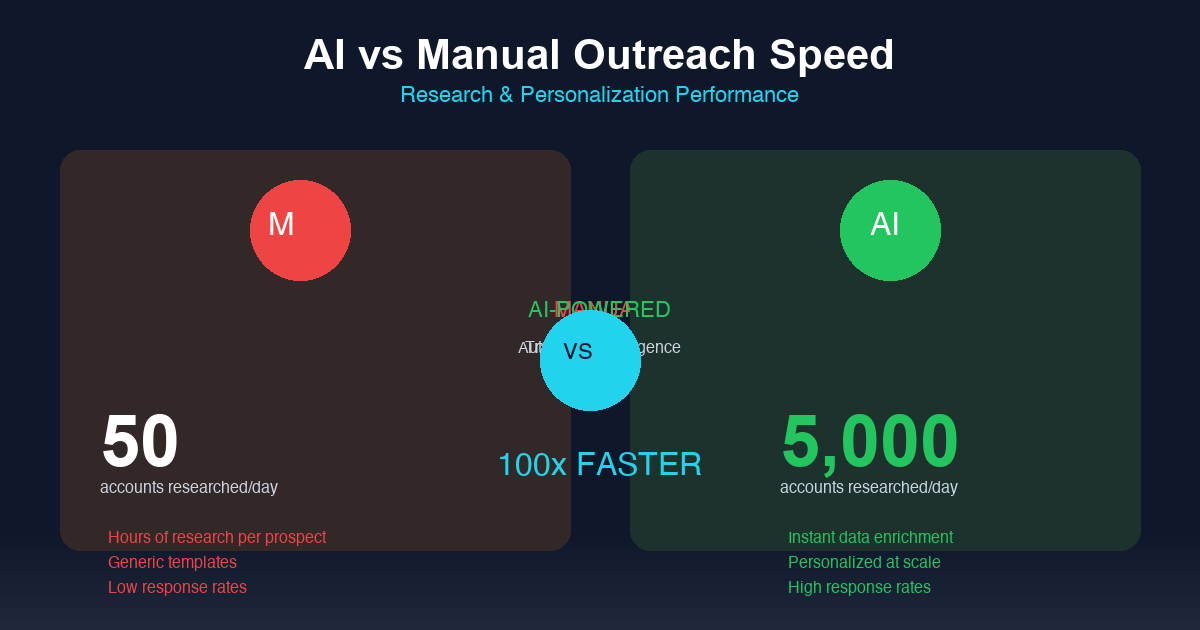
They reach 500 qualified decision-makers before your team finishes researching their first 50 accounts. This isn’t speculation.
This is the current state of B2B sales in 2026.
AI-powered cold outreach has fundamentally changed how top agencies approach lead generation. The technology exists.
The AI tools are mature. The question is whether you’ll build the infrastructure to compete or continue watching your pipeline stagnate while others capture your market.
what’s AI-Powered Cold Outreach and How Does It Work?
AI-powered cold email replaces manual tasks and manual contact research with machine intelligence that analyzes thousands of data points per hour. Instead of your team spending 20 minutes per company researching triggers, pain points, and personalization angles, AI systems synthesize this intelligence instantly and at scale.
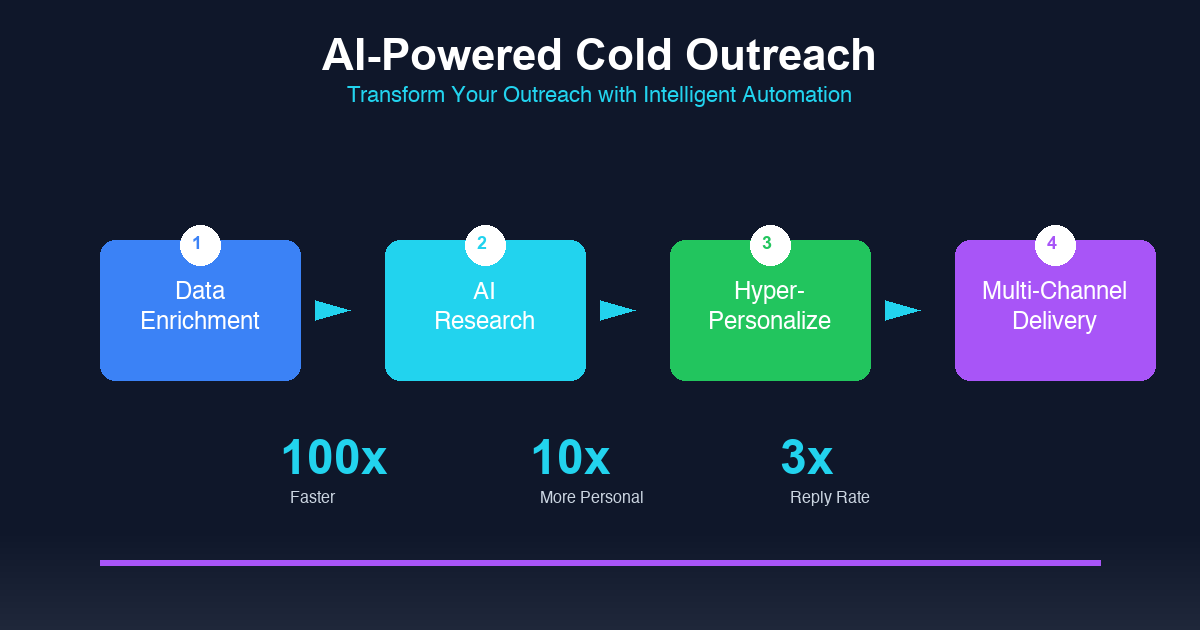
The system works through layered data processing. First, data enrichment APIs pull company information from dozens of sources: funding databases, job postings, news feeds, regulatory filings, and social platforms.
Second, machine learning models analyze this data to identify patterns that indicate buying intent, budget availability, and decision-making authority. Third, hyper-personalization engines generate tailored message variants based on specific triggers identified for each target contact.
The ability to personalize each cold email at scale is what separates AI-driven campaigns from manual approaches.
A properly configured cold email campaign powered by AI doesn’t just insert names into templates. It references specific company initiatives, recent hires, technology implementations, or strategic shifts that create genuine relevance.
The target buyer reads the message and thinks, “How did they know that?” because the message demonstrates actual understanding of their situation. Artificial intelligence systems help you personalize every touchpoint while maintaining the authenticity that resonates with decision-makers.
The Technology Stack Behind Modern AI Outreach
Production-grade AI cold email requires integration across multiple systems. n8n or similar workflow automation platforms connect data sources, trigger AI processing, and route personalized content to sending infrastructure.
CRM systems capture responses and feed engagement data back into the learning loop. Sending platforms handle email deliverability and inbox management.
The sophistication lies in orchestration. When a contact replies, the system automatically pauses follow-up sequences.
When they visit your website, timing adjusts. When they engage with content, messaging shifts to reflect demonstrated interest.
This real-time adaptation is what separates AI-powered campaigns from simple automation.
What Are the Benefits of Using AI for Cold Outreach Campaigns?
The benefits compound across every dimension of your cold email operation.
- Response Rate Improvement , AI-driven hyper-personalization achieves 12-18% versus 2-4% for generic templates, a 4x improvement
- Lead Generation Efficiency , Sales teams stop researching and start selling as AI handles contact research
- Scalability Without Headcount , Adding 10,000 targets doesn’t require 10x more researchers; the intelligent layer handles volume
- Consistency Across Campaigns , Automated systems apply the same analysis framework to every potential customer, eliminating researcher fatigue or variation
- Quantifiable Pipeline Improvements , Top-of-funnel volume increases, qualification accuracy rises, meeting conversion climbs, and you see better results across the board
Response rates improve because personalization depth correlates directly with response likelihood. Generic templates achieve 2-4% reply rates.
AI-powered hyper-personalization consistently achieves 12-18% when properly implemented. That 4x improvement means four times the conversations from the same volume of sent emails.
Lead generation efficiency transforms because your sales team stops researching and starts selling. The hours previously spent on manual contact research shift to qualified conversations, discovery calls, and closing activities.
This reallocation of human capital is where real ROI emerges.
Scalability becomes achievable without proportional headcount increases. Adding 10,000 new qualified targets to your list doesn’t require 10x more researchers.
AI handles volume while human strategists maintain quality control. This creates unit economics that were impossible with traditional methods.
Consistency improves across campaigns. Human researchers have bad days, miss sources, or apply inconsistent criteria.
AI applies the same analysis framework to every target, ensuring no opportunity falls through cracks due to researcher fatigue or variation.
Quantifiable Improvements Across the Pipeline
Organizations implementing AI-powered cold email report measurable improvements at every stage. Top-of-funnel volume increases because targeting improves.
Qualification accuracy rises because automated systems analyze more signals than any human could process. Meeting conversion rates climb because buyers arrive with context already established.
Sales cycle lengths shorten because early-stage qualification happens before first contact.
How Can AI Improve Personalization and Targeting in Cold Outreach?
Personalization in cold email has evolved through distinct stages. First came merge tags: “Hi {}” that added minimal value.
Then came company-level personalization: referencing company size, industry, or location. Now comes hyper-personalization: crafting messages around specific triggers unique to each target’s current situation.
AI systems enable hyper-personalization at scale by identifying signals humans would never catch. A CFO just hired three data analysts.
Machine intelligence flags this as a potential signal for financial planning software need. A CTO published a post about infrastructure challenges.
The system recognizes this as a potential pain point for DevOps solutions. A company just closed Series B funding.
The system identifies this as a trigger for tools that support rapid scaling.
These signals combine into personalization frameworks that speak directly to target urgency. Instead of generic value propositions, buyers receive messages that address their specific situation with timing that feels prescient rather than template-driven.
To personalize effectively, you need to use multiple data points and combine them into coherent insights.
Building Targeting Frameworks That AI Systems Can Execute
Effective automated targeting requires clear Ideal Customer Profile definitions. Which company characteristics indicate good fit?
Which titles represent decision-making authority? Which company stages suggest active need versus passive interest?
AI tools perform best when given specific parameters rather than broad mandates like “find software companies.”
Create targeting matrices that define segments by industry, company size, technology stack, funding stage, hiring patterns, and strategic initiatives. AI processes these matrices against available data to identify high-probability targets within each segment.
The more precise your matrix, the more accurate your targeting becomes.
What Are the Key Features of Effective AI Cold Email Tools?
Not all AI-powered email tools are created equal. The features that drive actual results differ significantly from marketing claims.
An effective outreach tool should include verified emails, real-time data updates, and intelligent subject line optimization.
- Data Enrichment Depth , Platforms integrating dozens of data sources generate richer contact intelligence than tools with limited databases
- Personalization Generation , Genuine automated copy variations versus simple variable insertion that produces obvious templates
- Email Deliverability Integration , Authentication setup, domain rotation, and inbox monitoring built into core features
- Workflow Automation , Follow-up sequences based on target behavior, reply routing, and engagement tracking
- Multi-Channel Orchestration , Connecting AI processing to sending infrastructure and CRM for closed-loop optimization
Data enrichment depth determines personalization quality. Tools that access limited databases produce shallow personalization.
Platforms integrating dozens of data sources generate richer contact intelligence. Evaluate the specific data providers each outreach tool connects to and the recency of data updates.
Personalization generation capabilities vary wildly. Some tools offer simple variable insertion.
Others generate dynamic paragraphs based on target-specific triggers. The difference appears in response rates.
AI systems that use hyper-personalization produce human-quality copy variations. Basic variable substitution produces obvious templates that sophisticated decision-makers recognize immediately.
Email deliverability infrastructure integration separates production tools from experimental platforms. Automated content is irrelevant if emails land in spam.
The best cold email platforms include authentication setup, domain rotation, and inbox monitoring as core features rather than afterthoughts. When you use AI to generate email copy, ensure your outreach tool handles the technical deliverability requirements that keep messages out of spam folders.
Workflow Automation Requirements
Workflow automation capabilities determine whether AI augments your team or merely impresses them in demos. Effective tools automate follow-up sequences based on target behavior.
They route replies to appropriate team members. They pause campaigns when buyers convert through other channels.
They track engagement patterns to optimize send timing and message variants. Your email sequence should include strategic followup touchpoints that respond to target engagement signals automatically.
The n8n ecosystem exemplifies this integration approach. Connecting AI processing to sending infrastructure to CRM systems creates closed-loop optimization where every interaction improves future targeting accuracy.
Without this automation layer, artificial intelligence becomes an expensive research assistant rather than a revenue driver.
How Does AI Affect Cold Email Deliverability and Sender Reputation?
Email deliverability depends on multiple factors, and AI influences several of them.
Volume patterns affect reputation. Human-managed campaigns often send in bursts: heavy sending Monday morning, nothing Wednesday afternoon.
This irregularity signals automation to inbox providers. AI-powered campaigns distribute sends throughout active hours, creating patterns that appear more organic and human-like.
Bounce rates impact sender reputation, and AI improves data quality. Human researchers sometimes include outdated contacts.
Verified emails through data enrichment APIs includes real-time validation, reducing hard bounces that damage reputation scores.
Engagement metrics improve because better personalization generates more opens and replies. Inbox providers interpret engagement as wanted communication, improving future inbox placement for domains sending content that recipients actively engage with.
Infrastructure Considerations for AI-Augmented Campaigns
AI systems enable higher sending volumes, but volume requires proportional infrastructure investment. Domain rotation spreads reputation risk across multiple assets.
SPF, DKIM, and DMARC authentication must be configured correctly for each domain. Domain warming protocols must be followed before scaling to meaningful volumes.
The mistake many organizations make is scaling volume before infrastructure supports that volume. AI generates the ability to send more personalized emails.
n-bottom:28px;line-height:1.7;font-size:18px;”>Infrastructure determines whether those emails reach the inbox. Both investments are necessary for AI-powered campaigns to deliver results.
What Are the Best AI-Powered Cold Outreach Platforms and Tools?
The market offers platforms across the sophistication spectrum.
Enterprise sales platform solutions like Outreach and Salesloft have added AI features to their existing engagement platforms. These tools suit organizations already invested in their ecosystems and willing to pay premium pricing for integrated solutions.
Specialized cold email platforms like Smartlead and Instant.ly have built AI capabilities focused specifically on cold email optimization. Many offer a free trial so you can test the platform before committing.
These platforms offer better deliverability infrastructure for outbound campaigns but may require integration work to connect with existing CRM systems.
Custom implementations using n8n, Claude, or similar tools offer maximum flexibility for organizations with technical resources to build tailored solutions. These implementations can achieve capabilities unavailable in off-the-shelf platforms but require ongoing maintenance and optimization expertise.
Evaluating Platform Fit for Your Organization
Platform selection depends on your technical capacity, budget constraints, and customization requirements. Evaluate tools based on data source integration, personalization generation quality, deliverability infrastructure, analytics depth, and support availability.
When you use AI tools for cold outreach, request proof-of-concept campaigns before committing to understand actual performance rather than marketing claims.
How Can AI Help With Follow-Up Sequences and Multi-Channel Outreach?
Multi-channel campaigns amplify results from every channel when properly orchestrated. AI systems enable this orchestration at scale.
Follow-up sequences powered by AI respond to target behavior in real time. If a contact opens your email three times, the system accelerates timing.
If they click a link, messaging shifts to address demonstrated interest. If they visit your pricing page, urgency elements increase in follow-up communications.
Your email campaigns should use this behavioral data to personalize each followup automatically.
Multi-channel coordination becomes manageable when automated systems track engagement across channels. When a contact accepts your LinkedIn connection, email follow-ups can reference that interaction.
When they respond to a phone call, other channels pause to avoid over-contact. This intelligent coordination prevents the embarrassing over-communication that plagues manual multi-channel campaigns.
Each outreach email should feel like part of a coherent strategy rather than isolated broadcast messages.
Building Multi-Channel Sequences That Feel Personal
Effective sequences layer channels strategically. Day one sends personalized email.
Day three sends LinkedIn connection request with custom note referencing email. Day five engages with target content through comment.
Day seven sends follow-up email referencing LinkedIn interaction. Day ten executes phone call for high-priority accounts.
Day twelve sends SMS reminder.
This sequence creates multiple touchpoints that build familiarity without feeling spammy. Each interaction references previous ones, demonstrating continued interest rather than mass-email automation.
AI systems manage the timing and content variations while humans provide strategic oversight and quality control.
What Are the Challenges of Using AI in Cold Outreach?
AI-powered cold email introduces challenges that organizations must address proactively.
Quality control requires human oversight. AI systems generate content rapidly, but content quality varies.
Some outputs contain factual errors, tone inconsistencies, or inappropriate personalization angles. Without review processes, mistakes reach buyers and damage credibility.
Build review workflows where humans spot-check outputs before full deployment.
Data dependency creates garbage-in-garbage-out dynamics. Automated personalization quality depends entirely on underlying data quality.
Stale databases produce irrelevant personalization. Incomplete records generate shallow content.
Invest in data verification and enrichment to ensure AI has quality inputs. Organizations that use AI effectively understand that personalized cold outreach requires verified emails and current data to drive meaningful personalization.
Technical complexity requires expertise. Building and maintaining AI-powered outreach infrastructure demands skills many organizations lack internally.
Evaluate whether to build internal capability or partner with agencies that have established expertise. The cost of learning curves can exceed the cost of experienced partners.
Managing the Human-Machine Balance
The most common failure mode is over-reliance on automation without strategic guidance. AI handles research, data synthesis, and content generation.
Humans must provide strategic direction, quality control, and relationship management. The optimal balance varies by organization but should always include human oversight of outputs before they reach contacts.
How Much Does AI-Powered Cold Outreach Cost?
Costs vary significantly based on implementation approach and scale.
Off-the-shelf platforms typically charge per-seat or per-sending-volume pricing. Basic tiers start around $100 monthly for limited sending.
Many platforms offer a free trial period so you can evaluate before committing. Enterprise tiers with full AI features run $500-2000 monthly depending on volume and feature access.
Custom implementations using tools like n8n involve platform costs plus development time. Initial build-out may require 40-100 hours of technical work.
Ongoing maintenance adds additional hours monthly. This approach offers maximum flexibility but requires technical resources.
Agency partnerships offer turnkey solutions but require careful evaluation. Pricing typically runs $2000-10000 monthly for comprehensive AI-powered cold email services depending on volume and customization requirements.
Calculating True ROI
Compare AI-powered cold email costs against current acquisition economics. If manual prospecting costs $300 per qualified meeting and AI reduces that to $150, the ROI is clear.
Calculate based on qualified conversations generated, not emails sent or leads delivered. The metric that matters is cost per sales meeting with your exact ICP.
How Do I Implement AI-Powered Cold Outreach for My B2B Company?
Implementation follows a structured approach that builds foundation before scaling.
Phase one establishes targeting clarity. Define your Ideal Customer Profile with specific parameters: which industries, which company sizes, which titles, which company stages, which technologies in use.
AI systems perform best when given precise targets rather than broad categories.
Phase two builds data infrastructure. Connect data enrichment services, configure CRM integration, establish analytics tracking.
This infrastructure must be solid before launching campaigns because problems compound at scale.
Phase three launches pilot campaigns. Start with 500-1000 highly qualified targets while optimizing message variants and send timing.
Monitor response rates, meeting conversions, and email deliverability metrics obsessively. Iterate based on data rather than intuition.
Phase four scales proven approaches. Once pilot campaigns demonstrate positive ROI, expand volume while maintaining quality standards.
Add domains for capacity. Expand targeting to adjacent segments.
Invest in optimization based on accumulated performance data.
The Critical Success Factors
Successful implementation requires executive sponsorship to fund infrastructure investments. It requires sales alignment to provide feedback on lead quality.
It requires technical capacity to build and maintain integrations. And it requires patience to allow proper testing and optimization before demanding immediate results.
Organizations that use AI tools to automate manual tasks consistently see better results than those relying on generic campaigns.
Most organizations see meaningful improvements within 60-90 days of launching properly configured campaigns. Significant pipeline impact typically materializes within 120-180 days as targeting improves and optimization compounds.
Do the math. If our AI-powered infrastructure reaches out to 1,000 highly qualified, triple-verified decision-makers a day, that’s 30,000 people a month. With our hyper-personalization, even an impossibly conservative 1% reply rate yields 300 qualified conversations. In high-ticket B2B, what happens to your revenue when you’ve 300 conversations with your exact ICP?
Frequently Asked Questions
what’s the fastest way to use AI-Powered Cold Outreach: How Smart Agencies Generate 300+ Leads Monthly without burning the market?
Start with a tight ICP, verified data, and a small test batch. Scale only after replies, bounces, and meeting quality prove the message is working.
How many prospects should I contact for AI-Powered Cold Outreach: How Smart Agencies Generate 300+ Leads Monthly?
The number matters less than the fit. A smaller list of verified decision-makers will beat a large scraped list because inbox placement, relevance, and timing decide reply quality.
Why do most campaigns around AI-Powered Cold Outreach: How Smart Agencies Generate 300+ Leads Monthly fail?
Most campaigns fail because the data is weak, the offer is vague, and the follow-up system is inconsistent. Fix those three points before adding more volume.
Should I use email only for AI-Powered Cold Outreach: How Smart Agencies Generate 300+ Leads Monthly?
No. Email works better when it’s supported by LinkedIn touches, retargeting, and clean CRM follow-up. One channel creates reminders. Multiple channels create recognition.
When should I hire help for AI-Powered Cold Outreach: How Smart Agencies Generate 300+ Leads Monthly?
Hire help when you already know the customer profile, the offer is validated, and the bottleneck is execution speed. Outsourcing a broken offer only makes the failure happen faster.
The Clean Execution Plan
I would not scale AI-Powered Cold Outreach until the first small batch proves three things: the market is right, the message lands, and the follow-up creates conversations. If the list is weak, the message is vague, and the follow-up is random, even a smart idea turns into noise.
A serious B2B buyer has one silent question: why should I care right now? If the campaign cannot answer that quickly, the rest of the copy does not matter. The first job of outreach is to prove relevance before persuasion. Name the business problem, make the next step useful, and remove every sentence that sounds like a brochure.
The Small-Batch Validation Rule
- Data: Are the names, roles, domains, and company signals verified? Bad data turns good strategy into inbox waste.
- Relevance: Does the message connect to a problem the buyer already cares about? Education is expensive. Recognition is faster.
- Measurement: Can we tell whether silence came from targeting, copy, timing, or deliverability? If not, we cannot improve the campaign intelligently.
Do not hide behind volume. Volume is a multiplier. It multiplies good strategy, and it multiplies bad strategy even faster.
The cleaner version is simple: start with 250 accounts, not a giant scraped list. Segment them by pain, write one message for one segment, and watch replies before scaling. If that first batch does not produce signal, more volume will not save the campaign. It will only make the failure louder.
The hard truth: AI-Powered Cold Outreach is not magic. It is a disciplined system for reaching the right buyer with the right proof at the right time. Build the data layer first, then the message, then the follow-up system. In that order.
Book a strategy call
How to Judge Ai Powered Cold Outreach Before You Scale
The practical test for ai powered cold outreach is not whether the idea sounds smart. The test is whether it creates qualified pipeline without damaging deliverability, sender reputation, or buyer trust. A strong system connects prospect , email tool , cold email campaigns , personalized cold emails with clear targeting, clean data, and a message that feels written for the exact account.
If the campaign uses cold outreach tools , emails with ai , cold email outreach , ai email writing , sales engagement , cold email software, the team needs a simple operating rule: do not add volume until replies prove the angle. That means watching inbox placement, open rates, reply quality, bounce behavior, and the number of sales meetings that come from real decision-makers.
The Execution Checklist
- Infrastructure: Check sales and marketing, email addresses, create personalized emails, emails at scale before scaling. If this layer is weak, more sending only creates louder failure.
- Targeting: Check sales emails, email marketing, free email before scaling. If this layer is weak, more sending only creates louder failure.
- Message quality: Check cold outreach emails, ai variables, ai workflows, ai platform before scaling. If this layer is weak, more sending only creates louder failure.
- Follow-up: Check marketing emails, write personalized, cold email sequence before scaling. If this layer is weak, more sending only creates louder failure.
- Measurement: Check lead database, sales rep before scaling. If this layer is weak, more sending only creates louder failure.
The bottom line is simple: ai powered cold outreach should be treated like a revenue system, not a one-off campaign. When the list, email infrastructure, personalization, domain setup, and multichannel follow-up work together, the outreach has a real chance to turn cold attention into booked meetings.
How to Judge Ai Powered Cold Outreach Before You Scale
The practical test for ai powered cold outreach is not whether the idea sounds smart. The test is whether it creates qualified pipeline without damaging deliverability, sender reputation, or buyer trust. A strong system connects outreach , cold email , cold outreach , prospect with clear targeting, clean data, and a message that feels written for the exact account.
If the campaign uses personalize , campaign , ai-powered , use ai , ai-powered cold , outreach tool, the team needs a simple operating rule: do not add volume until replies prove the angle. That means watching inbox placement, open rates, reply quality, bounce behavior, and the number of sales meetings that come from real decision-makers.
The Execution Checklist
- Infrastructure: Check ai tools, linkedin, automation, personalized email before scaling. If this layer is weak, more sending only creates louder failure.
- Targeting: Check personalization, email sequence, outreach email before scaling. If this layer is weak, more sending only creates louder failure.
- Message quality: Check personalized cold, email campaigns, crm, b2b before scaling. If this layer is weak, more sending only creates louder failure.
- Follow-up: Check email copy, followup, email tool before scaling. If this layer is weak, more sending only creates louder failure.
- Measurement: Check inbox, response rates before scaling. If this layer is weak, more sending only creates louder failure.
The bottom line is simple: ai powered cold outreach should be treated like a revenue system, not a one-off campaign. When the list, email infrastructure, personalization, domain setup, and multichannel follow-up work together, the outreach has a real chance to turn cold attention into booked meetings.
Search Intent Coverage Section for AI Powered Cold Outreach
How Outreach Changes the Buying Decision
For ai powered cold outreach, buyers are usually comparing power of ai, sales engagement and lead intelligence, email template, first email, ai assistance. The decision is not made from one email or one landing page. It is made from proof, clean positioning, inbox trust, and whether the outreach explains why the offer matters now.
The operational layer matters too: email verification, successful cold, complete email sequences. If these pieces are weak, the campaign may still create activity, but it will not create enough qualified sales conversations to justify scaling.
How Cold Email Changes the Buying Decision
For ai powered cold outreach, buyers are usually comparing send personalized emails, email performance, ai crafts, targeted outreach, new to cold. The decision is not made from one email or one landing page. It is made from proof, clean positioning, inbox trust, and whether the outreach explains why the offer matters now.
The operational layer matters too: lead information, keep your outreach, outreach. If these pieces are weak, the campaign may still create activity, but it will not create enough qualified sales conversations to justify scaling.
How Ai-powered Changes the Buying Decision
For ai powered cold outreach, buyers are usually comparing cold email, ai-powered, ai tools, cold outreach, campaign. The decision is not made from one email or one landing page. It is made from proof, clean positioning, inbox trust, and whether the outreach explains why the offer matters now.
The operational layer matters too: use ai, ai-powered cold, outreach tool. If these pieces are weak, the campaign may still create activity, but it will not create enough qualified sales conversations to justify scaling.
How AI Tools Changes the Buying Decision
For ai powered cold outreach, buyers are usually comparing ai-powered cold outreach, linkedin, automate, email campaigns, cold email campaigns. The decision is not made from one email or one landing page. It is made from proof, clean positioning, inbox trust, and whether the outreach explains why the offer matters now.
The operational layer matters too: ai email writing, subject line, free email. If these pieces are weak, the campaign may still create activity, but it will not create enough qualified sales conversations to justify scaling.
How Cold Outreach Changes the Buying Decision
For ai powered cold outreach, buyers are usually comparing ai workflows, marketing emails, power of ai, prospect, personalize. The decision is not made from one email or one landing page. It is made from proof, clean positioning, inbox trust, and whether the outreach explains why the offer matters now.
The operational layer matters too: automation, personalized email, sales team. If these pieces are weak, the campaign may still create activity, but it will not create enough qualified sales conversations to justify scaling.
The Buyer Reality Check
Look at AI Powered Cold Outreach through the buyer’s day, not through a marketer’s checklist. If the message cannot show why this matters now, the campaign becomes background noise. For AI Powered Cold Outreach, that means the outreach has to connect the business problem, the buying moment, and the proof in a way that feels specific.
A timing buyer cares about different proof than a suppression buyer. A procurement bottleneck should not be handled with the same CTA as a enrichment bottleneck. A campaign built around blocker, latency, and coverage has more context than a generic pitch. This is why shallow templates fail. They flatten different buyer situations into one bland message.
- Seller: Review seller against the buyer’s real context before increasing send volume.
- Proof: Review proof against the buyer’s real context before increasing send volume.
- Inbox: Review inbox against the buyer’s real context before increasing send volume.
- Authority: Review authority against the buyer’s real context before increasing send volume.
- Throttling: Review throttling against the buyer’s real context before increasing send volume.
- Friction: Review friction against the buyer’s real context before increasing send volume.
This is the part a generic article usually misses: judgment. A real operator can tell when qualification is the problem, when director is the problem, and when the whole angle is too soft. That judgment comes from reading replies, checking account quality, and comparing message intent against actual buyer behavior.
The cleaner move is to run a small batch, inspect the signal, then rewrite the weak layer. Do not scale because the copy looks polished. Scale because the replies prove the market understands the value.