

Cold emailing has completely changed the way I generate leads, land high-ticket clients, and scale outbound systems. But here’s the truth most people won’t tell you,cold email isn’t about blasting messages and hoping for a miracle.
It’s about precision. It’s about relevance. And most importantly, it’s about avoiding the amateur mistakes that silently destroy your reply rates.
Over time,after thousands of emails sent, dozens of domains warmed up, and enough spam folders to build a castle,I figured out what was holding my outreach back.
These mistakes weren’t just minor errors… they were reply killers.
So in this post, I’m breaking down the 5 biggest cold email mistakes I’ve seen (and personally made) that can tank your reply rates. Avoiding these will instantly put you ahead of 90% of people doing outreach right now.
Mistake #1: Writing Long, Fluffy Emails That Nobody Has Time For
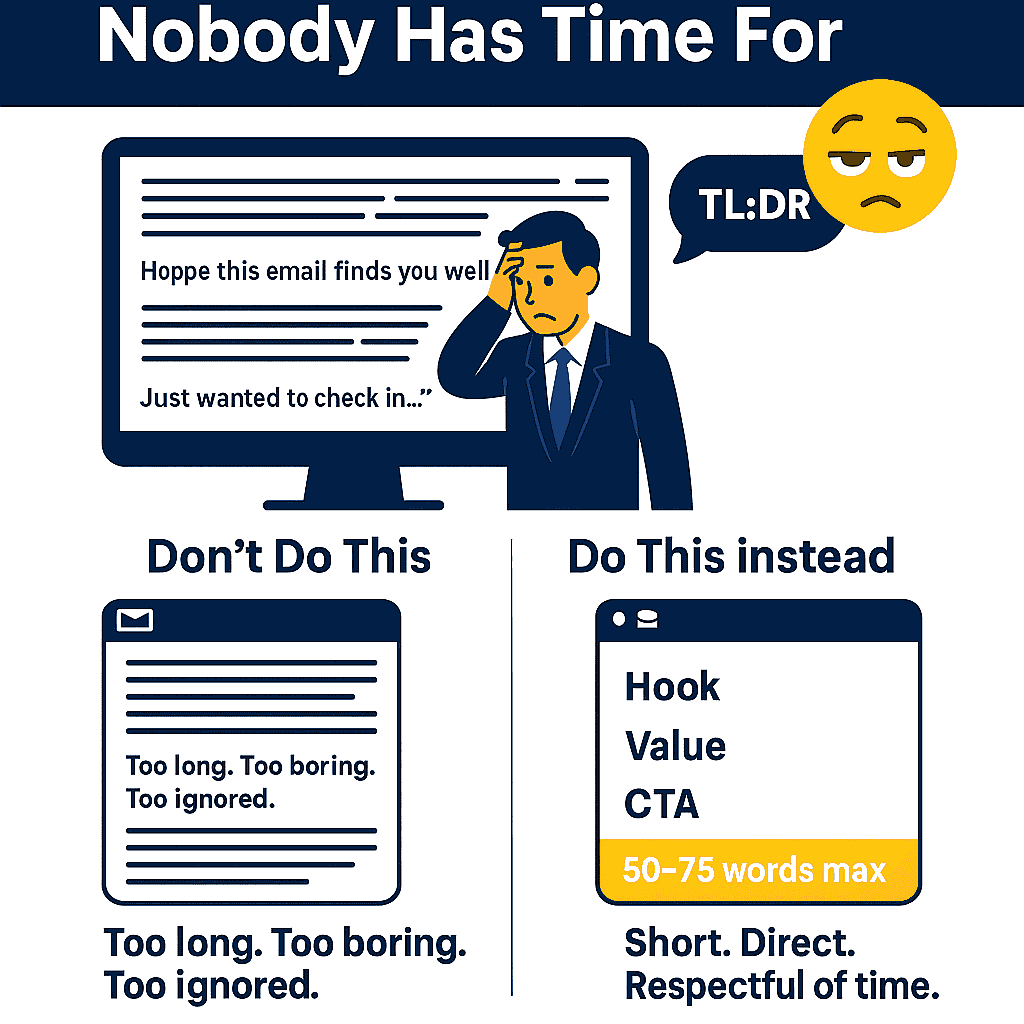
This one is brutal. I see so many people over-explaining, adding irrelevant backstories, listing all their services like a brochure, or even including paragraphs about their “mission and vision.” Newsflash: your prospect doesn’t care.
Cold email isn’t content marketing. It’s not a newsletter. You’ve got 3–5 seconds to grab attention, show relevance, and make it easy to reply. That’s it.
Here’s what I do now:
First line = personalization (not a compliment, but a relevant observation)
Second line = value (specific problem you solve or outcome you enable)
Third line = social proof (credibility or results that back it up)
Final line = simple CTA (no hard sell, just a soft nudge)
That’s it. 4–5 lines max.
I stopped trying to impress and started trying to connect. That’s when replies started flowing in.
Mistake #2: Sending Generic Templates That Sound Like Everyone Else
If your email looks like it was copied from a “cold email swipe file” you found on Reddit, it’s going to die in the inbox.
Your prospect can smell a mass-sent template from a mile away.
When I used to send emails that started with:
“Hey [First Name], I hope this email finds you well. I wanted to reach out because I help companies just like yours…”
…they tanked. Every. Single. Time.
You know why? Because I sounded like everyone else.
Here’s what works for me now: relevance > personalization. Sure, using someone’s first name and company is the minimum. But if that’s the only personalization you’re doing, you’re already losing.
Instead, I focus on relevance signals:
Did their company just raise funding?
Are they hiring for a role I’m qualified for?
Did they launch a new product?
Are they growing traffic but not converting?
Did they just get featured in a podcast, tweet something interesting, or comment on a competitor?
That’s the gold.
When you reference something timely, relevant, and strategic, your cold email doesn’t feel cold anymore. It feels intentional. That’s the difference between a delete and a reply.
Mistake #3: using a weak subject.
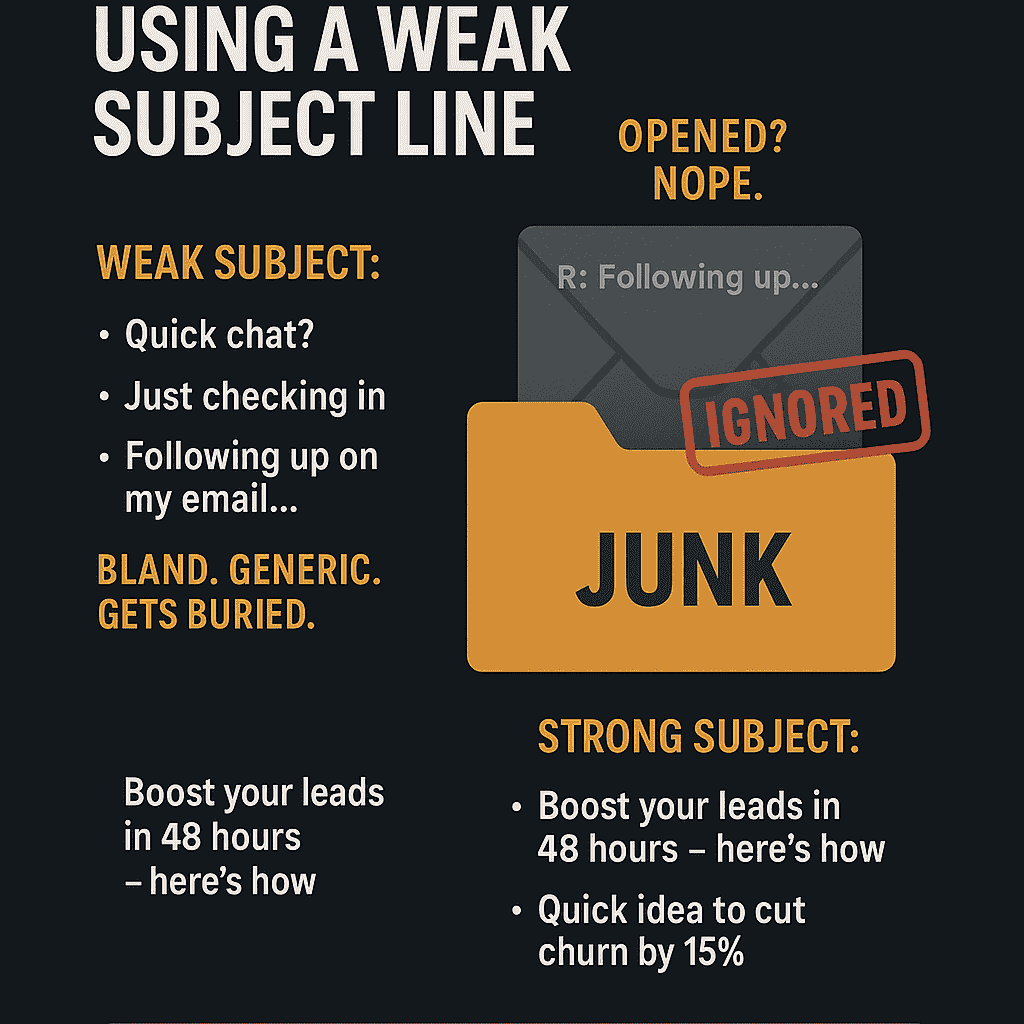
The subject line is the gatekeeper. If it doesn’t get opened, nothing else matters.
Some subject lines are so bad they scream “spam” before the email is even clicked:
“Grow your business fast!!!”
“You’re leaving money on the table!”
“Hey there, just checking in…”
Nah. You’ve lost me.
Now, I approach subject lines like mini headlines. My only job is to spark curiosity or signal relevance, without sounding clickbaity or scammy.
Here are a few subject line types that work consistently for me:
First name + curiosity: “Josh, quick idea for your sales funnel”
Mutual connection or company: “Noticed Acme’s new product launch”
Pain point trigger: “Fixing drop-off on demo pages?”
Short & mysterious: “Quick Q” or “Saw this,thought of you”
Subject lines don’t need to be clever. They just need to feel human, relevant, and worth opening.
And remember: if it looks like marketing, it gets ignored.
Mistake #4: Asking soon
This one kills so many potentially great conversations.
If your CTA is:
“Let me know a good time for a 30-minute call next week so I can walk you through a detailed demo and explain how our platform works…”
You’ve already lost.
Your prospect doesn’t know you. Doesn’t trust you. And doesn’t want to block off 30 minutes of their day for a random pitch.
In the early days, I was making this mistake non-stop. I thought being “direct” meant asking for a meeting right away. But what I learned is that the real goal of a cold email isn’t to sell,it’s to start a conversation.
Here’s what works for me now:
“Would it make sense to send over a few ideas?”
“Open to a quick chat if this is relevant?”
“Want me to send over a short Loom to explain?”
“Does this sound like something worth exploring?”
These CTAs are low-friction. They invite a reply, not a commitment. Once they reply, then I can qualify and move the conversation forward.
The more you respect the buyer’s time, the more they’ll respect yours.
Mistake #5: Poor Deliverability = Zero Visibility
This one is the silent killer.
You can write the perfect email… but if it lands in spam, it might as well not exist.
In my early campaigns, I didn’t even know about SPF, DKIM, DMARC, warming up domains, or email reputation. I was just sending emails from my main Gmail account and wondering why open rates were 3%.
Turns out, deliverability is everything.
Now, I don’t even start a campaign until:
I’ve warmed up the domain for at least 2–3 weeks
SPF, DKIM, and DMARC are properly configured
I’m sending from a custom domain (not my main business domain)
I keep sending volume low and gradually increasing
I check my spam score before launching any campaign
I also avoid spammy words like “guaranteed,” “limited time,” or “100% free.”
Deliverability is like oxygen. You don’t notice it when it’s working… but once it’s gone, nothing survives.
I thought sending more emails would automatically mean more leads. I thought using shiny templates, catchy subject lines, and a list I scraped overnight would be enough to get responses.
they’re silent deal-killers. They’ll make your outreach fall flat no matter how good your offer is or how passionate you’re about your service.
And the reason I’m so obsessed with pointing them out is simple: I’ve been there.
Cold Email Is a Craft, Not a Shortcut
I used to think cold emailing was a numbers game. Blast 500 emails, and you’ll get 5 replies, right?
Wrong.
When I focused only on volume, all I was doing was amplifying my mistakes. I was multiplying mediocrity. And I was digging a hole for my sender reputation that was hard to climb out of.
The moment I started treating cold email like a craft,like a skill to refine and a system to engineer,everything changed. Replies started coming in from the exact type of clients I wanted to work with. Conversations became warmer. And most importantly, I started feeling confident that the work I was doing wasn’t just guesswork. It was intentional.
Frequently Asked Questions
1. Why does personalization matter when doing cold emails?
Personalization means acknowledging that you put the effort into trying to understand the person’s needs and interests. Generic emails may honestly feel like spam, and that only reduces the chances of a reply. The more tailor-made an email is, the more likely the recipient will respond for engagement and forging of meaningful relationships.
2. How can I optimize a subject line for a cold email?
The subject line has to be the clearest of all. It should be short, precise, and relevant to the recipient. Avoid using general expressions that hold no significance whatsoever. It should spark curiosity or mention something valuable. Wonder if you can refer to a recent accomplishment or interest of the recipient; this will make your email stand out in their inbox.
3. what’s the optimum length for a cold email?
An ideal cold email is about 50-125 words long; greater degrees of brevity cause higher bounce rates. The recipients are busy people who prefer messages that quickly get to the point. The email needs to be readable and shouldn’t inundate the reader with unwanted information; instead, allow the offer to shine through.
4. Why is having a prominent call to action in cold emails so important?
The CTA would instruct the recipient on what action you wish them to take-namely setting up a call, replying to your email, or visiting a website. When there’s no clear, specific, or simple CTA included within your email, recipients will be unsure as to how they should respond, thus lowering the likelihood of one.
5. How do timing and conduct affect cold emails?
Sending at times most conducive to the recipient checking his inbox during business hours on a weekday will yield a greater chance that the email will be opened and responded to. Also, the sample should consider the time zone so that the email would be received at an hour most suitable to be read immediately.
Frequently Asked Questions
what’s the fastest way to use Avoid These 5 Common Cold Email Mistakes That Kill Reply Rates without burning the market?
How many prospects should I contact for Avoid These 5 Common Cold Email Mistakes That Kill Reply Rates?
Why do most campaigns around Avoid These 5 Common Cold Email Mistakes That Kill Reply Rates fail?
Should I use email only for Avoid These 5 Common Cold Email Mistakes That Kill Reply Rates?
When should I hire help for Avoid These 5 Common Cold Email Mistakes That Kill Reply Rates?
Research worth checking
What This Looks Like in a Real Pipeline
Here is the part most teams miss with Avoid These Common Cold Email Mistakes Kill Reply Rates. The tactic is not the asset. The system around the tactic is the asset. If the list is weak, the message is vague, and the follow-up is random, even a smart idea turns into noise. That is why we look at Avoid These Common Cold Email Mistakes Kill Reply Rates through one simple question: would a serious buyer believe this was built for their situation, or would they assume it was blasted to 10,000 people?
The buyer is not sitting around waiting for your pitch. They are dealing with inbox providers, skeptical buyers, and prospects who delete anything that feels copied. So the first job of outreach is not persuasion. It is pattern interruption with proof. Show that you understand the buyer’s world, name the business problem clearly, and make the next step feel useful instead of needy.
The 3-Part Check We Use Before Scaling
- Fit: Can we explain why this exact person should care in one sentence? If not, the list is too broad.
- Timing: Is there a trigger, market shift, hiring signal, funding event, expansion move, compliance deadline, or operational pain that makes the message relevant now?
- Proof: Does the email give the buyer a reason to trust the claim before asking for time? A sharp observation beats a generic case-study line.
This is not complicated, but it is unforgiving. A sloppy list makes copy look bad. Weak positioning makes good data useless. And a CTA that asks for a meeting too early forces the buyer to do all the mental work. That is where most campaigns die.
Want the cleaner version? Start with 200 accounts, not 20,000. Segment them by pain, write one message for one segment, and watch replies before scaling. If the first 200 prospects do not produce signal, more volume will not save the campaign. It will only make the failure louder.
The bottom line: Avoid These Common Cold Email Mistakes Kill Reply Rates works when it is specific, measured, and tied to a real buying moment. It fails when it sounds like every other vendor trying to sound clever. If you want this installed properly, build the data layer first, then the message, then the follow-up system. In that order.
