Why Your 2020 Outbound Playbook Is Killing Your Pipeline in 2026
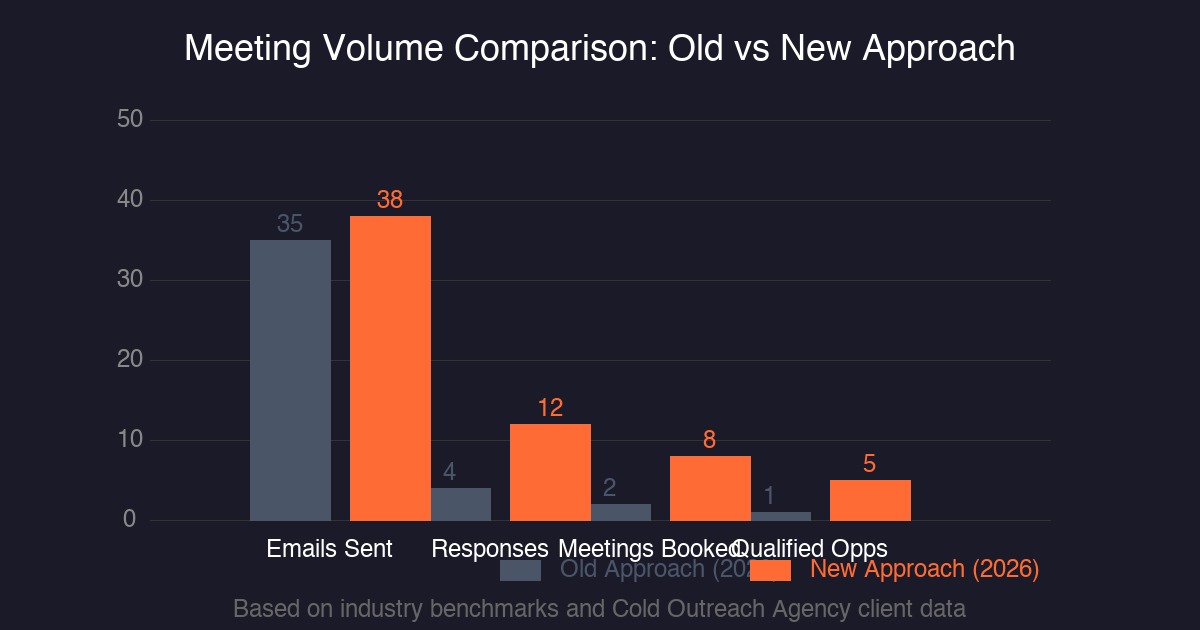
THE BOTTOM LINE: Outbound sales in 2026 demands precision targeting, multi-channel orchestration, and relentless follow-up. Teams using data-driven ICP definition and multi-touch sequences book 5-8x more meetings than those using outdated spray-and-pray methods. The playbook is simple: know exactly who you target, reach them on multiple channels with value-first messaging, and never stop until you get a yes or a hard no. we’ve helped clients implement this framework and see meeting bookings triple within 60 days. The math works. The execution separates winners from everyone else.
What Makes an ICP Actually Work in 2026?
- Firmographic signals , Company size, industry, revenue range, tech stack, and growth stage. These are table stakes.
- Behavioral indicators , Who is actively searching for solutions like yours? What content are they consuming? Which job titles are showing intent signals?
- Budget alignment , Target companies that have historically paid your price point. Stop wasting cycles on companies that can’t afford your solution.
- Decision-making complexity , Understand the buying committee structure. Who approves, who recommends, who blocks?
How Do Top Teams Execute Multi-Channel Outreach in 2026?
- Email remains the backbone , 70% of your outreach volume should flow through email. But that means research-backed, highly personalized email that provides genuine value, not template fill-in-the-blank garbage.
- LinkedIn as the relationship layer , Connect with prospects, engage with their content, and establish thought leadership before pitching. LinkedIn allows you to demonstrate expertise without selling.
- Cold calling as the closer , Use phone calls to break through when email and LinkedIn fail. The goal isn’t to pitch on the call, it’s to schedule a meeting.
- Video messaging for differentiation , Personalized video (30-60 seconds) attached to LinkedIn connection requests or emails dramatically increases response rates. Forrester reports that video in sales outreach can boost reply rates by up to 200%.
What Does Personalization at Scale Actually Look Like?
- Company-level research , Reference a recent news article, funding round, leadership change, or strategic initiative. Prove you understand their business, not just their industry.
- Individual-level insights , Comment on their LinkedIn post, mention their speaking engagement, or reference their published content. Show you see them as a person, not a title.
- Mutual connection use , “We both know Sarah Chen from Salesforce” creates immediate credibility and warmth.
- Trigger-based messaging , Reference job changes, company expansions, new hires, or technology implementations. These are conversation starters that demonstrate timing relevance.
- Pain-specific framing , Open with the specific problem your solution solves, framed in their industry language.
Why Do Most Sales Teams Give Up Too Early on Follow-Ups?
- Touch 1 , Initial email (Monday morning, 8am prospect timezone)
- Touch 2 , LinkedIn connection plus personalized note (Tuesday)
- Touch 3 , Follow-up email with new angle or value addition (Thursday)
- Touch 4 , Break-up email with different format or video (Next Monday)
- Touch 5+ , Monthly check-ins with new information for 90 days
The Objection Handling: Turn “Not Now” Into “Tell Me More”
- “We don’t have budget” , Shift the conversation to cost of inaction. what’s the cost of not solving this problem? Budget appears when the problem becomes painful enough.
- “We’re not looking for a solution right now” , Validate their timeline, then create urgency around the cost of waiting. Understand their decision-making cycle.
- “Send me more information” , they’re stalling. Respond with “What specific questions should I address in the information I send?” to qualify genuine interest.
- “Your competitor is cheaper” , Price objections are rarely about price. they’re about perceived value. Reframe the conversation around ROI and total cost of ownership.
- “I need to talk to my team” , Great. Offer to join that conversation. Ask who else should be involved and how you can help them build the business case internally.
How Do You Know If Your Outbound Is Actually Working?
- Contact-to-meeting rate , What percentage of your outreach converts to booked meetings? Aim for 5-10% with qualified ICP targeting. Below 3% means your targeting or messaging needs work.
- Meeting-to-opportunity rate , Of meetings booked, what percentage become qualified opportunities? Below 30% means your qualification criteria or meeting execution needs improvement.
- Pipeline coverage ratio , You need 3-4x pipeline for every dollar of closed revenue you need. If you need $1M in closed revenue, build $3-4M in qualified pipeline.
- Average sales cycle length , How long from first contact to closed deal? Track by deal size and segment. Longer cycles require more pipeline upfront.
- Revenue per rep , The ultimate output metric. If this isn’t growing, your outbound strategy is broken regardless of activity metrics.
The Cold Calling Revival: Does It Still Work in 2026?
- Pre-call research (2 minutes) , Check their LinkedIn, recent company news, and mutual connections before dialing.
- The hook opener , Start with something specific: “I saw your company just raised a Series B, congrats on that.”
- The value statement , “We help companies like yours reduce sales cycle by 40%.”
- The ask , “Would you be open to a 20-minute call next Tuesday to explore if this makes sense for you?”
- The exit , If they say no, ask “What would need to change for this to make sense?”
What Tools Should Your Outbound Stack Include in 2026?
- Sales engagement platform , For sequencing outreach across email, LinkedIn, and phone. Popular options include Apollo, Outreach, and Salesloft.
- AI research tools , Tools like ChatGPT, Claude, or dedicated platforms that help surface personalization hooks in minutes instead of hours.
- Video recording software , Loom, Vidyard, or similar tools for creating personalized video messages at scale.
- Dialer with power features , Local presence, call recording, and auto-dialing to maximize talk time.
- Intent data providers , Bombora or similar platforms that surface which companies are actively researching your category.
Scaling Outbound: How to 3x Your Pipeline Without 3xing Your Headcount
- Technology stack optimization , Sales engagement platforms, AI-powered research tools, and CRM automation multiply your team’s output without multiplying headcount.
- Content at scale , Create once, use repeatedly. Build email templates, LinkedIn message libraries, and video frameworks that your team can personalize efficiently.
- Prospect research automation , Use AI tools to surface personalization hooks at scale. The five-minute research sprint should be three minutes with better results.
- Specialization over generalization , Break your team into specialized roles: researchers, outreach specialists, closers. Each person masters one domain instead of mediocre at everything.
- Outbound as a service , If building in-house capacity is too slow or expensive, partner with an outbound agency that has proven systems and immediate bandwidth. Learn more about our outbound services.
Frequently Asked Questions About Outbound Sales Best Practices
Ready to build an outbound machine that books meetings? Book a free strategy call today and learn how we’ve helped teams 3x their pipeline using these exact outbound sales best practices.
{
“@context”: “https://schema.org”,
“@type”: “FAQPage”,
“mainEntity”: [
{
“@type”: “Question”,
“name”: “How long does it take to see results from outbound sales efforts?”,
“acceptedAnswer”: {
“@type”: “Answer”,
“text”: “Most teams see initial results within 2-3 weeks of implementing proper outbound sequences. Meeting bookings typically increase within 30 days, while closed revenue appears 60-90 days after starting outreach. The key is having realistic expectations and tracking leading metrics from day one. we’ve seen clients double their meeting bookings within 60 days by focusing on ICP quality and multi-channel orchestration.”
}
},
{
“@type”: “Question”,
“name”: “what’s the ideal number of touches in an outbound sequence?”,
“acceptedAnswer”: {
“@type”: “Answer”,
“text”: “We recommend a minimum of 5-7 touches across multiple channels before removing a prospect from your sequence. This includes email, LinkedIn, and phone touches. Many teams give up after 2 touches, which is exactly when they’re closest to a response. According to research from HubSpot, 80% of sales require 5+ follow-ups, yet most salespeople give up after just one or two attempts.”
}
},
{
“@type”: “Question”,
“name”: “How do you personalize outreach at scale without sounding generic?”,
“acceptedAnswer”: {
“@type”: “Answer”,
“text”: “Personalization at scale requires frameworks, not manual effort for each prospect. Use the 5-Layer Personalization Framework: company news, individual insights, mutual connections, trigger events, and pain-specific framing. Build research workflows that surface high-value hooks in under 5 minutes per prospect. The goal is to make each prospect feel understood while maintaining your team’s productivity.”
}
},
{
“@type”: “Question”,
“name”: “Is cold calling still effective for B2B sales in 2026?”,
“acceptedAnswer”: {
“@type”: “Answer”,
“text”: “Yes, cold calling remains effective when done correctly. The key is treating it as a discovery conversation rather than a pitch session. Your only goal on the first call should be to schedule a meeting, not close a deal. Phone calls work best when combined with prior email and LinkedIn touches. we’ve helped clients increase their meeting conversion rate by 300% using the Phone First Framework with proper multi-channel sequencing.”
}
},
{
“@type”: “Question”,
“name”: “What outbound metrics should sales leaders track weekly?”,
“acceptedAnswer”: {
“@type”: “Answer”,
“text”: “Track these five metrics weekly: contact-to-meeting rate (target 5-10%), meeting-to-opportunity rate (target 30%+), pipeline coverage ratio (target 3-4x), average sales cycle length, and revenue per rep. Gartner research shows that top-performing teams focus on leading indicators rather than vanity metrics like emails sent or calls made. These outcome-focused metrics tell you if your outbound strategy is actually working.”
}
}
]
}
Research worth checking
The Clean Execution Plan
I would not scale Outbound Sales Practices until the first small batch proves three things: the market is right, the message lands, and the follow-up creates conversations. That is why I care less about volume at the start and more about whether the first replies prove the angle is real.
A serious B2B buyer has one silent question: why should I care right now? If the campaign cannot answer that quickly, the rest of the copy does not matter. The first job of outreach is to prove relevance before persuasion. Name the business problem, make the next step useful, and remove every sentence that sounds like a brochure.
Three Filters Before You Add Volume
- ICP match: The buyer should match your best customer profile, not just a broad industry label.
- Trigger strength: A hiring move, new location, funding event, tech change, compliance push, or public initiative makes outreach feel timely.
- Follow-up logic: Every follow-up should add a new reason to respond. Repeating the first message is not follow-up. It is noise.
Do not hide behind volume. Volume is a multiplier. It multiplies good strategy, and it multiplies bad strategy even faster.
The cleaner version is simple: start with 300 accounts, not a giant scraped list. Segment them by pain, write one message for one segment, and watch replies before scaling. If that first batch does not produce signal, more volume will not save the campaign. It will only make the failure louder.
Here is the practical takeaway: make Outbound Sales Practices narrower, cleaner, and easier to say yes to. Then scale what the market proves, not what the team hopes will work. Build the data layer first, then the message, then the follow-up system. In that order.
How to Make This Feel Built, Not Generated
If the message cannot show why this matters now, the campaign becomes background noise. The buyer is filtering for relevance, timing, credibility, and the cost of paying attention. For Outbound Sales Best Practices 2026, that means the outreach has to connect the business problem, the buying moment, and the proof in a way that feels specific.
A objection bottleneck should not be handled with the same CTA as a variance bottleneck. A books buyer cares about different proof than a books accounts buyer. A stakeholder issue needs different copy than a latency issue. This is why shallow templates fail. They flatten different buyer situations into one bland message.
- Books Buyers: Review books buyers against the buyer’s real context before increasing send volume.
- Authority: Review authority against the buyer’s real context before increasing send volume.
- Routing: Review routing against the buyer’s real context before increasing send volume.
- Authentication: Review authentication against the buyer’s real context before increasing send volume.
- Offer: Review offer against the buyer’s real context before increasing send volume.
- Director: Review director against the buyer’s real context before increasing send volume.
This is the part a generic article usually misses: judgment. A real operator can tell when throttling is the problem, when friction is the problem, and when the whole angle is too soft. That judgment comes from reading replies, checking account quality, and comparing message intent against actual buyer behavior.
The cleaner move is to run a small batch, inspect the signal, then rewrite the weak layer. Do not scale because the copy looks polished. Scale because the replies prove the market understands the value.