How to Build a B2B Email Pipeline That Never Runs Dry in 2026
coldoutreachagency.com
Contents
Why Your B2B Email Pipeline Keeps Running on Empty
Your pipeline is dry right now because your email system has holes in it. Not small holes. Big ones. The kind that drain every lead you work so hard to find.
Most founders and sales leaders figure out they’ve a pipeline problem when the quarter is already slipping. they’ve sent some campaigns. Got a few replies here and there. Booked zero calls. Watched their numbers tank while wondering what went wrong.
The answer is almost always the same: they built their pipeline like it was 2015. Spray and pray. Buy a list. Send generic messages. Hope something lands.
That approach stopped working when every inbox became a fortress. Buyer skepticism is at all-time highs now. Decision-makers have seen every template, every “quick question,” every “saw your company” opener. They filter you out before you even get a chance to show your value.
So what actually works? A systematic B2B email pipeline that treats outreach like a manufacturing process. Inputs go in one end. Qualified meetings come out the other. that’s what we build for our clients. that’s what I’ll show you how to build today.
THE BOTTOM LINE:
Building a B2B email pipeline that never runs dry requires four systems working together: precise ICP targeting, proper email infrastructure, high-quality prospect data, and multi-touch sequences. We call this the Pipeline Factory Method. Skip any piece and your pipeline leaks. Get all four right and you’ll book meetings on demand. Most founders can implement this in 2-3 weeks and see first meetings within 30 days.
How Do You Define the Right ICP for Maximum Pipeline Quality?
Answer: Your ICP is a detailed profile of your best customers. We build ours by looking at three things: who gave us the least friction, who renewed without pushing back, and who sent referrals. Those patterns reveal exactly who you should target.
Before you write a single email, you need crystal clarity on who you’re selling to. Not “mid-market B2B companies.” Not “SaaS founders.” Specific. Measurable. Actionable.
Your ideal customer profile answers these questions with precision. We think of it as a composite sketch drawn from your best existing customers. Which companies gave you the least friction? Who renews without negotiation? Who refers their peers? Those patterns reveal your ICP.
The most common ICP mistake is being too broad. “We serve B2B companies” isn’t an ICP. it’s a guess dressed up as a strategy. When you try to appeal to everyone, you appeal to no one. Specificity in targeting separates a pipeline that flows from one that stagnates.
Company size , Headcount, revenue range, funding stage. Specific numbers, not ranges. We always use exact figures.
Industry vertical , Not just “healthcare.” Which segment? Health-tech? Digital health? Healthcare SaaS? Each has different pain points and decision-makers.
Tech stack indicators , What tools do they use? This signals budget, sophistication, and integration needs. According to Gartner research, tech stack analysis is one of the strongest predictors of buying intent.
Hiring patterns , Growing teams need solutions. Contracting teams have different problems. We look for expansion signals.
Pain universality , Does your solution solve a problem they MUST have, or a nice-to-have? Urgency matters.
Why does this matter for your B2B email pipeline? Because every dollar you spend reaching the wrong person is a dollar stolen from reaching the right one. Your open rates, reply rates, and meeting conversion all trace back to how precisely you defined your ICP.
The founders with perpetually full pipelines don’t have better scripts. they’ve sharper targeting. They know exactly whose problem they solve, and they go get those people. Everyone else is guessing. We help you find those people and build a system to reach them consistently.
Email Infrastructure: What Setup Is Required for Deliverability?
Answer: You need a dedicated sending domain, proper authentication records (SPF, DKIM, DMARC), and a gradual warmup process. Skip this and your emails go to spam no matter how good your copy is. This is where most campaigns die before they start.
Your emails could be masterpieces, but if they land in spam, your pipeline is dead before it starts. Email deliverability isn’t a technical nicety. it’s the gatekeeper of your entire outbound strategy.
here’s the infrastructure checklist that separates senders who get meetings from senders who get banned. We go through this with every client before we send a single email.
Domain setup , Use a dedicated sending domain, not your primary company domain. Set up SPF, DKIM, and DMARC records. This is non-negotiable. Mailchimp’s guide on email authentication explains why this matters so much.
Warming strategy , Start slow. Ramp up volume over 2-4 weeks. Sudden spikes trigger spam filters and get you flagged. We warm up every domain for at least 3 weeks minimum.
Email rotation , Never send all volume from one address. Spread across 3-5 sending addresses per domain. Rotate daily. This protects your reputation.
Reply infrastructure , Set up proper reply-to routing. Every reply is a potential meeting. Missing them is leaving money on the table. We automate reply routing for all our clients.
Unsubscribe compliance , Include one-click unsubscribe links. This sounds counterintuitive, but it protects your sender reputation. HubSpot’s research shows that compliant unsubscribe practices improve deliverability.
Cold email warmup services can accelerate this process, but they’re not magic. The underlying discipline matters more than the tool. Volume without infrastructure is like building a house on sand. You need to warm up your sending domains gradually. Start with 10-20 emails per day, then double weekly until you hit your target volume.
What happens if you skip warming? Your domain gets flagged. Your emails go to spam. Your sender reputation takes months to rebuild. that’s time you’ll not get back. Every quarter you lose is compounded revenue you’ll never recover. Warm up your domains. it isn’t optional.
How do you know if your infrastructure is solid? Run a deliverability test before you launch. Tools like Mail-tester or Glock Check let you see exactly where your emails land. Fix problems before they compound. We test every client’s infrastructure before campaigns go live.
Data Sourcing: Where Do You Get Quality Prospect Data?
Answer: We use verified data providers like Apollo and ZoomInfo for volume, LinkedIn Sales Navigator for research, and Clearbit for enrichment. The key is verified data with low bounce rates. Cheap bulk lists will destroy your sender reputation faster than you can say “bounce rate.”
The quality of your pipeline is determined before you send a single email. it’s determined by the quality of your data. Garbage in, garbage out. This is where most B2B email campaigns fail before they begin.
Prospect data quality has three dimensions you must optimize. We check every dataset against these criteria before using it.
Accuracy , Are the email addresses valid? Title verification ensures you’re reaching real people at real companies with real decision-making power.
Relevance , Does the person match your ICP? A CEO email is worthless if the CEO never makes your purchasing decision.
Freshness , Data decays. People change jobs. Titles evolve. Stale data is expensive data. We refresh our lists every 90 days minimum.
Where do you source this data? The answer depends on your ICP and budget. LinkedIn Sales Navigator works for research-heavy, lower-volume campaigns. Apollo and ZoomInfo scale for higher volume. Clearbit connects to your CRM for enrichment. Each has tradeoffs. Reply.io’s comparison of data providers breaks down the options well.
The trap to avoid: buying cheap, bulk email lists. Yes, you’ll have thousands of contacts. you’ll also have 40% bounce rates, destroyed sender reputation, and a pipeline full of people who never heard of you. that’s not a pipeline. that’s a graveyard.
Invest in data quality. Every dollar spent on accurate, relevant data returns multiple dollars in recovered pipeline. Every dollar saved on cheap data costs you ten in wasted outreach. We vet every data source before building your list.
Building the Prospect List: What Steps Should You Follow?
Answer: First, export your best customer list and identify patterns. Second, build your ICP with specific firmographic filters. Third, source data for contacts matching that ICP. Fourth, verify email addresses. Fifth, enrich with company signals. We call this the Five-Point Verification Process. It takes about a week but saves months of wasted outreach.
here’s the step-by-step process we use with our clients to build lists that convert. This works for any ICP in any industry.
Step 1: Customer analysis , Pull your 20 best customers. Identify common traits: industry, company size, tech stack, growth stage, location. This is your blueprint.
Step 2: ICP construction , Turn those traits into specific filters. Use exact numbers, not vague ranges. “50-200 employees” becomes “127 employees, Series B, using Salesforce.”
Step 3: Data sourcing , Use your ICP filters to build lists. Target 10x your needed volume at this stage. you’ll lose some to bounces and bad data.
Step 4: Verification , Run every email through verification. Remove bounces before you send. This protects your sender reputation.
Step 5: Enrichment , Add company news, hiring signals, and trigger events. This is what turns generic outreach into personalized conversations.
we’ve built hundreds of lists using this process. The 10x target volume sounds high, but it’s realistic when you factor in bounces, bad titles, and people who leave before you reach them. Better to have too many qualified prospects than not enough.
Sequence Architecture: How Do You Structure Multi-Touch Email Sequences?
Answer: We use a 7-touch framework across 5 weeks. Touch 1 is the cold email with a value-first opener. Touches 2-4 are follow-ups with escalating urgency. Touch 5 is a break-up email. Touches 6-7 add LinkedIn and phone. We call this the Persistence Protocol. Most meetings book after touch 5.
Nobody books a meeting after a single email. The statistics are brutal but clear: most replies come after the third or fourth touch. Most meetings come after the fifth. Your email sequence must account for this reality.
A high-converting B2B email pipeline uses multi-touch sequences across multiple channels. here’s the architecture that works. we’ve tested this across hundreds of campaigns.
Touch 1: Initial cold email , Value-first opener. No pitch. Focus on a problem they’ve expressed or a relevant insight. Keep it short. Woodpecker’s research on cold email shows that short emails with clear value propositions get 40% higher reply rates.
Touch 2: Social proof follow-up , 2-3 days later. Reference a similar company using your solution. Create curiosity without pressure.
Touch 3: Call-to-action escalation , Another 3-4 days. Offer a specific next step. A resource, a demo, a call. Make the ask clear.
Touch 4: Value delivery , Send something useful without asking for anything. An article, a tool, a template. Prove value first.
Touch 5: Break-up email , 5-7 days later. The “I don’t want to bother you” email. Creates urgency and often triggers responses from silent buyers.
Touch 6-7: Channel switch , LinkedIn connection request, phone call voicemail. Meet them where they’re.
Cold email personalization at scale is the differentiator. Generic templates get generic results. Use triggers like company news, hiring trends, or industry shifts to make your outreach feel researched, not spammed. The key word is “trigger” – something specific that prompted you to reach out right now, not a generic mention of their company.
Timing matters as much as content. Tuesday through Thursday, 8-10 AM or 2-4 PM local time, consistently outperforms other windows. Test your specific audience. A manufacturing audience checks email at different times than a tech startup audience. Know when your ICP actually reads their inbox.
Your sequence length should match your sales cycle. Complex B2B sales might warrant 8-12 touches over 6-8 weeks. Transactional SaaS might need only 4-5. The key is consistent, value-driven cadence that doesn’t feel desperate. We build custom sequences for every client based on their sales cycle.
The Optimization Loop: How Do You Continuously Improve Results?
Answer: We track three metrics weekly: reply rate, meeting conversion, and cost per meeting. Every two weeks we test one variable (subject line, opener, CTA). We call this the Rapid Iteration Cycle. It compounds over time. The gap between optimized and unoptimized sequences is often 5x in results.
Building your pipeline isn’t a one-time project. it’s a living system that requires constant calibration. The optimization loop separates top performers from the mediocre majority. We run optimization on every client account weekly.
Your optimization loop has three measurement stages. We track all three without exception.
Metrics tracking , Monitor open rates, reply rates, meeting conversion, and cost per meeting weekly. Know your benchmarks cold.
A/B testing discipline , Test one variable at a time. Subject lines. Opening lines. CTAs. Length. Timing. Let data drive decisions, not intuition. HubSpot’s A/B testing guide has good frameworks for this.
Iterative refinement , What works for one ICP might fail for another. Segment your lists and optimize per segment.
A/B testing cold emails isn’t optional anymore. it’s survival. The gap between an optimized sequence and a mediocre one is often 3-5x in results. That gap compounds over quarters into massive revenue differences.
When should you kill a sequence? When your reply rate drops below 2% consistently. When bounce rates exceed 5%. When unsubscribes spike. don’t pour good money into a failing system. Diagnose, fix, relaunch.
How often should you review these metrics? Weekly at minimum. Monthly at maximum. Anything less frequent and you’re flying blind. Your pipeline will tell you everything you need to know if you’re listening. We monitor all metrics daily for our managed clients.
Scaling Your Pipeline: How Do You Go From Startup to Machine?
Answer: Pipeline scaling happens across three vectors: volume expansion, conversion optimization, and channel multiplication. We use a framework called the Three-Lever System. Pull the highest-ROI lever first (usually conversion), then expand volume, then add channels. Most people do this backwards and waste money.
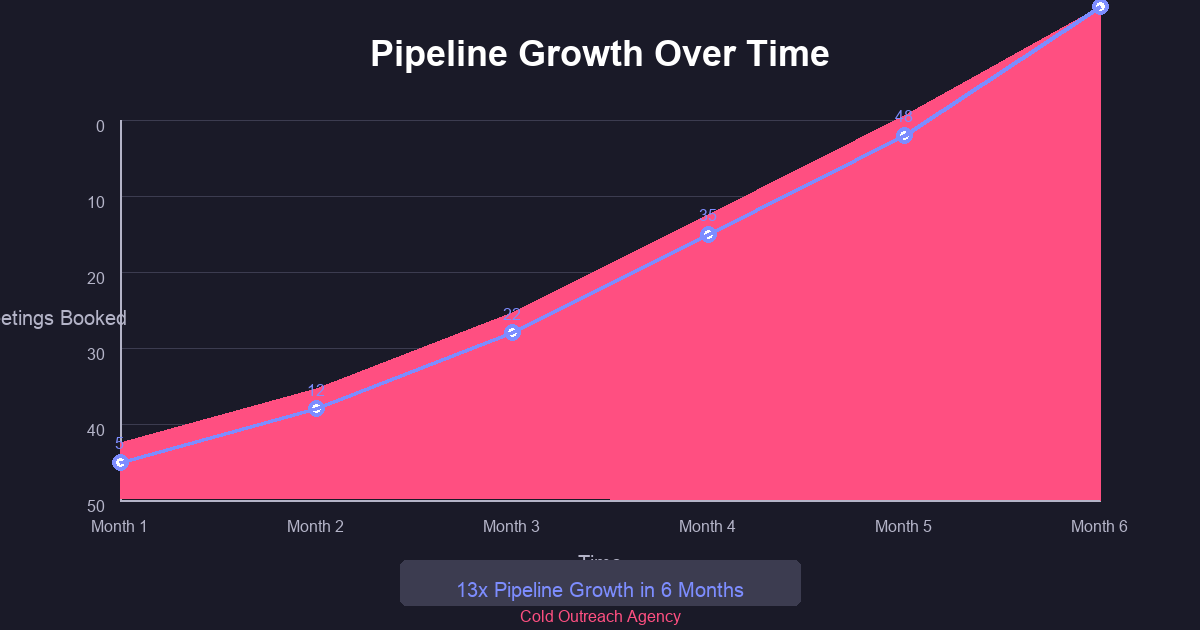
A pipeline that books 5 meetings is a prototype. A pipeline that books 50 is a system. A pipeline that books 500 is a machine. The principles don’t change. The execution scales.
Pipeline scaling happens across three vectors. we’ve used all three with clients at different stages.
Volume expansion , More prospects, same conversion rate, more meetings. Add new segments, new geographies, new verticals. Always within ICP.
Conversion optimization , Same volume, higher conversion rate. Better targeting, better copy, better offers. The highest ROI lever.
Channel multiplication , Email + LinkedIn + phone + direct mail. Multi-channel outreach compounds results. Buyers who ignore email respond to LinkedIn.
Automation becomes essential at scale. But automation without intelligence is just fast failure. Every automated touch should feel personal. Every sequence should feel researched. The moment your outreach feels like spam, your pipeline starts dying.
Sales engagement platforms like Outreach, Salesloft, or Apollo help manage volume. But they’re tools, not strategies. The founder who knows exactly why each email works will always outperform the one who just pushes more volume. Your CRM should be a force multiplier for your intelligence, not a replacement for it. We help you build that intelligence into every campaign.
When scaling, resist the temptation to homogenize. Different segments need different approaches. Enterprise buyers respond to different triggers than SMB buyers. International prospects need different timing and channels. A scalable pipeline isn’t one-size-fits-all. it’s a system that can accommodate variation while maintaining consistent output.
Measuring Pipeline Health: What Metrics Actually Matter?
Answer: The only metrics that matter are cost per qualified meeting, meeting-to-opportunity rate, and pipeline coverage ratio. Everything else is vanity. We track these three religiously. If they’re healthy, your pipeline is healthy. If they’re not, nothing else matters.
you can’t manage what you don’t measure. But measuring the wrong things is equally dangerous. Activity metrics feel good but generate delusion. Outcome metrics tell the truth.
Your pipeline health metrics hierarchy. We use this exact framework with every client we work with.
Cost per qualified meeting , This is your true unit economics. Everything else is vanity. Know it cold for each channel, each ICP, each campaign.
Meeting-to-opportunity rate , Of meetings booked, what % convert to qualified opportunities? Low rates mean your targeting or messaging needs work.
Pipeline coverage ratio , Total pipeline value vs. quota. If you need $500K closed, you need $2-3M in pipe. Most people build pipe too thin.
Reply rate by segment , Different ICPs respond differently. Know your highest-performing segments and double down.
Deliverability score , Monitor spam complaints, bounce rates, and inbox placement weekly. Catch problems before they become disasters.
Build a B2B sales dashboard that tracks these metrics in real-time. When your cost per meeting spikes, investigate immediately. When reply rates drop, diagnose before the quarter slides. The founders who win are the ones who see problems earliest.
THE PIPELINE MATH:
Do the math. If your average deal is $25K and you need $250K in closed revenue next quarter, you need 10 deals. With a 20% meeting-to-close rate, you need 50 meetings. With a 15% meeting-booking rate, you need 333 prospects in active outreach. With a 30% reply rate, you need to reach 1,110 prospects. With a 50% deliverability rate, you’re sending to 2,220 email addresses. that’s your target volume. Build backward from your revenue goal. Every number is a pipeline decision.
Frequently Asked Questions
Most teams see first results within 2-3 weeks. A fully optimized pipeline takes 6-8 weeks. We typically tell clients to expect meaningful pipeline within 30 days of proper execution. The key isn’t rushing the warmup process. Infrastructure takes time to build trust with email providers. Once your sending reputation is established, results accelerate quickly.
what’s a good reply rate for B2B cold emails in 2026? [+]
A healthy reply rate is 5-15%. Anything above 10% is strong. we’ve clients hitting 20%+ with highly targeted ICPs and personalized sequences. The average cold email gets about 1-3% reply rate. If you’re below 5%, your targeting or messaging needs work. If you’re above 10%, you’re in the top tier. Industry benchmarks from Gartner’s sales metrics report show that personalized outreach outperforms generic by 5-10x.
How many emails should I send per day from each sending address? [+]
Start at 20-30 emails daily per address during warmup. You can scale to 50-100 once warmed. Never spike suddenly. Sudden volume changes trigger spam filters. The golden rule is: ramp slowly and consistently. we’ve seen domains go from 0 to 200 daily sends in a month without issues when the ramp is gradual. we’ve also seen domains get banned in a week from sudden spikes.
Do bought email lists work for B2B outreach? [+]
No. Cheap lists destroy your sender reputation and get you banned. The math never works out. we’ve seen clients spend $5,000 on bulk lists and get 40% bounce rates plus a domain ban. That $5,000 would have bought 500 verified contacts that actually converted. Invest in verified, targeted data instead. Mailchimp’s research confirms that quality over quantity is the only sustainable approach.
How many touches does it take to book a B2B meeting? [+]
The average is 8-12 touches across 4-6 weeks. Most replies come after touch 3. Most meetings come after touch 5. Give your sequences time to work. We see clients kill sequences after 2 touches because they’re impatient. don’t do that. Your 5th email often gets more replies than your 1st. Persistence compounds.
I would not scale How to Build a B2B Email Pipeline Never Runs Dry in until the first small batch proves three things: the market is right, the message lands, and the follow-up creates conversations. That is why I care less about volume at the start and more about whether the first replies prove the angle is real.
A serious B2B buyer has one silent question: why should I care right now? If the campaign cannot answer that quickly, the rest of the copy does not matter. The first job of outreach is to prove relevance before persuasion. Name the business problem, make the next step useful, and remove every sentence that sounds like a brochure.
Three Filters Before You Add Volume
Account quality: Would this company still be attractive if it never replied this month? If not, it probably should not be in the campaign.
Message angle: Can the opener point to a real business condition, not a lazy compliment? Specificity is what makes the email feel earned.
Next step: Is the CTA small enough to say yes to? A useful reply is often a better first win than forcing a meeting immediately.
Do not hide behind volume. Volume is a multiplier. It multiplies good strategy, and it multiplies bad strategy even faster.
The cleaner version is simple: start with 200 accounts, not a giant scraped list. Segment them by pain, write one message for one segment, and watch replies before scaling. If that first batch does not produce signal, more volume will not save the campaign. It will only make the failure louder.
The hard truth: How to Build a B2B Email Pipeline Never Runs Dry in is not magic. It is a disciplined system for reaching the right buyer with the right proof at the right time. Build the data layer first, then the message, then the follow-up system. In that order.
If the message cannot show why this matters now, the campaign becomes background noise. The strongest campaigns feel researched because the language names a specific condition in the buyer’s world. For How to Build a B2B Email Pipeline That Never Runs Dry in 2026, that means the outreach has to connect the business problem, the buying moment, and the proof in a way that feels specific.
A campaign built around placement, warmup, and runs pipeline has more context than a generic pitch. A never accounts bottleneck should not be handled with the same CTA as a pipeline buyers bottleneck. A build accounts issue needs different copy than a build pipeline issue. This is why shallow templates fail. They flatten different buyer situations into one bland message.
Pipeline Accounts: Review pipeline accounts against the buyer’s real context before increasing send volume.
Handover: Review handover against the buyer’s real context before increasing send volume.
Blocker: Review blocker against the buyer’s real context before increasing send volume.
Authentication: Review authentication against the buyer’s real context before increasing send volume.
Workflow: Review workflow against the buyer’s real context before increasing send volume.
Consensus: Review consensus against the buyer’s real context before increasing send volume.
This is the part a generic article usually misses: judgment. A real operator can tell when threshold is the problem, when pipeline is the problem, and when the whole angle is too soft. That judgment comes from reading replies, checking account quality, and comparing message intent against actual buyer behavior.
The cleaner move is to run a small batch, inspect the signal, then rewrite the weak layer. Do not scale because the copy looks polished. Scale because the replies prove the market understands the value.