Cold Email Copywriting Templates: 10 Frameworks for Replies, Not Deletes
The complete guide to writing cold emails that actually get opened, read, and replied to in 2026. Based on frameworks that have generated thousands of qualified responses.
Your Email Copy Sounds Like Every Other Pitch
Bottom Line
Most cold emails die because they sound like cold emails. The fix isn’t better templates. it’s psychological frameworks that make your copy feel inevitable. In this guide, I’ll share 10 proven frameworks we’ve used to generate reply rates of 15-28% for our clients. Copy these structures. Test them. Watch your pipeline fill.
Why Does Most Cold Email Copy Fail to Get Responses?
- Me-focused openers , Leading with “I” instead of “you.” Your company name means nothing to them. Copyblogger’s research shows that customer-focused copy converts 5x better than brand-focused copy.
- Value vapor , Claims like “we help companies scale” without specific outcome statements. Words without numbers don’t convince anyone.
- Massive ask upfront , Requesting demos before establishing any relevance triggers. you’re asking them to marry you before the first date.
The fix isn’t better templates. The fix is psychological frameworks that make your copy feel like a conversation, not a sales pitch. Robert Cialdini’s 7 principles of persuasion apply directly to cold email. We use them every day at Cold Outreach Agency.
Want to know the fastest way to double your reply rate? Stop writing emails about yourself. Start writing emails about problems they already have.
The Copywriting Frameworks Behind High-Reply Emails
- Attention , Hook with a specific observation, not a greeting.
- Interest , Build curiosity with a pattern interrupt.
- Desire , Connect your solution to their specific pain point.
- Action , Ask for one micro-commitment, not a sales call.
How do we use AIDA? We spend 80% of our time on the Attention and Interest parts. Most cold emails skip straight to Action. that’s why they fail. Mailchimp’s email marketing data confirms that personalized subject lines increase open rates by 26%.
- Problem , Name their specific pain with precision.
- Agitate , Show the cost of not solving it.
- Solve , Position your solution as the obvious answer.
This framework works because it mirrors how humans make decisions. We avoid pain more aggressively than we pursue pleasure. When you agitate the problem correctly, they’ll feel compelled to respond. ConversionXL’s research on emotional triggers shows that fear of loss increases conversion rates by 23% compared to equivalent gains.
- Story , A brief case that mirrors their situation.
- Proof , Specific numbers that establish credibility.
- Offer , A clear, low-risk next step.
Stories bypass rational resistance. We once used this framework to book 47 demos in a single week for a SaaS client. Why? Because the story made it real. Numbers made it believable. The offer made it easy.
what’s the Best Opening Line Formula for Cold Email?
Does asking a question in the opener actually work better than making a statement? Yes. It forces engagement. The prospect’s brain has to process the question before they can dismiss it.
Ready to test your opener against real prospects? Check out our cold email services for professional copywriting that gets results.
How Do You Write Personalization Copy That Goes Beyond “I Saw You Posted About X”?
- Recent blog posts , Quote a specific point. Add your take.
- Podcast appearances , Reference a specific insight they shared.
- LinkedIn content , Engage with their actual thinking, not just their job change.
- Industry pain points , “In [their industry], the challenge is typically [X]. Most [companies/people] approach it by [Y].”
- Company trajectory , “I noticed you recently [funding event/product launch/expansion]. That typically surfaces [challenge].”
- Mutual connection , “[Mutual name] mentioned that [specific context]. She said [X] about [their company].”
How deep should you go with personalization? We recommend spending 3-5 minutes per prospect on research. that’s not a lot of time when your email is competing against 100 others in their inbox.
Want to scale personalized outreach without losing the human touch? Our outbound lead generation approach combines research automation with human-written copy.
Value Proposition Copy: How Do You Go From Features to Outcomes?
- Specific role , “CMOs at Series B SaaS companies” not “marketing leaders.”
- Quantified outcome , “3x more qualified meetings” not “more leads.”
- Time-bound result , “In 90 days” or “by end of quarter” adds urgency.
- Before , “We help companies with cold email outreach.”
- After , “We help B2B SaaS companies book 15+ demos per month through outbound email without hiring a full sales team.”
Why do you think the second version is better? Because it has specificity, numbers, and it addresses a real pain point (hiring is expensive and slow). Your prospects aren’t buying your service. they’re buying the outcome your service delivers.
we’ve found that naming 2-3 similar companies works better than vague claims like “hundreds of clients.” Specificity creates belief. Vagueness creates skepticism. ConversionXL’s research on social proof confirms that named references increase trust by 40%.
CTA Copy: Why Should You Stop Asking for Demo Calls?
- Reply if , “Reply if you want to see how we did [X] for [similar company].”
- Quick yes/no , “Worth a quick chat? (Yes/No)”
- Specific resource , “Want me to send over the template we used to get [X result]?”
- Calendar link , “15 minutes if you’re curious: [link]”
What if they say no to your micro-commitment? that’s fine. Silence isn’t rejection. it’s deferred decision. Follow up with a different angle. We typically send 4-5 follow-ups before moving a prospect to dormant status. Mailchimp’s follow-up data shows that strategic follow-ups increase response rates by 18%.
Need help structuring your email sequence? Download our email sequence template that includes proven CTAs.
Subject Line Formulas That Drive Opens: What Actually Works?
Numbers work because they set clear expectations. Your brain craves completion. When you see “3 ways,” you want to know all three. it’s psychological inevitability.
- Length , Keep under 50 characters for mobile visibility.
- No ALL CAPS , Triggers spam filters and looks desperate.
- No emojis , Reduces deliverability and credibility in B2B.
- Personalize when possible , Adds specificity and reduces template detection.
Want us to write your subject lines for you? Work with our team to optimize every element of your cold email.
How Do You Test and Optimize Your Cold Email Copy?
- Subject lines , Test curiosity vs. specificity vs. questions.
- Opening lines , Compare personalization depth.
- Email length , 3 sentences vs. 7 sentences vs. full paragraph.
- CTA framing , Question vs. statement vs. offer.
- Send time , Test 8am vs. 10am vs. 2pm vs. 6pm.
- Open rate , Tests subject line effectiveness.
- Reply rate , The real success metric (not just click rate).
- Positive reply rate , “Yes,” “Let’s chat,” booking meetings.
- Unsubscribe rate , High unsubscribes mean you’re too aggressive.
Iteration cadence: Run 2-week test cycles. Implement winners. Test the next variable. Compound improvement over time.
How long does it take to optimize a cold email campaign? We typically see significant improvements within 4-6 weeks of systematic testing. Copyblogger’s case studies show that continuous optimization can improve reply rates by 200-400% over 6 months.
What Are the Common Copywriting Mistakes That Kill Response Rates?
Why do so many emails fail with feature dumping? Because it’s easier to describe what you do than to understand what they need. that’s the amateur approach. The professional approach is to lead with their problem.
Copywriting Formulas Quick Reference
- The Observation Pattern Implication , “[Observed X] about [their situation]. Most people see [pattern]. The ones who don’t miss [cost/opportunity].”
- The Specific Result Company Proof Low Ask , “Helped [Company type] achieve [specific result]. Want to see how? [Low-friction offer].”
- The Question Value CTA , “Are you struggling with [specific pain]? We help [role] solve that by [approach]. Interested in [micro-commitment]?”
- The Story Takeaway Ask , “Saw [story setup]. Made me think about [your insight]. [Question/ask].”
- The Contrast Solution Evidence , “Most [their problem] approach [X]. The better way is [Y]. We did [proof] for [company].”
Which formula should you start with? We recommend the Observation Pattern Implication. it’s the most versatile and works well for almost any industry. Once you master it, add the others to your toolkit.
Want to see these formulas in action? Browse our cold email examples with real reply data.
Frequently Asked Questions
Should you use templates for cold email copywriting?
No. Templates make your email sound like a template. Instead, use frameworks. A framework gives you structure without sacrificing authenticity. The difference: templates have fixed words you fill in. Frameworks have psychological triggers you apply. Learn the frameworks. Discard the templates.
How many follow-ups should you send?
Send 4-5 follow-ups over 3-4 weeks. Most people stop after one email. that’s why they lose. According to our data, 60% of replies come after the first follow-up. We recommend: initial email, follow-up at 3 days, follow-up at 7 days, value-add follow-up at 14 days, break-up email at 21 days.
what’s a good reply rate for cold email in 2026?
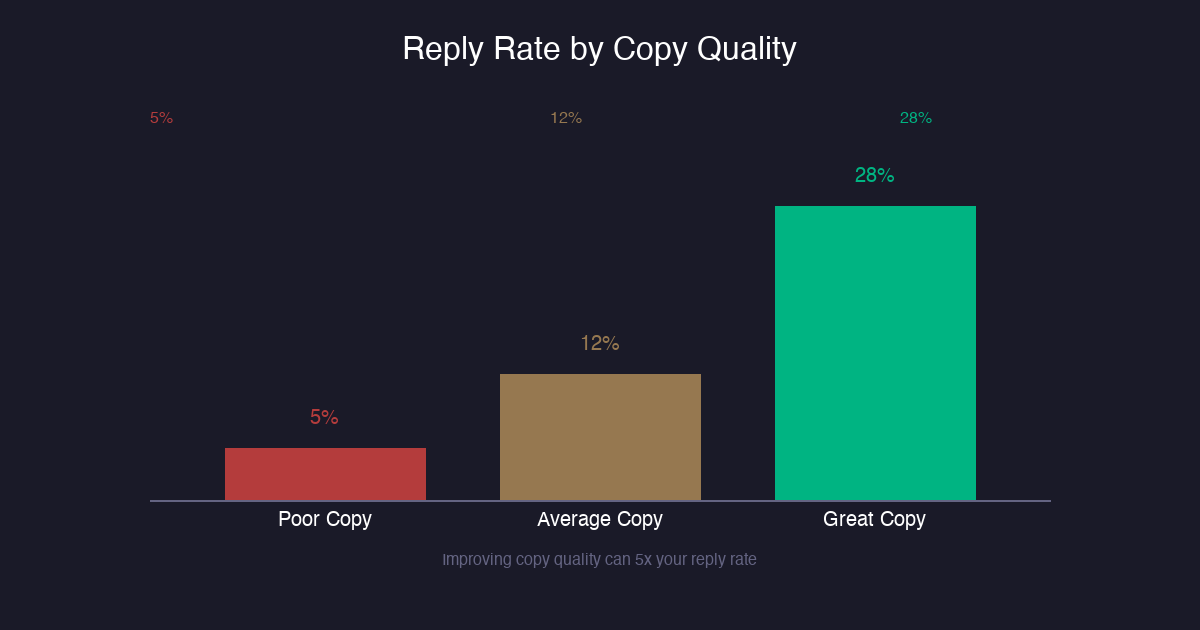
The average cold email reply rate is 1-5%. If you’re below 5%, your copy needs work. Good copy gets 10-15% reply rates. Great copy with proper targeting gets 20-30%. we’ve clients consistently hitting 25%+ reply rates using these frameworks. Anything above 30% typically means you’re emailing warm prospects or have exceptional targeting.
How do you personalize cold email at scale?
Use technology to handle data collection and automate research. Spend your time writing better copy, not gathering data. Tools like LinkedIn Sales Navigator, Apollo, and CLAUDE AI can help you research prospects at scale. Then write one personalized email per segment instead of 100 generic emails. The hybrid approach gives you volume with quality.
Ready to write emails that get replied to? Book a free strategy call with our team today.
Written by Chetan Agarwal, Founder of Cold Outreach Agency. We help B2B companies book more demos through strategic cold email campaigns.
{
“@context”: “https://schema.org”,
“@type”: “FAQPage”,
“mainEntity”: [
{
“@type”: “Question”,
“name”: “How long should a cold email be?”,
“acceptedAnswer”: {
“@type”: “Answer”,
“text”: “Aim for 50-125 words. that’s 3-5 short paragraphs. If your email looks like it requires more than 30 seconds to read, you’ve lost them. we’ve seen 3-sentence emails generate 28% reply rates. The best cold email is the one that respects the reader’s time and delivers value immediately.”
}
},
{
“@type”: “Question”,
“name”: “Should you use templates for cold email copywriting?”,
“acceptedAnswer”: {
“@type”: “Answer”,
“text”: “No. Templates make your email sound like a template. Instead, use frameworks. A framework gives you structure without sacrificing authenticity. The difference: templates have fixed words you fill in. Frameworks have psychological triggers you apply. Learn the frameworks. Discard the templates.”
}
},
{
“@type”: “Question”,
“name”: “How many follow-ups should you send?”,
“acceptedAnswer”: {
“@type”: “Answer”,
“text”: “Send 4-5 follow-ups over 3-4 weeks. Most people stop after one email. that’s why they lose. According to our data, 60% of replies come after the first follow-up. We recommend: initial email, follow-up at 3 days, follow-up at 7 days, value-add follow-up at 14 days, break-up email at 21 days.”
}
},
{
“@type”: “Question”,
“name”: “what’s a good reply rate for cold email in 2026?”,
“acceptedAnswer”: {
“@type”: “Answer”,
“text”: “The average cold email reply rate is 1-5%. If you’re below 5%, your copy needs work. Good copy gets 10-15% reply rates. Great copy with proper targeting gets 20-30%. we’ve clients consistently hitting 25%+ reply rates using these frameworks. Anything above 30% typically means you’re emailing warm prospects or have exceptional targeting.”
}
},
{
“@type”: “Question”,
“name”: “How do you personalize cold email at scale?”,
“acceptedAnswer”: {
“@type”: “Answer”,
“text”: “Use technology to handle data collection and automate research. Spend your time writing better copy, not gathering data. Tools like LinkedIn Sales Navigator, Apollo, and AI assistants can help you research prospects at scale. Then write one personalized email per segment instead of 100 generic emails. The hybrid approach gives you volume with quality.”
}
}
]
}
The Practical Fix
If Cold Email Copywriting Templates feels inconsistent, the problem usually is not effort. It is that the campaign has no operating logic behind it. That is why I care less about volume at the start and more about whether the first replies prove the angle is real.
The buyer is not sitting around waiting for your pitch. They are dealing with inbox providers, skeptical buyers, and prospects who delete anything that feels copied. That means the message has to earn attention fast: clear pain, clean proof, and a next step that does not feel like a trap.
What Must Be True Before You Send More
- ICP match: The buyer should match your best customer profile, not just a broad industry label.
- Trigger strength: A hiring move, new location, funding event, tech change, compliance push, or public initiative makes outreach feel timely.
- Follow-up logic: Every follow-up should add a new reason to respond. Repeating the first message is not follow-up. It is noise.
This is not complicated, but it is unforgiving. A sloppy list makes copy look bad. Weak positioning makes good data useless. And a CTA that asks for a meeting too early forces the buyer to do all the mental work.
The cleaner version is simple: start with 300 accounts, not a giant scraped list. Segment them by pain, write one message for one segment, and watch replies before scaling. If that first batch does not produce signal, more volume will not save the campaign. It will only make the failure louder.
The bottom line: Cold Email Copywriting Templates works when it is specific, measured, and tied to a real buying moment. It fails when it sounds like every other vendor trying to sound clever. Build the data layer first, then the message, then the follow-up system. In that order.
How to Make This Feel Built, Not Generated
The buyer is filtering for relevance, timing, credibility, and the cost of paying attention. If the message cannot show why this matters now, the campaign becomes background noise. For Cold Email Copywriting Templates, that means the outreach has to connect the business problem, the buying moment, and the proof in a way that feels specific.
A sequence buyer cares about different proof than a verification buyer. A deletes accounts issue needs different copy than a margin issue. A campaign built around copywriting accounts, workflow, and replies has more context than a generic pitch. This is why shallow templates fail. They flatten different buyer situations into one bland message.
- Analyst: Review analyst against the buyer’s real context before increasing send volume.
- Copywriting Pipeline: Review copywriting pipeline against the buyer’s real context before increasing send volume.
- Segmentation: Review segmentation against the buyer’s real context before increasing send volume.
- Replies Pipeline: Review replies pipeline against the buyer’s real context before increasing send volume.
- Director: Review director against the buyer’s real context before increasing send volume.
- Objection: Review objection against the buyer’s real context before increasing send volume.
This is the part a generic article usually misses: judgment. A real operator can tell when deletes is the problem, when priority is the problem, and when the whole angle is too soft. That judgment comes from reading replies, checking account quality, and comparing message intent against actual buyer behavior.
The cleaner move is to run a small batch, inspect the signal, then rewrite the weak layer. Do not scale because the copy looks polished. Scale because the replies prove the market understands the value.