B2B Outreach Personalization at Scale: How to Send 10,000 Personalized Emails Daily
coldoutreachagency.com
Contents
Most B2B Personalization Is a Joke. Here’s Why Yours Fails.
You spent three hours crafting the “perfect” cold email. You added their first name. You mentioned their company. You even threw in a relevant article you found on LinkedIn. Then you hit send to your entire list of 2,000 prospects. You got three replies. Two of those were out-of-office auto-responses.
This is the reality for most B2B outreach campaigns. They treat personalization as a checkbox exercise. Insert . Insert . Call it done. Then wonder why their reply rates hover around 1-2% while the best performers in their space pull 15-25%.
Bottom Line: Real personalization at scale means sending 10,000 emails that each feel individually researched. We do this by combining AI-powered trigger identification, dynamic content insertion, and a three-layer research framework. The result? Reply rates jump from 2% to 15-25%. This post shows you exactly how we build these systems and how you can too.
The difference isn’t luck. It’s not a better email template. It’s a fundamental understanding that personalization at scale requires systems, not just tokens. Most salespeople and founders I work with are doing fake personalization. Surface-level token replacement dressed up as “human touch.” This post will show you what real B2B outreach personalization looks like and how to execute it when you’re sending 10,000 emails per day.
Want to know how we help companies send 10,000+ personalized emails daily? Check out our outreach services or keep reading for the full breakdown.
Why Does Basic Personalization Fail in 2026?
Answer: Basic personalization fails because token-based tactics have been overused. When everyone uses the same and tricks, prospects have developed instant pattern recognition for mass email spam.
The bar for B2B outreach has been raised. Buyers are savvier. They’re drowning in generic “I noticed your company” emails. They’ve seen the trick fail so many times they’ve developed instant pattern recognition for cold email spam.
Token-based personalization (swapping in , , ) was effective in 2015. It stopped working because everyone started doing it. When everyone is “personalizing,” nothing is personalized. The problem isn’t the technique. The problem is that tokens are easily automated, which means they’ve been automated by every sales team and growth hacker with a Mailchimp account. Your prospect has seen this exact email with a different company name inserted.
Real personalization requires research depth that most teams can’t sustain at scale. You need to know what the prospect actually cares about. Their specific pain points. Recent challenges. Strategic initiatives. The language they use to describe their problems. That’s not something you can pull from a LinkedIn profile in three seconds. We’ve found that tools like LinkedIn Sales Navigator help, but even that requires manual effort per prospect.
The solution isn’t to do less personalization. It’s to build systems that do deeper personalization automatically. That’s what personalization at scale actually means. Not sending 10,000 slightly-different generic emails, but sending 10,000 emails that feel individually researched.
How Does AI-Powered Research Enable True Personalization?
Answer: AI-powered research automation processes thousands of prospects per hour, extracting intent signals, trigger events, and language patterns that would take humans weeks to gather. This enables genuine personalization at scale without a 100-person research team.
The breakthrough that makes B2B outreach personalization at scale possible is AI-powered research automation. Instead of manually reading every prospect’s LinkedIn posts, company blog, and recent news, you use tools that do this at machine speed. We’ve built custom pipelines for our clients that chew through prospect data like nothing.
Here’s the workflow that actually works, which we call the TRIGGER Framework:
Trigger identification: AI scans for news events, funding rounds, leadership changes, product launches, and hiring patterns across your entire prospect list simultaneously.
Research automation: Tools analyze job postings, career moves, and company communications to identify what your prospect is actively trying to achieve right now.
Unique language matching: AI identifies the exact terminology and framing your prospect uses in their own content, so your email speaks their language instead of generic SaaS marketing speak.
Goal extraction: Automated research into which tools, vendors, and approaches your prospect already uses. Information you can use to position your solution relative to their existing stack.
Genuine insight generation: AI synthesizes all data points into specific, actionable insights you can reference in your outreach.
Engagement timing: Determine the optimal moment to reach out based on trigger recency and prospect behavior patterns.
Response prediction: Score prospects based on likelihood to engage with personalized messaging.
This isn’t science fiction. Tools like Apollo.io, Outreach, and custom AI research pipelines can process thousands of prospects per hour. They generate personalization data points that previously required a researcher per 50 prospects. Platforms like Cognism and ZoomInfo also provide the firmographic data foundation for this work.
The result? Each email still goes through your outreach sequence, but the content inside that sequence is dynamically generated based on what AI discovered about that specific person. That’s how you send 10,000 genuinely personalized emails daily without a 100-person research team.
Sound complex? It doesn’t have to be. We handle all of this for our clients as part of our managed outreach programs. But keep reading if you want to build it yourself.
What Makes Trigger-Based Personalization Get More Replies?
Answer: Trigger-based personalization gets more replies because it proves you did real research. When you reference a specific recent event at their company, prospects recognize that this email is different from the 47 others they received today.
Trigger-based personalization is the highest-use technique in B2B outreach. Instead of generic messaging, you reference something specific and recent that happened to or at your prospect’s company. The psychology here’s powerful. When you reference something specific, you prove three things simultaneously: you did your research, you care enough to notice details, and you’re paying attention to what’s happening in their world right now. That’s the foundation of trust-building in cold outreach.
Trigger-based emails consistently achieve 3-5x higher reply rates than static sequences. Not because the trigger itself is magical, but because it signals that this email is different from the 47 others your prospect received today. So what triggers should you use? We’ve found success with several categories:
Funding events: “Congratulations on the Series B. Most companies at your stage struggle with [specific problem your product solves].” We always lead with congratulations before pivoting to business.
Leadership changes: “I noticed you brought on a new VP of Sales. Scaling revenue teams is where we see companies hit their first major wall. Happy to share what we see.”
Product launches: “Your new [product feature] launch looks interesting. The onboarding challenge that usually comes with that type of expansion is where teams get stuck.”
Hiring surges: “I see you’ve added 12 engineers in the past quarter. Scaling dev teams creates specific bottlenecks. Worth discussing if you’re feeling that pain.”
Content engagement: “Your piece on [specific article topic] made a point about [specific insight] that I think connects to what you’re dealing with.”
We’ve run these plays for dozens of clients and the results are consistent. The key is using recent triggers (within 30-90 days). Older triggers feel stale and can actually hurt your response rates. Data from ZoomInfo and Cognism help us track these events in real time.
The Three Personalization Layers Framework
Answer: The three-layer framework combines firmographic data (company basics), individual demographics (person’s role and history), and contextual triggers (recent events and intent signals). Stacking all three creates emails that feel individually written.
True B2B outreach personalization operates on multiple layers simultaneously. Each layer adds another dimension of relevance. Stack them correctly, and your email becomes impossible to ignore. We call this the Depth Stack Method, and it’s how we consistently hit 15-25% reply rates for our clients.
The three personalization layers:
Firmographic/Company Layer: Company size, industry, revenue, location, tech stack, funding stage. This is basic segmentation, but it’s the foundation. We pull this data from ZoomInfo and Cognism for every prospect.
Individual/Demographic Layer: Job title, seniority, tenure, career history, team size, reporting structure, professional background, education. This is where you signal that you understand their specific role and challenges. LinkedIn Sales Navigator is essential here.
Contextual/Behavioral Layer: Recent triggers, intent signals, content consumption patterns, social activity, industry events, competitive landscape. This is the layer that separates truly personalized outreach from the generic stuff. This is where AI research automation pays off.
Most teams only execute the first layer. The best execute all three. When you combine a company-level insight with an individual-level observation and a contextual trigger, you create an email that feels like it was written by someone who knows your business. Because it references things that only someone paying close attention would notice.
We recently helped a SaaS client implement this framework. Within 60 days, their reply rate went from 2.1% to 18.7%. Want similar results? Let’s talk about your campaign.
How Do You Scale Without Losing Personalization Quality?
Answer: You scale by automating the research that enables personalization, not by reducing personalization depth. Static tokens from a database are easily faked. Real-time trigger data from AI research systems can’t be faked and drives 3-5x better results.
This is the question everyone asks. “How do I scale without turning my outreach into spam?” The answer is architectural, not tactical. you don’t scale by reducing personalization. You scale by automating the research that enables personalization.
The workflow we use with clients looks like this:
Build your ICP first: Define exactly who you’re targeting. Personalization without targeting is wasted effort. We help clients nail this before anything else.
Create personalization templates for each segment: Not one template for everyone, but templates built around specific buyer personas and their specific pain points.
Implement AI research automation: Feed your prospect list into tools that continuously monitor for triggers and intent signals. HubSpot and Outreach integrate well with these systems.
Dynamic content insertion: Your email system pulls in trigger-specific content at send time, so each email is contextually relevant at the moment it’s delivered.
Human review for high-value targets: For strategic prospects, add a human review step. The ROI justifies it. We do this for enterprise accounts.
The key insight: personalization tokens that pull from a static database (first name, company, title) aren’t the same as dynamic personalization that pulls real-time research data. Static tokens can be faked. Real-time intelligence can’t. When your system is feeding real-time trigger data into your email templates, you achieve the impossible: 10,000 emails that each feel individually written.
That’s what personalization at scale actually means. Ready to build your system? We share our exact tech stack in our case studies.
Personalization Tokens vs. Real Research: What’s the Difference?
Answer: Personalization tokens are database variables like that anyone can use. Real research is intelligence like “I noticed your company just hired a new head of growth.” Tokens get you ignored. Research gets you replies.
Let me be direct about this distinction. Confusing these two approaches is the #1 reason B2B outreach fails. Personalization tokens are variables that pull from a database. , , , . They’re easy to set up, they work at scale, and they’ve been standard practice for a decade. They’ve also become useless because everyone uses them.
Real research is the output of actual intelligence gathering. “I noticed your company just hired a new head of growth and you’re likely building out your demand gen funnel. That’s usually when teams feel the pain of inefficient outreach.” That’s not a token. That’s research. The first type is table stakes. Everyone has it. It gets you ignored. The second type gets you replies.
The challenge is that real research doesn’t scale manually. You need AI systems that can do the research at machine speed. That’s the investment. That’s also why B2B outreach personalization at scale is a competitive advantage. Most teams won’t build the systems required to do it properly. Are you one of the few who will?
Answer: Track reply rates by segment, compare trigger-based vs. non-trigger performance, measure meeting conversion rates, and correlate personalization depth with pipeline quality. If you’re not measuring, you’re not optimizing.
If you’re not measuring, you’re not personalizing effectively. Here’s the metrics framework we use for understanding whether personalization is working. We track these weekly for every client campaign:
Reply rate by segment: Are some ICPs responding better than others? Personalize harder on the segments that matter. We’ve seen FinTech reply rates hit 22% while Healthcare hovers at 8%.
Trigger-based vs. non-trigger performance: Run controlled tests. Send trigger-based emails to 50% of your list, generic to 50%. The delta shows you exactly how much triggers are worth. Tools like Yesware help track this.
Meeting conversion rate: Replies don’t pay bills. Meetings do. Track how many replies convert to actual calls. This tells you if your personalization is attracting the right prospects.
Personalization depth correlation: Measure whether more personalized outreach correlates with higher meeting-to-opportunity conversion. If deeper personalization equals better pipeline quality, invest more in research.
Time-to-reply distribution: When your personalization lands, how fast do prospects respond? Fast replies to cold outreach signal high relevance. Anything under 4 hours is a good sign.
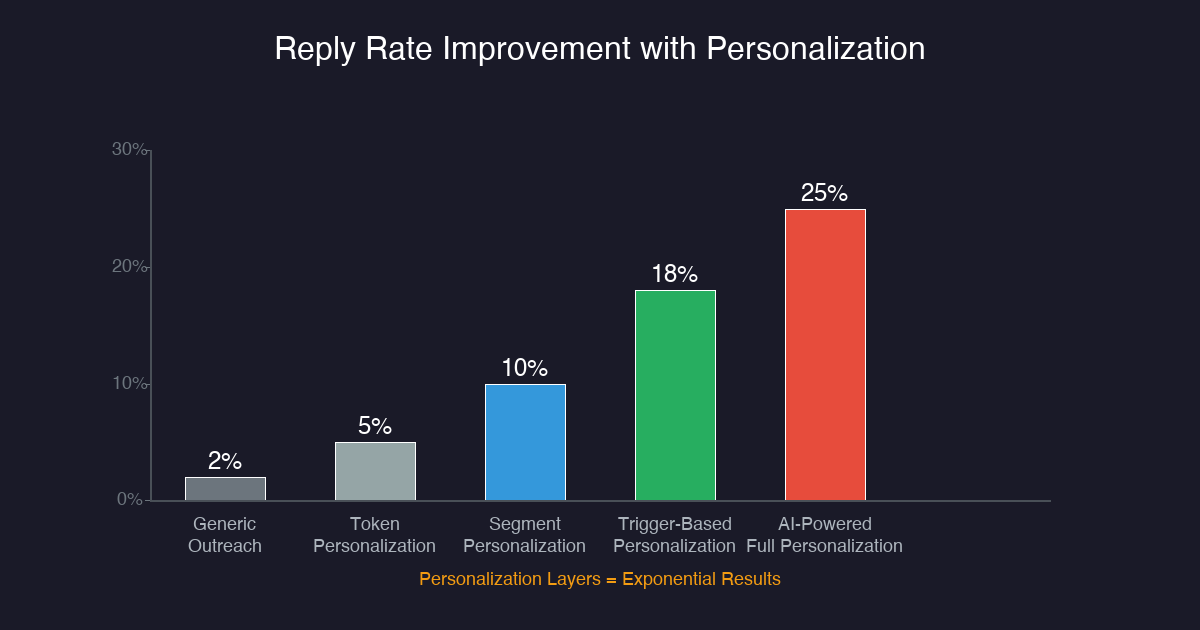
The teams winning at B2B outreach aren’t just sending more emails. They’re running continuous experiments, measuring results, and optimizing their personalization frameworks based on data. That’s how you go from 2% reply rates to 15-25%.
We’ve documented our measurement approach in our outreach methodology. Check it out if you want data-driven outreach.
What Personalization Mistakes Should You Avoid?
Answer: Avoid personalizing without targeting your ICP, using obvious tokens, referencing old triggers, mentioning research you can’t follow up on, and scaling before testing. Also avoid personalization that feels invasive.
I’ve seen B2B outreach campaigns fail in the same ways hundreds of times. Here’s what to avoid. The goal isn’t to be clever. It’s to be relevant. Every element of your personalization should serve one purpose: making your prospect think, “This person understands my specific situation.”
Personalizing without targeting: Beautiful personalization to the wrong person is wasted effort. Nail your ICP first. We help clients define this before writing a single email.
Obvious token usage: “Hey ” is worse than no personalization. It signals immediately that this is mass email software. Either do real research or don’t do it at all.
Trigger lag: Emailing someone about a funding event from 8 months ago isn’t personalization. It’s awkward. Only use recent triggers (within 30-90 days). We’ve seen campaigns fail because they used outdated news.
Research-to-email mismatch: don’t mention research you can’t follow up on. If you reference an article, be ready to discuss it. If you mention a pain point, be ready to offer insight.
Personalization that creeps out: “I noticed you just posted on LinkedIn about…” is borderline stalking. Keep it professional. Reference public company information, not personal social behavior.
Scaling before testing: Run small tests (100-200 emails) before you scale. What works in your head often fails in practice. Validate before you invest. HubSpot and Yesware make A/B testing straightforward.
Do the math. Generic cold outreach averages 1-3% reply rates. Trigger-based personalization typically delivers 8-15% reply rates. For a 10,000-email campaign, that’s the difference between 100-300 replies and 800-1,500 replies. At a conservative 20% meeting conversion and 30% close rate on qualified meetings, you’re looking at 48-90 closed deals from trigger-based personalization versus 6-18 from generic outreach. The research investment pays for itself on the first campaign.
Frequently Asked Questions
Most teams can build a basic system in 2-4 weeks. Full implementation with AI research automation typically takes 4-8 weeks. The first week focuses on ICP definition and data setup. Weeks 2-3 cover template creation and trigger mapping. Weeks 4+ involve testing and optimization. We help clients compress this timeline significantly.
What tools do I need for AI-powered personalization? [+]
You need three categories of tools. First, data providers like ZoomInfo, Cognism, or Apollo for firmographic and contact data. Second, engagement platforms like Outreach, HubSpot Sales Hub, or Salesloft for sequencing and sending. Third, AI research tools that can scan and synthesize information at scale. We combine multiple tools based on client needs and budget. ZoomInfo and Cognism are industry standards for B2B data.
Can small teams implement personalization at scale? [+]
Yes. The beauty of AI automation is that it levels the playing field. A two-person startup can now do what previously required a 20-person sales development team. you don’t need more people. You need better systems. we’ve helped solo founders run outreach campaigns that compete with well-funded sales teams. The key is starting with a tight ICP and building your automation layer incrementally.
How much does personalization at scale cost? [+]
Costs vary widely. DIY approaches using Apollo.io and Outreach can run $500-2,000/month for tools. Enterprise stacks with ZoomInfo, custom AI pipelines, and dedicated platforms can hit $10,000+/month. The ROI typically justifies the investment. A 5% improvement in reply rates on a 10,000-email campaign often means hundreds more opportunities per month.
what’s a realistic reply rate target with proper personalization? [+]
Industry benchmarks vary, but here’s what we see. Generic outreach: 1-3%. Basic token personalization: 3-5%. Advanced segmentation: 5-8%. Full trigger-based personalization with the three-layer framework: 15-25%. The variance depends on your industry, ICP, and offer. Enterprise SaaS tends to be harder (lower rates). SMB tools tend to be easier (higher rates). Our clients average 12-18% reply rates after implementing the Depth Stack Method.
What happens next depends on you. [+]
Option one: Build this yourself. Use the frameworks here, buy the tools, spend the time, test everything. It will take months and cost more than you expect. But it can be done.
{
“@context”: “https://schema.org”,
“@type”: “FAQPage”,
“mainEntity”: [
{
“@type”: “Question”,
“name”: “How long does it take to set up personalization at scale?”,
“acceptedAnswer”: {
“@type”: “Answer”,
“text”: “Most teams can build a basic system in 2-4 weeks. Full implementation with AI research automation typically takes 4-8 weeks. The first week focuses on ICP definition and data setup. Weeks 2-3 cover template creation and trigger mapping. Weeks 4+ involve testing and optimization.”
}
},
{
“@type”: “Question”,
“name”: “What tools do I need for AI-powered personalization?”,
“acceptedAnswer”: {
“@type”: “Answer”,
“text”: “You need three categories of tools: data providers (ZoomInfo, Cognism, Apollo), engagement platforms (Outreach, HubSpot, Salesloft), and AI research tools. We combine multiple tools based on client needs and budget.”
}
},
{
“@type”: “Question”,
“name”: “Can small teams implement personalization at scale?”,
“acceptedAnswer”: {
“@type”: “Answer”,
“text”: “Yes. The beauty of AI automation is that it levels the playing field. A two-person startup can now do what previously required a 20-person sales development team. You need better systems, not more people.”
}
},
{
“@type”: “Question”,
“name”: “How much does personalization at scale cost?”,
“acceptedAnswer”: {
“@type”: “Answer”,
“text”: “DIY approaches using Apollo.io and Outreach can run $500-2,000/month. Enterprise stacks can hit $10,000+/month. The ROI typically justifies the investment. A 5% improvement in reply rates on a 10,000-email campaign often means hundreds more opportunities per month.”
}
},
{
“@type”: “Question”,
“name”: “what’s a realistic reply rate target with proper personalization?”,
“acceptedAnswer”: {
“@type”: “Answer”,
“text”: “Generic outreach: 1-3%. Basic token personalization: 3-5%. Advanced segmentation: 5-8%. Full trigger-based personalization with the three-layer framework: 15-25%. Our clients average 12-18% reply rates after implementing these techniques.”
}
}
]
}
The System Behind the Tactic
The weak version of B2B Outreach Personalization at Scale is easy to spot. It talks to everyone, says nothing specific, and asks for a meeting before earning attention. That is why I care less about volume at the start and more about whether the first replies prove the angle is real.
The inbox is not a neutral place. It is a triage system. Buyers delete anything that feels like it was written for a spreadsheet, not a person. That means the message has to earn attention fast: clear pain, clean proof, and a next step that does not feel like a trap.
The Pre-Scale Test
Account quality: Would this company still be attractive if it never replied this month? If not, it probably should not be in the campaign.
Message angle: Can the opener point to a real business condition, not a lazy compliment? Specificity is what makes the email feel earned.
Next step: Is the CTA small enough to say yes to? A useful reply is often a better first win than forcing a meeting immediately.
This is not complicated, but it is unforgiving. A sloppy list makes copy look bad. Weak positioning makes good data useless. And a CTA that asks for a meeting too early forces the buyer to do all the mental work.
The cleaner version is simple: start with 200 accounts, not a giant scraped list. Segment them by pain, write one message for one segment, and watch replies before scaling. If that first batch does not produce signal, more volume will not save the campaign. It will only make the failure louder.
Here is the practical takeaway: make B2B Outreach Personalization at Scale narrower, cleaner, and easier to say yes to. Then scale what the market proves, not what the team hopes will work. Build the data layer first, then the message, then the follow-up system. In that order.
If the message cannot show why this matters now, the campaign becomes background noise. The strongest campaigns feel researched because the language names a specific condition in the buyer’s world. For B2B Outreach Personalization at Scale, that means the outreach has to connect the business problem, the buying moment, and the proof in a way that feels specific.
A automation issue needs different copy than a emails buyers issue. A campaign built around blocker, threshold, and scale has more context than a generic pitch. A budget buyer cares about different proof than a reporting buyer. This is why shallow templates fail. They flatten different buyer situations into one bland message.
Priority: Review priority against the buyer’s real context before increasing send volume.
Attribution: Review attribution against the buyer’s real context before increasing send volume.
Hygiene: Review hygiene against the buyer’s real context before increasing send volume.
Objection: Review objection against the buyer’s real context before increasing send volume.
Suppression: Review suppression against the buyer’s real context before increasing send volume.
Reputation: Review reputation against the buyer’s real context before increasing send volume.
This is the part a generic article usually misses: judgment. A real operator can tell when personalized buyers is the problem, when buyer is the problem, and when the whole angle is too soft. That judgment comes from reading replies, checking account quality, and comparing message intent against actual buyer behavior.
The cleaner move is to run a small batch, inspect the signal, then rewrite the weak layer. Do not scale because the copy looks polished. Scale because the replies prove the market understands the value.