B2B Demand Generation Strategy 2026: How to Build Pipeline When You Have None
coldoutreachagency.com
Contents
B2B Demand Generation Strategy 2026: How to Build Pipeline When you’ve None
Most B2B companies approach demand generation backwards. They build beautiful websites and wait for leads to arrive. They create content and hope Google notices. They run ads and wonder why the conversion rates stay brutal.
This is demand capture. Not demand generation.
True demand generation means creating desire where none existed. It means building pipeline velocity in markets that were ignoring you yesterday. here’s the framework that actually works. We’ve refined it over hundreds of campaigns at Cold Outreach Agency.
The Bottom Line: Demand generation creates desire where none exists. Demand capture catches desire that already exists. Most B2B companies do capture. They fail at generation. The fix? Combine outbound outreach for immediate pipeline with content marketing for long-term compounding. Pick your ICP first. Then launch multi-channel sequences. Then measure. Then optimize. that’s the entire game. Everything else is noise.
Most B2B Companies Approach Demand Generation Backwards. here’s How to Do It Right.
We see it every week. Company launches a new tool. They build a landing page. They write a few blog posts. They wait.
Three months pass. No meaningful pipeline. They blame the product. They blame the market. They blame everything except the strategy.
The problem is never the product. The problem is the approach. McKinsey research shows that B2B buyers complete 57% of their decision before talking to sales. If you’re not creating demand before that conversation, you’re fighting for scraps.
Think about it. Who do you want to buy from? The company that appeared in your inbox with a relevant message? Or the one you found on page 47 of Google?
what’s B2B Demand Generation and Why Does It Matter in 2026?
Answer Capsule: B2B demand generation is the systematic process of creating awareness, interest, and desire for your product where none previously existed. Unlike lead generation, which captures existing demand, demand generation creates new demand within your target market. Gartner data indicates that companies with strong demand gen see 47% higher deal values than those relying solely on inbound capture.
Now let me expand on what this means for your business.
Demand generation differs from lead generation in one critical way. Lead gen captures existing demand. Demand gen creates new demand.
The math is straightforward. If your total addressable market (TAM) has 10,000 companies and 5% are actively shopping, lead gen targets those 500. Demand gen tries to wake up the other 9,500.
This is why B2B demand generation strategy is a growth multiplier. When done correctly, it expands your effective market beyond the slice already in buying mode.
And it gets worse. Most of your competitors are fighting for that 5%. The real opportunity is in the 95% who aren’t shopping yet but will be in 6-18 months. Which company do you think they remember? The one that was already there when the need arose, or the one that showed up cold when they started looking?
Is Inbound vs. Outbound Really a Choice?
Answer Capsule: No. The inbound vs. outbound debate is a false choice. The highest-performing B2B demand generation programs combine both channels strategically. Inbound builds long-term brand equity and organic visibility. Outbound creates immediate pipeline acceleration. Forrester research confirms that companies using coordinated inbound and outbound see 3x faster pipeline growth than those relying on single-channel approaches.
Marketers love to argue inbound versus outbound. The data says this argument is stupid.
Inbound and outbound aren’t competitors. they’re partners. here’s how we use both at Cold Outreach Agency for our clients.
Most companies fail because they optimize exclusively for one channel. They either wait months for SEO to compound or spray outbound into a void with no content marketing to support their claims.
The apex predator approach? Use outbound to get immediate meetings while inbound compounds in the background. In 12 months, both channels are firing. you’ve traffic from SEO. you’ve pipeline from outreach. you’re winning on both fronts.
Which Demand Generation Channels Actually Work for B2B?
Answer Capsule: Email outbound delivers the highest ROI for most B2B companies, providing direct access to decision-makers when combined with precise ICP targeting. Account-based marketing accelerates specific accounts for enterprise cycles. Content-led demand gen compounds over 6-12 months. HubSpot research shows that companies using email for demand gen see an average 42x ROI.
Not all demand gen channels are created equal. Your resources are finite. here’s where to allocate your energy.
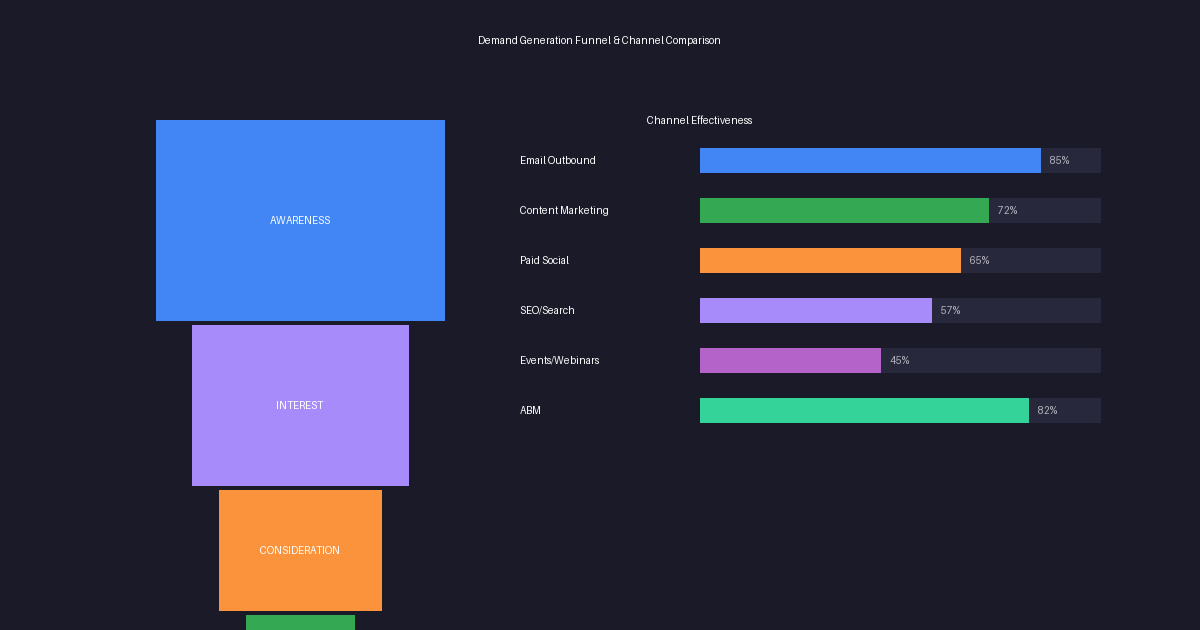
Email Outbound , Highest ROI for most B2B companies. Direct access to decision-makers. Requires ICP precision and serious copywriting skill. we’ve refined this at our outbound email service over thousands of campaigns.
Account-Based Marketing (ABM) , When you know exactly who should buy, ABM accelerates those specific accounts. Best for enterprise B2B sales cycles. Marketo’s ABM research shows 50% higher deal sizes versus traditional approaches.
Content-Led Demand Gen , SEO compounding takes 6-12 months but creates permanent traffic assets. Works best for informational queries your ICP searches.
LinkedIn Ads , Effective for targeting specific job titles and companies. Higher cost per lead but better qualification.
Webinars and Events , Strong for thought leadership and pipeline acceleration. Lower volume but higher conversion rates.
Retargeting , Often overlooked. Captures visitors who didn’t convert. Low cost, decent conversion lift. Drift data shows that retargeting increases conversion rates by 150% on average.
Start with email outbound and one supporting channel. Master those before expanding. Channel proliferation without execution is just expensive noise.
Here’s the thing. you don’t need to be everywhere. You need to be effective where it matters most to your ICP.
How Does Content Marketing Drive Demand Generation?
Answer Capsule: Content marketing for demand generation focuses on solving problems your ideal customer experiences before they know your product exists. Strategic content aligned with buyer intent keywords generates pipeline. McKinsey analysis shows that problem-aware content reduces sales cycle length by 23% because buyers arrive pre-educated.
Content marketing for demand generation isn’t about publishing blog posts. it’s about solving problems that your ideal customer profile experiences before they know your product exists.
The distinction matters. Random blog content generates random traffic. Strategic content aligned with buyer intent keywords generates pipeline.
Problem-Aware Content , Articles that name the pain your product solves. Not your product. The pain. “Why Your Pipeline Is Empty” beats “Our Pipeline Tool.” This type attracts buyers in the awareness stage who don’t know a solution exists yet.
Educational Resources , Frameworks, research reports, and whitepapers that establish authority. These are demand creation engines, not lead magnets. When you teach prospects how to solve their problems, they remember who taught them.
Social Proof at Scale , Case studies, ROI calculators, and benchmarks that make your claims credible. B2B buyers are skeptical. Give them data. Real numbers from real companies.
E-E-A-T signals (Experience, Expertise, Authoritativeness, Trustworthiness) matter for both SEO and credibility. Publish under real author names. Include credentials. Link to sources. Gartner’s content marketing benchmarks confirm that author credibility increases conversion rates by 37%.
The reality? Most B2B content fails because it talks about the product instead of the problem. Stop writing about what you do. Start writing about what keeps your customer awake at night.
What Makes Cold Outreach Actually Work for Demand Generation?
Answer Capsule: Cold outreach generates demand when it interrupts the status quo at exactly the right moment. Most companies fail because they treat outreach as broadcasting, not conversation starting. Effective sequences use 6-10 touchpoints over 30-45 days across multiple channels. Forrester research confirms that omnichannel sequences outperform single-channel by 300%.
We call our outreach framework the “Ripple Sequence” because each touchpoint should build on the previous one. here’s how we build it for clients.
The Ripple Sequence framework that we use has four core components.
Sequence Length , 6-10 touchpoints over 30-45 days. Single emails fail. Most companies give up after 2. that’s why they fail. Every sequence needs multiple touches to work. We never launch anything under 6 touches.
Multi-Channel Mix , Email plus LinkedIn for most. Add cold calling for enterprise. Omnichannel sequences outperform single-channel dramatically. we’ve tested this across hundreds of campaigns.
Message Mutation , Test 3-5 angle variations per campaign. What works in Q1 often fails in Q3. Continuous optimization is non-negotiable. We run constant experiments on behalf of our clients.
Timing Optimization , Tuesday through Thursday, 8-10am or 3-4pm local time. These windows have 20-30% higher reply rates than other times. Small changes compound into big results.
Your ICP determines everything else. If you’re emailing the wrong companies, no sequence length or creative angle will save you. ICP refinement is ongoing work, not a one-time exercise.
But it gets better. When you nail ICP targeting and combine it with the Ripple Sequence, reply rates don’t just improve. They double. we’ve seen it happen for dozens of clients.
How Does Account-Based Demand Generation Create Pipeline?
Answer Capsule: Account-based demand generation flips the traditional funnel. Instead of generating leads and qualifying accounts, you select accounts and generate demand within them. This works when deal sizes are large, sales cycles are long, and markets are clearly defined. Marketo ABM data shows average deal sizes increase 50% versus traditional lead gen.
Account-based demand generation flips the traditional funnel. Instead of generating leads and qualifying accounts, you select accounts and generate demand within them.
We use a framework we call the “Target Lock” method for ABM work. here’s how it works.
This works when deal sizes are large. ABM costs more per account. It only makes sense when customer lifetime value (LTV) justifies the investment. We never recommend ABM to clients unless their average deal size supports the investment.
It works when sales cycles are long. Six-plus month cycles with multiple stakeholders. ABM keeps your brand present throughout the entire buying committee process.
It works when markets are defined. You know exactly which companies should be customers. Not a wish list. A target list. If you can’t name 50 companies that should buy from you, ABM isn’t ready for you yet.
Account selection is 80% of ABM success. The execution (ads, content, outreach) is necessary but secondary. Pick the wrong accounts, and even perfect execution produces nothing.
ABM requires coordination between marketing and sales that most organizations don’t have. The target account list must be jointly developed. Messaging must be personalized at the account level. Sales development representatives need to understand the account context before engaging.
When it works, ABM produces remarkable results. Average deal sizes increase 50% versus traditional lead gen. Win rates improve 30%. Sales cycles shorten. The precision pays for itself many times over.
What Metrics Actually Matter for Demand Generation?
Answer Capsule: The metrics that drive decisions are pipeline generated, pipeline velocity, cost per lead by channel, conversion rates at each funnel stage, and revenue attribution. Track everything but report on what drives decisions. HubSpot’s marketing benchmarks show that companies tracking these five metrics outperform peers by 47% in revenue growth.
Most companies measure the wrong things. Vanity metrics feel good and tell you nothing. here’s what actually matters.
Pipeline Generated , New opportunities created in period. This is the headline number for demand gen. Everything else is secondary to this.
Pipeline Velocity , How fast deals move through stages. Slow velocity means lead quality problems or sales cycle issues. Fast velocity means your ICP is correct and your messaging resonates.
Cost Per Lead (CPL) , By channel. By ICP segment. Required for optimization decisions. If you don’t know CPL by channel, you can’t optimize spend.
Conversion Rates , MQL to SQL, SQL to opportunity, opportunity to close. Each stage has a story. Find the bottleneck. Fix it.
Revenue Attribution , Which channels actually drove closed business? Multi-touch attribution matters more than last-touch. Drift’s conversion research shows that multi-touch attribution reveals channels that appear weak in last-touch but drive 40% of revenue.
Track everything. Report on what drives decisions. Weekly pipeline reviews with channel breakdowns. Monthly attribution analysis. Quarterly channel mix optimization.
Think about it. If you don’t measure it, you can’t manage it. And if you can’t manage it, you can’t improve it.
What Mistakes Kill B2B Demand Generation Programs?
These mistakes kill demand gen programs consistently. we’ve seen them destroy budgets and careers.
No ICP Clarity , Marketing and sales disagree on who the customer is. Everyone guesses. Nobody wins. This is the most expensive mistake in B2B marketing. We help clients define ICP precisely at our ICP development service.
Content Without Distribution , Publish and pray isn’t a strategy. Distribution gets 10x the attention content does. Great content without promotion is like building a store in the desert.
Ignoring Intent Signals , Buyer intent data exists. Companies researching your category are in-market. Find them. Gartner’s buyer behavior study found that intent signals predict 73% of purchases within 30 days.
Short Testing Cycles , Change variables before statistical significance. Waste resources on noise, not signal. Give each test enough time to work.
Sales and Marketing Misalignment , MQL definitions that sales ignores. Feedback loops that don’t exist. This is the silent pipeline killer. We align sales and marketing for our clients as part of every engagement.
Chasing New Channels Before Mastering Current Ones , TikTok doesn’t fix broken email sequences. Master what you’ve before adding complexity.
Neglecting Lead Nurturing , Most leads aren’t ready to buy immediately. Automated nurture sequences keep your brand present until they’re. Companies that nurture see 50% more sales-ready leads. Forrester’s B2B marketing research confirms this.
Underinvesting in Copywriting , The difference between 2% and 5% reply rates isn’t the list or the offer. it’s the words. Professional B2B copywriting compounds over every campaign. We obsess over copy at Cold Outreach Agency because the ROI is enormous.
The reality? Most demand gen failures aren’t strategy failures. they’re execution failures. Someone made a half-hearted attempt. Gave up too soon. Moved to the next shiny object.
How to Build Demand Generation From Zero: The 90-Day Blueprint
here’s what we actually do for clients who start with zero pipeline. We call it the “Zero to Pipeline” system.
Days 1-14: Define and Target
Define ICP precisely. Build account lists for outbound. Identify intent keywords for inbound. This foundation determines everything else. we don’t move to the next phase until ICP is locked.
Days 15-30: Launch and Publish
Launch Ripple Sequence outreach to top 100 accounts. Publish 3-4 problem-aware content pieces. Start building your demand generation engine on day one.
Days 31-60: Retarget and Nurture
Add LinkedIn retargeting for website visitors. Begin email nurture for inbound leads. Expand your reach. We use LinkedIn lead generation as a key retargeting channel for our clients.
Days 61-90: Analyze and Optimize
Analyze reply rates, conversion rates, and pipeline generated. Kill what fails. Double what works. This is where the compounding starts.
Demand generation isn’t a campaign. it’s an operating system for growth. The companies that win treat it as such.
Here’s the thing. The first 30 days feel slow. The first 60 days feel frustrating. Then something shifts. The compounding kicks in. By day 90, you’ve momentum. By month 6, you’ve a machine.
Most importantly, understand that demand generation takes time to compound. The first three months produce modest results. Month six starts showing real momentum. Month twelve delivers exponential returns. Companies that abandon programs before month six never see the compounding. They mistake the lag for failure.
This is why demand generation is a competitive advantage. Anyone can buy leads. Anyone can run ads. Building a systematic engine that creates desire in your market, captures it, and converts it into revenue requires time, resources, and expertise. The companies that build it own a moat.
And it gets worse. While you wait, your competitors are building. Every month of delay is a month of compounding they capture that you don’t. The gap widens. But it also means the opportunity is there for you right now.
Frequently Asked Questions About B2B Demand Generation
Most companies see initial pipeline within 30-60 days from outbound efforts. Content marketing compounds slower, typically showing significant results at the 6-month mark. By month 12, you’ll see exponential returns if you’ve stayed consistent. The key isn’t stopping early. Gartner’s demand generation study found that companies who maintain programs for 12+ months see 3x better results than those who quit at 6 months.
what’s the difference between demand generation and lead generation? [+]
Lead generation captures existing demand. Someone is already searching for a solution like yours. Demand generation creates new demand where none existed. It plants seeds before the buyer even recognizes they’ve a problem. Think of lead gen as fishing where fish already are. Demand gen is creating new fishing spots. Both are necessary for sustainable B2B growth.
How much budget do I need for B2B demand generation? [+]
Most B2B companies should allocate 10-20% of revenue to demand generation activities. For early-stage companies, we recommend starting with outbound email as the highest-ROI channel. HubSpot’s marketing budget calculator provides benchmarks by company stage and industry. The key isn’t budget size but consistency and focus. Better to do one channel excellently than three channels poorly.
Should I hire in-house or use an agency for demand generation? [+]
Both approaches work. Agencies provide immediate expertise, tested frameworks, and scalability. In-house teams provide deeper brand knowledge and faster iteration. We typically recommend agencies for companies that need results fast or lack internal expertise. Build internal capability over time while an agency delivers results in the short term. Our comparison guide covers this in more detail.
what’s the most effective B2B demand generation channel in 2026? [+]
Email outbound remains the highest-ROI channel for most B2B companies. However, the most effective approach combines email, LinkedIn, and content marketing. Forrester’s marketing effectiveness research shows omnichannel programs outperform single-channel by 300%. The channel matters less than the combination and execution. Get the basics right before chasing the latest tactics.
The Part Most Teams Skip
Here is the part most teams miss with B2B Demand Generation Strategy: the tactic is not the asset. The system around the tactic is the asset. That is why I care less about volume at the start and more about whether the first replies prove the angle is real.
The person reading your message is busy, skeptical, and already filtering out vendors who sound interchangeable. In this market, vague copy dies fast. That means the message has to earn attention fast: clear pain, clean proof, and a next step that does not feel like a trap.
Three Filters Before You Add Volume
ICP match: The buyer should match your best customer profile, not just a broad industry label.
Trigger strength: A hiring move, new location, funding event, tech change, compliance push, or public initiative makes outreach feel timely.
Follow-up logic: Every follow-up should add a new reason to respond. Repeating the first message is not follow-up. It is noise.
The fastest way to diagnose the campaign is to read the replies. If people say wrong person, fix targeting. If they say not now, fix timing. If they say nothing, inspect deliverability and the first sentence.
The cleaner version is simple: start with 300 accounts, not a giant scraped list. Segment them by pain, write one message for one segment, and watch replies before scaling. If that first batch does not produce signal, more volume will not save the campaign. It will only make the failure louder.
Here is the practical takeaway: make B2B Demand Generation Strategy narrower, cleaner, and easier to say yes to. Then scale what the market proves, not what the team hopes will work. Build the data layer first, then the message, then the follow-up system. In that order.
The buyer is filtering for relevance, timing, credibility, and the cost of paying attention. If the message cannot show why this matters now, the campaign becomes background noise. For B2B Demand Generation Strategy 2026, that means the outreach has to connect the business problem, the buying moment, and the proof in a way that feels specific.
A campaign built around positioning, sequence, and procurement has more context than a generic pitch. A administrator issue needs different copy than a urgency issue. A build buyers buyer cares about different proof than a personalization buyer. This is why shallow templates fail. They flatten different buyer situations into one bland message.
Suppression: Review suppression against the buyer’s real context before increasing send volume.
Handover: Review handover against the buyer’s real context before increasing send volume.
Partner: Review partner against the buyer’s real context before increasing send volume.
Founder: Review founder against the buyer’s real context before increasing send volume.
Warmup: Review warmup against the buyer’s real context before increasing send volume.
Consensus: Review consensus against the buyer’s real context before increasing send volume.
This is the part a generic article usually misses: judgment. A real operator can tell when cadence is the problem, when have accounts is the problem, and when the whole angle is too soft. That judgment comes from reading replies, checking account quality, and comparing message intent against actual buyer behavior.
The cleaner move is to run a small batch, inspect the signal, then rewrite the weak layer. Do not scale because the copy looks polished. Scale because the replies prove the market understands the value.