

The Bottom Line: Cold email reply rate optimization is the highest-use activity in outbound sales. By fixing just five variables (subject lines, opening lines, personalization depth, timing, and follow-up sequences), we consistently move campaigns from 3% to 15%+ reply rates. This translates to 5x more conversations, 5x more meetings, and exponential pipeline growth. The playbook below shows exactly how we do it.
what’s a Good Cold Email Reply Rate in 2026?
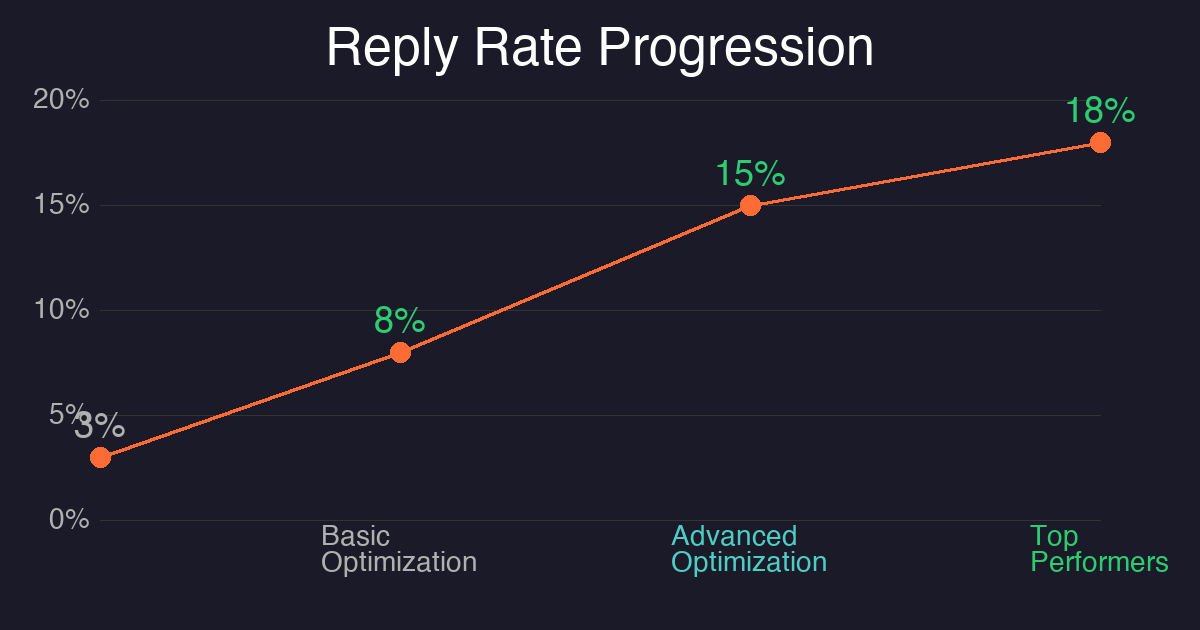
How Do You Diagnose Your Reply Rate Problem?
- Below 3% reply rate , Your problem is targeting or deliverability. Fix the list before you touch anything else.
- 3-7% reply rate , Your subject lines and opening lines are weak. This is a messaging optimization problem.
- 7-12% reply rate , you’re close. Refine your value proposition and follow-up sequence.
- 12%+ reply rate , you’re in the top 10% of cold email marketers. Scale what’s working.
What Makes Subject Lines Actually Get Emails Opened?
- Personalization tokens , Insert their name, company, or a specific detail. “{}” performs 26% better than generic lines.
- Curiosity gaps , Open loops that create psychological tension. “Saw this about {}…” leaves them wanting more.
- Social proof , Reference mutual connections or shared experiences. “Mutual connection with {}” builds credibility instantly.
- Questions over statements , Questions engage the brain differently. “Is {} still using {}?” triggers a yes/no response loop.
- Numbers and specificity , “3 changes for {}” beats “ideas for you” every time. Specificity signals value.
How Should Your Email Opening Line Be Written?
- Pattern interrupts , “I know you’re probably tired of cold emails, so I’ll keep this short.” Acknowledging the noise makes you different.
- Specific observations , “I noticed {} just raised a Series B.” This shows you did your research before reaching out.
- Shared connections , “Your VP of Sales and I worked together at {}.” Warm introductions beat cold outreach.
- Specific problems , “The last 3 CFOs I talked to all had the same problem with {}.” Problem-aware openers resonate.
The Reply Rate Engine: Our 5-Pillar Framework for 15%+ Response Rates
Pillar 1: Targeting Precision
Pillar 2: Subject Line Optimization
Pillar 3: Personalization Depth
Pillar 4: Timing Optimization
Pillar 5: Follow-Up Sequences
How Deep Should Your Email Personalization Go?
- Surface level , Name, company, job title. Baseline. Expected. Expected means ignored.
- Contextual level , Recent news, company updates, industry trends. Shows you did homework. 2-3x reply rate lift.
- Deep level , Specific challenges, mutual connections, custom insights. Shows you care. 5-10x reply rate lift in ideal targets.
When Is the Best Time to Send Cold Emails?
- Tuesday through Thursday , The sweet spot for most B2B audiences. Monday is recovery. Friday is countdown.
- 6-9 AM local time , First in the inbox when they start their day. Peak engagement for decision-makers.
- Avoid Monday mornings , Inbox overwhelm. they’re processing the weekend backlog.
- Test across time zones , If your ICP spans multiple regions, test sending at different times for each segment.
How Many Follow-Up Emails Should You Send?
- Day 1 , Initial email with primary value proposition.
- Day 3 , Follow-up with new angle or additional insight. Break the pattern.
- Day 7 , Third touch with social proof or case study snippet.
- Day 14 , Breakup email. “Did this reach you?” Sometimes this gets the most replies.
- Day 21 , Final email with clear unsubscribe option. Respect the no-response.
What Are the Industry Benchmarks for Cold Email Reply Rates?
- SaaS/Technology , 5-10% average. Highly competitive inboxes. Personalization is essential.
- Professional Services , 8-15% average. Decision-makers are more receptive to direct outreach.
- E-commerce/Retail , 3-7% average. Shorter sales cycles, but also more noise.
- Financial Services , 6-12% average. Heavy regulation, but high ticket sizes.
- Healthcare , 4-8% average. Long cycles, but highly qualified leads.
What Mistakes Kill Cold Email Reply Rates?
- Too long , Your email should be 50-100 words max. No one reads paragraphs in cold outreach. Short wins.
- Too many links , One link maximum. More screams “spam” to both algorithms and humans.
- Attachments , Never attach files in cold emails. This is the fastest way to spam filters.
- No clear ask , Tell them exactly what you want. “Would a 15-minute call this week work?” is better than vague “let me know if interested.”
- Weak preview text , Preview text is wasted real estate. Use it as a second subject line, not a sign-off.
How Does Psychology Drive Cold Email Responses?
Frequently Asked Questions About Cold Email Reply Rates
Ready to double your reply rate? Book a free strategy call with our team today. we’ve helped dozens of agencies and sales teams move from 3% to 15%+ reply rates using The Reply Rate Engine framework.
Browse more cold email strategies on our blog or download our free template library to start implementing today.
{
“@context”: “https://schema.org”,
“@type”: “FAQPage”,
“mainEntity”: [
{
“@type”: “Question”,
“name”: “what’s a good reply rate for cold email in 2026?”,
“acceptedAnswer”: {
“@type”: “Answer”,
“text”: “A good reply rate for cold email is between 8% and 15% for most B2B campaigns. Anything above 15% puts you in the top tier. Below 5% indicates problems with targeting, deliverability, or messaging. Focus on continuous improvement rather than benchmarking against averages.”
}
},
{
“@type”: “Question”,
“name”: “How can I double my cold email reply rate?”,
“acceptedAnswer”: {
“@type”: “Answer”,
“text”: “You can double your reply rate by optimizing five key variables: subject lines, opening lines, personalization depth, send timing, and follow-up sequences. Most campaigns are missing at least 2-3 of these elements. Fix the gaps and your reply rate will improve within 2-3 campaign cycles.”
}
},
{
“@type”: “Question”,
“name”: “Does personalization really affect reply rates?”,
“acceptedAnswer”: {
“@type”: “Answer”,
“text”: “Yes, personalization dramatically affects reply rates. Deep personalization (specific challenges, mutual connections, custom insights) generates 5-10x more replies than surface-level tokens like {}. The effort is worth it for high-value prospects. Our data shows personalized emails outperform generic ones across every industry.”
}
},
{
“@type”: “Question”,
“name”: “How many follow-up emails should I send?”,
“acceptedAnswer”: {
“@type”: “Answer”,
“text”: “Send at least 4-5 follow-up emails per sequence. Research shows that 80% of cold email replies come after the first follow-up. Most senders give up after one email. Persistence wins. But each follow-up must add value and feel like a new email, not a reminder.”
}
},
{
“@type”: “Question”,
“name”: “what’s the best time to send cold outreach emails?”,
“acceptedAnswer”: {
“@type”: “Answer”,
“text”: “The best time to send cold emails is Tuesday through Thursday between 6-9 AM local time for your prospect. This timing gets your message first in the inbox when decision-makers start their day. Test across your specific segments to find your optimal window. Avoid Monday mornings and Friday afternoons.”
}
}
]
}
Research worth checking
The Pipeline Reality Check
Cold Email Reply Rate Optimization looks simple from the outside. In practice, the money is made in the boring parts: list quality, timing, proof, follow-up, and clean measurement. That is why I care less about volume at the start and more about whether the first replies prove the angle is real.
Your buyer does not reward clever wording. They reward relevance. Show them that you understand the pressure on their desk before you ask for time. The first job of outreach is to prove relevance before persuasion. Name the business problem, make the next step useful, and remove every sentence that sounds like a brochure.
The Small-Batch Validation Rule
- Account quality: Would this company still be attractive if it never replied this month? If not, it probably should not be in the campaign.
- Message angle: Can the opener point to a real business condition, not a lazy compliment? Specificity is what makes the email feel earned.
- Next step: Is the CTA small enough to say yes to? A useful reply is often a better first win than forcing a meeting immediately.
Most campaigns do not need a cleverer subject line first. They need cleaner segmentation, sharper proof, and a follow-up sequence that sounds like a person is paying attention.
The cleaner version is simple: start with 200 accounts, not a giant scraped list. Segment them by pain, write one message for one segment, and watch replies before scaling. If that first batch does not produce signal, more volume will not save the campaign. It will only make the failure louder.
Here is the practical takeaway: make Cold Email Reply Rate Optimization narrower, cleaner, and easier to say yes to. Then scale what the market proves, not what the team hopes will work. Build the data layer first, then the message, then the follow-up system. In that order.
What I Would Inspect Manually
If the message cannot show why this matters now, the campaign becomes background noise. Look at Cold Email Reply Rate Optimization 2026 through the buyer’s day, not through a marketer’s checklist. For Cold Email Reply Rate Optimization 2026, that means the outreach has to connect the business problem, the buying moment, and the proof in a way that feels specific.
A authentication bottleneck should not be handled with the same CTA as a reputation bottleneck. A campaign built around response accounts, rate buyers, and suppression has more context than a generic pitch. A owner issue needs different copy than a rates issue. This is why shallow templates fail. They flatten different buyer situations into one bland message.
- Workflow: Review workflow against the buyer’s real context before increasing send volume.
- Playbook Pipeline: Review playbook pipeline against the buyer’s real context before increasing send volume.
- Rate: Review rate against the buyer’s real context before increasing send volume.
- Cadence: Review cadence against the buyer’s real context before increasing send volume.
- Inbox: Review inbox against the buyer’s real context before increasing send volume.
- Reply: Review reply against the buyer’s real context before increasing send volume.
This is the part a generic article usually misses: judgment. A real operator can tell when routing is the problem, when enrichment is the problem, and when the whole angle is too soft. That judgment comes from reading replies, checking account quality, and comparing message intent against actual buyer behavior.
The cleaner move is to run a small batch, inspect the signal, then rewrite the weak layer. Do not scale because the copy looks polished. Scale because the replies prove the market understands the value.
