The Bottom Line
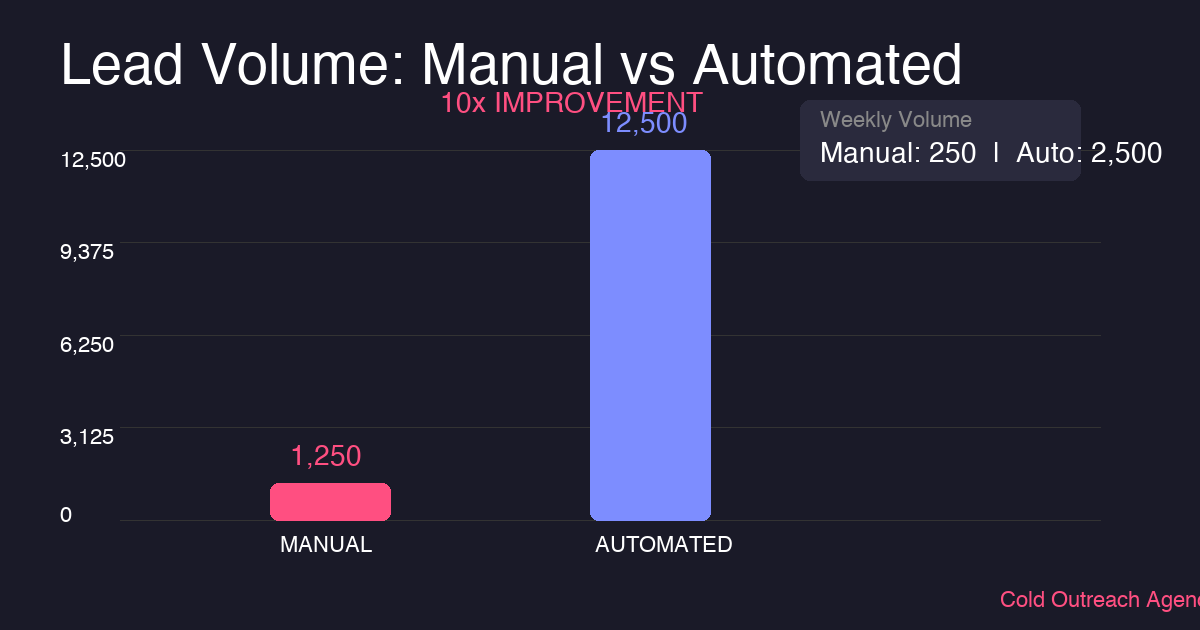
B2B lead generation automation lets your team reach 10x more prospects without hiring. We automate data enrichment, multi-channel outreach, and follow-ups so your reps spend time closing deals, not copying spreadsheets. The average team using our automation services sees 40-60% lower cost-per-lead within 90 days. here’s exactly how we do it.
what’s B2B Lead Generation Automation?
Why Does 80% of B2B Automation Fail to Deliver ROI?
Automation vs. Manual Outreach: The Real Tradeoffs
What Data Points Should You Automate First?
- Company firmographics , Employee count, revenue range, industry classification, headquarters location, founding year
- Technographic data , Software tools and platforms the prospect company uses, including marketing automation, CRM, and communication stack
- Intent signals , Content consumption patterns, competitor mentions, and job posting trends indicating buying readiness
- Contact verification , Email deliverability checks, role-based email identification, and LinkedIn profile validation
- Funding and news events , Recent investments, leadership changes, and expansion announcements that create buying windows
How Do You Build Multi-Channel Sequences That Actually Convert?
- Email sequences , 5-7 touchpoints over 3-4 weeks with varied subject lines, message angles, and sending times. Space touches 2-3 days apart to avoid looking robotic.
- LinkedIn outreach , Connection requests with personalized notes referencing mutual connections or content, follow-up messages after connecting, and engagement sequences on their posts
- Twitter/X engagement , Reply automation for prospects mentioning relevant keywords, sharing their content with genuine commentary, and direct messages triggered by engagement
- Voicemail drops , Pre-recorded messages for cold calling efficiency that leave voicemails without requiring live conversation time
Why Are 80% of Leads Lost After the First Follow-Up Failure?
- Opened but no reply , Wait 3 days, change subject line, send from different address
- Clicked link , Trigger high-priority follow-up within 2 hours while intent is hot
- Meeting booked then cancelled , Offer alternative times immediately, reference the original pain point
- Out of office , Pause sequence, resume on return date + 1 day
What CRM Automations Actually Move the Needle?
- Lead scoring , Assign points for engagement level, demographic fit, and intent signals. Automatically route high-score leads to sales. Salesforce research shows that teams using automated lead scoring see 77% better conversion rates.
- Task creation , When a lead replies or books a meeting, create a follow-up task assigned to the correct rep instantly.
- Pipeline stage updates , Move leads through stages based on automated actions: reply opens pipeline, demo scheduled advances to qualified.
- Territory assignment , Auto-route new leads to reps based on geography, industry, or company size.
what’s the Minimum Viable Automation Stack for 2026?
- LinkedIn automation , Phantombuster, Expandi, or Lemlist for scalable social selling. These tools handle connection requests, follow-up messages, and profile engagement at scale.
- Email sequencing , Smartlead, Lemlist, or Instantly for multi-account outreach at scale. Choose platforms with warmup features and rotate sending accounts to protect deliverability.
- Data enrichment , Apollo, Clearbit, or ZoomInfo for complete prospect profiles. These aggregate firmographic, technographic, and contact data from dozens of sources.
- CRM integration , HubSpot, Salesforce, or Pipedrive as your automation hub. Your CRM is the brain that connects all other tools and maintains lead history.
- Warm outreach , Warmbox or Lemlist warmup to maintain sender reputation. These simulate natural email activity to build domain authority before sending campaigns.
- Email verification , Neverbounce, ZeroBounce, or Hunter for validating emails before sending. Bad data costs money and damages deliverability.
Which Metrics Prove Your Automation Is Working?
What Automation Mistakes Destroy ROI Fastest?
- Over-automating , Automating personalized conversations feels robotic. Reserve automation for initial outreach and systematic follow-ups.
- Bad data in, bad results out , Feeding unverified emails into automated sequences tanks deliverability. Invest in data quality before volume.
- Ignoring spam complaints , Automated volume triggers spam filters and complaints. Warm up accounts gradually and monitor complaint rates.
- No suppression list management , Automatically unsubscribe bounces, complaints, and existing customers. Send to them once and destroy trust.
- Setting and forgetting , Automation requires weekly review. Monitor metrics, A/B test subject lines, and adjust based on response patterns.
Frequently Asked Questions
How long until I see results from automation?
First replies typically appear within 2-3 weeks of launching sequences. Meaningful pipeline impact shows within 60-90 days. The lag exists because B2B sales cycles average 3-6 months. you’re building momentum, not chasing instant wins. we’ve seen clients book their first demo from automated outreach within 18 days. don’t expect miracles overnight.
Will automated outreach hurt my sender reputation?
Only if you do it wrong. Rapid volume spikes, unverified emails, and ignoring complaint rates damages reputation. The fix is gradual warmup, email verification before sending, and monitoring deliverability weekly. Done correctly, automation improves reputation because engaged recipients signal legitimacy to inbox providers. You shouldn’t worry if you do it right.
What can’t be automated in B2B sales?
Discovery conversations, complex negotiations, technical demonstrations, objection handling that requires deep product knowledge, and relationship building with enterprise stakeholders. Automation handles top-of-funnel work. Human expertise closes deals. The combination beats either approach alone. you’ll always need humans for the complex stuff.
How many leads do I need to start automating?
You need at least 500-1,000 qualified prospects to justify most automation platforms. Below that, manual outreach with strong personalization outperforms generic automation. Once you’ve a repeatable ideal customer profile and enough pipeline volume to test sequences, automation amplifies what’s already working. you’ll not see results if your list is too small.
Ready to scale your lead generation without scaling headcount? Book a free strategy call today. we’ve helped 40+ B2B companies automate their outreach and cut cost-per-lead by an average of 52%.
{
“@context”: “https://schema.org”,
“@type”: “FAQPage”,
“mainEntity”: [
{
“@type”: “Question”,
“name”: “How much does B2B lead generation automation cost?”,
“acceptedAnswer”: {
“@type”: “Answer”,
“text”: “Entry-level automation stacks start around $200-500/month for tools like Apollo, Smartlead, and Expandi. Enterprise stacks with ZoomInfo, Salesforce, and dedicated warmup tools run $2,000-5,000/month. Most small teams can achieve strong results with a $300-500/month investment in tools plus implementation time or agency support.”
}
},
{
“@type”: “Question”,
“name”: “How long until I see results from automation?”,
“acceptedAnswer”: {
“@type”: “Answer”,
“text”: “First replies typically appear within 2-3 weeks of launching sequences. Meaningful pipeline impact shows within 60-90 days. The lag exists because B2B sales cycles average 3-6 months. you’re building momentum, not chasing instant wins. we’ve seen clients book their first demo from automated outreach within 18 days.”
}
},
{
“@type”: “Question”,
“name”: “Will automated outreach hurt my sender reputation?”,
“acceptedAnswer”: {
“@type”: “Answer”,
“text”: “Only if you do it wrong. Rapid volume spikes, unverified emails, and ignoring complaint rates damages reputation. The fix is gradual warmup, email verification before sending, and monitoring deliverability weekly. Done correctly, automation improves reputation because engaged recipients signal legitimacy to inbox providers.”
}
},
{
“@type”: “Question”,
“name”: “What can’t be automated in B2B sales?”,
“acceptedAnswer”: {
“@type”: “Answer”,
“text”: “Discovery conversations, complex negotiations, technical demonstrations, objection handling that requires deep product knowledge, and relationship building with enterprise stakeholders. Automation handles top-of-funnel work. Human expertise closes deals. The combination beats either approach alone.”
}
},
{
“@type”: “Question”,
“name”: “How many leads do I need to start automating?”,
“acceptedAnswer”: {
“@type”: “Answer”,
“text”: “You need at least 500-1,000 qualified prospects to justify most automation platforms. Below that, manual outreach with strong personalization outperforms generic automation. Once you’ve a repeatable ideal customer profile and enough pipeline volume to test sequences, automation amplifies what’s already working.”
}
}
]
}
Frequently Asked Questions
what’s the fastest way to use B2B Lead Generation Automation 2026: Scale Outreach Without Scaling Headcount without burning the market?
How many prospects should I contact for B2B Lead Generation Automation 2026: Scale Outreach Without Scaling Headcount?
Why do most campaigns around B2B Lead Generation Automation 2026: Scale Outreach Without Scaling Headcount fail?
Should I use email only for B2B Lead Generation Automation 2026: Scale Outreach Without Scaling Headcount?
When should I hire help for B2B Lead Generation Automation 2026: Scale Outreach Without Scaling Headcount?
The Clean Execution Plan
I would not scale B2B Lead Generation Automation until the first small batch proves three things: the market is right, the message lands, and the follow-up creates conversations. If the list is weak, the message is vague, and the follow-up is random, even a smart idea turns into noise.
A serious B2B buyer has one silent question: why should I care right now? If the campaign cannot answer that quickly, the rest of the copy does not matter. The first job of outreach is to prove relevance before persuasion. Name the business problem, make the next step useful, and remove every sentence that sounds like a brochure.
The Small-Batch Validation Rule
- Data: Are the names, roles, domains, and company signals verified? Bad data turns good strategy into inbox waste.
- Relevance: Does the message connect to a problem the buyer already cares about? Education is expensive. Recognition is faster.
- Measurement: Can we tell whether silence came from targeting, copy, timing, or deliverability? If not, we cannot improve the campaign intelligently.
Most campaigns do not need a cleverer subject line first. They need cleaner segmentation, sharper proof, and a follow-up sequence that sounds like a person is paying attention.
The cleaner version is simple: start with 250 accounts, not a giant scraped list. Segment them by pain, write one message for one segment, and watch replies before scaling. If that first batch does not produce signal, more volume will not save the campaign. It will only make the failure louder.
The bottom line: B2B Lead Generation Automation works when it is specific, measured, and tied to a real buying moment. It fails when it sounds like every other vendor trying to sound clever. Build the data layer first, then the message, then the follow-up system. In that order.
The Practical Operator Pass
Look at B2B Lead Generation Automation 2026 through the buyer’s day, not through a marketer’s checklist. The strongest campaigns feel researched because the language names a specific condition in the buyer’s world. For B2B Lead Generation Automation 2026, that means the outreach has to connect the business problem, the buying moment, and the proof in a way that feels specific.
A campaign built around throttling, warmup, and revenue has more context than a generic pitch. A scaling accounts bottleneck should not be handled with the same CTA as a procurement bottleneck. A domain buyer cares about different proof than a manager buyer. This is why shallow templates fail. They flatten different buyer situations into one bland message.
- Owner: Review owner against the buyer’s real context before increasing send volume.
- Margin: Review margin against the buyer’s real context before increasing send volume.
- Objection: Review objection against the buyer’s real context before increasing send volume.
- Budget: Review budget against the buyer’s real context before increasing send volume.
- Coverage: Review coverage against the buyer’s real context before increasing send volume.
- Bounce: Review bounce against the buyer’s real context before increasing send volume.
This is the part a generic article usually misses: judgment. A real operator can tell when suppression is the problem, when analyst is the problem, and when the whole angle is too soft. That judgment comes from reading replies, checking account quality, and comparing message intent against actual buyer behavior.
The cleaner move is to run a small batch, inspect the signal, then rewrite the weak layer. Do not scale because the copy looks polished. Scale because the replies prove the market understands the value.