Lead Qualification Framework B2B: How to Stop Booking Meetings That Go Nowhere in 2026
Why Do Most B2B Meetings End in Nothing?
The BANT Framework, Modernized for 2026
Budget: Do they’ve Money to Spend?
Authority: Who Actually Decides?
Need: Is There a Real Problem Worth Solving?
Timeline: When Do They Actually Buy?
What Other B2B Qualification Frameworks Should You Know?
what’s CHAMP and When Should You Use It?
what’s MEDDIC and Why Do Enterprise Teams Love It?
How Does ANUM Simplify Qualification?
what’s GPCT and When Did Salesforce Create It?
What Questions Should You Ask Every Lead?
- Budget opener: “What did you budget for this type of initiative last year?”
- Authority probe: “Who else is involved in this decision?”
- Need validator: “what’s the cost of inaction?”
- Timeline stretcher: “what’s driving your timeline?”
- Metric capture: “What does success look like in numbers?”
- Pain quantification: “How much is this problem costing you annually?”
- Competitor awareness: “What solutions have you looked at?”
- Commitment test: “If we can demonstrate X, would you be ready to move forward?”
When Should You Walk Away from a Lead?
- No documented pain: they can’t describe a specific problem your solution solves.
- No decision-making power: you’re talking to an influencer who can’t close.
- No budget cycle alignment: Their fiscal year doesn’t support a purchase.
- Timeline is vague or infinite: “we’ll get to it eventually” isn’t a pipeline.
- Attitude problems: If they’re dismissive or treat you as a vendor first, disqualify.
- Red flag answers: “We talked to your competitor last week” or “We just need a quote.”
How Can You Automate Lead Qualification at Scale?
How Does Lead Scoring Work for Qualification?
what’s Intent Data and Why Should You Use It?
How Can Chatbots Pre-Qualify Visitors on Your Website?
How Do You Qualify Leads in Cold Outbound Sequences?
What Metrics Should You Track to Measure Qualification Quality?
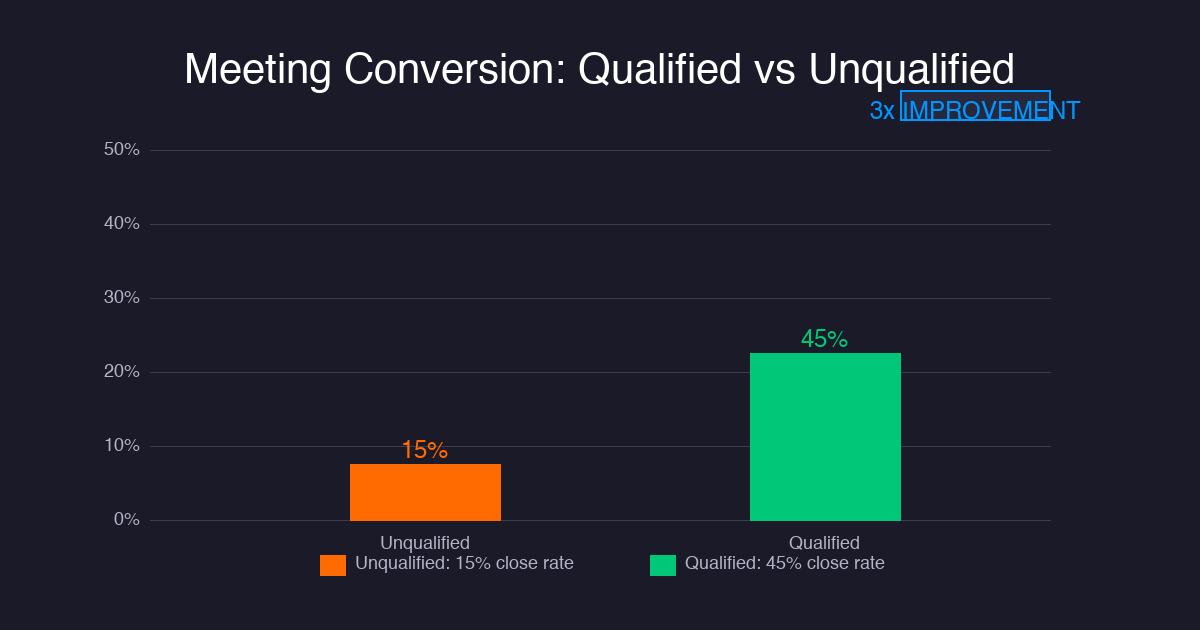
- Meeting-to-close rate: What percentage of booked meetings convert to customers? Below 20% means your qualification is weak.
- Lead-to-MQL conversion rate: Are you passing too many unqualified leads to marketing? Aim for 15-25%.
- Sales cycle length by qualification score: Higher-scored leads should close faster.
- Disqualification rate: Track why leads are disqualified. If the top reason is “no budget,” your targeting is off.
- Average deal size by qualification source: Some channels bring better leads. Double down on what works.
What Common Mistakes Destroy Lead Qualification Efforts?
- Qualifying too late: Waiting until the demo to discover they’ve no budget is a disaster.
- Accepting “we need to think about it”: This is a polite no. Push for specifics.
- Trusting self-reported timelines: Prospects underestimate how long their buying process takes.
- Ignoring organizational changes: A company in the middle of a merger isn’t buying anything.
- Letting champions oversell internally: Always validate directly with the economic buyer.
Frequently Asked Questions about B2B Lead Qualification
what’s the best lead qualification framework for B2B sales in 2026?
The best framework depends on your sales motion. For high-volume outbound, use ANUM or CHAMP. For complex enterprise deals, use MEDDIC. For consultative selling, use GPCT. We recommend testing each for 30 days to see which improves your close rate. BANT remains a solid foundation for any team starting out.
How do you qualify leads without being too pushy?
Frame qualification questions as discovery, not interrogation. Ask “What does success look like for you?” rather than “what’s your budget?” Most prospects appreciate working with salespeople who respect their time and focus only on qualified opportunities.
what’s a good lead-to-MQL conversion rate?
A healthy lead-to-MQL rate is between 15% and 25%. If you’re above 30%, your criteria are too loose. If you’re below 10%, your lead generation sources may be attracting the wrong audience. Monitor this metric monthly and adjust your ICP if needed.
Should you disqualify leads quickly or try to nurture them?
Both. Quick disqualification saves your team time on bad fits. However, leads that fail on timing or budget should enter a nurture sequence. Use marketing automation to keep them warm for 6-12 months. Our data shows that 30% of nurtured leads eventually convert.
How do you align sales and marketing on lead qualification?
Create a shared service level agreement (SLA) that defines what qualifies a lead. Include criteria like company size, budget indicators, job title, and engagement thresholds. Review the SLA quarterly and adjust based on data. Misalignment between sales and marketing is the number one cause of lead quality issues.
Ready to only book meetings that convert? Book a free strategy call today and we’ll show you how to build a qualification framework that actually works.
{
“@context”: “https://schema.org”,
“@type”: “FAQPage”,
“mainEntity”: [
{
“@type”: “Question”,
“name”: “what’s the best lead qualification framework for B2B sales in 2026?”,
“acceptedAnswer”: {
“@type”: “Answer”,
“text”: “The best framework depends on your sales motion. For high-volume outbound, use ANUM or CHAMP. For complex enterprise deals, use MEDDIC. For consultative selling, use GPCT. We recommend testing each for 30 days to see which improves your close rate. there’s no universal answer, but BANT remains a solid foundation for any team starting out.”
}
},
{
“@type”: “Question”,
“name”: “How do you qualify leads without being too pushy?”,
“acceptedAnswer”: {
“@type”: “Answer”,
“text”: “Qualification questions work best when framed as discovery, not interrogation. Ask open-ended questions like ‘What does success look like for you?’ rather than ‘what’s your budget?’ Frame qualification as helping them solve a problem, not filtering them out. Most prospects appreciate working with salespeople who respect their time and focus only on qualified opportunities.”
}
},
{
“@type”: “Question”,
“name”: “what’s a good lead-to-MQL conversion rate?”,
“acceptedAnswer”: {
“@type”: “Answer”,
“text”: “A healthy lead-to-MQL rate is between 15% and 25%. If you’re above 30%, your criteria are too loose and you’re wasting sales time. If you’re below 10%, your lead generation sources may be attracting the wrong audience. Monitor this metric monthly and adjust your ICP if needed.”
}
},
{
“@type”: “Question”,
“name”: “Should you disqualify leads quickly or try to nurture them?”,
“acceptedAnswer”: {
“@type”: “Answer”,
“text”: “Both. Quick disqualification saves your team time on bad fits. However, leads that fail on timing or budget should enter a nurture sequence. Use marketing automation to keep them warm for 6-12 months. Our data shows that 30% of nurtured leads eventually convert. The key is proper segmentation so you don’t waste resources on leads with zero buying intent.”
}
},
{
“@type”: “Question”,
“name”: “How do you align sales and marketing on lead qualification?”,
“acceptedAnswer”: {
“@type”: “Answer”,
“text”: “Create a shared service level agreement (SLA) that defines what qualifies a lead. Include criteria like company size, budget indicators, job title, and engagement thresholds. Both teams should agree on the definition before launching any campaigns. Review the SLA quarterly and adjust based on data. Misalignment between sales and marketing is the number one cause of lead quality issues.”
}
}
]
}
The System Behind the Tactic
The weak version of Lead Qualification Framework B2B is easy to spot. It talks to everyone, says nothing specific, and asks for a meeting before earning attention. That is why I care less about volume at the start and more about whether the first replies prove the angle is real.
The inbox is not a neutral place. It is a triage system. Buyers delete anything that feels like it was written for a spreadsheet, not a person. That means the message has to earn attention fast: clear pain, clean proof, and a next step that does not feel like a trap.
The Pre-Scale Test
- ICP match: The buyer should match your best customer profile, not just a broad industry label.
- Trigger strength: A hiring move, new location, funding event, tech change, compliance push, or public initiative makes outreach feel timely.
- Follow-up logic: Every follow-up should add a new reason to respond. Repeating the first message is not follow-up. It is noise.
Do not hide behind volume. Volume is a multiplier. It multiplies good strategy, and it multiplies bad strategy even faster.
The cleaner version is simple: start with 300 accounts, not a giant scraped list. Segment them by pain, write one message for one segment, and watch replies before scaling. If that first batch does not produce signal, more volume will not save the campaign. It will only make the failure louder.
Here is the practical takeaway: make Lead Qualification Framework B2B narrower, cleaner, and easier to say yes to. Then scale what the market proves, not what the team hopes will work. Build the data layer first, then the message, then the follow-up system. In that order.
Where This Campaign Needs Judgment
If the message cannot show why this matters now, the campaign becomes background noise. The strongest campaigns feel researched because the language names a specific condition in the buyer’s world. For Lead Qualification Framework B2B, that means the outreach has to connect the business problem, the buying moment, and the proof in a way that feels specific.
A friction issue needs different copy than a warmup issue. A pipeline bottleneck should not be handled with the same CTA as a context bottleneck. A campaign built around attribution, director, and segmentation has more context than a generic pitch. This is why shallow templates fail. They flatten different buyer situations into one bland message.
- Stakeholder: Review stakeholder against the buyer’s real context before increasing send volume.
- Category: Review category against the buyer’s real context before increasing send volume.
- Revenue: Review revenue against the buyer’s real context before increasing send volume.
- Signal: Review signal against the buyer’s real context before increasing send volume.
- Constraint: Review constraint against the buyer’s real context before increasing send volume.
- Nowhere Buyers: Review nowhere buyers against the buyer’s real context before increasing send volume.
This is the part a generic article usually misses: judgment. A real operator can tell when procurement is the problem, when stop accounts is the problem, and when the whole angle is too soft. That judgment comes from reading replies, checking account quality, and comparing message intent against actual buyer behavior.
The cleaner move is to run a small batch, inspect the signal, then rewrite the weak layer. Do not scale because the copy looks polished. Scale because the replies prove the market understands the value.