SDR Tools 2026: The Stack Top Performers Actually Use
coldoutreachagency.com
Contents
Your SDRs are using the wrong tools. here’s what separates top performers from everyone else.
The average SDR spends 65% of their day on manual tasks that could be automated. They jump between 5-7 different platforms. They copy and paste data from one system to another. They do everything except actually sell.
that’s a tool problem. Not a people problem.
In this guide, I’m breaking down the exact sales development representative tools that high-performing SDR teams use to hit quota consistently. No fluff. Just the stack that works.
BOTTOM LINE
The best SDR teams in 2026 combine five tool categories: prospecting, engagement, CRM, AI, and analytics. They prioritize integration over feature count, automate repetitive tasks, and measure everything. If your tool stack doesn’t connect smoothly, you’re wasting money and your team is working harder than they need to. Start with a clean CRM foundation, layer on engagement tools, then add AI capabilities.
What Tools Do SDRs Actually Need?
Before we dive into specific tools, let’s establish the categories that matter. An SDR tool stack isn’t about having the most software. it’s about having the right software working together.
Every high-performing SDR team needs tools across five categories:
Prospecting tools , Finding and qualifying leads
Engagement tools , Email, phone, and social outreach
CRM integration , Data management and pipeline visibility
AI-powered tools , Automation and intelligence
Analytics tools , Measuring performance and ROI
Missing one category creates a bottleneck. Your outreach is only as strong as your weakest integration point.
Think about it. You can have the best email templates in the world, but if your CRM data is garbage, you’ll never know which prospects actually engaged. You can have perfect call recordings, but if you can’t analyze them at scale, you’re just guessing at what works.
The SDR Power Stack framework we use with clients prioritizes integration over feature count. Each tool should enhance the others. When data flows automatically between systems, your team spends time selling instead of data entry.
What Are the Best SDR Prospecting Tools in 2026?
The best SDR prospecting tools in 2026 combine accurate contact data, real-time enrichment, and AI-powered prioritization. LinkedIn Sales Navigator, Apollo.io, and ZoomInfo remain the top choices for teams that need reliable data at scale.
Prospecting is where every sales cycle starts. If your SDRs spend hours manually searching LinkedIn or buying outdated lists from 2019, you’re bleeding efficiency before the first email ever gets sent.
LinkedIn Sales Navigator remains the gold standard for finding decision-makers. The advanced filters allow SDRs to target by industry, company size, job title, and tenure. The boolean search capabilities separate serious prospects from random connections.
Apollo.io and Hunter.io handle email discovery and verification. Apollo combines prospecting with engagement features, while Hunter excels at domain-level searches and email pattern detection. According to Forrester research on B2B sales tools, teams using combined prospecting and engagement platforms see 23% higher conversion rates.
ZoomInfo and Clearbit provide data enrichment that keeps your CRM accurate. Dirty data is a silent quota killer. When 25% of your leads have wrong titles or departed employees, your conversion rates collapse.
Top SDR teams run their prospecting tools daily. they’re not waiting for weekly imports. They build targeted lists for every campaign and update contact data in real-time as information changes.
The cost of bad data compounds fast. One incorrect email domain means bounces, which damages sender reputation. One outdated contact means wasted time on disconnected numbers. Data quality isn’t a one-time fix. It requires continuous verification and enrichment throughout the sales cycle.
But it gets better. The new generation of prospecting tools uses AI to predict which contacts are most likely to respond. They analyze engagement patterns across millions of data points to score leads before your SDR ever touches them.
How Do Top SDRs Use Engagement Tools to Book More Meetings?
Top SDRs use engagement tools to run coordinated multichannel sequences that combine email, phone, and LinkedIn in a single strategy. They treat every channel as part of one conversation, not separate touchpoints.
Prospecting gets you contacts. Engagement tools convert those contacts into conversations. This is where the average SDR wastes the most time.
Email sequencing platforms like Outreach, Salesloft, and HubSpot Sales Hub handle the heavy lifting of multi-touch campaigns. Gartner research shows that sales engagement platforms increase productivity by 30% when implemented correctly.
The key word is sequence, not blast. Each email should build on the last.
The best platforms include:
Automated follow-ups , Triggered by opens, clicks, or silence
Delivery optimization , Send time recommendations and warming features
Template performance tracking , A/B testing at scale
Phone prospecting still works when done correctly. Callio and Orum provide power dialing with local presence and voicemail drop capabilities. Your SDR should be making 50-80 calls per day, not 15.
LinkedIn outreach through tools like Phantombuster and MeetAlfred enables social selling at scale. Connection requests, follow-up messages, and profile views can all be automated while maintaining personalization.
The biggest mistake I see? SDRs treating email and LinkedIn as separate channels. The winners use multichannel sequences that combine LinkedIn touches with emails and calls in a single coordinated strategy.
Cold outreach at scale requires consistency. Your prospects should receive a coordinated experience across every touchpoint, not disjointed messages from different tools. The engagement layer connects your prospecting data with your outreach execution.
Video prospecting is emerging as a differentiator. Tools like Vidyard and Loom enable SDRs to record personalized video messages embedded in emails. Personalized video increases reply rates by 26% on average compared to text-only emails. Not everyone has adopted this yet, which makes it a competitive advantage for teams willing to experiment.
here’s the thing. Most SDRs send one email and move on. The top performers run 7-12 touch sequences across multiple channels before giving up. Salesforce research confirms that it takes an average of 8 touches to generate a qualified lead, yet most SDRs quit after 1 or 2.
Why Is CRM Integration Critical for SDR Success?
CRM integration is critical because it eliminates manual data entry and gives SDRs a complete view of every prospect. When engagement tools sync automatically with your CRM, your team works faster and makes fewer mistakes.
Customer Relationship Management isn’t optional. it’s the backbone of every scalable SDR operation. Without a proper CRM integration, your team is flying blind.
Salesforce dominates the enterprise space. Its customization depth and reporting capabilities are unmatched. HubSpot CRM wins on simplicity and cost for growing teams. Pipedrive appeals to teams that want visual pipeline management.
The platform matters less than the discipline. Every touchpoint must be logged. Every status change recorded. Every conversation timestamped.
here’s what proper CRM hygiene looks like for SDRs:
Log all emails automatically , Via email tracking or Gmail/Outlook integrations
Log all calls , With call notes and outcome classification
Update lead status , At every stage of the qualification process
When CRM data is clean, managers can identify patterns. Why are certain verticals converting better? Which email templates generate replies? Which SDRs need coaching? Data-driven sales management requires a disciplined data foundation.
Salesforce remains the industry standard for enterprise sales teams. Its AppExchange marketplace offers thousands of integrations. However, the learning curve is steep, and setup costs can be significant. Smaller teams often find HubSpot’s free CRM tier sufficient until they reach a certain scale.
The CRM migration process is often underestimated. Moving historical data, retraining staff, and reconfiguring integrations takes longer than expected. Plan for a 90-day transition period minimum. Rushing this phase creates data quality issues that haunt you for years.
And it gets worse. I’ve seen companies spend $200,000 on CRM implementations that get abandoned because nobody trained the team properly. The tool sits there collecting dust while everyone goes back to their spreadsheets.
What AI Tools Are Transforming SDR Workflows in 2026?
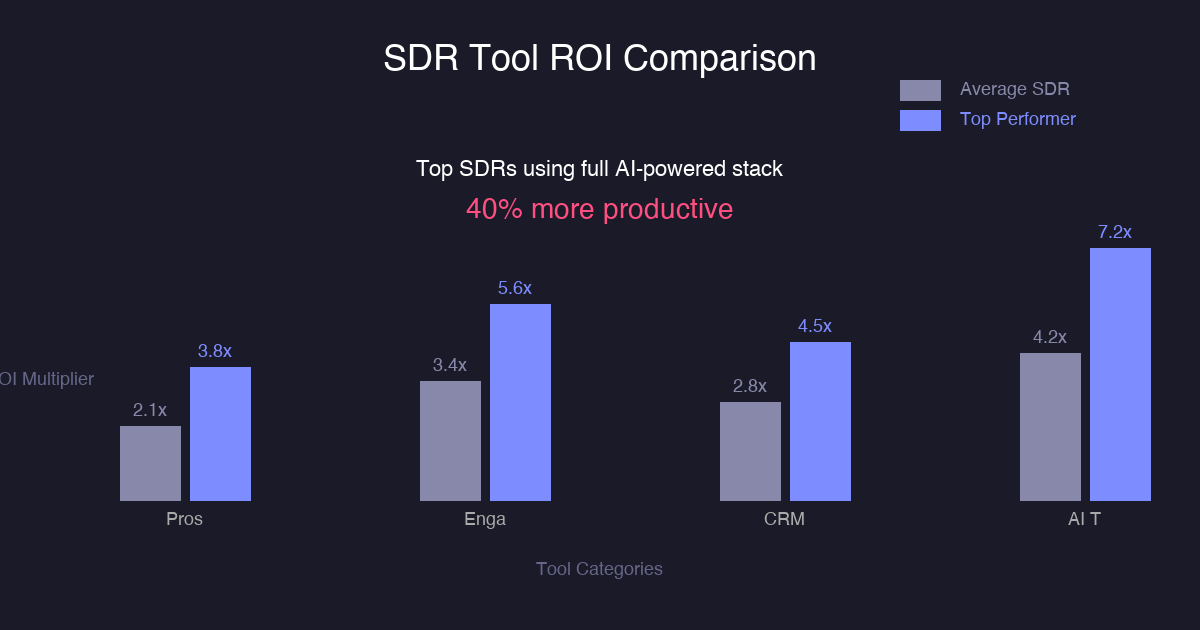
AI tools transforming SDR workflows in 2026 include AI writing assistants for personalization, predictive lead scoring, conversation intelligence, and AI-powered scheduling. Teams using these tools report 40% productivity gains.
Artificial intelligence is no longer optional for competitive SDR teams. it’s the multiplier that separates the best from the rest.
AI writing assistants like ChatGPT, Copy.ai, and Lavender accelerate email personalization. The key is using AI to generate first drafts, not final versions. Your SDR still needs to review and add genuine human touches.
Predictive lead scoring tools like 6sense, Terminus, and MadKudu identify which prospects are most likely to convert based on behavioral signals. Your SDRs stop wasting time on cold leads and focus on buyers who are actively researching. Gartner predicts that by 2026, 75% of B2B sales organizations will use AI-driven lead scoring.
Conversation intelligence platforms like Gong, Clari, and ExecVision analyze sales calls at scale. They identify winning talk tracks, flag objection handling issues, and surface coaching opportunities without managers having to listen to every call.
AI-powered scheduling tools eliminate the back-and-forth of meeting booking. Calendly, Chili Piper, and HubSpot Meetings let prospects book time instantly, reducing drop-off between accepted demos and scheduled meetings.
The SDR teams seeing 40% productivity gains aren’t replacing humans with AI. they’re using AI to handle the repetitive work so SDRs can focus on relationship building and complex deal navigation.
AI personalization at scale goes beyond inserting a first name. Modern tools can analyze a prospect’s website, recent social posts, press releases, and job changes to craft genuinely relevant messages. This level of personalization was impossible to scale manually.
Sentiment analysis tools help SDRs understand how prospects feel before they engage. By analyzing public communications, SDRs can gauge company health, identify pain points, and time their outreach for maximum impact.
The reality? Most SDR teams are still using AI wrong. They treat it like a magic button instead of a force multiplier. The best results come when AI handles research and drafting while humans provide strategic judgment and relationship skills.
How Do We Implement an SDR Tool Stack That Actually Works?
We implement SDR tool stacks by auditing current tools, prioritizing integration, documenting workflows, and training relentlessly. Most teams fail because they buy before they plan.
Having the right tools is only half the battle. Tool stack implementation determines whether your investment pays off or becomes expensive shelfware.
Most teams fail at implementation for three reasons: insufficient training, poor integration setup, and lack of process documentation.
Step 1: Audit your current state. Map out every tool your SDRs currently use. Identify redundancies. A common problem is paying for both Outreach and HubSpot Sales Hub when one could handle both email and calling.
Step 2: Prioritize integration depth. Your CRM must connect to your engagement platform. Your engagement platform must sync with your prospecting tools. Data silos kill productivity faster than missing tools.
Step 3: Document standard operating procedures. Every workflow should have a written playbook. When does an SDR log a call? How do they handle a bounced email? What triggers a lead escalation? Ambiguity creates inconsistency.
Step 4: Train relentlessly. New tools require new skills. Schedule monthly refreshers. Create video libraries for onboarding new SDRs. The best teams treat training as ongoing, not one-time.
Implementation isn’t a project with an end date. it’s a discipline that compounds over time. Your tool stack should evolve as your team matures and your market shifts.
The total cost of ownership extends beyond monthly subscriptions. Factor in implementation hours, training time, data migration costs, and ongoing admin overhead. A tool that looks cheap on paper may cost more than a premium solution that works out of the box.
Consider your tech debt. Legacy systems that don’t integrate with modern tools create manual workarounds. These workarounds accumulate until your team is spending 20% of their time on data reconciliation instead of selling.
Think about it. you’re paying how many salaries? And your team is spending one full day per week on manual data entry? that’s not a productivity problem. that’s a tool problem wearing a productivity costume.
What Metrics Should SDRs Track to Measure Tool ROI?
SDRs should track activities per day, response rates, meeting conversion rates, cost per meeting, and pipeline generated. These metrics show whether your tool investment is actually working.
you’re investing in tools. Now prove they’re working. Measuring tool ROI requires tracking the right metrics before and after implementation.
Key SDR metrics to track monthly:
Activities per day , Emails sent, calls made, LinkedIn touches
Response rate , Percentage of prospects who reply
Meeting conversion rate , Percentage of responses that become booked meetings
Cost per meeting , Tool costs divided by meetings booked
Pipeline generated , Total opportunity value created
Calculate the cost of your entire SDR tool stack. Include subscriptions, training hours, and implementation time. Then measure the output in qualified meetings and pipeline generated.
If your tool investment exceeds the revenue generated from the meetings those tools create, you’re either paying too much or using them wrong. Usually both.
Set up dashboards that update in real-time. Your managers should be able to see team performance at a glance without waiting for weekly reports. This enables course correction before small problems become quota misses.
Attribution modeling helps you understand which tools contribute most to pipeline. Multi-touch attribution assigns credit across the entire buyer journey. First-touch attribution credits the prospecting tool that started the conversation. Neither is perfect, but combining both gives you a complete picture.
Conduct quarterly tool stack reviews. Are all your tools still serving a purpose? Are there gaps you’ve ignored? Is new technology changing how your competitors operate? Standing still isn’t an option in B2B sales.
Do the math. If your SDR team generates $2M in pipeline per quarter and your tool stack costs $50,000 annually, you’re looking at a 10x ROI. But only if those tools are actually being used. If your SDRs are using 30% of your stack’s capabilities, you’re getting 3x ROI on your investment and leaving 7x on the table. that’s not a tool problem. that’s an adoption problem. Fix the adoption first.
What Does the Future Hold for SDR Tools?
The future of SDR tools involves deeper AI integration, real-time intent data, and fully automated personalization. The teams that adopt early will have a significant competitive advantage.
Where is this all heading? The trajectory is clear.
Real-time intent signals will replace static lead scoring. Instead of guessing who is interested based on website visits, SDRs will know exactly when a prospect is researching solutions. Forrester research on B2B buying trends shows that buyers who show intent signals are 8x more likely to convert.
AI-generated personalized content will become standard. SDRs won’t write emails from scratch. they’ll approve AI-generated drafts that are personalized to each prospect’s specific situation, industry challenges, and buying stage.
Autonomous SDR agents are already emerging. These AI systems handle top-of-funnel outreach automatically, qualifying leads and booking meetings without human intervention. The question isn’t whether this will happen. it’s how fast.
But it gets better. The SDR role isn’t dying. it’s evolving. The SDRs who thrive will become AI orchestrators, managing automated systems while providing strategic judgment that machines can’t replicate.
Multi-channel coordination will become seamless. Instead of managing separate tools for email, phone, LinkedIn, and video, SDRs will run unified campaigns that adapt in real-time based on prospect engagement.
The gap between top performers and average SDRs will widen. Tools amplify whatever skills you bring to the table. A mediocre SDR with great tools is still mediocre. An elite SDR with elite tools is unstoppable.
We stay ahead of these trends so our clients don’t have to. The tools change. The fundamentals of human connection remain.
Frequently Asked Questions
An SDR uses prospecting tools like LinkedIn Sales Navigator or Apollo for finding contacts, engagement tools like Outreach or Salesloft for email sequences, a CRM like Salesforce or HubSpot for tracking interactions, and increasingly AI tools like Lavender or 6sense for personalization and lead scoring. The exact combination depends on company size and budget, but every SDR needs something in each category working together.
How much does an SDR tool stack cost? [+]
A basic SDR tool stack with HubSpot CRM, Outreach, and LinkedIn Sales Navigator runs about $150-300 per user per month. Enterprise stacks with Salesforce, Gong, 6sense, and multiple engagement tools can exceed $1000 per user per month. The key is measuring ROI. If your tools help each SDR generate one additional qualified meeting per week, the investment pays for itself many times over.
Can AI replace SDRs? [+]
AI won’t fully replace SDRs in 2026, but it will transform the role significantly. AI handles research, drafting, scheduling, and analysis. SDRs provide strategic judgment, relationship building, and complex objection handling. The best SDRs will become AI orchestrators who manage automated systems while focusing their human skills where they matter most. Outreach.io research on sales automation trends confirms this hybrid model is the future.
what’s the best CRM for SDR teams? [+]
Salesforce leads for enterprise SDR teams due to its customization and integrations. HubSpot CRM wins for startups and SMBs due to its free tier and simplicity. Pipedrive appeals to teams that prioritize visual pipeline management. The best CRM is the one your team actually uses consistently. A Salesforce instance nobody logs into is worthless. HubSpot used properly beats Salesforce ignored.
How do I reduce SDR tool stack costs without losing productivity? [+]
Audit your current stack for unused seats and redundant tools. Many companies pay for tools nobody uses. Consolidate to platforms that handle multiple functions, like Apollo for prospecting and engagement instead of separate tools. Negotiate annual contracts for discounts. Consider HubSpot’s free CRM tier before paying for Salesforce. And always calculate true cost including implementation and training, not just monthly subscriptions.
{
“@context”: “https://schema.org”,
“@type”: “FAQPage”,
“mainEntity”: [
{
“@type”: “Question”,
“name”: “What tools does an SDR actually use daily?”,
“acceptedAnswer”: {
“@type”: “Answer”,
“text”: “An SDR uses prospecting tools like LinkedIn Sales Navigator or Apollo for finding contacts, engagement tools like Outreach or Salesloft for email sequences, a CRM like Salesforce or HubSpot for tracking interactions, and increasingly AI tools like Lavender or 6sense for personalization and lead scoring. The exact combination depends on company size and budget, but every SDR needs something in each category working together.”
}
},
{
“@type”: “Question”,
“name”: “How much does an SDR tool stack cost?”,
“acceptedAnswer”: {
“@type”: “Answer”,
“text”: “A basic SDR tool stack with HubSpot CRM, Outreach, and LinkedIn Sales Navigator runs about $150-300 per user per month. Enterprise stacks with Salesforce, Gong, 6sense, and multiple engagement tools can exceed $1000 per user per month. The key is measuring ROI. If your tools help each SDR generate one additional qualified meeting per week, the investment pays for itself many times over.”
}
},
{
“@type”: “Question”,
“name”: “Can AI replace SDRs?”,
“acceptedAnswer”: {
“@type”: “Answer”,
“text”: “AI won’t fully replace SDRs in 2026, but it will transform the role significantly. AI handles research, drafting, scheduling, and analysis. SDRs provide strategic judgment, relationship building, and complex objection handling. The best SDRs will become AI orchestrators who manage automated systems while focusing their human skills where they matter most.”
}
},
{
“@type”: “Question”,
“name”: “what’s the best CRM for SDR teams?”,
“acceptedAnswer”: {
“@type”: “Answer”,
“text”: “Salesforce leads for enterprise SDR teams due to its customization and integrations. HubSpot CRM wins for startups and SMBs due to its free tier and simplicity. Pipedrive appeals to teams that prioritize visual pipeline management. The best CRM is the one your team actually uses consistently.”
}
},
{
“@type”: “Question”,
“name”: “How do I reduce SDR tool stack costs without losing productivity?”,
“acceptedAnswer”: {
“@type”: “Answer”,
“text”: “Audit your current stack for unused seats and redundant tools. Many companies pay for tools nobody uses. Consolidate to platforms that handle multiple functions, like Apollo for prospecting and engagement instead of separate tools. Negotiate annual contracts for discounts. Consider HubSpot’s free CRM tier before paying for Salesforce. And always calculate true cost including implementation and training, not just monthly subscriptions.”
}
}
]
}
SDR Tools looks simple from the outside. In practice, the money is made in the boring parts: list quality, timing, proof, follow-up, and clean measurement. That is why I care less about volume at the start and more about whether the first replies prove the angle is real.
The buyer is not sitting around waiting for your pitch. They are dealing with B2B buyers who are busy, skeptical, and already flooded with bad outreach. That means the message has to earn attention fast: clear pain, clean proof, and a next step that does not feel like a trap.
The Checks I Would Run Before Scaling
ICP match: The buyer should match your best customer profile, not just a broad industry label.
Trigger strength: A hiring move, new location, funding event, tech change, compliance push, or public initiative makes outreach feel timely.
Follow-up logic: Every follow-up should add a new reason to respond. Repeating the first message is not follow-up. It is noise.
The fastest way to diagnose the campaign is to read the replies. If people say wrong person, fix targeting. If they say not now, fix timing. If they say nothing, inspect deliverability and the first sentence.
The cleaner version is simple: start with 300 accounts, not a giant scraped list. Segment them by pain, write one message for one segment, and watch replies before scaling. If that first batch does not produce signal, more volume will not save the campaign. It will only make the failure louder.
The hard truth: SDR Tools is not magic. It is a disciplined system for reaching the right buyer with the right proof at the right time. Build the data layer first, then the message, then the follow-up system. In that order.
The buyer is filtering for relevance, timing, credibility, and the cost of paying attention. Look at SDR Tools 2026 through the buyer’s day, not through a marketer’s checklist. For SDR Tools 2026, that means the outreach has to connect the business problem, the buying moment, and the proof in a way that feels specific.
A campaign built around handoff, bounce, and proof has more context than a generic pitch. A timing issue needs different copy than a cadence issue. A operator bottleneck should not be handled with the same CTA as a urgency bottleneck. This is why shallow templates fail. They flatten different buyer situations into one bland message.
Enrichment: Review enrichment against the buyer’s real context before increasing send volume.
Payback: Review payback against the buyer’s real context before increasing send volume.
Partner: Review partner against the buyer’s real context before increasing send volume.
Actually Buyers: Review actually buyers against the buyer’s real context before increasing send volume.
Champion: Review champion against the buyer’s real context before increasing send volume.
Authentication: Review authentication against the buyer’s real context before increasing send volume.
This is the part a generic article usually misses: judgment. A real operator can tell when priority is the problem, when buyer is the problem, and when the whole angle is too soft. That judgment comes from reading replies, checking account quality, and comparing message intent against actual buyer behavior.
The cleaner move is to run a small batch, inspect the signal, then rewrite the weak layer. Do not scale because the copy looks polished. Scale because the replies prove the market understands the value.