Most B2B sales teams are still doing outreach the hard way. they’ve a 3-person crew grinding through 400 prospects per week and wondering why their pipeline looks like a desert. Meanwhile, the agencies using B2B sales automation software are pushing 4,000+ prospects per week with the same headcount. The gap isn’t talent. it’s systems. We built our entire agency around this principle, and in 2026, it’s the difference between agencies that scale and agencies that stall.
The Bottom Line
B2B sales automation software replaces the manual grunt work that eats 70% of your team’s day. We automate prospecting, follow-ups, CRM logging, and meeting booking so your closers do what they’re actually paid to do. The result: 10x more outreach volume, same headcount, exponential pipeline growth. Our clients typically hit $10M+ ARR with teams that manual competitors use to hit $2M.
what’s B2B Sales Automation Software in 2026?
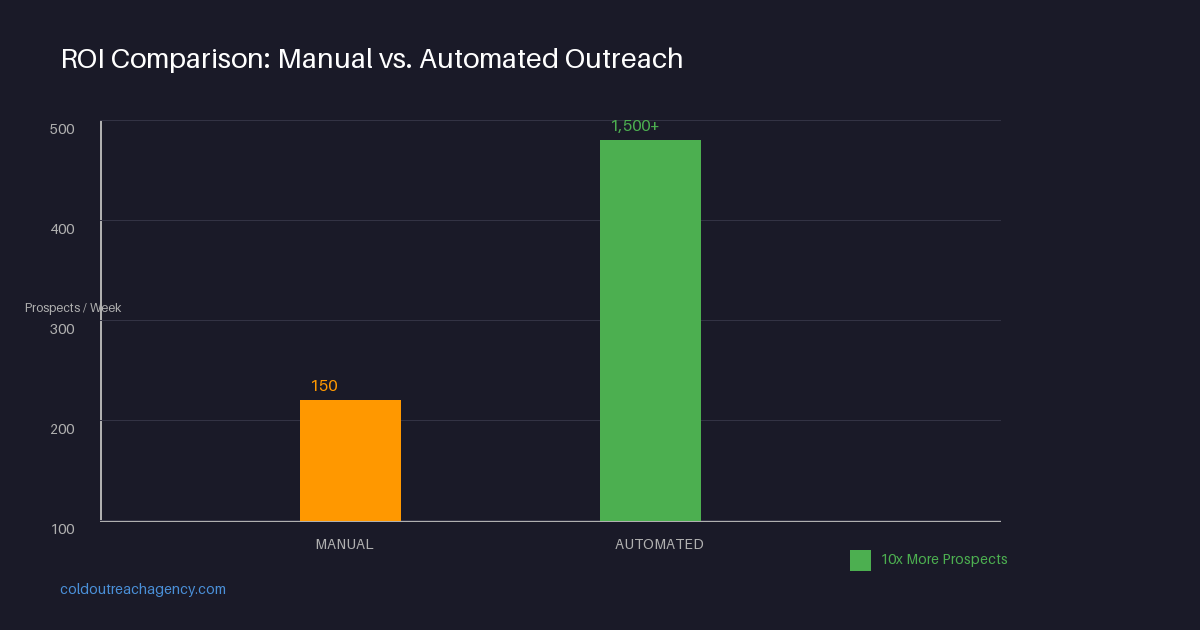
Answer: B2B sales automation software replaces manual, repetitive outreach tasks with intelligent workflows that execute at scale. It connects prospecting tools, email systems, and CRM platforms into a unified pipeline. The goal isn’t to replace your sales team. it’s to eliminate the grunt work that burns out your best closers. Cold outreach agencies using automation reach 1,500+ prospects per week with the same headcount that manually reaches 150.
How Do Top Agencies Actually Use B2B Sales Automation Tools?
Answer: Top agencies deploy specific tools for specific functions, creating a stack that works together. They use prospecting automation to find and qualify leads, email sequence tools to send follow-ups at optimal times, data enrichment to populate contact records, CRM automation to log activities, meeting schedulers to eliminate back-and-forth, and dialers to automate outbound calls. Predictive dialers make 300+ calls per rep per day versus 50-80 manually.
- Prospecting automation finds and qualifies leads without manual research. Tools in this category scrape LinkedIn, cross-reference company databases, and filter by ICP fit automatically.
- Email sequence tools send personalized follow-ups at optimal times based on recipient behavior. They trigger based on opens, clicks, or website visits. According to Outreach.io, multi-touch sequences increase reply rates by 300% compared to single-touch outreach.
- Data enrichment platforms populate contact records with verified information. Job titles, company sizes, funding rounds, tech stacks, and social profiles all get pulled automatically.
- CRM automation updates records, logs activities, and triggers workflows when deal stages change. No more manual data entry. No more missed follow-ups.
- Meeting schedulers eliminate the back-and-forth coordination that wastes hours every week. Prospects pick a slot. Calendars sync. Done.
- Dialers and calling tools automate outbound phone sequences. Forrester research shows predictive dialers can boost agent productivity by 300% compared to manual calling. Apollo.io data confirms automated follow-up sequences increase response rates by 47%.
What Should You Automate and What Should You Never Touch?
Answer: Automate high-volume, low-complexity tasks: email prospecting, data enrichment, follow-up sequences, CRM updates, meeting booking, reporting, task assignment, and proposal generation. Never automate tasks requiring human judgment: first-line personalization (generic openings tank reply rates by 40%), closing conversations, complex objections, relationship building, strategic decisions, executive outreach, and negotiations.
- Email prospecting:Automate database queries, list building, and initial contact sequencing
- Data enrichment:Automatically pull job titles, company sizes, funding rounds, and tech stacks
- Follow-up sequences:Set multi-touch cadences that trigger based on engagement signals
- CRM updates:Auto-log emails, calls, and deal stage changes without manual entry
- Meeting booking:Let prospects self-schedule from your availability in real-time
- Reporting:Generate weekly performance dashboards and pipeline forecasts automatically
- Task assignment:Route leads to reps based on territory, capacity, or deal size
- Proposal generation:Auto-populate quotes based on CRM data and pricing tables
- First-line personalization:Generic openings tank reply rates by 40% or more. This is where your message either hooks or dies.
- Closing conversations:Never let a bot ask for the signature. Humans close deals, not sequences.
- Complex objections:Pricing, timeline, and competitor objections need human nuance. A bot can’t read the room.
- Relationship building:Trust forms in conversations, not in sequences. People buy from people they like.
- Strategic decisions:Which accounts to prioritize, which deals to kill, which markets to enter. These require human judgment.
- Executive outreach:C-suite targets expect human-level personalization. They can spot a bot from orbit.
- Negotiations:Any conversation involving terms, discounts, or commitments. Automate this and you’ll leave money on the table.
How Long Does It Take to Implement B2B Sales Automation Software?
Answer: We recommend a 90-day rollout using The Automation Stack Framework. Days 1-30 focus on auditing current tasks and mapping ideal workflows. Days 31-60 automate one high-volume, low-risk workflow like email follow-up sequences with a small test batch. Days 61-90 layer prospecting automation, CRM updates, and data enrichment. Attempting everything on day one creates chaos. Build the foundation first.
What Metrics Actually Prove B2B Sales Automation ROI?
Answer: Track these metrics before and after automation: prospects reached per rep per week (should increase 5-10x), reply rate (should hold steady), meeting conversion rate (key indicator of message quality), sales cycle length, revenue per rep, cost per qualified lead, and pipeline coverage ratio. Calculate ROI by comparing automation costs against the additional revenue one rep produces. Automation is headcount use, not just a software expense.
- Prospects reached per rep per week:This should increase 5-10x with proper automation
- Reply rate:Should hold steady or improve if personalization is maintained
- Meeting conversion rate:Key indicator of message quality and lead fit
- Sales cycle length:Automation shouldn’t slow this down
- Revenue per rep:The ultimate measure of automation success
- Cost per qualified lead:Should decrease as volume increases
- Pipeline coverage ratio:Are you hitting 3x quota in pipeline?
Do the math. A 3-person agency manually reaching 450 prospects per week generates X conversations. The same agency with automation reaches 4,500 prospects per week. If your reply rate is 5% and your meeting conversion is 20%, the difference is 36 meetings per week versus 360. At a $5,000 average deal size, that’s $180,000 in pipeline weekly versus $1.8 million. The numbers don’t lie. The only question is whether you build the system.
What Mistakes Do Agencies Make with Sales Automation?
Answer: The six most common mistakes: buying tools before defining processes (automation amplifies bad processes), over-automation that destroys sender reputation, ignoring data quality (automation on dirty data produces dirty results), treating automation as set-and-forget (sequences decay), ignoring compliance (CAN-SPAM and GDPR requirements apply), and automating everything at once instead of layering over time.
Why Does Automation Give You a Competitive Advantage That Compounds?
Answer: Manual agencies have linear growth tied to headcount. Automated agencies have exponential growth because every month of optimized automation makes the next month more productive. In 24 months, the agency automating today will have data on 100,000+ prospects, refined sequences from thousands of A/B tests, and machine learning models predicting which prospects convert. Catching up is expensive.
Which Tools Should Be in Your B2B Sales Automation Stack?
Answer: Essential tools include a reliable CRM as your source of truth, an email outreach platform with strong deliverability, and a prospecting tool with fresh data. The tools you choose matter less than how you connect them. A simple stack that shares data beats a sophisticated stack that creates silos every time. Budget matters. Many SaaS sales teams succeed with mid-market stacks that cost 80% less than enterprise tools.
- CRM as source of truth:Your single source for all customer data
- Email outreach platform:With strong deliverability and sequence capabilities
- Prospecting tool:Provides fresh, accurate data on target accounts
Why Does the Human Element Remain Critical Despite All This Automation?
Answer: Automation handles volume. Humans handle complexity. Any tool that promises to replace human judgment in complex sales situations is overselling. Your job as a sales leader is to identify which tasks belong in each bucket. The highest-performing cold outreach agencies treat automation as a force multiplier, not a replacement. Their reps spend their days having high-value conversations with qualified prospects.
How Can You Start Automating Your B2B Sales Outreach Today?
Frequently Asked Questions
what’s the best B2B sales automation software for cold outreach in 2026?
The top performers for cold outreach include Outreach.io, Salesloft, and HubSpot Sales Hub for sequence management and email deliverability. For prospecting and data enrichment, Apollo.io and ZoomInfo lead the market. The best combination depends on your target market, budget, and team size. We recommend starting with a CRM plus one outreach tool plus one prospecting tool. Master those three before adding complexity.
Does B2B sales automation actually increase reply rates?
Yes, when implemented correctly. Gartner research shows sales automation increases productivity by 14.5%. The key is maintaining personalization in your first-line outreach. Generic automated messages tank reply rates by 40% or more. Use automation for follow-ups, CRM logging, and meeting scheduling while keeping human-written personalized openers for your initial contact.
How do you avoid emails going to spam with automated outreach?
Email deliverability requires three things: clean data, sending limits, and relevant content. Always validate emails before adding to sequences. Warm up new sending accounts gradually. Space your outreach across multiple hours and days. Use domain authentication (SPF, DKIM, DMARC). And most importantly, write messages that people actually want to read. Templates that sound like templates end up in spam. Personalization that sounds human passes the filter.
Can you automate cold outreach without sounding robotic?
Absolutely. The secret is separating what you automate from what you humanize. Automate the timing, the follow-up cadence, the CRM logging, and the meeting booking. Write your own personalization for the initial contact. Use the prospect’s specific pain point, recent achievement, or mutual connection as your opener. The sequence itself is automated. The message shouldn’t be. When done right, prospects can’t tell the difference between automated and manual outreach because the quality is identical.
Ready to scale your outreach with automation? Book a free strategy call today. we’ll audit your current outreach and show you exactly how to 10x your pipeline with the right automation stack.
Home | Cold Outreach Services | B2B Cold Email Templates | Sales Lead Generation | Email Marketing Services | Contact Us
{
“@context”: “https://schema.org”,
“@type”: “FAQPage”,
“mainEntity”: [
{
“@type”: “Question”,
“name”: “How much does B2B sales automation software cost for a small agency?”,
“acceptedAnswer”: {
“@type”: “Answer”,
“text”: “Small agency stacks typically cost $500-$2,000/month for core tools like CRM, email outreach, and prospecting. Mid-market solutions like HubSpot CRM (free tier available), Outreach.io, or Salesloft provide excellent automation without enterprise pricing. The ROI usually pays for itself within the first month if you’re automating follow-ups and prospecting correctly. Enterprise tools can run $10,000+/month but are rarely necessary until you hit $5M+ ARR.”
}
},
{
“@type”: “Question”,
“name”: “what’s the best B2B sales automation software for cold outreach in 2026?”,
“acceptedAnswer”: {
“@type”: “Answer”,
“text”: “The top performers for cold outreach include Outreach.io, Salesloft, and HubSpot Sales Hub for sequence management and email deliverability. For prospecting and data enrichment, Apollo.io and ZoomInfo lead the market. The best combination depends on your target market, budget, and team size. We recommend starting with a CRM plus one outreach tool plus one prospecting tool. Master those three before adding complexity.”
}
},
{
“@type”: “Question”,
“name”: “Does B2B sales automation actually increase reply rates?”,
“acceptedAnswer”: {
“@type”: “Answer”,
“text”: “Yes, when implemented correctly. Gartner research shows sales automation increases productivity by 14.5%. The key is maintaining personalization in your first-line outreach. Generic automated messages tank reply rates by 40% or more. Use automation for follow-ups, CRM logging, and meeting scheduling while keeping human-written personalized openers for your initial contact.”
}
},
{
“@type”: “Question”,
“name”: “How do you avoid emails going to spam with automated outreach?”,
“acceptedAnswer”: {
“@type”: “Answer”,
“text”: “Email deliverability requires three things: clean data, sending limits, and relevant content. Always validate emails before adding to sequences. Warm up new sending accounts gradually. Space your outreach across multiple hours and days. Use domain authentication (SPF, DKIM, DMARC). And most importantly, write messages that people actually want to read. Templates that sound like templates end up in spam. Personalization that sounds human passes the filter.”
}
},
{
“@type”: “Question”,
“name”: “Can you automate cold outreach without sounding robotic?”,
“acceptedAnswer”: {
“@type”: “Answer”,
“text”: “Absolutely. The secret is separating what you automate from what you humanize. Automate the timing, the follow-up cadence, the CRM logging, and the meeting booking. Write your own personalization for the initial contact. Use the prospect’s specific pain point, recent achievement, or mutual connection as your opener. The sequence itself is automated. The message shouldn’t be. When done right, prospects can’t tell the difference between automated and manual outreach because the quality is identical.”
}
}
]
}
Frequently Asked Questions
what’s the fastest way to use B2B Sales Automation Software: How Top Agencies Automate 10x Outreach Volume without burning the market?
How many prospects should I contact for B2B Sales Automation Software: How Top Agencies Automate 10x Outreach Volume?
Why do most campaigns around B2B Sales Automation Software: How Top Agencies Automate 10x Outreach Volume fail?
Should I use email only for B2B Sales Automation Software: How Top Agencies Automate 10x Outreach Volume?
When should I hire help for B2B Sales Automation Software: How Top Agencies Automate 10x Outreach Volume?
Where This Breaks in the Real World
The weak version of B2B Sales Automation Software is easy to spot. It talks to everyone, says nothing specific, and asks for a meeting before earning attention. That is why I care less about volume at the start and more about whether the first replies prove the angle is real.
Your buyer does not reward clever wording. They reward relevance. Show them that you understand the pressure on their desk before you ask for time. That means the message has to earn attention fast: clear pain, clean proof, and a next step that does not feel like a trap.
The Small-Batch Validation Rule
- ICP match: The buyer should match your best customer profile, not just a broad industry label.
- Trigger strength: A hiring move, new location, funding event, tech change, compliance push, or public initiative makes outreach feel timely.
- Follow-up logic: Every follow-up should add a new reason to respond. Repeating the first message is not follow-up. It is noise.
Most campaigns do not need a cleverer subject line first. They need cleaner segmentation, sharper proof, and a follow-up sequence that sounds like a person is paying attention.
The cleaner version is simple: start with 300 accounts, not a giant scraped list. Segment them by pain, write one message for one segment, and watch replies before scaling. If that first batch does not produce signal, more volume will not save the campaign. It will only make the failure louder.
The hard truth: B2B Sales Automation Software is not magic. It is a disciplined system for reaching the right buyer with the right proof at the right time. Build the data layer first, then the message, then the follow-up system. In that order.
How to Make This Feel Built, Not Generated
The buyer is filtering for relevance, timing, credibility, and the cost of paying attention. Look at B2B Sales Automation Software through the buyer’s day, not through a marketer’s checklist. For B2B Sales Automation Software, that means the outreach has to connect the business problem, the buying moment, and the proof in a way that feels specific.
A campaign built around revenue, conversion, and enrichment has more context than a generic pitch. A personalization issue needs different copy than a partner issue. A feedback buyer cares about different proof than a coverage buyer. This is why shallow templates fail. They flatten different buyer situations into one bland message.
- Blocker: Review blocker against the buyer’s real context before increasing send volume.
- Reporting: Review reporting against the buyer’s real context before increasing send volume.
- Priority: Review priority against the buyer’s real context before increasing send volume.
- Deliverability: Review deliverability against the buyer’s real context before increasing send volume.
- Category: Review category against the buyer’s real context before increasing send volume.
- Routing: Review routing against the buyer’s real context before increasing send volume.
This is the part a generic article usually misses: judgment. A real operator can tell when volume is the problem, when agencies accounts is the problem, and when the whole angle is too soft. That judgment comes from reading replies, checking account quality, and comparing message intent against actual buyer behavior.
The cleaner move is to run a small batch, inspect the signal, then rewrite the weak layer. Do not scale because the copy looks polished. Scale because the replies prove the market understands the value.